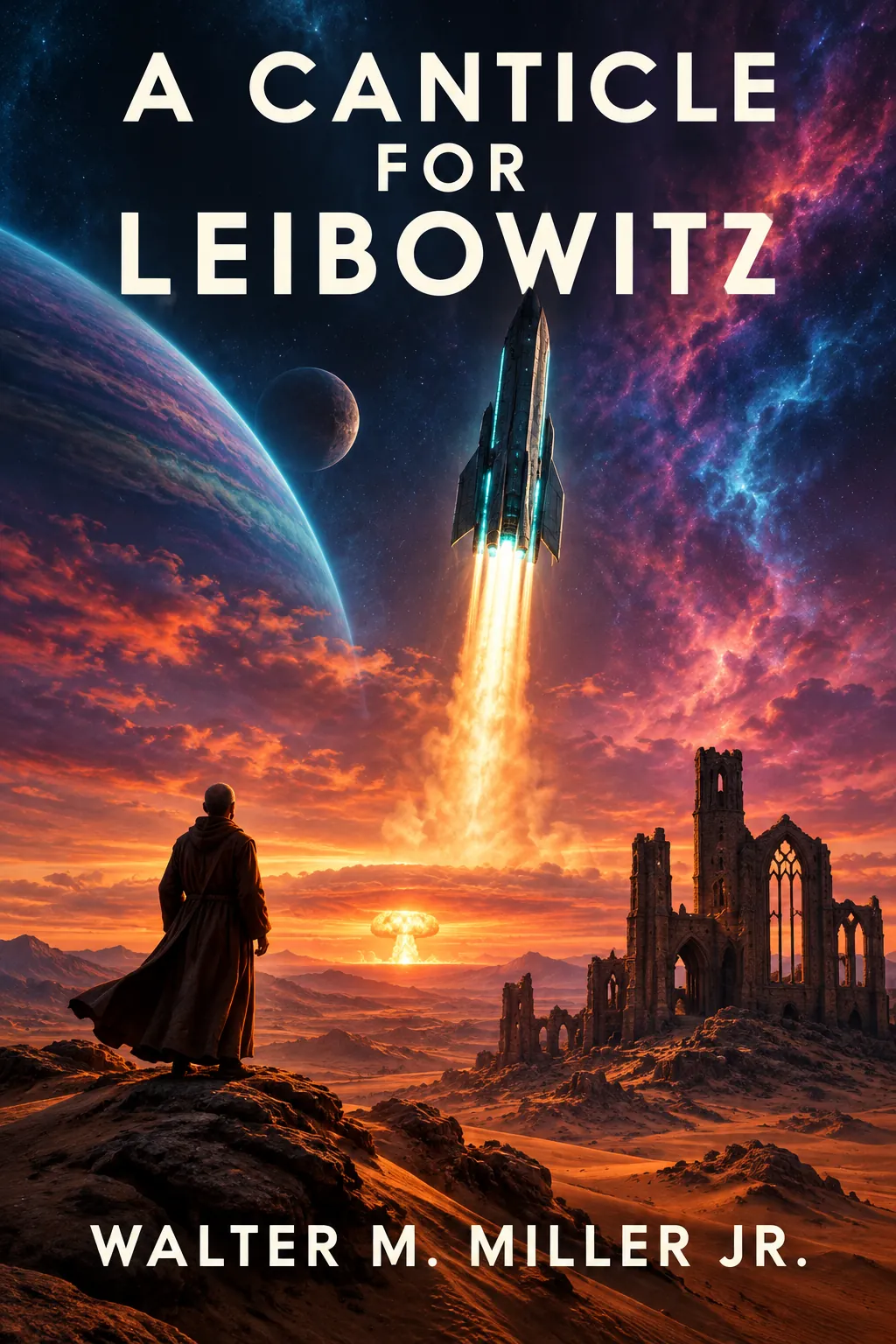
A Canticle for Leibowitz
by Walter M. Miller Jr.
A Canticle for Leibowitz is a 1959 novel about monks in the American desert who protect scraps of scientific knowledge after a nuclear war has wiped out most of civilisation. It follows their order across three eras, each separated by about six centuries, as the world slowly climbs from ignorance back toward learning and power. The monks copy documents they cannot understand, and the story asks what people will do with knowledge once they have it again.
The Big Idea
"After nuclear war, monks preserve fragments of lost science without understanding them, and the novel asks whether humanity will repeat the same cycle once knowledge returns."
Key Insights
History as a cycle
Miller shows civilisation falling, climbing and falling again. Each part opens with people who think they are starting fresh, yet the old pressures return: fear, hunger for power and the urge to use whatever has been discovered. The book never says the cycle cannot be broken. It shows how easily it repeats when memory is short and wisdom lags behind skill.
In Part 1 monks hide books from angry mobs. In Part 3 two great powers again stand ready to use nuclear weapons.
Knowledge needs wisdom
Scholars like Thon Taddeo treat knowledge as a useful power, and there is nothing wrong with that. Trouble begins when no one asks what the power is for. The abbots worry less about science than about the people who will use it, and the book suggests that more knowledge does not automatically bring better judgment.
Brother Kornhoer's lamp brings real light, yet the ruler who protects the scholar wants the same learning for war.
Faith and science as partners and rivals
The Church in this novel does not ban science. It is the institution that keeps old records safe for centuries when nobody else will. It is also made of fallible people who fear change. Miller treats neither side as simply right, and shows how each can complete or block the other.
In Part 2 the monks' hand-built lamp and the scholar's research sit side by side, and the two ways of learning both inspire and misunderstand each other.
Keeping what you do not understand
Francis copies the blueprint beautifully without knowing what it means. The book smiles at this, yet it also honours it. Careful copying, repeated over many lifetimes, is what carries knowledge across the dark centuries. Preservation may look pointless to the person doing it, but later generations depend on it.
The documents the scholar studies in Part 2 are the same kind of papers that the monks of Part 1 spent years copying.
What mercy means
In Part 3 the abbot faces a government program that offers death to the suffering, and he opposes it. At the same time the two-headed Mrs. Grales shows human suffering and innocence side by side. Miller gives no easy answer. He asks what it means to value a life when pain and fear are everywhere.
Rachel, the second head, wakes at the end in one of the book's quietest and most moving moments.
Chapter Breakdown
Chapter-by-chapter summary
Spoiler warning: this section covers the whole plot, including the ending.
Part 1, Fiat Homo: The Pilgrim and the Shelter
The story opens in the desert of the American Southwest, in the twenty-sixth century. Centuries earlier a nuclear war, the Flame Deluge, was followed by the Simplification, when angry mobs burned books and killed the educated. Novice Francis is fasting alone for Lent when a stranger passes by, and soon after Francis finds the entrance to an old fallout shelter. Inside are relics said to belong to Isaac Leibowitz, the engineer who founded the monks' order. The find matters because it gives the order proof of its own founder and a reason to hope.
Part 1: Is the Find Real?
Among the relics are a blueprint and a shopping list, ordinary papers from a lost world. For the monks they are sacred, since they come from the man who began their mission. The Church sends a sceptical examiner, the so-called devil's advocate, to test whether the relics are genuine and whether Leibowitz deserves sainthood. Francis is doubted as a young man who sees what he wants to see. The episode shows how a society without science treats a piece of paper: as a holy object, not as a set of instructions.
Part 1: The Illuminated Blueprint
Francis spends years copying the blueprint in colour and gold, treating the lines as ornament because he cannot read what they mean. When the work is done he carries it to New Rome as a gift for the Pope. On the road back to the abbey he is attacked by robbers and killed. Part 1 sets the tone for the whole book: faithful, funny and sad at once, with devotion keeping alive things that nobody understands. The act of copying itself becomes a kind of prayer.
Part 2, Fiat Lux: A Scholar Comes to the Abbey
Six centuries later, in the year 3174, the world has begun to wake. City-states fight over land, and a secular scholar, Thon Taddeo Pfardentrott, travels to the abbey to study the Memorabilia, the old documents the monks have kept. The abbot, Dom Paulo, welcomes him, though the monks feel both pride and nerves. They have guarded these papers for generations, and now a stranger who can actually understand them is standing at the gate. For the abbey this is a long-awaited moment, and an unsettling one.
Part 2: The Lamp
Brother Kornhoer, a monk with a talent for tinkering, has pieced together a working electric arc lamp from fragments in the Memorabilia. It is a small miracle: light made by a machine. Thon Taddeo is impressed, but he treats the monks more as caretakers of a library than as thinkers. He expects to turn their knowledge into something useful for his own people. The meeting sets two kinds of learning side by side, one rooted in faith and patience, the other in practical power, and neither fully understands the other.
Part 2: A Ruler's Shadow
Thon Taddeo works under the protection of a ruler with plans for conquest, and the abbey stands near the path of coming wars. Dom Paulo senses that science freed from moral limits can serve violence as easily as healing. A strange old hermit who lives near the abbey, and who seems far older than any man should be, watches events with a sour humour. Part 2 closes with the feeling that the old cycle is turning again and that the monks can only watch it happen.
Part 3, Fiat Voluntas Tua: The Edge of War
By the year 3781 humanity has rebuilt its technology, including nuclear weapons. Two great powers glare at each other across the world, and the abbey is led by Abbot Dom Jethras Zerchi. Radiation sickness and mutation are everyday problems again. Zerchi must decide how the Church should respond as the old threat returns, and the Order of Leibowitz must decide what to do with its Memorabilia now that the world seems ready to repeat its history.
Part 3: Mercy and Mrs. Grales
Zerchi is drawn into a fight over whether the state should help the dying to die, and he opposes it as a religious duty. At the same time a poor woman, Mrs. Grales, arrives at the abbey with two heads: one awake, and one asleep. The second head, called Rachel, seems innocent in a way the rest of the world is not. These scenes ask what mercy means when suffering is everywhere, and when the human race has just shown again how easily it can hurt itself.
Part 3: The Ship and the Fire
As war breaks out, the order sends a starship, the Quo Peregrinatur Grex, carrying monks and the Memorabilia to begin again on another world. Zerchi stays on Earth. Nuclear weapons fall, and the abbey is destroyed with him inside it. Yet the ending is not only despair: the Church's work travels outward with the ship, and Rachel awakens in a final moment of grace. A burning world and a departing ship leave the idea of a cycle as an open question rather than a verdict.
Characters
Brother Francis Gerard of Utah
A shy, devout novice in Part 1. He finds the fallout shelter in the desert and spends years copying the blueprint in gold and colour, never knowing what its lines mean. He shows a devotion that works without understanding, and the book treats him gently.
Isaac Edward Leibowitz
An engineer from before the war who later founds the order and is honoured as a saint. He appears through relics and stories rather than in person, a founder whose real life is almost lost and whose memory has turned into legend.
Dom Paulo of Pecos
The abbot in Part 2. He is thoughtful, tired and loyal to his monks. He welcomes the visiting scholar but worries that knowledge in the wrong hands will bring back the destruction it once caused.
Thon Taddeo Pfardentrott
A brilliant secular scholar in Part 2 who comes to study the monks' documents. He sees knowledge as a tool for his own people and does not share the monks' sense of duty, which makes him a quiet rival to the abbey.
Brother Kornhoer
A monk who loves machines. From scraps in the old papers he builds a working electric arc lamp, a rare moment of real progress inside the abbey. His joy in the invention is simple and genuine.
The old hermit
A very old man who lives near the abbey and watches events with dry humour. He is hinted to be far older than any normal person, and he echoes the stranger of Part 1, a figure who seems to have seen history repeat before.
Dom Jethras Zerchi
The abbot of Part 3. He leads the abbey as the world slides toward nuclear war and fights bitterly against the state's euthanasia program. Stubborn, haunted and brave, he carries the book's final moral weight.
Mrs. Grales and Rachel
A poor woman with two heads in Part 3. One head is awake; the other, Rachel, sleeps and seems untouched by the world's sorrow. Their story carries some of the book's most unsettling and most hopeful ideas.
Writing about this book
Start with one question the book leaves open instead of a plot summary. Three good ones are below.
- Is history really a cycle in this novel, or does each era change a little? Compare the monks of Part 1 with the abbot of Part 3.
- What does the book say about faith and science? Look at the arc lamp scene in Part 2 and ask who benefits from knowledge and who pays for it.
- Why does Miller give the final scenes to a dying abbot and a starship instead of to politicians?
For structure, choose one theme, pick two scenes from different parts, and show how they echo each other. The three-part layout makes this easy: objects such as the blueprint and the Memorabilia return at different stages. Avoid retelling the whole story, because your reader already knows it. Use one short quote at most, and say which part it came from.
The Latin part titles also help. Fiat homo, fiat lux and fiat voluntas tua point toward creation, light and acceptance, which gives you a clear way to organise an essay.
Take Action
Practical steps you can implement today:
-
Knowledge is power and responsibility together; grow the wisdom to use it at the same pace as the skill.
-
Careful record-keeping can look pointless today and still save the future, so value the people who preserve things quietly.
-
Whether history repeats depends partly on how well people remember what went wrong the last time.
-
Do not treat faith and science as simple enemies; ask what each one protects and what each one risks.
-
When suffering is everywhere, ask what it means to value each individual life, not only what solves the problem.
Notable Quotes
"“Fiat homo.” (Part 1 title, Latin for “let man be made”)"
— Walter M. Miller Jr.
"“Fiat lux.” (Part 2 title, Latin for “let there be light”)"
— Walter M. Miller Jr.
"“Fiat voluntas tua.” (Part 3 title, Latin for “thy will be done”)"
— Walter M. Miller Jr.
Who Should Read This
Readers from about 15 up who enjoy classic science fiction, post-apocalyptic stories or questions about science and faith. It suits high school and university students looking for a book report topic. Latin phrases and church terms appear, but this guide explains them, so no religious background is needed.
Frequently Asked Questions
What is A Canticle for Leibowitz about?
It follows a monastic order in the American desert that preserves scientific documents after a nuclear war. The story jumps across three eras, about six centuries apart, and shows how people relearn science and then face the risk of destroying themselves again.
Who wrote A Canticle for Leibowitz and when?
Walter M. Miller Jr. wrote it. It was published as a novel in 1959, built from short stories he had printed in magazines in the mid-1950s. It won the Hugo Award for best novel in 1961 and is considered a classic of post-apocalyptic science fiction.
How is the book organised?
It has three parts: Fiat Homo, Fiat Lux and Fiat Voluntas Tua. Each is set in a different era and follows a different abbot or monk, while the abbey and its Memorabilia link them together. You can read each part almost like a separate story.
Who was Leibowitz?
Isaac Edward Leibowitz was an engineer from before the nuclear war who became the founder of the order and is later honoured as a saint. We know him mostly through relics, stories and the monks' devotion, not through scenes in which he appears.
Is it a religious book?
It is full of Catholic setting, language and ideas, and its main characters are monks. But it does not preach one answer. It uses faith, science and politics to ask how people use knowledge, so readers of any belief can follow and enjoy it.
Is the book hard to read?
Moderately. The prose is clear, but Latin phrases and church terms appear often, and the time jumps can surprise first-time readers. Keeping track of the three parts, their abbots and the Memorabilia makes the story much easier to follow.
Check Your Understanding
Pick an answer for each question to see if you were right.
-
What is the Flame Deluge in the story?
A nuclear war — The Flame Deluge is the nuclear war that destroyed the old civilisation before the story begins.
-
What does Brother Francis find in Part 1?
A fallout shelter with relics of Leibowitz — Francis finds an old fallout shelter holding relics linked to the order's founder.
-
What does Brother Kornhoer build in Part 2?
An electric arc lamp — From fragments in the Memorabilia he builds a working electric arc lamp.
-
What does the Latin title Fiat Lux mean?
Let there be light — Fiat lux is Latin for let there be light, the title of Part 2.
-
What does the order send away at the end of the novel?
A starship with monks and the Memorabilia — The order sends a starship carrying monks and the Memorabilia to start again on another world.
About Walter M. Miller Jr.
Walter M. Miller Jr. (1923–1996) was an American writer. He served as a bomber crewman in the Second World War and took part in the bombing of the abbey at Monte Cassino, an experience often linked to this book. He later became Catholic. A Canticle for Leibowitz, grown from earlier short stories, won the 1961 Hugo Award.
Summary Written By

Software Engineer & Writer
Software engineer with a passion for distilling complex ideas into actionable insights. Writes about finance, investment, entrepreneurship, and technology.
View all summaries →Reviews
No reviews yet. Be the first to share your thoughts!
Write a Review
Keep reading
Explore the topic: Science FictionSummaries

Out of My Mind
Sharon M. Draper
“Out of My Mind” by Sharon M. Draper is a poignant narrative that explores the life of Melody Brooks, a…

Ender’s Game
Orson Scott Card
“Ender’s Game” by Orson Scott Card is a riveting science fiction novel that transports readers into a future where humanity…

Pachinko
Min Jin Lee
“Pachinko”, a spellbinding multigenerational historical saga by Min Jin Lee, explores the lives of a Korean family trying to make…

The Perks of Being a Wallflower
Stephen Chbosky
The Perks of Being a Wallflower by Stephen Chbosky is a profound coming-of-age novel, told through the intimate letters of…
Articles

A Christmas Carol themes: generosity, isolation and responsibility
Dickens's novella is usually read as a story about a man who changes his mind. Its themes are sharper than…

Nebula Award: What It Is and Notable Winners
The Nebula Award is an American science fiction and fantasy prize voted on by working writers. The Science Fiction and…

Seiun Award
The Seiun Award is Japan's oldest science fiction award, first given in 1970. Fans who attend the annual Japan SF…