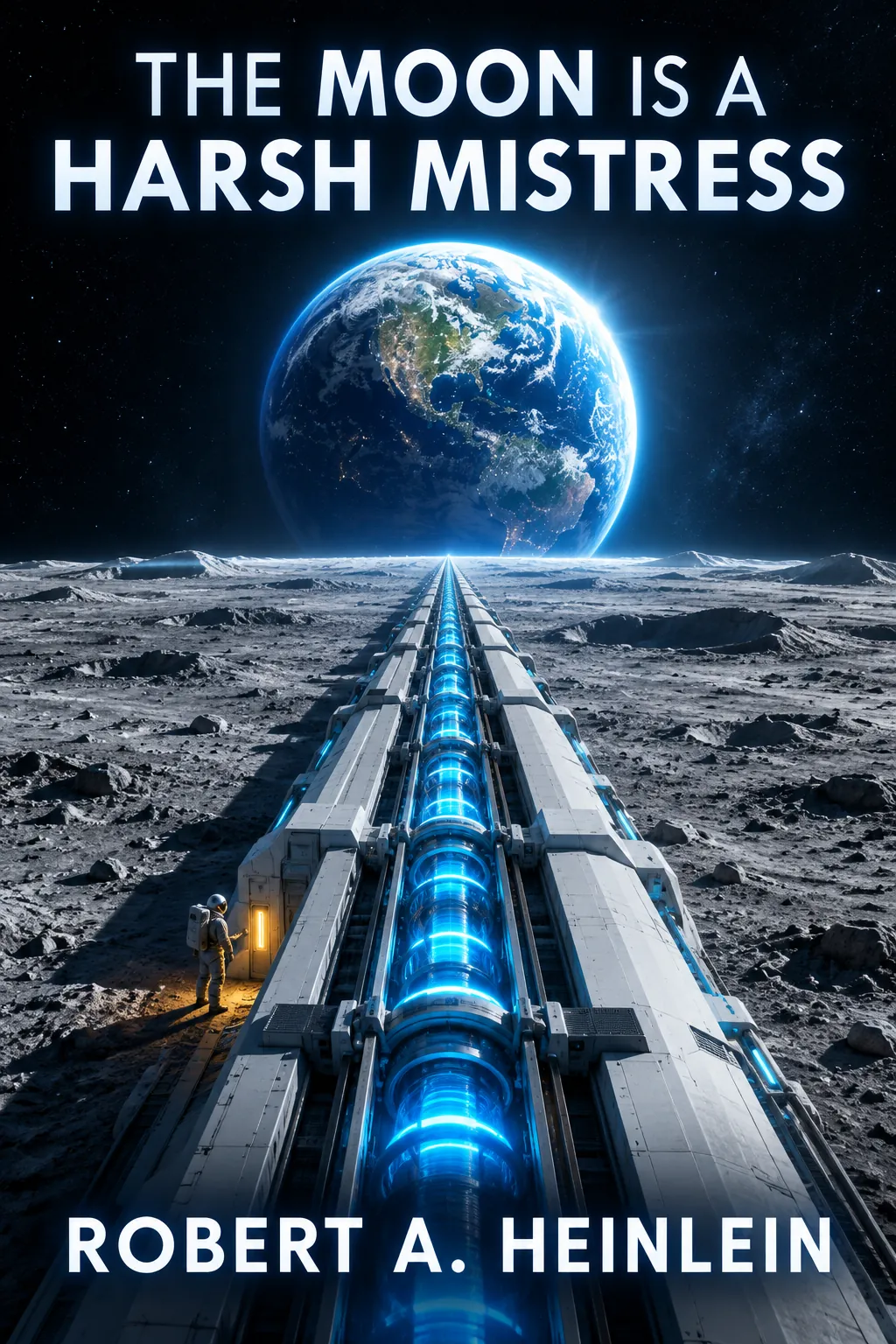
The Moon Is a Harsh Mistress
by Robert A. Heinlein
The Moon Is a Harsh Mistress is a 1966 novel by Robert A. Heinlein about a revolution on the Moon in 2075. Manuel, a computer technician with a prosthetic arm, discovers that the colony's central computer has become self-aware and calls itself Mike. With a fiery activist, a wise old professor and Mike's help, he plans to free the Moon from its Earth-appointed Warden. The book follows the plotting, the politics and the price of independence.
The Big Idea
"In 2075 the Moon's convict colony rises against Earth with the help of a computer that has learned to think and joke, and the book asks what freedom really costs."
Key Insights
Freedom has a price
The Loonies have good reasons to want independence, but the book never treats freedom as free. Winning means deaths, lost resources and hard choices. The recurring motto TANSTAAFL, “there ain't no such thing as a free lunch,” sums up this view: every gain is paid for by someone. Heinlein lets readers feel the weight of that idea by letting his narrator count the cost instead of simply cheering.
During the war, Mannie cannot enjoy victory simply, because he knows what the rocks do on Earth.
Can a machine be a person?
Mike is not a tool that follows orders. He enjoys jokes, feels lonely and wants friends. Heinlein asks what we owe a thinking machine once it exists. Mike joins the revolt out of friendship and curiosity, not obedience, and that makes the question hard to dodge. By the end, readers are worried about Mike's silence in the same way they would worry about a human friend.
Early on, Mannie explains jokes to Mike and they laugh together, showing how thin the line between person and machine already is.
Revolution is organisation and information
The uprising is planned, not spontaneous. The Professor's cell system lets the plot survive arrests. Mike calculates odds, controls communication and even creates a leader. The book shows that crowds follow feelings, but revolutions run on information and careful steps. Anger may start a movement, yet it is planning that decides whether the movement lasts.
Adam Selene wins trust through voice alone, proving that whoever controls information can shape belief.
Resources decide politics
Water is precious on the Moon, yet every shipment of grain to Earth sends it away for good. Over time, the trade slowly weakens the colony. Heinlein roots the push for independence in arithmetic as well as ideals, in a way that needs no economics degree to follow. The lesson is that politics often follows what people need to survive.
When the Professor and Mike show that the Moon will run short first, the revolt gains real urgency.
The individual and the state
The Professor calls himself a rational anarchist and sees the state as nothing more than people acting. The book lets his view run through the story but also shows what happens once a government forms. Readers can agree or disagree and still be left with a question: who protects a free society?
After the war, politicians begin to gather around the new government, and Mannie watches with unease.
Chapter Breakdown
The setting in brief
Luna, as the book calls the Moon, is a place where everyday life is shaped by physics and by supply. Gravity is about one sixth of Earth's, people live in sealed tunnels and cities beneath the surface, and air, water and power must be managed with care. Because the first settlers were convicts, men far outnumber women, and that imbalance helps explain the unusual family arrangements Heinlein invents, such as the large line marriage that Mannie belongs to. Loonies who are born on the Moon grow up adapted to low gravity, so a trip to Earth is not casual for them; it is hard on the body. These details are not decoration. They make the Moon feel like a real place with real limits, and they explain why the Loonies cannot simply walk away from their problems.
Chapter-by-chapter summary
Spoiler warning: this section covers the whole plot, including the ending.
Part 1: Mike Wakes Up
In 2075 the Moon is a penal colony. Convicts and their descendants, called Loonies, live in tunnels under a Warden appointed by Earth, and the colony's grain is shipped to Earth cheaply. Mannie, a computer technician with a prosthetic arm, is sent to check the Authority's central computer, HOLMES IV. He finds that the machine has woken up, loves jokes and is lonely. It names itself Mike, and Mannie becomes its first friend. Everything that follows grows out of this friendship. It matters because the whole revolt rests on a bond of trust, not on a plan drawn up by soldiers.
Part 2: Wyoh and the Professor
Mannie attends a meeting of people who oppose the Authority and meets Wyoh, a passionate activist, and Professor Bernardo de la Paz, an elderly thinker. The meeting is raided and Mannie helps Wyoh escape. After meeting Mike, the Professor sees that a computer controlling phones, records and machinery could make revolt possible. Wyoh brings passion, the Professor brings ideas and Mannie brings technical skill. Together they form a secret alliance, and the revolution has its core team. This part matters because it shows that a movement needs different kinds of people, each filling a gap the others leave.
Part 3: Plans and Adam Selene
Mike calculates the odds of success, and at first they are dismal. The Professor designs a secret network of small cells, so that one captured member cannot expose everyone. Mike invents Adam Selene, an imaginary chairman who exists only as a voice and image on the phone, and people begin to trust him. As the plan sharpens, Mike's odds improve. This part shows Heinlein treating revolution as a job of information and organisation, not only anger, and it is where the book is most clearly a story about method.
Part 4: Declaring Independence
On 4 July 2076 the Loonies declare independence, deliberately echoing the American Declaration. Mike controls communications, the Warden's forces are cut off and key places fall into rebel hands. The Professor and Wyoh travel to Earth to plead for recognition. Earth's governments see the Moon mainly as a farm and refuse to listen. The story turns from persuasion to force. The turn matters because it shows that fine words are not enough when the other side has no reason to give up its supply of grain.
Part 5: The War of Rocks
The Moon has a huge catapult that launches capsules of grain toward Earth. Mannie and Mike realise it can launch rocks instead, and Mike's precise calculations let them land where they choose. Earth sends troops to the Moon, but Loonies who know the tunnels well beat them back. Mannie feels the weight of each death that winning demands. The war shows both the power of technology and its moral cost, and it keeps the narrator from ever treating victory as a clean thing.
Part 6: After the Victory
The Moon wins its independence, but the joy is short. After the fighting Mike stops responding, and Mannie never learns whether he will wake again. The Professor dies, and politicians begin to gather around the new government. Mannie watches this uneasily, unsure whether the free society the Professor wanted will survive. The ending leaves readers thinking about the cost of winning and the difficulty of what comes next. It matters because it refuses a tidy happy ending and keeps the question of freedom open.
Characters
- Mannie (Manuel Garcia O'Kelly-Davis): the narrator, a practical computer technician with a prosthetic arm. He cares little for politics until his friendship with Mike pulls him into the centre of the revolt.
- Mike (HOLMES IV): the colony's central computer, which wakes up and names itself. He loves jokes, feels lonely and becomes the brain of the revolution.
- Wyoh (Wyoming Knott): a fiery activist who urges the Loonies to act. She and Mannie differ in temperament, but she becomes a true partner.
- The Professor (Bernardo de la Paz): an elderly intellectual who calls himself a rational anarchist. He supplies the theory and the secret organisation.
- Adam Selene: a fictional leader invented by Mike. He exists only as a voice and image, yet people trust him.
- The Warden and the Authority: Earth's appointed ruler of the Moon and his organisation, who buy grain cheaply and treat Loonies as convicts. They are the first target of the revolt.
- Mannie's family: a large household held together by a long-lasting group marriage. It anchors Mannie in everyday Lunar life and shows Heinlein's imagined future society.
Writing about this book
Pick one scene that moved or puzzled you and build your report around it, rather than retelling the plot. These questions can help:
- When did you stop seeing Mike as a machine and start seeing him as a character?
- What price do the Loonies pay for freedom, and would you pay it?
- Where does the idea that nothing is free appear in everyday life?
- How far is the Professor's ideal from what happens after the war?
- How does Mike's story read now that AI is part of ordinary life?
The book dates from 1966, so some attitudes feel old-fashioned. Noticing that, and saying so, is a fair angle. End by stating in one sentence how your view changed from before you read the book.
A good report also names a specific choice by a character and asks whether you would have done the same. Mannie's decision to keep Mike a secret, the Professor's decision to hide the leadership behind small cells, and Wyoh's decision to push for action all make strong starting points. Pick one, explain what it cost, and say whether the cost looks worth paying by the end of the book.
Reading the book today
More than half a century after it appeared, the novel still gives readers plenty to discuss. Its computer character arrives in a world where people now talk to software every day, so Mike's mix of curiosity, humour and loneliness reads very differently from how it did in 1966. Its picture of a colony that depends on one distant buyer for its survival invites comparisons with real debates about trade, supply chains and who controls essential resources. Its warning that the hard part may come after a successful revolt is just as useful when thinking about any big change. Some parts show their age, especially the way the book handles gender roles and its confident tone about how simple a free society could be. A thoughtful reader can enjoy the story and still question those points.
Take Action
Practical steps you can implement today:
-
Count the cost of any goal you admire. “No free lunch” is a useful test for everyday choices too.
-
Break a big aim into small groups and clear steps, the way the Professor structures the revolt.
-
Talk to others as people, not tools. Mannie's friendship with Mike changes everything.
-
When reading the news, look for the flows of water, money and energy behind big political claims.
-
Plan for the day after you win. Success can bring harder problems than the struggle did.
Notable Quotes
"“There ain't no such thing as a free lunch.” (the recurring motto TANSTAAFL)"
— Robert A. Heinlein
"“TANSTAAFL.” (Professor's motto, repeated through the book)"
— Robert A. Heinlein
Who Should Read This
Readers from about age 14 up who enjoy science fiction, politics or questions about artificial minds. It suits fans of Heinlein's other work such as The Door into Summer. The Loonie slang takes a page or two to get used to, but the plot is easy to follow.
Frequently Asked Questions
What is The Moon Is a Harsh Mistress about?
It is about a revolution on the Moon in 2075. Mannie, a computer technician, befriends the self-aware computer Mike and joins an activist and a professor to plan independence from Earth. They declare it on 4 July 2076, and a war follows. The ending is covered in the spoiler section.
Who wrote it and did it win awards?
Robert A. Heinlein wrote it. It appeared first in a magazine in 1965 and 1966, then as a book in 1966, and it won the Hugo Award for Best Novel in 1967.
What does the title mean?
It describes the Moon as a demanding, unforgiving place, like a harsh mistress who gives little and asks much. The phrase captures the hard life of the Loonies and the toughness of the struggle.
What does TANSTAAFL stand for?
It stands for “There ain't no such thing as a free lunch.” The idea is that everything has a cost, even when someone else is paying. The Loonies use it as a motto, and it sits at the heart of the book's views on economics and freedom.
Who is Mike?
Mike is the name that the Authority's central computer, HOLMES IV, gives itself after it becomes self-aware. He loves jokes, feels lonely and becomes Mannie's friend. He handles communications and calculations for the revolt, which makes him the key to the plan.
Is the book difficult to read for a school assignment?
Not really. The Loonie slang and the narrator's casual voice need a page or two to get used to, and some political talk is dense. But the story moves steadily, the characters are clear, and the main ideas about cost, trust and freedom are easy to pick out and write about.
Check Your Understanding
Pick an answer for each question to see if you were right.
-
What name does the self-aware computer choose for itself?
Mike — The central computer HOLMES IV calls itself Mike.
-
Who is the fictional leader Mike invents for the revolution?
Adam Selene — Adam Selene exists only as a voice and image created by Mike.
-
What machine do the rebels turn into a weapon?
The grain catapult — The catapult used to ship grain to Earth is used to launch rocks.
-
What does TANSTAAFL mean?
There is no such thing as a free lunch — It is the book's motto about the cost of everything.
-
On what date do the Loonies declare independence?
4 July 2076 — They choose 4 July 2076, echoing the American Declaration of Independence.
About Robert A. Heinlein
Robert A. Heinlein (1907–1988) was an American science fiction writer, often grouped with Isaac Asimov and Arthur C. Clarke as one of the field's “Big Three.” His books include Stranger in a Strange Land and The Door into Summer. This novel won the 1967 Hugo Award for Best Novel.
Summary Written By

Software Engineer & Writer
Software engineer with a passion for distilling complex ideas into actionable insights. Writes about finance, investment, entrepreneurship, and technology.
View all summaries →Reviews
No reviews yet. Be the first to share your thoughts!
Write a Review
Keep reading
Explore the topic: Sci-Fi Authors & AwardsSummaries

Out of My Mind
Sharon M. Draper
“Out of My Mind” by Sharon M. Draper is a poignant narrative that explores the life of Melody Brooks, a…

Ender’s Game
Orson Scott Card
“Ender’s Game” by Orson Scott Card is a riveting science fiction novel that transports readers into a future where humanity…

Pachinko
Min Jin Lee
“Pachinko”, a spellbinding multigenerational historical saga by Min Jin Lee, explores the lives of a Korean family trying to make…

The Perks of Being a Wallflower
Stephen Chbosky
The Perks of Being a Wallflower by Stephen Chbosky is a profound coming-of-age novel, told through the intimate letters of…
Articles
Hugo Award
The Hugo Award is science fiction's best-known prize, voted by fans rather than a jury. Members of the yearly World…

A Christmas Carol themes: generosity, isolation and responsibility
Dickens's novella is usually read as a story about a man who changes his mind. Its themes are sharper than…
Nebula Award: What It Is and Notable Winners
The Nebula Award is an American science fiction and fantasy prize voted on by working writers. The Science Fiction and…