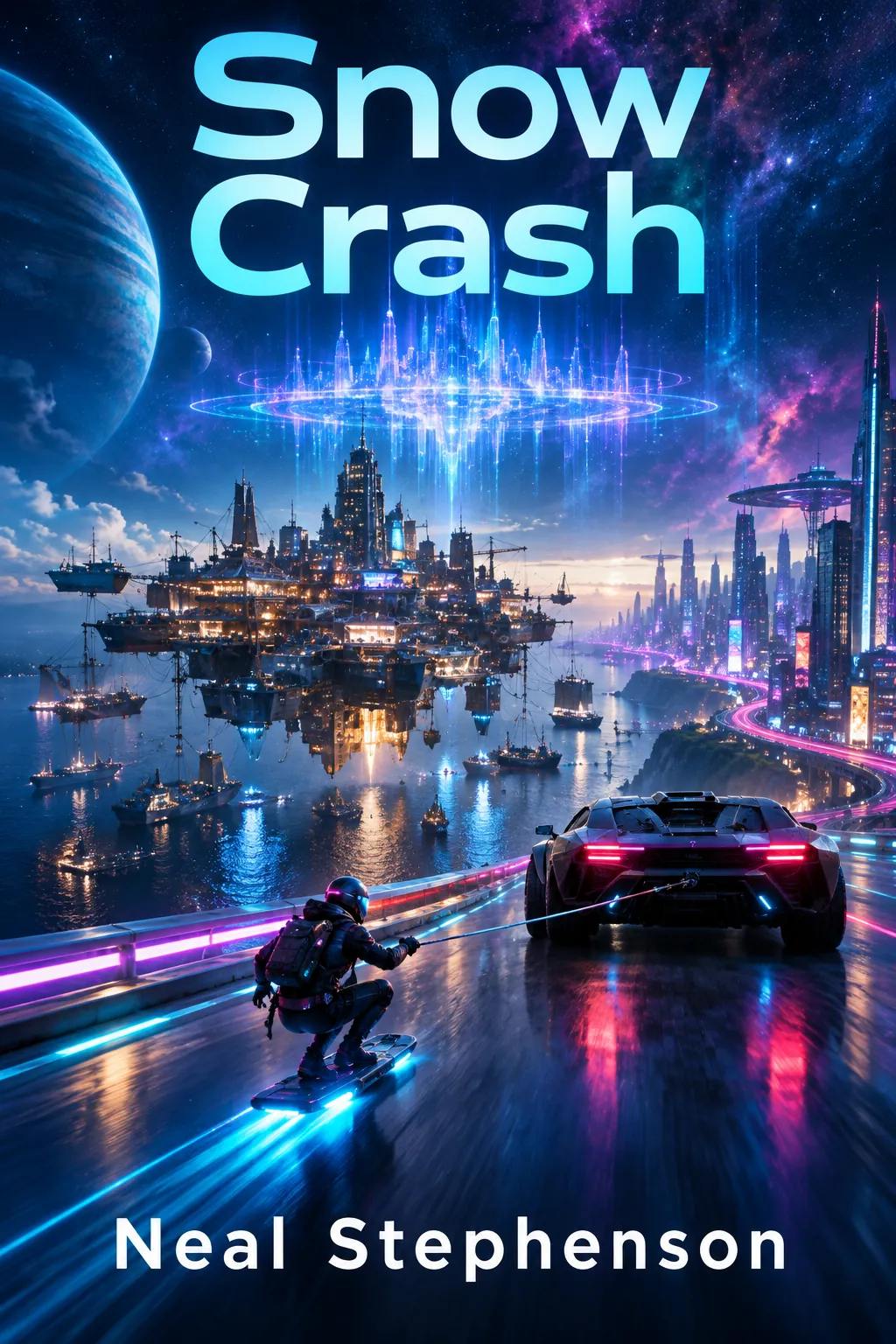
Snow Crash
by Neal Stephenson
Snow Crash is Neal Stephenson’s 1992 cyberpunk novel about a near-future America split into corporate franchises. Hiro Protagonist, a hacker who delivers pizza for the Mafia, and Y.T., a teenage skateboard courier, chase a mysterious “Snow Crash” that harms minds both in the virtual Metaverse and in real life. Their search runs through ancient Sumerian myth, a media tycoon’s floating city and a fight over who gets to control language itself. It is fast, funny satire with a serious idea at its centre.
The Big Idea
"Snow Crash imagines information as a virus: words and code can spread through human minds like an infection, and in a world run by companies, whoever controls that spread controls people."
Key Insights
Language works like code
Stephenson asks whether the brain has a built-in “machine language” that certain sounds and images can reach, the way code reaches a computer. In the novel, such signals bypass thought and change behaviour. Real science does not support a hidden switch like that, but the idea is a useful way to ask how strongly words shape us.
The followers at Reverend Wayne’s church repeat strange sounds in a trance, a picture of language acting on a body without being understood.
Companies take over from countries
The America of the book has been sold off in pieces. Roads, security and even citizenship belong to businesses, and the Mafia runs a pizza chain. The satire is exaggerated, yet it asks a real question: what happens to ordinary rights when every service comes with a logo and a contract?
Hiro and Y.T. cross from one burbclave to another, each with its own entry rules, like travellers passing through tiny countries.
Ideas can spread like viruses
The book treats beliefs, religions and advertising as things that copy themselves from mind to mind. That view lets one plot connect ancient Sumer, a modern franchise church and computer malware. It also warns the reader to ask where an idea comes from before letting it run in the head.
Hiro and Juanita compare the Asherah cult, Reverend Wayne’s church and the Snow Crash file as three forms of the same spreading idea.
Status in two worlds
Hiro has little money in the real world but earns respect online through skill. Other users pay for polished avatars that hide who they are. The Metaverse becomes a mirror in which people choose their faces and wealth, and the book is curious about what that does to trust.
At the Black Sun, Hiro’s sword skill earns him a respect that his storage-unit home never could.
Chapter Breakdown
Chapter-by-chapter summary
Spoiler warning: this section covers the whole plot, including the ending.
The novel has 71 short chapters. Here they are grouped into seven parts, each with what happens and why it matters.
Part 1: A country of franchises
The story is set in a United States where the government has shrunk and companies split the land like small nations. Housing areas are private “burbclaves”, each with its own rules. Hiro Protagonist lives in a rented storage unit and delivers pizza for Cosa Nostra Pizza, a chain run by the Mafia that promises delivery in thirty minutes. He soon loses the job and meets Y.T., a fifteen-year-old Kourier who rides a skateboard and hooks onto cars with a harpoon line. The two start working together selling information. Why it matters: the opening shows a world where companies, even criminal ones, make the rules.
Part 2: The Black Sun and the bitmap
Hiro is poor in real life but famous in the Metaverse, a shared virtual world where people appear as avatars. He is a respected sword fighter there and spends time at the Black Sun, a well-known bar. A stranger offers him a small piece of data called Snow Crash. His hacker friend Da5id looks at it and is badly hurt in the real world. Hiro learns that the file can damage a hacker’s brain and that Snow Crash is also sold as a drug on the street. Why it matters: the danger travels as information, not as a weapon.
Part 3: The Library and an old friend
Hiro looks for answers in the Library, a huge archive where a program called the Librarian fetches whatever he asks for. His ex-girlfriend Juanita, who studies religion and how the brain handles language, suggests that Snow Crash may be a virus, a drug and a religion at once. The trail leads to L. Bob Rife, a fibre-optic and media tycoon, and to Reverend Wayne’s Pearly Gates, a franchise church. Why it matters: the book starts to treat religion as a system for copying ideas from mind to mind.
Part 4: The Raft and Raven
Rife’s power base is the Raft, a huge floating city of old ships tied together and crowded with refugees. His enforcer is Raven, a giant Aleut man with a glass knife. Raven carries a nuclear weapon, which keeps nearly everyone from touching him. Y.T. is pulled into the conflict and crosses paths with Rife’s people. Why it matters: Raven shows what happens when one angry man is armed like a small state.
Part 5: Enki and the nam-shub
Back in the Library, Hiro and Juanita find the answer in Sumerian myth. Enki, the god of wisdom, is said to have spoken a spell called a nam-shub that changed how human brains work and split one shared language into many, a story the book ties to the Tower of Babel. The cult of the goddess Asherah is described as spreading like an infection. Rife, they realise, is trying to bring this old idea back using modern tools: drugs, recordings and code. Why it matters: myth becomes a question about the brain’s “machine language”.
Part 6: The fight for the Raft
Hiro goes to the Raft with help from the Mafia, while Juanita is already inside. Rife wants to use Snow Crash to turn huge numbers of people into followers who act on his words. In the battle, the ancient Sumerian text is used against him and his hold on the Raft breaks. Why it matters: knowledge of old stories turns into the most useful weapon in the book.
Part 7: The end of the chase
The action moves from the Raft to the Metaverse and then to an airport. Rife flees with Y.T., and Raven tries to spread the digital version of Snow Crash online. Hiro stops it. Y.T. escapes, and Rife is killed while trying to leave by private jet. Raven’s fate is left open. Y.T. returns to her mother, and Hiro and Juanita move closer again. Why it matters: critics often call the ending rushed, but it keeps the book’s light, adventurous tone.
Characters
Hiro Protagonist
A hacker, sword fighter and pizza deliverer who helped write early Metaverse software and now scrapes by selling information. Quick, funny and often broke, he values skill and loyalty above money. His name is a joke on “hero protagonist”.
Y.T.
Short for “Yours Truly”. A fifteen-year-old Kourier who rides a skateboard and hooks onto cars with a harpoon line. Bold and street-smart, she grows from Hiro’s partner into one of the story’s main actors.
Raven
A huge Aleut fighter who works for Rife. He carries a glass knife and a nuclear weapon and answers to nobody else. He is the story’s most dangerous person and also one of its most puzzling.
L. Bob Rife
A media and fibre-optic tycoon who owns the Raft and controls a large following. He wants to use Snow Crash to bring people under his command. Smooth, rich and patient, he stands for power built on information.
Juanita Marquez
Hiro’s ex-girlfriend, an expert in religion and how the brain handles language. She explains why Snow Crash might be a virus, a drug and a belief at the same time, and she works against Rife from inside the Raft.
Uncle Enzo
The head of the Mafia, which runs Cosa Nostra Pizza as a respectable business. Dignified and old-fashioned, he becomes an ally when Rife’s plan threatens everyone.
Da5id Meister
Hiro’s hacker friend and former partner. His mind is damaged when he looks at the Snow Crash file, which shows Hiro that the threat is real and not a prank.
The Librarian
A helpful program in the Library that finds and sums up information on request. It is a picture of a polite search engine, imagined long before search engines became common.
Writing about this book
This section gives ideas and questions, not a finished essay. Pick one theme and stay with it instead of retelling the plot.
- Information that spreads. Think of a rumour or phrase that moved from person to person online. How is it like the Snow Crash in the book, and how is it different?
- Two lives. Hiro is poor in real life and admired in the Metaverse. What is the difference between who you are online and offline, and which one feels more real?
- Companies as countries. The novel is funny about private cities and franchise nations. Which parts feel like jokes and which feel close to real life today?
- Language and power. The Sumerian story suggests that whoever controls words controls people. Do you agree?
A good way to open is with one scene that stayed in your head, then explain why. End by saying what changed in your thinking between the first page and the last.
Take Action
Practical steps you can implement today:
-
Ask who benefits when an idea spreads. The person who controls the channel often matters more than the message itself.
-
Treat new ideas like code: check where they come from before you let them run in your own head.
-
Read old myths as early attempts to explain how minds and language work, not only as stories.
-
When reading near-future fiction, notice what the author exaggerates. The exaggeration usually points at a real trend.
Notable Quotes
"“When you are wrestling for possession of a sword, the man with the handle always wins.” (Chapter 3)"
— Neal Stephenson
"“Watching government regulators trying to keep up with the world is my favorite sport.” (Chapter 14)"
— Neal Stephenson
"“The Deliverator belongs to an elite order, a hallowed subcategory.” (Chapter 1)"
— Neal Stephenson
Who Should Read This
Good for readers aged about 16 and up, including high-school and university students curious about cyberpunk, the internet or how language shapes people. It has some violence and rude humour, and the middle section carries long explanations. Readers who like fast, funny science fiction will enjoy it most.
Frequently Asked Questions
What is Snow Crash about?
Snow Crash is a 1992 cyberpunk novel set in a near-future America run by companies. A hacker named Hiro and a teenage courier named Y.T. trace a mysterious “Snow Crash” that harms minds in both the Metaverse and real life. The trail leads to Sumerian myth and a tycoon who wants to control people through language.
What is the Metaverse in Snow Crash?
The Metaverse is a shared virtual world in the novel where people appear as avatars. The book is widely credited with popularising both the word “metaverse” and the use of “avatar” for an online body. Its version is Stephenson’s invention and differs from today’s real products.
Is Snow Crash a virus, a drug or a religion?
All three. In the story it is a file that damages hackers’ brains, a drug sold on the street and a belief system that turns people into followers. Working out that these are one spreading kind of information is the central mystery.
Do I need to know computers to read it?
No. The book explains what it needs. The middle section has long passages on myth and language that can feel heavy, so many readers find it easier to treat them as a detective story, with Hiro and Juanita collecting clues.
Is Snow Crash serious or funny?
Both. It is a comic satire full of odd names and absurd companies, and it also asks real questions about language, belief and power. The tone stays quick and playful even when the plot turns dangerous.
Check Your Understanding
Pick an answer for each question to see if you were right.
-
What job does Hiro Protagonist do in the real world at the start?
He delivers pizza for a Mafia-run chain — Hiro delivers pizza for Cosa Nostra Pizza, which the Mafia runs.
-
What is the Metaverse?
A shared virtual world where people appear as avatars — The Metaverse is the virtual world where Hiro is a famous sword fighter.
-
Who is Y.T.?
A fifteen-year-old skateboard courier — Y.T. is a teenage Kourier who rides a skateboard and hooks onto cars.
-
Which ancient culture’s myth is central to the mystery?
Sumerian — The story turns on Sumerian myth, including Enki and the nam-shub.
-
What is the Raft?
A floating city of lashed-together ships owned by Rife — The Raft is L. Bob Rife’s huge floating city, crowded with refugees.
About Neal Stephenson
Neal Stephenson (born 1959) is an American novelist. He published Snow Crash in 1992 and has since written long novels that mix computing, cryptography, history and philosophy. Snow Crash is the book most often credited with popularising the word “metaverse” and the use of “avatar” for an online body.
Summary Written By

Software Engineer & Writer
Software engineer with a passion for distilling complex ideas into actionable insights. Writes about finance, investment, entrepreneurship, and technology.
View all summaries →Reviews
No reviews yet. Be the first to share your thoughts!
Write a Review
Keep reading
Explore the topic: Sci-Fi Genres & IdeasSummaries

Out of My Mind
Sharon M. Draper
“Out of My Mind” by Sharon M. Draper is a poignant narrative that explores the life of Melody Brooks, a…

Ender’s Game
Orson Scott Card
“Ender’s Game” by Orson Scott Card is a riveting science fiction novel that transports readers into a future where humanity…

Pachinko
Min Jin Lee
“Pachinko”, a spellbinding multigenerational historical saga by Min Jin Lee, explores the lives of a Korean family trying to make…

The Perks of Being a Wallflower
Stephen Chbosky
The Perks of Being a Wallflower by Stephen Chbosky is a profound coming-of-age novel, told through the intimate letters of…
Articles
Cyberpunk
Cyberpunk is a science fiction genre about advanced technology and hard lives: hackers, outsiders and giant corporations in neon-lit near-future…

A Christmas Carol themes: generosity, isolation and responsibility
Dickens's novella is usually read as a story about a man who changes his mind. Its themes are sharper than…
Nebula Award: What It Is and Notable Winners
The Nebula Award is an American science fiction and fantasy prize voted on by working writers. The Science Fiction and…