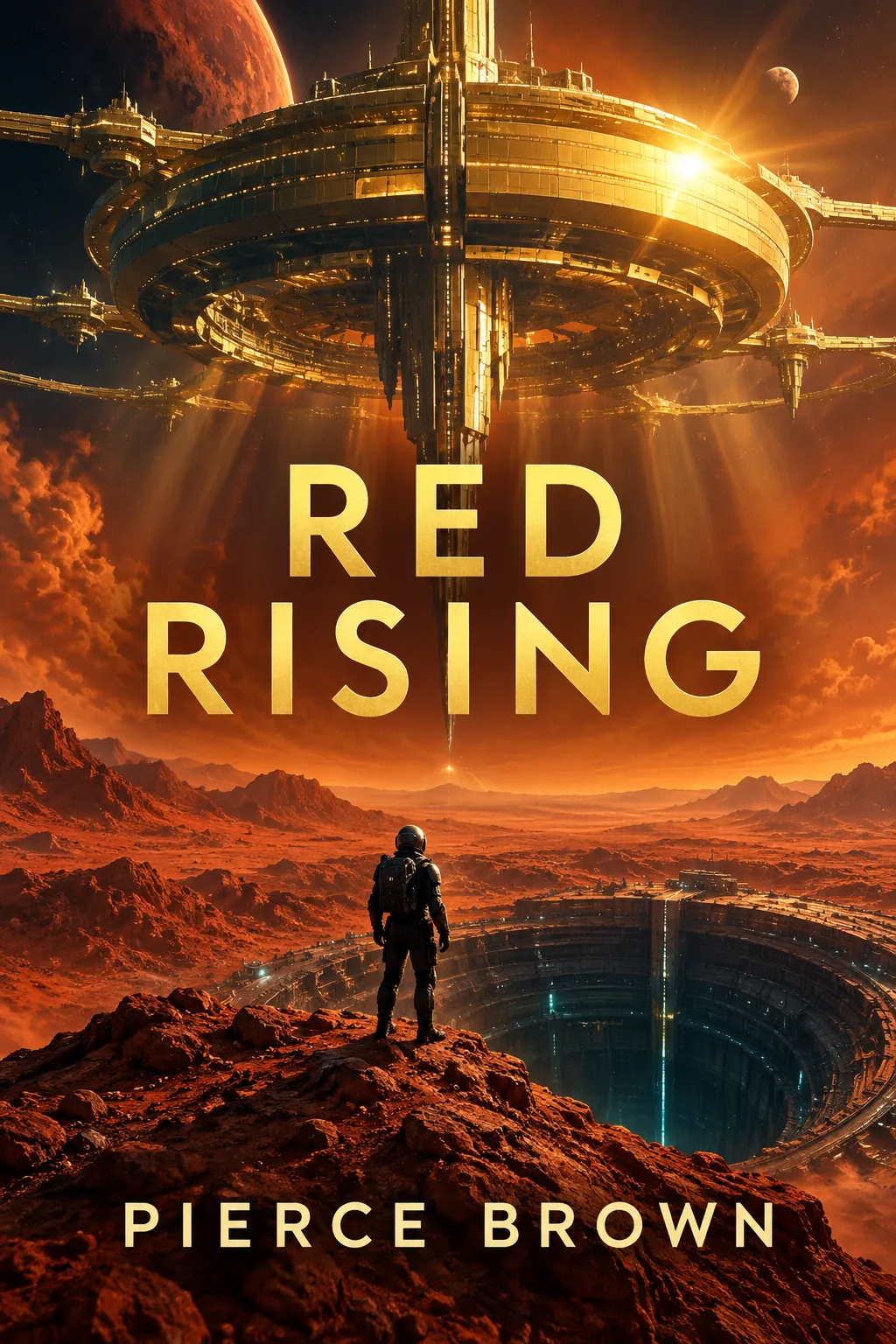
Red Rising
by Pierce Brown
Red Rising is a science-fiction novel set on Mars, where society is split into color castes. Darrow, a sixteen-year-old Red who mines helium-3 underground, believes his work prepares the planet for humanity. After a tragedy, he learns the surface was settled long ago and Reds are being used. A rebel group reshapes him into a Gold, the ruling class, and sends him into a brutal school for future leaders. There he must win, and decide who he is becoming.
The Big Idea
"In a color-coded society built on lies, a young miner learns that the system can only be beaten from inside, and that becoming the enemy to defeat him costs something of yourself."
Key Insights
A caste system held up by a story
The Reds are not only kept down by force. They are kept working by a story: that their labor prepares a better world for humanity. Red Rising argues that inequality lasts when the people at the bottom believe the story told about them. Once the lie is seen, they look at their work and at their rulers in a completely different way.
Darrow takes pride in his dangerous mining until the forbidden forest and Eo's questions begin to show him that the world he was shown is not the whole world.
Revenge needs a purpose
Darrow starts from grief and anger. The novel shows that anger gets him moving but cannot tell him where to go. The further he goes with his mission, the more the methods he uses change who he is, so he has to keep asking what he is fighting for. Hatred is a strong fuel, but a poor map.
His final choice to serve Nero, whom he hates for Eo's death, shows the price of holding back feelings for the sake of a larger aim.
Leading by force or by trust
After he takes control of House Mars, Darrow tries both ways of leading. Conquering other Houses by force wins battles, but freeing enslaved students and building an army from willing followers proves stronger. The book suggests that loyalty given freely lasts longer than obedience taken by fear, and that how a leader wins matters as much as winning.
He conquers House Minerva and House Diana, then frees the enslaved students and builds an army that takes House Ceres and House Apollo.
Power rigs the game
The Institute looks like a fair test for future leaders, but it hides cheating at the top. When Darrow learns that Nero is bribing the Proctors, he has to face the idea that winning within the rules is not the same as being just. The book asks who writes the rules and who benefits from them, and it leaves the reader to answer.
Fitchner's news about the bribes turns Darrow's contest from a race for the top into a fight against a rigged system.
Chapter Breakdown
Chapter-by-chapter summary
Spoiler warning: this section covers the whole plot, including the ending. The book does not use named parts, so the labels below are our own.
Part 1: Below the Surface
Darrow is a sixteen-year-old Helldiver, a Red who drills helium-3 deep beneath Mars. Reds live on thin rations and are told that their work will one day make the surface fit for humans. Darrow believes it and is proud of it. His wife, Eo, does not. She dreams of freedom, and one day the two slip into a forbidden forest. They are caught and publicly whipped. Why it matters: this opening plants the lie that the whole book attacks. The Reds think they are building a future, but that future already exists for someone else.
Part 2: The Song and the Rope
At a public gathering, Eo sings a song that is forbidden. The ArchGovernor, Nero au Augustus, orders her hanged in front of the clan. Darrow secretly buries her, which is also a crime, and he is hanged for it. His uncle Narol has drugged him, though, so he only seems to die. He survives carrying the grief of losing Eo. Why it matters: this is where grief turns into purpose, and every later choice Darrow makes is measured against her. The scene also shows how the rulers answer even a song: any voice raised against them is punished in public, as a warning.
Part 3: Remade as a Gold
Darrow wakes among the Sons of Ares, a rebel group. A member named Dancer asks him to take a dangerous job: pass as a Gold, the ruling color, and break the system from inside. A carver named Mickey reshapes his body, while Matteo and Dancer teach him how Golds speak and behave. He becomes Darrow au Andromedus. Why it matters: the change is more than skin deep. The better Darrow fits into the Gold world, the wider the gap grows between him and the Red he used to be.
Part 4: The Institute and the Passage
Darrow enters the Institute, where young Golds are gathered and sorted into Houses named for gods. He is placed in House Mars and quickly befriends Cassius au Bellona. The first test, the Passage, pairs students and forces them to fight, and some die. In it, Darrow kills Julian, Cassius's brother. Why it matters: Darrow meant to learn Gold secrets from behind a disguise, yet he crosses a line he cannot undo. The killing sets up the book's central friendship and its central enmity, and it comes back to haunt both young men.
Part 5: Taking Charge of House Mars
In the next contest, House Mars splits. Titus and his faction treat captured students cruelly. Darrow turns House Minerva against that faction, defeats it, and becomes the leader of House Mars. He soon earns the nickname Reaper. Others follow him because he gets results, and he learns how quickly people give their loyalty to a winner. Why it matters: Darrow stops being only a spy and becomes a commander. But the game rewards force, and the story starts to ask whether winning this way is something he can live with.
Part 6: Conquest and Mercy
Darrow brings House Minerva and House Diana under his control, but he protects Mustang, whose real name is Virginia, rather than let his housemates kill her. Meanwhile the Jackal, a cruel Gold rival named Adrius, sends Cassius a recording that shows Darrow killed Julian. Cassius challenges Darrow to a duel, leaves him for dead and takes back House Mars. Mustang finds and hides Darrow, and as he recovers the two grow close. Why it matters: the hero loses everything, and the person who saves him is someone he once meant to defeat.
Part 7: A Rigged Game
Fitchner, one of the Proctors who run the contest, tells Darrow that Nero is bribing the Proctors so the Jackal will win. Darrow frees the enslaved students, rebuilds an army and takes over House Ceres and House Apollo. Cornered, the Jackal cuts off his own hand to escape. Then the Proctors kidnap Mustang, and Darrow kills Proctor Apollo. Why it matters: the Institute is no longer just a school test. It exposes how power cheats the game, and it moves Darrow's goal from winning to breaking the system.
Part 8: Olympus and Nero's Offer
Darrow's army attacks Olympus, the Proctors' base, rescues Mustang and captures the Proctors. Cassius gives up leadership of House Mars but swears a blood feud against Darrow. Mustang delivers the Jackal, and House Mars wins the Institute. Then Nero makes Darrow an offer: hide the rigging and serve as his Lancer, and Darrow can go on to the Academy. Though he hates Nero for Eo's death, Darrow accepts and joins House Augustus. Why it matters: he ends the book standing closer to his enemy than ever, which sets up the rest of the series.
Characters
Darrow
The narrator and hero. A sixteen-year-old Red miner from Mars who becomes a Gold in disguise after Eo's death. He is brave and gifted at leading others, yet torn between revenge, duty and the person he is turning into.
Eo
Darrow's wife. She questions the Reds' way of life and longs for freedom. She is executed for singing a forbidden song, but her memory remains the root of everything Darrow does, even though she leaves the story early.
Dancer
A member of the Sons of Ares who recruits Darrow for the plan to infiltrate the Golds. He helps teach Darrow how to behave as a Gold, and he stands for the rebel cause that sent Darrow into the enemy's world.
Mickey
The carver who reshapes Darrow's body into a Gold's. He is a craftsman, and his work marks the point where Darrow stops being a Red in the eyes of everyone around him. He stands for the physical side of Darrow's change.
Cassius au Bellona
A young Gold who becomes Darrow's first close friend at the Institute. After losing his brother Julian, he becomes Darrow's rival, defeats him in a duel and swears a blood feud. Friendship and hatred point at the same person.
Julian
Cassius's brother and a student at the Institute. He dies in the Passage at Darrow's hands. He has little time on the page, but his death is the wound that drives the rivalry between Darrow and Cassius in the second half.
Mustang (Virginia au Augustus)
Nero's daughter and a sharp, strategic Gold. Darrow spares her when he could have let her be killed, and she later saves his life. She grows from an opponent into his most important ally.
Nero au Augustus
The ArchGovernor of Mars. He orders Eo's execution, rigs the Institute's contest, and later tempts Darrow with an offer of power. He is both Darrow's most hated enemy and, in the end, the man he agrees to serve.
The Jackal (Adrius)
A cunning, ruthless Gold rival. He turns Cassius against Darrow with a recording and cuts off his own hand to escape when he is cornered. He remains a stubborn threat and keeps tension high through the story.
Fitchner
A Proctor at the Institute who tells Darrow that Nero is bribing the Proctors. He is a source of inside knowledge, showing Darrow that the game is not what the students think it is.
Writing about this book
A good report on Red Rising does not retell the plot. Pick one scene or idea that stayed with you, then explain why. These questions can help you find it.
- Darrow agrees to wear a Gold's face in order to destroy the Golds. Would you make the same choice? What would you lose?
- Darrow kills Julian in the Passage and later takes charge of House Mars. Does a worthy goal excuse the methods he uses?
- The Reds work for a promise of a better future. Where do you see people told to accept hardship for the greater good today, and who benefits?
- Eo wants Darrow to live for more than survival. What does that mean for him, and does he live up to it?
Start with the moment that moved you, say what it shows about the book's ideas, and finish by connecting it to something from your own life or from the world around you. Because the novel is violent, you may also want to say what the violence is doing in the story: is it shown to thrill, or to make a point?
Take Action
Practical steps you can implement today:
-
Ask who benefits from a role or a rule that everyone treats as natural, before you accept it.
-
Anger can start action, but name your purpose, or the methods will start choosing the goal for you.
-
People follow leaders who give them freedom and trust more reliably than leaders who rule by fear.
-
Check whether the rules of a contest are fair before you spend everything trying to win it.
Notable Quotes
"“Break the chains, my love.” (Eo, early chapters)"
— Pierce Brown
"“Live for more.” (Eo, early chapters)"
— Pierce Brown
"“I live for the dream that my children will be born free.” (Eo, early chapters)"
— Pierce Brown
Who Should Read This
Readers from about sixteen up who enjoy science fiction, fast-moving competitions and stories of rebellion. The book contains violence, executions and war scenes, so it suits older teens and adults better than younger readers. Fans of The Hunger Games or Ender's Game will find a similar mix of young people in a harsh contest, with a darker tone.
Frequently Asked Questions
Is Red Rising part of a series?
Yes. It is the first book in the Red Rising series by Pierce Brown, published in 2014. Later books include Golden Son and Morning Star. This first novel tells a fairly complete story about Darrow's time at the Institute, but its ending points clearly toward the next volume.
What are the colors in Red Rising?
Society on Mars is divided into color castes that decide a person's job and status. Reds, like Darrow, mine underground. Golds rule over everyone else. Other colors fill other roles, but this first book focuses on the clash between the Reds and the Golds.
Is Red Rising like The Hunger Games?
Both involve young people thrown into a harsh contest run by a ruling class. The difference is that Darrow is not a victim picked at random. He enters on purpose, in disguise, to wreck the system from inside, and he spends much of the book leading armies of other students.
What age is Red Rising for?
Because of its violence, executions and war scenes, it is best for older teens and adults. The story is serious throughout, so it helps to know what to expect before you start. Choose it according to the reader's age and comfort with dark material.
Why does Darrow mine helium-3?
Helium-3 is the resource the Reds dig out under Mars. They are told that mining it helps prepare the surface for human settlement. That claim turns out to be the lie at the heart of the system, which is why the mining stands for the whole society's unfairness.
Check Your Understanding
Pick an answer for each question to see if you were right.
-
What does Darrow mine under the surface of Mars?
Helium-3 — Darrow is a Helldiver who drills helium-3, the resource the Reds are told will prepare Mars for humanity.
-
Who is Eo to Darrow?
His wife — Eo is Darrow's wife, and her execution drives his decision to join the rebels.
-
Which rebel group recruits Darrow to pass as a Gold?
The Sons of Ares — Dancer and the Sons of Ares ask Darrow to infiltrate the Golds from the inside.
-
Which color's body is Darrow reshaped into?
Gold — Mickey the carver remakes Darrow into a Gold, the ruling caste.
-
What is the name of the school Darrow is sent to?
The Institute — The Institute is where young Golds are tested; the Passage is its first trial, and Olympus is the Proctors' base.
About Pierce Brown
Pierce Brown is an American science-fiction author. Red Rising, published in 2014, was his debut novel and became the first book of a long-running series. His stories are set among rival castes and brutal contests on Mars and beyond, and are known for fast action and political scheming.
Summary Written By

Software Engineer & Writer
Software engineer with a passion for distilling complex ideas into actionable insights. Writes about finance, investment, entrepreneurship, and technology.
View all summaries →Reviews
No reviews yet. Be the first to share your thoughts!
Write a Review
Keep reading
Explore the topic: Science FictionSummaries

Out of My Mind
Sharon M. Draper
“Out of My Mind” by Sharon M. Draper is a poignant narrative that explores the life of Melody Brooks, a…

Ender’s Game
Orson Scott Card
“Ender’s Game” by Orson Scott Card is a riveting science fiction novel that transports readers into a future where humanity…

Pachinko
Min Jin Lee
“Pachinko”, a spellbinding multigenerational historical saga by Min Jin Lee, explores the lives of a Korean family trying to make…

The Perks of Being a Wallflower
Stephen Chbosky
The Perks of Being a Wallflower by Stephen Chbosky is a profound coming-of-age novel, told through the intimate letters of…
Articles

A Christmas Carol themes: generosity, isolation and responsibility
Dickens's novella is usually read as a story about a man who changes his mind. Its themes are sharper than…

Clarke's Three Laws
Clarke's three laws are three short rules about prediction, written by science fiction author Arthur C. Clarke. They say that…

Generation Ship
A generation ship is a slower-than-light starship so large that its crew lives, raises children and dies aboard during a…