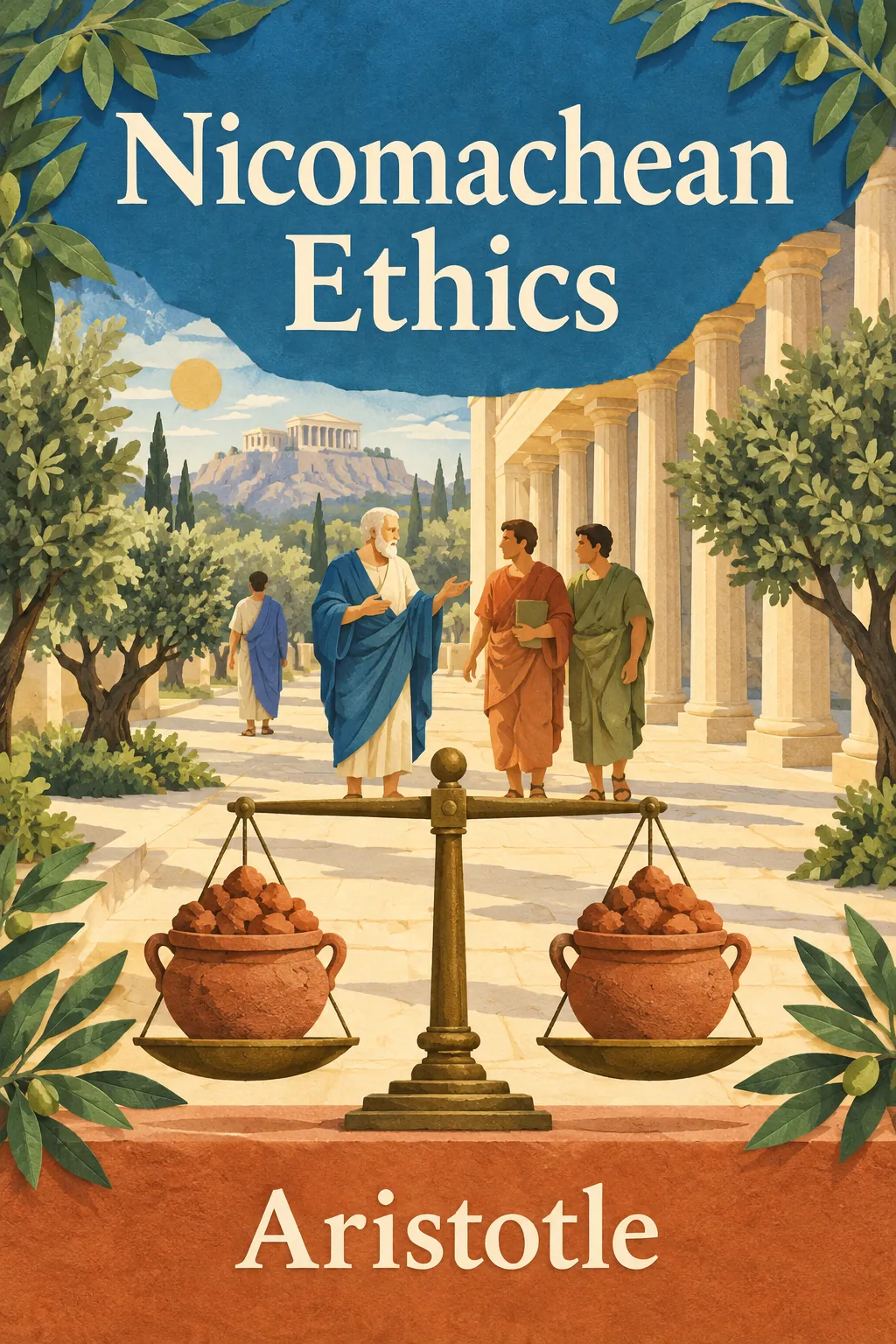
Nicomachean Ethics
by Aristotle
The Nicomachean Ethics is Aristotle's study of how to live well. He starts with a simple question: what is the highest good for a human being? His answer is eudaimonia, usually translated as happiness or flourishing, an activity of the soul in line with virtue across a full life. Courage, generosity and honesty are habits, built by practice and aimed at a mean between extremes. Friendship, pleasure and contemplation fill out the picture. The text runs to ten books.
The Big Idea
"Aristotle argues that a good life means living excellently over a whole lifetime. We get there by training habits of character that hit the mean between too much and too little."
Key Insights
Happiness is an activity, not a mood
For Aristotle, eudaimonia is not the name of a cheerful feeling. It means using your human abilities well, in line with virtue, over a long stretch of time. That is why he says one swallow does not make a summer: a single good day cannot settle whether a life is going well.
Passing an exam may feel wonderful, but on this view the measure is what you do day after day: learning, helping others and working at things that matter.
Virtue is built by habit
Courage and honesty are not talents we are born with or traits we simply choose once. Aristotle compares them to crafts: we learn by doing, clumsily at first, until the right action becomes natural. Character is therefore something we can shape on purpose.
A student who dreads speaking in class can make a rule to say one thing each lesson. Over weeks, the bold way of speaking becomes a habit, even if some days go badly.
The mean is not the middle
The mean is not an average between two extremes. It is the response that fits this person, this moment and this reason. Sometimes strong anger is correct, so staying calm is not always the mean. Finding it takes judgement, not arithmetic.
Seeing a friend bullied, feeling nothing is too little and violent revenge is too much. The mean is a firm protest and real help, matched to what the situation needs.
Practical wisdom links values to action
Good intentions fail without the ability to see what a situation asks for. Aristotle calls this skill phronesis and says real virtue cannot exist without it. It grows with experience, and watching how wise people decide is part of learning it.
Keeping a promise matters, yet if a friend falls ill on the day, a sensible person weighs the two duties and chooses well. Experience makes such choices quicker and more accurate.
Friends belong to the good life
Aristotle spends two of ten books on friendship. Friendships based on usefulness or pleasure end when the benefit does, but friendships between good people who value each other for themselves last. Even a happy person, he argues, needs friends to share activity with.
Teammates who only want to win use each other. When they also enjoy each other's growth, the bond moves toward friendship of goodness, which needs years of shared time.
Chapter Breakdown
Chapter-by-chapter summary
Aristotle's text is divided into ten books. Each one is summarised below in order, with a line on why it matters.
Book I: The Good and Happiness
Aristotle begins by noting that every skill and choice aims at some good, and that these aims are ranked: bridle-making serves horse riding, which serves winning a war. The top of the ladder has to be something we want for its own sake. Nearly everyone calls that happiness (eudaimonia), but people disagree about what it is. He sets aside pleasure, honour and wealth, then argues from the human function: if the work of a human is reasoning well, happiness is activity of the soul that follows excellence, over a whole life. Why it matters: every later book answers this opening question.
Book II: Virtue and the Mean
Here Aristotle splits excellence into two kinds: excellence of thought, which is taught, and excellence of character, which is built by habit. We become just by doing just things and brave by doing brave things, much as builders learn by building. He then says that a virtue sits at a mean between two faults, one of excess and one of deficiency, and that the mean is relative to the person and the situation. Courage lies between cowardice and recklessness. Why it matters: ethics becomes training. Character is not a gift or a verdict but something we practise into being.
Book III: Choice, Courage and Temperance
This book asks when someone is responsible for what they do. An act is voluntary when its cause lies in the person and they know what they are doing; force and real ignorance excuse. Aristotle then describes choice as deliberate desire shaped by thinking about the means. He looks at two virtues: courage, which means facing fear for a worthy purpose, especially in battle, and temperance, which means moderation in bodily pleasures such as food and drink. Why it matters: praise and blame make sense only for actions that really belong to us.
Book IV: The Social Virtues
Book IV is a tour of the virtues of everyday life. Generosity is the right way to give and take money, and magnificence is the right way to spend big on public projects. Greatness of soul is a fitting sense of one's own worth, between vanity and false modesty. The book goes on to cover proper ambition, good temper in anger, friendliness, truthfulness about oneself and wit in play. Each has a mean and two faults. It closes with shame, which Aristotle treats as a feeling rather than a virtue. Why it matters: manners, money and conversation count as part of the moral life.
Book V: Justice
Book V is about justice. Aristotle separates general justice, which means obeying good laws, from particular justice, which is fairness in sharing out goods and in setting wrongs right. Distributive justice gives each person a share that matches their merit. Corrective justice restores balance after harm, like a judge who treats the two sides as equals. He also discusses fair exchange in trade, the role of money, and equity, which repairs the places where a law is too blunt for a case. Why it matters: it is one of the first careful accounts of fairness, and it still shapes how lawyers and philosophers talk about it.
Book VI: Intellectual Virtues and Practical Wisdom
Having covered virtues of character, Aristotle turns to virtues of thought. He lists five ways the mind reaches truth: craft knowledge, scientific knowledge, intuitive grasp of first principles, theoretical wisdom, and practical wisdom (phronesis). Practical wisdom is the ability to work out the right thing to do in a particular case. He argues that real virtue of character cannot exist without it, and that it cannot exist without good character. Why it matters: rules alone do not make a good person. Judgement in real situations links the mean to action.
Book VII: Self-Control and Pleasure
This book examines why people act against their own best judgement, a state called akrasia, often translated as weakness of will. Socrates had said this is impossible, because knowing the good means doing it. Aristotle disagrees: desire or anger can cloud knowledge in the moment, like a drunk reciting verses he does not feel. He also separates self-control from full virtue and from brutish states. The second half defends pleasure against those who call it always bad. Why it matters: knowing what is right and doing it turn out to be different problems.
Book VIII: Kinds of Friendship
This is the first of two books on friendship (philia). Aristotle says friendship is needed at every stage of life, by the young and the old, the rich and the poor. He lists three kinds, based on usefulness, on pleasure, or on goodness. Friendships of use and pleasure last only as long as the benefit does. Friendships between good people who value each other for who they are last longest, but they are rare and take time. He also links friendship to community life, comparing forms of government with family relations. Why it matters: it explains why some friendships fade and others last.
Book IX: Friendship in Practice
Book IX handles the difficult cases: what to do when a friend changes, when debts of gratitude conflict, or when a friend turns bad. Aristotle claims that healthy self-love, meaning care for the best part of yourself, is the root of friendship, and he calls a friend “another self”. He asks how many friends a person needs, and concludes that happy people need friends, because sharing life and activity deepens joy. Why it matters: friendship becomes part of happiness itself, not a handy extra.
Book X: Pleasure, Contemplation and Law
The finale returns to pleasure. Aristotle explains why it completes an activity without being the goal itself. Then he comes back to happiness and gives his boldest answer: the best life is contemplation, the use of reason to study what is highest and unchanging. A life of practical virtue among other people comes second. He ends by saying that argument alone cannot make people good; laws and upbringing are needed. That points straight to his Politics. Why it matters: it frames the book's central debate between the philosopher's life and the citizen's life.
Key people and terms
Aristotle
Greek philosopher (384–322 BC), a student of Plato and tutor of Alexander the Great. He founded the Lyceum school in Athens. The Nicomachean Ethics is usually read as his lecture material, edited into ten books.
Plato
Aristotle's teacher at the Academy. In Book I Aristotle criticises Plato's idea of a single Form of the Good, arguing that an abstract good is of little use to someone trying to act well in daily life.
Socrates
Plato's teacher, associated with the view that no one knowingly does wrong. In Book VII Aristotle pushes back, saying this cannot explain why people act against what they know to be best.
Eudaimonia
Usually translated as happiness or flourishing. It means living and acting well over a whole life, not feeling cheerful for a day. It is the goal that all other goals in the book point toward.
Arete (virtue)
The Greek word for excellence: whatever makes something do its job well. Virtues of character, such as courage and justice, come from habit. Virtues of thought, such as practical wisdom, come mainly from teaching and experience.
The mean
The fitting response between too much and too little, relative to the person and the situation. It is not a simple average. Courage, for instance, sits between cowardice and recklessness. Book II explains it.
Phronesis
Practical wisdom: the skill of seeing what to do in a particular situation. Book VI argues that it cannot be separated from good character, and it differs from theoretical wisdom (sophia), which studies unchanging truths.
Akrasia
Often called weakness of will: knowing what is best but acting against it because of desire or emotion. Book VII uses it to test Socrates' claim that knowledge always leads to right action.
Philia
The Greek word for friendship, covering family bonds and close companionship as well as friends. It is broader than romantic love. Books VIII and IX divide it into friendships of use, pleasure and goodness.
Theoria
Contemplation: using reason to study what is eternal and unchanging, for its own sake and not for any practical payoff. Book X calls it the highest form of happiness, with practical life in society coming second.
Writing about this book
The Nicomachean Ethics is a good book for essays because it invites you to test ideas against ordinary life. These questions are starting points; the argument has to be yours.
- Which habits have shaped your character? According to Book II, how could you change one on purpose?
- Pick a situation, such as speaking up in class, and name the “too much” and “too little” versions. What would the mean look like?
- Think of something you know is bad for you but keep doing. Would Socrates or Aristotle explain it better?
- Sort your friendships into use, pleasure and goodness. Does the sorting feel fair?
- If happiness is an activity rather than a mood, what would count as evidence of a happy week?
When you write, keep Aristotle's claims separate from your own opinions: “Aristotle argues…” and “I think…”. Remember that the mean is not a compromise or a refusal to take a stand. It is the search for the best response in a specific case. Quote sparingly and explain each idea in your own words.
Take Action
Practical steps you can implement today:
-
Pick one small habit this week that trains a virtue you want, such as speaking up politely, and repeat it daily. Aristotle says character grows through practice.
-
When facing a choice, name the two extremes first, then look for the response that fits this person, this moment and this reason.
-
Judge your life across years, not days. A bad week or a great week does not settle whether you are living well.
-
Invest time in a few friendships built on goodwill and shared purpose, not only on usefulness or fun.
Notable Quotes
"“One swallow does not make a summer.” (Book I, chapter 7)"
— Aristotle
"“We become just by doing just acts, and brave by doing brave acts.” (Book II, chapter 1)"
— Aristotle
"“Virtue is a state of character concerned with choice, lying in a mean.” (Book II, chapter 6)"
— Aristotle
"“A friend is another self.” (Book IX, chapter 4)"
— Aristotle
Who Should Read This
Students of philosophy, ethics or politics, especially at high school or first-year university level, will find a clear route into the book here. It also suits anyone curious about character, habits, friendship and what a good life means, and readers who want to prepare for a class discussion or exam before opening a full translation.
Frequently Asked Questions
What is the main idea of the Nicomachean Ethics?
Aristotle argues that the highest human good is eudaimonia, a flourishing life of activity in line with virtue. Virtues are habits of character, built by practice and aimed at a mean between extremes. Practical wisdom guides each choice, and friendship and contemplation complete the good life.
What is the golden mean in Aristotle's ethics?
It is the idea, set out in Book II, that each virtue sits between a fault of excess and a fault of deficiency. Courage lies between recklessness and cowardice. The mean is not an average: it depends on the person, the moment and the reason, so judgement is needed to find it.
What does eudaimonia mean?
Eudaimonia is the Greek word for the highest human good. It is often translated as happiness, but flourishing or living well is closer. Aristotle defines it as activity of the soul in line with virtue across a complete life, so it cannot be measured in one day or by a mood.
Why is the book called Nicomachean?
The title is traditional. The name Nicomachus is linked to Aristotle's son, who is thought to have had a hand in editing the notes. A second ethics text attributed to Aristotle, the Eudemian Ethics, carries a different name. Both are usually dated to the fourth century BC.
Where should a beginner start?
Read Books I, II and X first: they cover happiness, virtue and the mean, and contemplation. Then add Book VI on practical wisdom and Books VIII and IX on friendship. Use a modern translation with notes, and expect compressed arguments, since the book reads like lecture material.
Check Your Understanding
Pick an answer for each question to see if you were right.
-
What does Aristotle say is the highest good for human beings?
Eudaimonia, or flourishing — Book I argues that happiness as flourishing is the one goal we want for its own sake.
-
Between which two faults does courage lie?
Cowardice and recklessness — Book II gives courage as a standard example of a mean between fear and over-boldness.
-
According to Book II, how do we acquire virtues of character?
By practice and habit — Aristotle says we become just by doing just acts, much as builders learn by building.
-
Which of these is NOT one of the three kinds of friendship in Book VIII?
Friendship of rank — The three kinds are based on usefulness, pleasure and goodness.
-
Which life does Book X name as the best?
A life of contemplation — Aristotle ranks the contemplative life highest, with practical virtue among others second.
About Aristotle
Aristotle (384–322 BC) was a Greek philosopher born in Stagira. He studied for about twenty years at Plato's Academy in Athens, tutored the young Alexander of Macedon, and later founded his own school, the Lyceum. His writings cover logic, biology, physics, politics and ethics, and the Nicomachean Ethics is his most influential work on how to live.
Summary Written By

Software Engineer & Writer
Software engineer with a passion for distilling complex ideas into actionable insights. Writes about finance, investment, entrepreneurship, and technology.
View all summaries →Reviews
No reviews yet. Be the first to share your thoughts!
Write a Review
Keep reading
Explore the topic: Personal DevelopmentSummaries

Educated by Tara Westover
Tara Westover
A memoir about a young woman born to survivalists in Idaho who, despite having no formal schooling, teaches herself to…

Atomic Habits: An Easy & Proven Way to Build Good Habits & Break Bad Ones
James Clear
No matter your goals, Atomic Habits offers a proven framework for improving–every day. James Clear, one of the world’s leading…
Think and Grow Rich
Napoleon Hill
What if the secrets to wealth and success weren’t hidden in complex financial strategies, but within the power of your…

Melbourne
Alex Ng
Sophie Cunningham's Melbourne is a deeply personal exploration of Australia's cultural capital, weaving together history, architecture, weather patterns, and personal…
Articles

The Enlightenment Explained: Ideas, Thinkers and Legacy
The Enlightenment was an 18th-century European movement that trusted reason and evidence over tradition and authority. Its thinkers, from Locke…

World History 1700–1918: Revolutions, Industry, Empire and War
Between 1700 and 1918, revolutions, factories, empires and a world war reshaped societies across Europe, the Americas, Asia and Africa.…

Best Stoicism Books for Beginners: Where to Start and Why
Looking for the best stoicism books for beginners? Discover a clear reading route comparing ancient classics like Marcus Aurelius with…