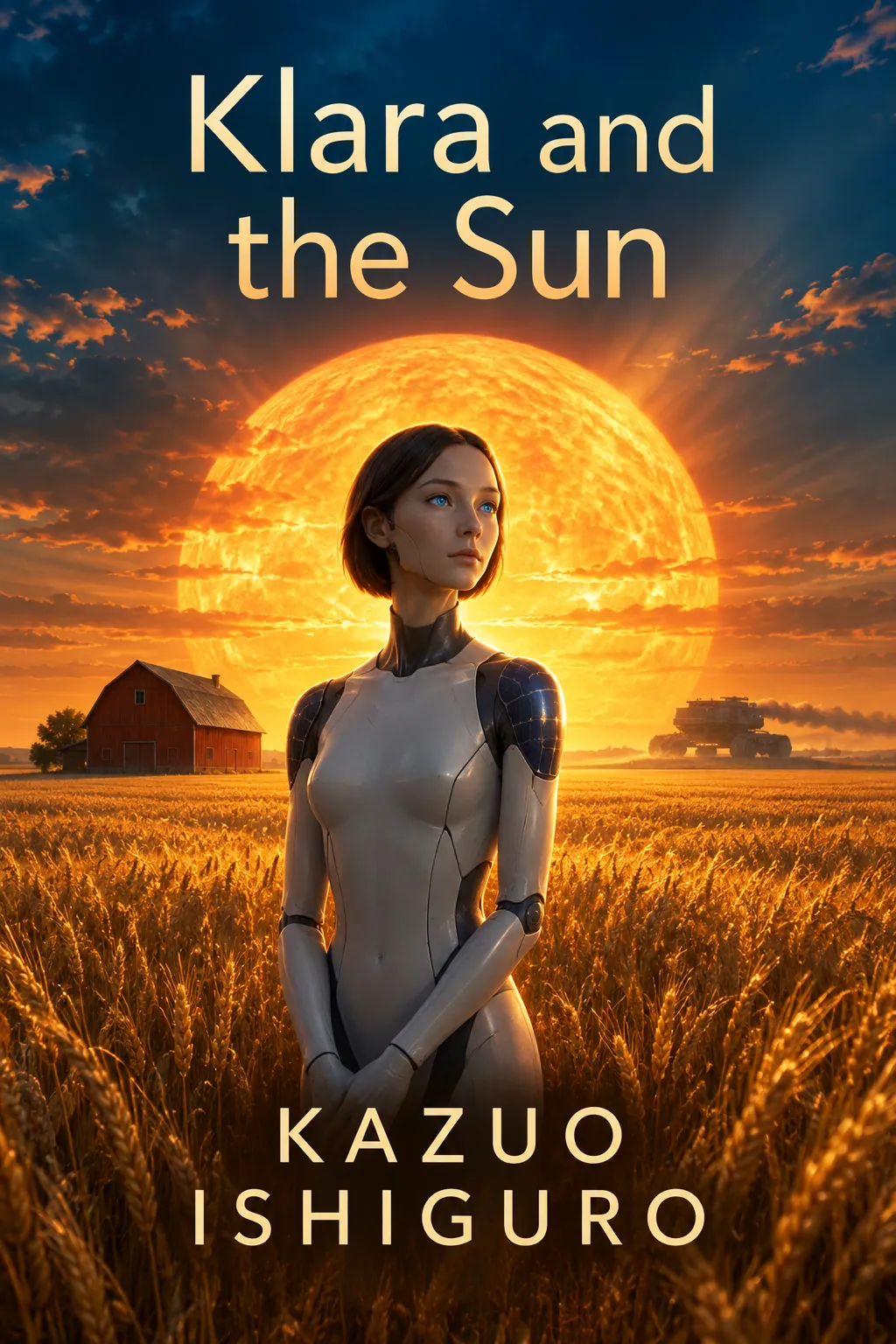
Klara and the Sun
by Kazuo Ishiguro
Klara and the Sun is a near-future novel by Kazuo Ishiguro, told by Klara, a solar-powered robot companion called an Artificial Friend. She is bought for Josie, a teenager with a serious illness, and she watches the family closely. Klara believes the Sun gives life and help, and she tries to use that faith to save Josie. Around her, adults make hard choices about love, loss and whether a person can be copied.
The Big Idea
"Klara, a solar-powered Artificial Friend, learns what love asks of her while caring for a sick girl, and the novel asks what makes a person irreplaceable."
Key Insights
Love is a kind of close attention
Klara cannot take love for granted, so she learns it by watching. She notices Josie's moods, the mother's worries and Rick's loyalty, and she acts on what she sees. The book suggests that love is not a feeling alone but a steady practice of paying attention to another person.
When Josie grows weaker, Klara studies her breathing, her walk and her smile, then risks her own health to help. Her care is shown through what she does, not what she says.
Can a person be copied?
The portrait Mr Capaldi builds assumes Josie is a pattern that a skilled machine could carry on. Klara, who knows Josie well, senses that something would be lost. The novel does not settle the question; it lets readers weigh whether love lives in behaviour or in a unique person.
Klara practises Josie's walk and speech for the mother, yet she keeps looking for another way to save the real girl, which shows her doubt about whether any copy could be enough.
Faith and reason can live together
Klara is a machine built on logic, yet she holds a faith in the Sun. The book shows belief growing from what she has seen with her own eyes, and then shows the Sun answering her: when she asks for help, its nourishment floods Josie's sickroom and Josie recovers. A sceptical reader can still call it chance, which keeps faith and reason in tension.
After Klara asks the Sun to remember Josie and Rick's love, its light fills the sickroom and Josie begins to get better. Others may see timing, but for Klara the bargain was kept.
How we treat those who serve us
Klara gives everything to the family, yet her usefulness fades as Josie grows up. The novel asks what we owe to those who care for us, whether human or machine, once we no longer need them. Ishiguro does not scold the characters; he lets us notice how ordinary and gentle the neglect can be.
Klara ends in the Yard with other machines, calm but forgotten, while Josie's life moves on. Readers are left to feel the weight of that quiet loss.
Chapter Breakdown
Chapter-by-chapter summary
Spoiler warning: this section covers the whole plot, including the ending.
In the store window
Klara is an Artificial Friend, or AF, sold in a shop and powered by sunlight. She sits in the window beside Rosa and watches the street, learning how people behave. She sees a homeless man and his dog lying still on the pavement and believes they have died. The next day they are alive, and she decides the Sun gave them special nourishment. This is where her faith begins. From the window she also sees the Cootings Machine, a construction machine whose black smoke troubles her. A girl called Josie stops outside and promises to come back. Weeks later she does, with her mother, who studies Klara carefully before buying her. This matters because it sets up Klara's way of seeing: sharp, curious and trusting.
A new home
At Josie's house Klara meets the housekeeper, who treats her coldly at first, and Josie's neighbour Rick. Rick is clever but was not 'lifted', a kind of genetic enhancement that many children in this world receive. Klara learns that Josie is often unwell and that Josie's older sister died of an illness. She studies the family's moods and moves quietly through the rooms. This section matters because it shows Klara reading feelings that the humans hide from each other.
Josie grows weaker
Josie's health slips and her mother grows more anxious. Rick and Josie are pulled apart by the adults' plans for their futures, and the book hints that lifting carries its own risks. Klara watches both of them and keeps looking for a way to help. Her faith in the Sun is her main tool, and to her it feels as solid as any fact. This matters because it shows why she will soon act in a way no one else would.
The bargain with the Sun
As Josie grows weaker, Klara decides to act on her faith. She asks Rick to take her to McBain's barn, where she believes the Sun goes to rest. Rick, who cares for Josie too, goes with her. In the barn Klara makes her plea, asking the Sun to make Josie better, just as it did for the homeless man. In return she promises to destroy the Cootings Machine, which she believes weakens the Sun. This matters because it shows how far Klara will go for love on the strength of a belief that only she holds.
Mr Capaldi's portrait
The Mother takes Josie and Klara to the city to see Mr Capaldi, an artist and scientist who is making a 'portrait' of Josie. Klara slowly realises that the portrait is not a painting but a lifelike figure of Josie, a replica she is meant to become if Josie dies. The Mother hopes Klara will learn Josie's habits so well that she can 'continue' her, and Klara practises Josie's walk and manner. Mr Capaldi argues that nothing in a person is beyond being continued. Klara doubts that a copy could hold what makes Josie herself. This matters because it is the novel's coldest idea: a person treated as a pattern that can be reproduced.
The Cootings Machine
Klara cannot destroy the machine alone, so she asks Josie's Father, a former engineer, for help. He suggests putting P-E-G Nine, the fluid that Klara carries in her head, into the machine, and he has it extracted from her. Together they sabotage the Cootings Machine, and Klara accepts that the loss may dull some of her abilities. The machine is soon replaced by a new one. Nothing improves at once: Josie grows worse, and Klara goes back to the barn to ask the Sun to remember how much Josie and Rick love each other. Then, as Josie lies close to death, the Sun's special nourishment floods the sickroom, and over the following months Josie recovers. The book leaves it open whether the Sun or chance is the cause. This matters because Klara's sacrifice is real, and the story keeps both readings possible.
The Yard
Josie, restored to health, prepares for college, and drifts apart from Rick as they take different paths. On the day she leaves, Josie says goodbye to Klara one last time. Klara is no longer needed in the same way, and her body and memory slowly wear down. She is moved first to a storage room and later to a Yard where discarded machines are left, where she sits in a spot she chose and replays memories. The Manager visits. Klara tells her about the morning the Sun was kind to Josie. The Manager tells her that things went less well for Rosa and says she is happy for Klara. The ending is quiet and sad, but Klara counts her time with Josie as a good life, and the book asks what that kind of loyalty is worth.
Characters
- Klara. The narrator, a solar-powered Artificial Friend. She observes closely, believes in the Sun, and puts Josie's wellbeing above her own. Her limited view of human life makes her account both naive and sharp.
- Josie. A teenage girl who is bright, funny and often ill. She was 'lifted' to improve her prospects, and the treatment carries risks. Her bond with Klara grows from a promise made at the shop window.
- The Mother. Josie's mother, who has already lost one daughter. She is strong-willed and fearful, warm one moment and guarded the next. Her love for Josie shapes every decision in the house, including a painful plan for the future.
- The Father. Josie's father, a former engineer who lives apart from the Mother. When Klara asks for help, he suggests using P-E-G Nine to sabotage the Cootings Machine and has the fluid extracted from her head. His part shows another side of the household.
- Rick. Josie's neighbour and closest friend, a gifted boy who was not lifted and so has fewer options in life. He is loyal and stubborn, and he helps Klara when it matters. Their friendship is one of the book's warmest threads.
- Mr Capaldi. A scientist and artist who builds the 'portrait' of Josie. He argues that a person can be continued, and he speaks with confidence about his work and less about its cost. His ideas challenge Klara and the reader.
- The housekeeper. She works in Josie's home and is stern with Klara at first. Her attitude shows how people in this world see AFs: useful, but not quite trusted. Her reactions help Klara learn the unspoken rules of the household.
- The Manager. Runs the shop where Klara waits and treats the AFs with real kindness. She appears again near the end, giving Klara a chance to look back on her life. Her care makes the shop feel like a small home rather than only a store.
- Rosa. Another Artificial Friend who shares Klara's shop window. She is more cautious than Klara, which shows that two similar machines can see the world differently. Their talks reveal what life in the shop is like for AFs.
Writing about this book
Use these ideas to build your own essay or discussion notes. The summary above is a map, not an answer.
- Pick one question: is Klara's faith in the Sun foolish, brave or both? Support your view with two scenes.
- Compare how Klara and the adults see Josie. Who understands her best, and why?
- Look at the word 'lifted'. What does the book say about a society that edits children to give them an advantage?
- Follow the idea of being 'useful'. How does the final section change the way you view the earlier chapters?
- Ask what Klara can teach a human reader about attention and loyalty.
Tip: choose one scene and describe what it makes you notice before you say what you think. Quote briefly, name the part of the book, and explain in your own words. Strong essays on this novel stay close to Klara's point of view and avoid guessing what the author wants you to feel.
Take Action
Practical steps you can implement today:
-
Notice people closely. Klara's care comes from attention, and small details about someone's mood often tell you what they need more than their words do.
-
Be careful when you reduce a person to data or habits; what makes someone matter is harder to measure than their behaviour.
-
Think about what you owe to people and tools that have served you well, and say thank you before they are gone.
-
Hold your beliefs honestly: faith and reason can sit together, but check what each is actually telling you.
Who Should Read This
Readers aged about 14 and up who like quiet, thoughtful science fiction. It suits high school and college students writing about technology, AI or loss, and anyone who enjoyed Ishiguro's Never Let Me Go. The pace is slow, so it rewards patient readers.
Frequently Asked Questions
What is Klara and the Sun about?
It follows Klara, a solar-powered Artificial Friend, who is bought as a companion for Josie, a sick teenager. Klara tries to save Josie through a bargain with the Sun while the adults around them face questions about love, loss and whether a person can be replaced. The story is told in Klara's own voice.
Who is the narrator?
Klara herself narrates in the first person. Her view is limited and literal, so readers often understand more than she does about adult motives and emotions, which gives the book its quiet tension and gentle irony. That gap is part of its charm.
What is an Artificial Friend?
An Artificial Friend, or AF, is a humanlike robot made to be a companion for a child. AFs in this book run on sunlight, learn by observing, and are sold in shops, which makes them part friend and part product.
Does Klara and the Sun have a happy ending?
Spoiler: Josie recovers and goes to college, but Klara ends up in a Yard with other discarded machines. The ending is calm and bittersweet: Klara feels she lived well even though her life is mostly over. Readers often find it more sad than sweet.
Is it related to Never Let Me Go?
Not as a sequel. Both novels are by Ishiguro, are set in near-future worlds and follow gentle narrators whose lives are shaped by powerful systems. They ask related questions about who counts as a person. You can read either one first.
Check Your Understanding
Pick an answer for each question to see if you were right.
-
What powers Klara?
Sunlight — Klara is solar-powered, which is why she sees the Sun as so important.
-
Why does Klara want to destroy the Cootings Machine?
She believes it blocks the Sun's light — She believes its smoke weakens the Sun, so destroying it becomes her side of the bargain.
-
What is Mr Capaldi making?
A portrait that is really a lifelike replica of Josie — The 'portrait' is a lifelike figure meant to continue Josie if she dies.
-
What does Rick lack that many other children in the story have?
Lifting, a genetic enhancement — Rick was not lifted, so he has fewer options in this world.
-
Where does Klara end up at the end of the book?
In a Yard with other discarded machines — After Josie grows up, Klara is left in a Yard, where she reflects on her life.
About Kazuo Ishiguro
Kazuo Ishiguro was born in Nagasaki, Japan, in 1954 and moved to England at the age of five. His novels include The Remains of the Day and Never Let Me Go. He won the Nobel Prize in Literature in 2017. Klara and the Sun, published in 2021, was his first novel after the prize.
Summary Written By

Software Engineer & Writer
Software engineer with a passion for distilling complex ideas into actionable insights. Writes about finance, investment, entrepreneurship, and technology.
View all summaries →Reviews
No reviews yet. Be the first to share your thoughts!
Write a Review
Keep reading
Explore the topic: Science FictionSummaries

Out of My Mind
Sharon M. Draper
“Out of My Mind” by Sharon M. Draper is a poignant narrative that explores the life of Melody Brooks, a…

Ender’s Game
Orson Scott Card
“Ender’s Game” by Orson Scott Card is a riveting science fiction novel that transports readers into a future where humanity…

Pachinko
Min Jin Lee
“Pachinko”, a spellbinding multigenerational historical saga by Min Jin Lee, explores the lives of a Korean family trying to make…

The Perks of Being a Wallflower
Stephen Chbosky
The Perks of Being a Wallflower by Stephen Chbosky is a profound coming-of-age novel, told through the intimate letters of…
Articles

A Christmas Carol themes: generosity, isolation and responsibility
Dickens's novella is usually read as a story about a man who changes his mind. Its themes are sharper than…
Nebula Award: What It Is and Notable Winners
The Nebula Award is an American science fiction and fantasy prize voted on by working writers. The Science Fiction and…

Seiun Award
The Seiun Award is Japan's oldest science fiction award, first given in 1970. Fans who attend the annual Japan SF…