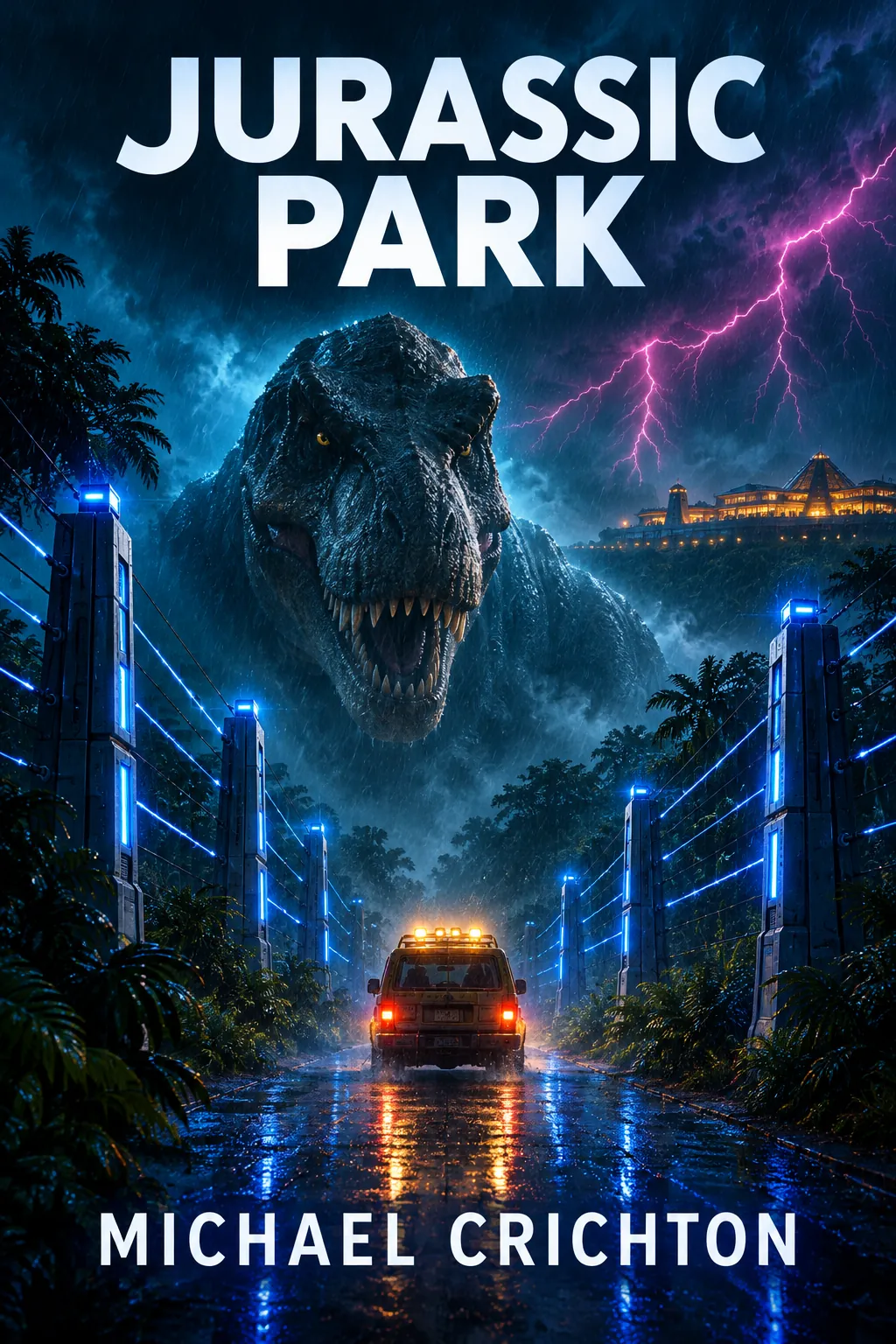
Jurassic Park
by Michael Crichton
Jurassic Park is a 1990 techno-thriller about a billionaire who builds a theme park on a Costa Rican island and fills it with dinosaurs brought back through genetic engineering. Before it opens, he invites a few experts to approve it. A security breach, a tropical storm and a mathematician's warnings about chaos turn the inspection into a fight for survival. The book asks who is responsible when science outruns caution.
The Big Idea
"Crichton's novel argues that a system as complex as a dinosaur park cannot be fully controlled, and that clever science without humility invites failure."
Key Insights
Complex systems fail in unplanned ways
Malcolm's chaos theory argument is the book's backbone: when many parts interact, small changes can grow into big, unpredictable outcomes. Crichton shows the park as a web of fences, computers, weather, animals and people, any of which can break the others.
The storm, Nedry's sabotage and the stalled tour cars combine into a crisis that no single safety plan covered.
Knowledge without responsibility is dangerous
The scientists in the story know how to make dinosaurs, but not how to live with them. The book argues that being able to do something is different from understanding what it will cause, and that those who gain power from science owe the world careful thought.
Wu is proud of the lysine safeguard, yet no one asks what else could go wrong with animals built from patched DNA.
Money and ego drive risky choices
Hammond's wish to build something wonderful and the investors' wish for a return both push the project forward faster than caution allows. Crichton suggests that good intentions are not enough when a profitable idea is also a dangerous one.
Hammond hires cheap, overworked staff and relies on one programmer for the whole control system.
Nature does not stay inside the plan
The designers assumed they could hold living things to a script. The book shows life adapting, changing and breeding in ways no one expected, and it treats that adaptability as a force the park's builders consistently underestimate.
The dinosaurs breed despite being engineered as all female, because the frog DNA used to fill gaps allows a change of sex.
Chapter Breakdown
Chapter-by-chapter summary
Spoiler warning: this section covers the whole plot, including the ending.
The novel is built as a prologue, seven numbered "iterations" and an epilogue. To keep this guide easy to scan, the story is grouped here into eight parts.
Part 1: Prologue, the clinic and the beach
On the Costa Rican coast, a clinic receives a badly mauled construction worker from a remote island. He mutters something that sounds like "raptor" and dies. Not long after, a young American girl on holiday is bitten on a beach by a small lizard-like animal that nobody can name. These two incidents will later trace back to a biotechnology company called InGen. Why it matters: the book opens with a mystery and shows that the park's secret is already leaking out before any visitor has walked through its gates.
Part 2: Hammond calls in the experts
John Hammond, the founder of InGen, faces nervous investors after the worker's death. They send a lawyer, Donald Gennaro, to demand an independent safety check. Hammond invites three outside experts: the paleontologist Alan Grant, the paleobotanist Ellie Sattler and the mathematician Ian Malcolm, who specialises in chaos theory. Grant and Sattler are tempted by the chance to see living dinosaurs and by Hammond's funding for their dig in Montana. Why it matters: Hammond hopes for a rubber stamp, but he has invited exactly the people most likely to spot problems.
Part 3: Arrival on the island
On Isla Nublar the group sees real dinosaurs for the first time and is stunned. The geneticist Henry Wu explains the method: DNA recovered from insects preserved in amber, with the gaps patched using DNA from living frogs. Every animal is bred female and engineered so that it cannot make the amino acid lysine, a safeguard meant to keep it from surviving outside the park. Hammond's grandchildren, Tim and Lex, arrive for a visit. Malcolm argues that a system this complex will find a way around any safeguard. Why it matters: this part sets out both the wonder and the book's central warning.
Part 4: The storm and the shutdown
The group boards computer-guided tour vehicles to see the park. Meanwhile the programmer Dennis Nedry, who feels underpaid, has agreed to steal frozen embryos for a rival company. He shuts down parts of the security system to cover his escape, just as a tropical storm hits. The vehicles stall on the road, the electric fences go dead, and a Tyrannosaurus attacks the stranded cars. Why it matters: the disaster does not come from one big mistake but from a human motive, bad weather and a tightly linked machine failing together.
Part 5: Lost in the park
Nedry, lost in the rain, is killed by a spitting Dilophosaurus before he can deliver the embryos. Malcolm is badly injured in the tyrannosaur attack. Grant, with Tim and Lex, escapes and begins a long walk back through the park, avoiding dinosaurs along the way. Muldoon, the game warden, and Ellie Sattler set out to find survivors. Why it matters: Grant, who starts the book uneasy around children, becomes their protector, and the journey shows the park up close rather than through Hammond's brochure.
Part 6: The animals are breeding
The staff discover that the dinosaurs have been breeding even though all of them were meant to be female. Wu's design used frog DNA, and some frogs can change sex in single-sex groups, so the dinosaurs have done the same. The head counts that should have caught this had been set up to look only for the expected number of animals. Meanwhile the velociraptors get out of their enclosure. Hammond goes out alone to look for his grandchildren, is hurt in a fall and is killed by a swarm of small Compsognathus. Why it matters: the lysine safeguard and the animal count both fail, showing that confidence in a design is not the same as control.
Part 7: The fight to take back the island
Raptors reach the visitor centre, and the survivors must restore power, regain control of the systems and stay alive. Tim's skill with computers is crucial in getting them working again, while Grant, Sattler and the remaining staff use what they know about the animals' behaviour to outwit the raptors. The children make it out alive. Why it matters: the rescue depends on knowledge, patience and teamwork rather than on the park's own technology.
Part 8: Epilogue
In the epilogue the Costa Rican authorities move to destroy the island and its animals. Grant then learns that some animals appear to have already reached the mainland. Why it matters: the closing note matches the book's main theme. A system that its builders believed was contained has already escaped.
Characters
- John Hammond: the founder of InGen and the park's driving force. He sees the park as a wonder for the public, but he keeps ignoring warnings that do not fit his vision.
- Alan Grant: a paleontologist who studies dinosaurs from fossils. He is practical, wary of the park and, at first, impatient with children.
- Ellie Sattler: Grant's former student and assistant, and a paleobotanist. She notices that some of the park's plants are poisonous, and she stays steady under pressure.
- Ian Malcolm: a mathematician who studies chaos theory. He speaks bluntly and acts as the book's voice of warning about complex systems.
- Donald Gennaro: a lawyer sent by the investors. He begins as a cautious businessman and becomes more thoughtful as events unfold.
- Henry Wu: InGen's chief geneticist. He is proud of his work and sure that his controls are enough, which is why the breeding problem catches him off guard.
- Dennis Nedry: the programmer who built the park's systems. His plan to sell embryos to a rival company sets the disaster in motion.
- Robert Muldoon: the game warden. He respects the animals as dangerous predators and has long believed the park is a mistake.
- Tim and Lex Murphy: Hammond's grandchildren. Tim loves dinosaurs and computers, and Lex is younger; both are tougher than the adults expect.
Writing about this book
If you need to write about Jurassic Park for school, start from one question rather than a plot recap. Here are some options. Is the book a warning about technology, or about the people who run it? Malcolm says complex systems behave in ways nobody can predict. Which events in the story prove him right, and are any of them down to plain bad luck?
You could also compare Hammond and Muldoon. Both know the park well, but one sees a wonder and the other sees a risk. Whose view does the story seem to support, and what do the details suggest? Look at the way characters treat the animals: as attractions, as property, or as living things.
Another angle is the role of money. Nedry steals for payment, the investors want results, and Hammond wants a park that earns its keep. Ask how much of the disaster comes from profit, and how much from curiosity.
Whatever you choose, back each point with a specific scene and say what it shows. Keep the original English title, Jurassic Park, and the author's name, Michael Crichton, in your notes so your references are exact.
Take Action
Practical steps you can implement today:
-
Before trusting a plan, ask what happens when two things go wrong at once.
-
Treat a warning from someone who disagrees with you as useful information, not an attack.
-
Build in checks that test for the unexpected, not only for what you already predicted.
-
When a new ability arrives, ask who is responsible for its consequences.
Notable Quotes
"“The tropical rain fell in drenching sheets” (Prologue)"
— Michael Crichton
Who Should Read This
Readers who enjoy fast, science-based thrillers and want the fuller story behind the famous dinosaur idea. Suitable for teenagers from about age 14 and adults, including students who need ideas about technology, ethics or chaos theory for class discussion.
Frequently Asked Questions
What is Jurassic Park about?
Jurassic Park is a 1990 novel by Michael Crichton about a theme park of cloned dinosaurs on a Costa Rican island. A few experts are invited to inspect it, but a sabotage and a storm cause the safety systems to fail. The book is as much about the limits of human control as about dinosaurs.
How are the dinosaurs created in the book?
InGen takes dinosaur DNA from blood in insects preserved in amber, then fills gaps in the genetic code with DNA from living animals, mainly frogs. The embryos are grown and hatched in the lab. The book presents this as a fictional process, not as established science.
What is the lysine contingency?
It is a safeguard in the story. The animals are engineered so they cannot make the amino acid lysine and must get it from the park's food supply. The idea is that they would not survive if they escaped. The plan relies on assumptions that later prove wrong.
Who is Ian Malcolm and why does he matter?
Ian Malcolm is a mathematician who specialises in chaos theory. He is invited to review the park and he predicts it will fail because it is too complex to control. His warnings give the novel its main argument and set the tone of the story.
How does the book differ from the film?
The novel is darker and more technical. It spends more time on chaos theory and on the science of cloning, and it includes events and character fates that the film changed or left out. Use the book itself, not the film, when you write about the text in class.
Check Your Understanding
Pick an answer for each question to see if you were right.
-
Where is the park built in the novel?
An island off Costa Rica — The park is on Isla Nublar, off the coast of Costa Rica.
-
What is used to fill gaps in the dinosaur DNA?
Frog DNA — Wu's team patches missing sections using frog DNA, which later helps explain the breeding problem.
-
Which character argues that the park will fail because of chaos theory?
Ian Malcolm — Ian Malcolm is the mathematician who warns that complex systems are unpredictable.
-
What does Dennis Nedry plan to do?
Steal frozen embryos for a rival company — Nedry agrees to sell embryos to a rival and disables security to cover his escape.
-
What is the purpose of the lysine contingency?
To stop the animals from surviving outside the park — The animals cannot make lysine and are meant to depend on the park's supply.
About Michael Crichton
Michael Crichton (1942–2008) was an American author and filmmaker who trained as a physician at Harvard Medical School. He wrote bestselling techno-thrillers such as The Andromeda Strain and Jurassic Park, often exploring how technology and institutions fail. He also created the television drama ER and directed several films.
Summary Written By

Software Engineer & Writer
Software engineer with a passion for distilling complex ideas into actionable insights. Writes about finance, investment, entrepreneurship, and technology.
View all summaries →Reviews
No reviews yet. Be the first to share your thoughts!
Write a Review
Keep reading
Explore the topic: Time Travel & RealitySummaries

Out of My Mind
Sharon M. Draper
“Out of My Mind” by Sharon M. Draper is a poignant narrative that explores the life of Melody Brooks, a…

Ender’s Game
Orson Scott Card
“Ender’s Game” by Orson Scott Card is a riveting science fiction novel that transports readers into a future where humanity…

Pachinko
Min Jin Lee
“Pachinko”, a spellbinding multigenerational historical saga by Min Jin Lee, explores the lives of a Korean family trying to make…

The Perks of Being a Wallflower
Stephen Chbosky
The Perks of Being a Wallflower by Stephen Chbosky is a profound coming-of-age novel, told through the intimate letters of…
Articles

Butterfly effect
The butterfly effect is the idea that a tiny change at the start can lead to a very different result…

A Christmas Carol themes: generosity, isolation and responsibility
Dickens's novella is usually read as a story about a man who changes his mind. Its themes are sharper than…
Nebula Award: What It Is and Notable Winners
The Nebula Award is an American science fiction and fantasy prize voted on by working writers. The Science Fiction and…