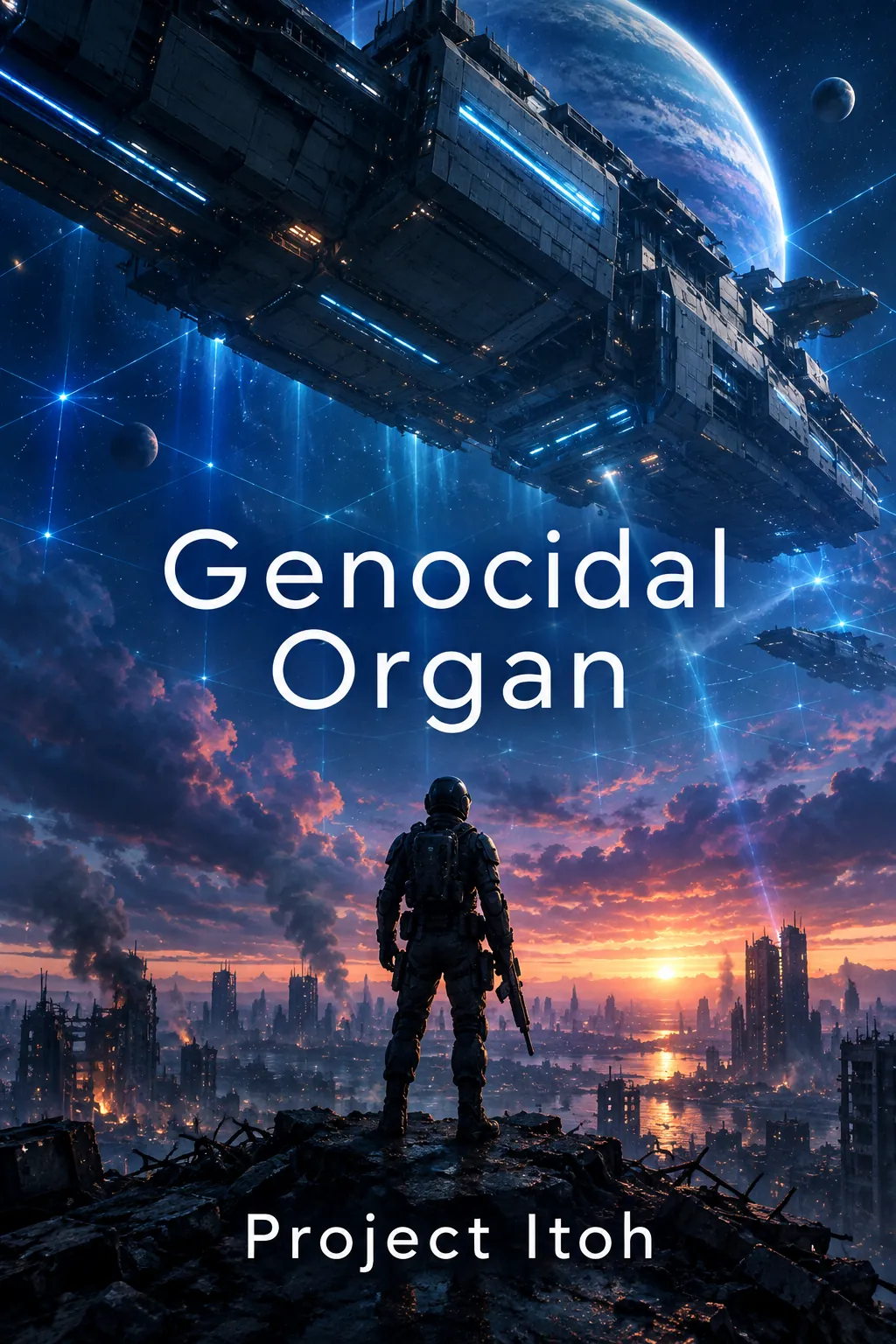
Genocidal Organ
by Project Itoh
Genocidal Organ is a Japanese science-fiction novel about Clavis Shepherd, a US Army captain whose job is to kill. In a near future where rich countries track every citizen to stop terrorism, civil wars and massacres are spreading elsewhere. Clavis's unit is sent after John Paul, an American who seems to turn up wherever mass killing begins. As the hunt moves from Prague to the world's war zones, the book turns into a hard question about guilt, language and what soldiers are allowed to feel.
The Big Idea
"In a world that keeps itself safe by watching and editing its soldiers, Genocidal Organ asks whether conscience is a natural gift or a setting that someone else can switch."
Key Insights
Conscience can be adjusted
In the book's world, soldiers receive technology that dulls pain and hesitation, so the army gets calm killers without nightmares. The novel uses this to ask where conscience really comes from. If a setting can turn feelings down, then the feeling was never a fixed part of who you are. Yet the book also shows that the setting never fully works, because memories and guilt still find a way back to Clavis.
Clavis carries out his missions calmly, while the death of his mother keeps returning to him.
Language can start a massacre
John Paul's idea is that mass killing can be triggered by the right structure of words, not by weapons alone. The book does not give a recipe. It points at something readers already know: propaganda, slogans and official documents shape what people think is acceptable. By making that process literal, the novel makes us look at how ordinary speech can prepare the ground for extreme violence.
After Paul's visits, unstable countries slide into killing along similar lines, as if guided by a script.
Safety has a price paid elsewhere
The opening world is peaceful inside rich borders and violent outside them. The novel shows that this calm is not natural. It is built with surveillance at home and conflict abroad, and the people who benefit rarely see the cost. Clavis's work sits exactly on the line between the two, which is why his story reads as a view of the whole system and not only of one soldier.
Citizens are tracked and protected, while Clavis's unit operates in countries where massacres are growing.
Guilt does not obey technology
Pain and fear can be edited, but the book insists that grief and guilt are stubborn. Clavis's decision about his mother is the memory he cannot edit away. The novel treats this as the most human thing about him and also the most dangerous, because a man with unresolved guilt is open to powerful ideas, including terrible ones.
In the middle of missions, memories of his mother's death cut in.
Responsibility is spread thin
No single villain explains the events. Paul uses the grammar, soldiers follow orders, and everyone else lives in countries that prefer not to look closely. The book asks who is responsible when a system's harm is split into many small parts. Clavis's final choice can be read as his own answer, and the novel leaves it to the reader to judge that answer.
Paul, the military and ordinary citizens each play a part, so blaming one person does not close the question.
Chapter Breakdown
Chapter-by-chapter summary
Spoiler warning: this section covers the whole plot, including the ending.
The novel weaves memories into the mission, so the parts below follow the logic of the story rather than strict page order.
Part 1: A safe world, a quiet soldier
The story begins in a near future shaped by terror. After the nuclear destruction of Sarajevo, rich countries have built tight ID-tracking systems, so every purchase and trip can be followed. Inside those borders life is calm. Outside them, civil wars and massacres keep growing. Clavis Shepherd belongs to a US special unit that works in the gap, assassinating leaders abroad. To get through the work, soldiers have their pain and their moral hesitation dulled by technology. Why it matters: the book first shows us a man who feels almost nothing, so that we can watch what happens when he starts to feel again.
Part 2: The weight of a mother's death
Between missions, Clavis is haunted by his mother's death. His father took his own life with a gun, and his mother was left brain-dead after a traffic accident. Clavis himself switched off her life-support machine. He has never settled whether that was letting her go or killing her. Technology can dull a soldier's pain and hesitation, but it cannot remove this memory. Why it matters: this private guilt is what the technology cannot reach, and it shapes the choice Clavis makes at the end of the book.
Part 3: Prague and Lucia
The trail to John Paul, an American accused of stirring up massacres in poorer countries, brings Clavis, a captain in the US Army's information unit, to Prague. His task is to watch Lucia, a Czech-language teacher who had studied linguistics in the US and was once Paul's lover. While watching her, Clavis finds himself drawn to her. She leads him to a club linked to a group that backs Paul, and on the way back the group captures him. Clavis meets Paul, who says humans have an organ for killing and that a “genocidal grammar” can switch it on. A member of the group tries to kill Clavis, but his own unit rescues him, and Paul and Lucia disappear. Why it matters: Clavis's calm cracks over something other than his mother, and the title idea is spoken aloud.
Part 4: John Paul's motive
The hunt continues, and in Africa Clavis faces Paul again. Paul explains his real reason. His wife and child had died in the bombing of Sarajevo, and he had been using the genocidal grammar to start conflicts abroad so that hatred would not turn toward America. In other words, he sacrificed other countries to keep his own safe. Why it matters: the man Clavis has chased turns out to be a grieving person who believes he is protecting his home, which makes the book's question about responsibility much harder to wave away.
Part 5: Lucia's death and Paul's end
Lucia urges Paul to expose everything in an American court and let the victims' deaths be shared by everyone. Paul decides to give himself up. Then Williams, Clavis's partner in the unit, kills Lucia and tries to kill Paul as well. Clavis kills Williams and escapes with Paul, but Paul is shot dead soon afterwards. Why it matters: Paul never gets to speak in public, so what he knew passes to Clavis alone, and that sets up the final choice.
Part 6: The hearing
Three months after the operation, someone leaks the assassination missions, and Clavis and other members of the information unit are summoned to a hearing. There Clavis uses the genocidal grammar Paul gave him to switch on the genocidal organ in English-speaking people. This sets off a civil war centered on America. Why it matters: the hunter does what the hunted man did, and the novel leaves the reader to judge what drives him and whether it can be defended.
Characters
Clavis Shepherd
The narrator and a captain in the US Army's information unit, which carries out assassinations. Calm on the surface, he is weighed down by his mother's death, which he caused by switching off her life support. His choices at the end define the book.
John Paul
An American and former linguist at MIT whose trail runs through many massacres. Clavis's unit is sent to find him. His wife and child died in Sarajevo, and his ideas about the genocidal grammar become the book's central question.
Lucia
A Czech-language teacher in Prague who studied linguistics and was once John Paul's lover. Clavis is ordered to watch her and finds himself attracted to her. She later urges Paul to make the truth public, and she is killed for it.
Alex
A teammate in Clavis's unit, a devout Catholic who speaks to Clavis politely. He contrasts with Clavis, an atheist.
Clavis's mother
Seen through memory. She was left brain-dead after a traffic accident, and Clavis himself ended her life support. His unresolved guilt over that decision is the emotional centre of the book.
Writing about this book
Genocidal Organ gives you plenty to build a book report around. You do not need to agree with the book. You need a clear question and a few scenes to point to. Here are some starting points.
- Conscience and technology. Soldiers can have pain and hesitation dulled. Does a feeling that can be turned down still belong to you?
- Words and violence. Think of a time when a slogan or a headline changed how people talked about a group. How does the novel's grammar idea relate to that?
- Safe here, violent there. The rich countries in the book are calm because conflict is somewhere else. Who pays for your own sense of safety?
- Responsibility. No single villain explains everything. Who is responsible for Clavis, for Paul, for the world around them?
When you write, choose one question, point to two or three moments from the story, and say what you think and why. Avoid retelling the plot from start to finish. Note that the novel deals with war and killing, so describe those scenes soberly and in your own words.
Take Action
Practical steps you can implement today:
-
Notice how slogans, headlines and official wording shape what feels normal, and read them as carefully as you read facts.
-
Ask who pays for the calm you enjoy; the book suggests safety is often supported by someone out of sight.
-
Treat numbness as a warning sign rather than a solution; feelings that are switched off tend to return later.
-
When you write about a hard book, choose one question and a few scenes instead of retelling the whole plot.
Who Should Read This
Readers of science fiction who like ideas as much as action, and anyone curious about war, language and ethics. It suits upper high school students and adults. It deals with killing and grief, so it is not for younger readers.
Frequently Asked Questions
What is Genocidal Organ about?
It follows Clavis Shepherd, a US Army captain in a near future where rich countries track their citizens and poorer ones fall into massacres. He hunts John Paul, an American linked to outbreaks of mass killing. The hunt becomes a story about guilt, language and responsibility.
Who wrote Genocidal Organ and who translated it?
It was written by Project Itoh, the pen name of Satoshi Ito, and first published in Japan in 2007. The English edition was translated by Edwin Hawkes and published by Haikasoru, an imprint of Viz Media, in 2012.
What does the title mean?
The genocidal organ is an idea in the book: a built-in readiness in the human mind to take part in mass killing. John Paul claims a grammar of language can switch it on. The title names the book's central question about whether violence is rooted in human nature.
Is Genocidal Organ based on a true story?
No. The plot, the characters and the grammar of genocide are fiction. The novel does refer to real places such as Sarajevo and Prague, and it reflects real worries about terrorism, surveillance and wars far from rich countries.
Is it a difficult or violent book?
It deals with war, assassination and grief, and some scenes are heavy. The ideas are not hard to follow, but the subject is serious. It is best suited to older teenagers and adults who are comfortable with dark themes.
Is there an anime version?
Yes. A feature-length anime film based on the novel was released in 2017, as one of three films adapted from Project Itoh's novels. This study guide covers the book. The film may differ in its details.
Check Your Understanding
Pick an answer for each question to see if you were right.
-
Who is the main character of Genocidal Organ?
Clavis Shepherd — Clavis Shepherd is the US Army captain through whose eyes the story is told.
-
Which European city does Clavis go to in order to watch Lucia?
Prague — The trail to John Paul leads Clavis to Prague, where he watches Lucia.
-
What does John Paul say can lead people to accept mass killing?
A grammar hidden in language — Paul describes a genocidal grammar in language that can switch on a readiness to kill.
-
What event shapes the security-obsessed world of the book's backstory?
The nuclear destruction of Sarajevo — After Sarajevo was destroyed by a nuclear bomb, rich countries built tight ID tracking to stop terror.
-
Who translated the English edition of the novel?
Edwin Hawkes — Edwin Hawkes translated the novel for Haikasoru in 2012.
About Project Itoh
Project Itoh was the pen name of Satoshi Ito (1974–2009), a Japanese science-fiction writer. Genocidal Organ, his debut novel, came out in 2007 and won strong praise from readers and critics. He died of cancer at 34, and his novels have since been adapted into a series of anime films.
Summary Written By

Software Engineer & Writer
Software engineer with a passion for distilling complex ideas into actionable insights. Writes about finance, investment, entrepreneurship, and technology.
View all summaries →Reviews
No reviews yet. Be the first to share your thoughts!
Write a Review
Keep reading
Explore the topic: Science FictionSummaries

Out of My Mind
Sharon M. Draper
“Out of My Mind” by Sharon M. Draper is a poignant narrative that explores the life of Melody Brooks, a…

Ender’s Game
Orson Scott Card
“Ender’s Game” by Orson Scott Card is a riveting science fiction novel that transports readers into a future where humanity…

Pachinko
Min Jin Lee
“Pachinko”, a spellbinding multigenerational historical saga by Min Jin Lee, explores the lives of a Korean family trying to make…

The Perks of Being a Wallflower
Stephen Chbosky
The Perks of Being a Wallflower by Stephen Chbosky is a profound coming-of-age novel, told through the intimate letters of…
Articles

A Christmas Carol themes: generosity, isolation and responsibility
Dickens's novella is usually read as a story about a man who changes his mind. Its themes are sharper than…

Nebula Award: What It Is and Notable Winners
The Nebula Award is an American science fiction and fantasy prize voted on by working writers. The Science Fiction and…

Seiun Award
The Seiun Award is Japan's oldest science fiction award, first given in 1970. Fans who attend the annual Japan SF…