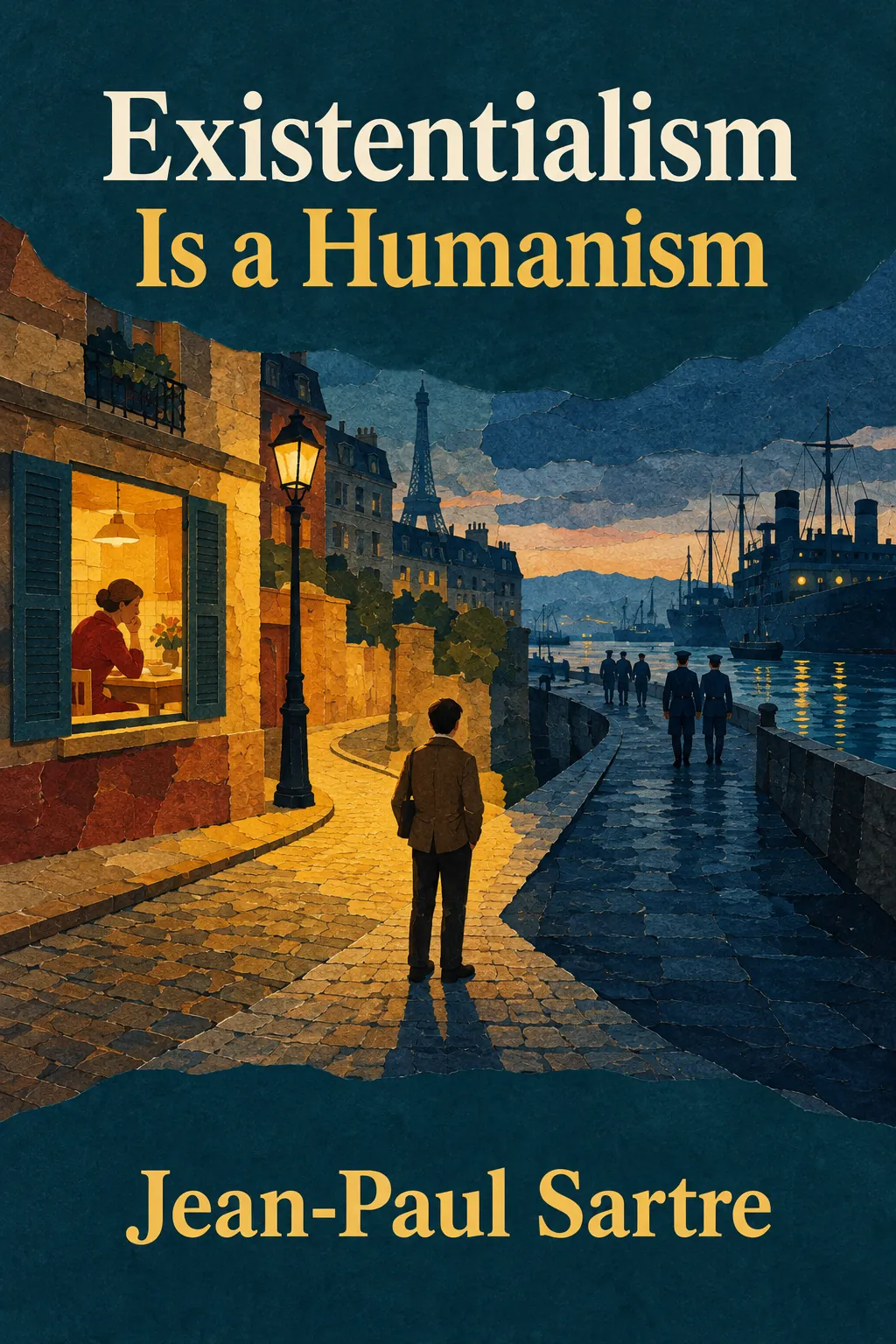
Existentialism Is a Humanism
by Jean-Paul Sartre
Existentialism Is a Humanism is a short lecture in which Jean-Paul Sartre explains his philosophy to a worried public in 1945. His central claim is that there is no human nature fixed in advance: we exist first and define ourselves by what we do. That makes us free, and freedom brings anxiety, because no god, rule or theory can make our choices for us. Sartre argues that this view is not gloomy but hopeful, since it makes every person responsible for building a more human world.
The Big Idea
"People have no fixed nature handed to them in advance. We exist first, then become who we are through our choices, and that means each of us carries full responsibility for those choices."
Key Insights
You make yourself by what you do
There is no blueprint for a person. Sartre says a human being is the sum of his actions, so character is built, not given. Temperament and background are a starting point, but they do not settle who someone finally becomes.
Someone who thinks “I'm bad at speaking in public” can take small talks again and again until the label stops fitting. Sartre's coward and hero work the same way: both become what they are through repeated acts.
Every choice speaks for everyone
When I choose, I am in effect saying this is how a person should act. That is why Sartre links freedom with anguish: no one can treat a decision as private when it quietly sets a standard for others. Responsibility reaches beyond oneself.
Deciding to cheat on an exam looks like a personal matter. Sartre invites the question: what if everyone did this? A choice you could not wish on all people is a warning sign about the choice itself.
Excuses are a way of hiding freedom
Blaming passions, upbringing or fate lets us feel we had no option. Sartre calls this bad faith. Feelings are real, but he argues they are measured by what we then do, so they never decide for us.
A student says, “I wanted to study, but I was too tired.” Sartre would ask what choices led to that evening, and what a different choice would have looked like. The aim is clarity, not guilt.
Responsibility is the source of hope
Because the future is not written, people are never finished and can still change a situation. Sartre argues that his view is a call to act. Despair, in his sense, means doing what lies in your power without waiting for guarantees.
The young man in the dilemma had no rule to lean on, yet he could still act, and the act would give his choice meaning. Hope here means commitment, not a promise that everything will turn out well.
Chapter Breakdown
Existentialism Is a Humanism: chapter-by-chapter summary
The book is a single lecture with no chapters, so the parts below are our own labels for its natural stages.
Part 1: Answering the critics
Sartre gave this talk in Paris in October 1945, a few months after the war in Europe ended. Existentialism had become a fashion and an insult at once. Communists accused it of keeping people still and brooding on despair. Catholic critics said it was gloomy and dwelt on human ugliness. Sartre promises to answer both sides. He describes existentialism as a doctrine that makes human life possible and says every truth and every action involves a human setting and a human point of view. This matters because the whole lecture is a defence, so each idea is shaped as a reply to someone.
Part 2: Existence comes before essence
Here Sartre states his main principle. Take a paper knife: a craftsman first imagines what it is for and then makes it, so its purpose comes before the object. Religious thinkers often picture people the same way, as made to a design in God's mind. Sartre says that if there is no God, nothing designs us. A person first turns up in the world and only afterwards defines himself. He adds that even atheist philosophers of the eighteenth century kept the idea of a shared human nature, and he rejects that too. This matters because it is the foundation of everything else: freedom is not an add-on but the basic condition of being human.
Part 3: Anguish, abandonment and despair
Sartre names three feelings that follow from this freedom. Anguish is the awareness that when I choose, I choose for everyone, as if I were setting a model of what a person should be. Abandonment, sometimes translated as forlornness, is the discovery that no god or fixed moral law tells us what is good, so we must decide alone. Despair means we can count only on what lies within our own power to do, and cannot rely on other people's hopes or on history to deliver results. Sartre insists these are not reasons to freeze. They describe an honest person who accepts responsibility and then acts, and anyone who claims to feel no anguish is hiding it from himself.
Part 4: The student's dilemma
To make this concrete, Sartre tells of a young man who came to him during the German Occupation. His brother had been killed in the 1940 fighting, his father leaned toward collaboration, and his mother depended on him. He could stay and care for her, or leave to join the Free French forces. Sartre notes that Christian ethics says to love your neighbour but not which one, and that Kant's rule never to treat a person as a means does not choose between helping one person and serving many. No rule or feeling can settle it, because the strength of a feeling is shown only by what a person does. The young man must invent his own way. The example shows that hard cases are decided by commitment, not by principles.
Part 5: Subjectivity and other people
Critics said Sartre trapped people inside their own heads. He replies that subjectivity is the starting point, not the end. Following Descartes, the one certain thing is my own awareness, “I think, therefore I am.” But in knowing myself I also meet other people, because I need them to learn who I am. Sartre calls this shared ground intersubjectivity. There is also a human condition: everyone must live in the world, work, live among others and die, and these limits are universal even though each person lives them differently. This matters because it answers the charge that existentialism cannot be shared. Because we choose for all, our choices are also proposals about what a human being can be.
Part 6: Why it is a humanism
Sartre now returns to the accusations. Existentialism is not quietism, he says, because a person is nothing but the sum of his actions. The coward makes himself a coward by what he does, and the hero makes himself a hero, so neither can blame a fixed nature. It is not pessimistic about people either, because the future is not yet written. He rejects the kind of humanism that praises humanity as if it were already great and complete. His own humanism holds that people are always unfinished and must go beyond themselves. He adds that even if God existed, nothing would change, since people must still find themselves. Existentialism keeps human beings and their freedom at the centre, and that is why he can call it a humanism.
Key people and terms
- Jean-Paul Sartre: French philosopher and writer (1905–1980). He delivered the lecture in Paris in 1945 to answer attacks on his ideas, and it was published the following year.
- The young student: an unnamed pupil who asks Sartre whether to stay with his mother or join the Free French. He stands for anyone facing a real moral choice that no rule can settle.
- The paper knife: Sartre's example of an object whose purpose is planned by a maker before it exists. He uses it to show how people differ, because nobody plans us in advance.
- Existence precedes essence: the lecture's central principle. A person first exists and only then, through actions, becomes what he is. There is no blueprint, no built-in human nature that decides for us.
- Anguish: the weight of knowing that each choice is also a model for everyone. Sartre treats it not as simple fear but as the feeling of a person who takes responsibility seriously.
- Abandonment: the situation of having no god or fixed moral law to tell us what is good. It is not a complaint about being alone but a plain fact that comes with being free.
- Despair: living by relying only on what we can actually do, without counting on others or on history to guarantee results. It is not an excuse for doing nothing.
- Bad faith: pretending we are not free by blaming feelings, circumstances or character for what we choose. Sartre sees it as a way of lying to oneself to escape responsibility.
- Humanism: for Sartre, the view that people are always unfinished and must create themselves. He rejects the idea that humanity is already admirable and complete.
Applying it in real life
The lecture works best as a spark for your own thinking. Pick one question and test it against your life instead of only retelling Sartre.
- Think of a choice you made because “that is just how I am.” Does Sartre's view change how you see it?
- Sartre says every choice also shows what a person should be. Which of your recent choices could you defend if everyone did the same?
- Where do you blame circumstances, feelings or other people to avoid deciding? Is that what he calls bad faith?
- Does the student's dilemma have a right answer? Do you agree that no rule can settle it?
- Is a philosophy with no fixed human nature hopeful or frightening to you, and why?
To use the ideas, write down one decision you are avoiding and say what you would choose if nobody else could decide for you. Notice excuses that begin “I can't, because I'm the kind of person who…”. When a friend asks for advice, share your reasons rather than a rule. One caution: this lecture is a popular introduction, not the whole of Sartre's thought, which is developed at length in Being and Nothingness (1943).
Take Action
Practical steps you can implement today:
-
Notice when you say “that's just how I am,” and ask whether it is a fact or an excuse for not choosing.
-
Before a big decision, ask what would happen if everyone made the same choice, and whether you could stand by that.
-
Treat strong feelings as information, then judge them by the actions you take afterwards, not by how intense they are.
-
Share your reasons rather than rules when you advise others, because the final choice is always theirs.
Notable Quotes
"“Existence precedes essence.” (Part 2)"
— Jean-Paul Sartre
"“Man is nothing else but what he makes of himself.” (Part 2)"
— Jean-Paul Sartre
"“Man is condemned to be free.” (Part 3)"
— Jean-Paul Sartre
Who Should Read This
This is a good fit for readers from about 16 upward who want a short, clear way into philosophy. It suits students meeting existentialism in ethics or humanities classes, anyone stuck on a life choice, and readers who want an overview before tackling Sartre's longer works.
Frequently Asked Questions
What is Existentialism Is a Humanism about?
It is the written form of a lecture Sartre gave in Paris in October 1945, published in 1946. He answers critics who called existentialism gloomy or irresponsible. His argument is that people are free, make themselves through their choices, and are responsible for those choices before everyone. It is the most common first book for readers new to existentialism.
What does “existence precedes essence” mean?
It means a person first exists, and only afterwards becomes someone through his actions. A made object like a paper knife has a purpose planned in advance; a human being does not. Sartre says that without a god who designs us, there is no fixed human nature that decides who we must be.
What does Sartre mean by “condemned to be free”?
He means that we cannot escape freedom. We did not create ourselves, yet once we exist we are responsible for everything we do, and even refusing to choose is a choice. The word “condemned” signals that this freedom is a heavy fact, not a prize, because no one else can take the burden from us.
Is existentialism pessimistic, according to Sartre?
No. Sartre argues the opposite. A philosophy that says people are never finished and that the future is open is, he says, a philosophy of action and hope. What it removes is the comfort of excuses: nobody can blame a fixed nature or fate for what they do.
Is this a good first book to read by Sartre?
Yes, it is short and written for a general audience, so it is a popular starting point. Keep in mind that it simplifies his ideas to answer critics. If you want his full argument, move on to Being and Nothingness or his plays and novels, such as No Exit and Nausea.
Check Your Understanding
Pick an answer for each question to see if you were right.
-
Why does Sartre use the paper knife as an example?
To show an object whose purpose is planned before it exists, unlike a human being — The paper knife has an essence planned in advance, while Sartre says people first exist and then define themselves.
-
In Sartre's example, what must the young student decide?
Whether to stay with his mother or join the Free French forces — The student must choose between caring for his mother and fighting, and no moral rule can decide for him.
-
Which of these is NOT one of the three feelings Sartre names?
Pride — Sartre names anguish, abandonment and despair as the feelings that come with freedom.
-
What does Sartre say about the person who blames his feelings or character for his actions?
He is acting in bad faith, hiding his freedom from himself — Sartre calls excuses that deny our freedom bad faith, a kind of lying to oneself.
-
Why does Sartre call existentialism a humanism?
Because it puts human beings and their freedom at the centre, seeing them as unfinished — His humanism treats people as always unfinished and responsible for creating themselves.
About Jean-Paul Sartre
Jean-Paul Sartre (1905–1980) was a French philosopher, novelist and playwright. His major philosophical work, Being and Nothingness, appeared in 1943, and in 1964 he was awarded the Nobel Prize in Literature, which he declined. This lecture, given in 1945, became the most widely read statement of his ideas and made existentialism a household word in postwar Europe.
Summary Written By

Software Engineer & Writer
Software engineer with a passion for distilling complex ideas into actionable insights. Writes about finance, investment, entrepreneurship, and technology.
View all summaries →Reviews
No reviews yet. Be the first to share your thoughts!
Write a Review
Keep reading
Explore the topic: Personal DevelopmentSummaries

Educated by Tara Westover
Tara Westover
A memoir about a young woman born to survivalists in Idaho who, despite having no formal schooling, teaches herself to…

Atomic Habits: An Easy & Proven Way to Build Good Habits & Break Bad Ones
James Clear
No matter your goals, Atomic Habits offers a proven framework for improving–every day. James Clear, one of the world’s leading…
Think and Grow Rich
Napoleon Hill
What if the secrets to wealth and success weren’t hidden in complex financial strategies, but within the power of your…

Melbourne
Alex Ng
Sophie Cunningham's Melbourne is a deeply personal exploration of Australia's cultural capital, weaving together history, architecture, weather patterns, and personal…
Articles

The Enlightenment Explained: Ideas, Thinkers and Legacy
The Enlightenment was an 18th-century European movement that trusted reason and evidence over tradition and authority. Its thinkers, from Locke…

World History 1700–1918: Revolutions, Industry, Empire and War
Between 1700 and 1918, revolutions, factories, empires and a world war reshaped societies across Europe, the Americas, Asia and Africa.…

Best Stoicism Books for Beginners: Where to Start and Why
Looking for the best stoicism books for beginners? Discover a clear reading route comparing ancient classics like Marcus Aurelius with…