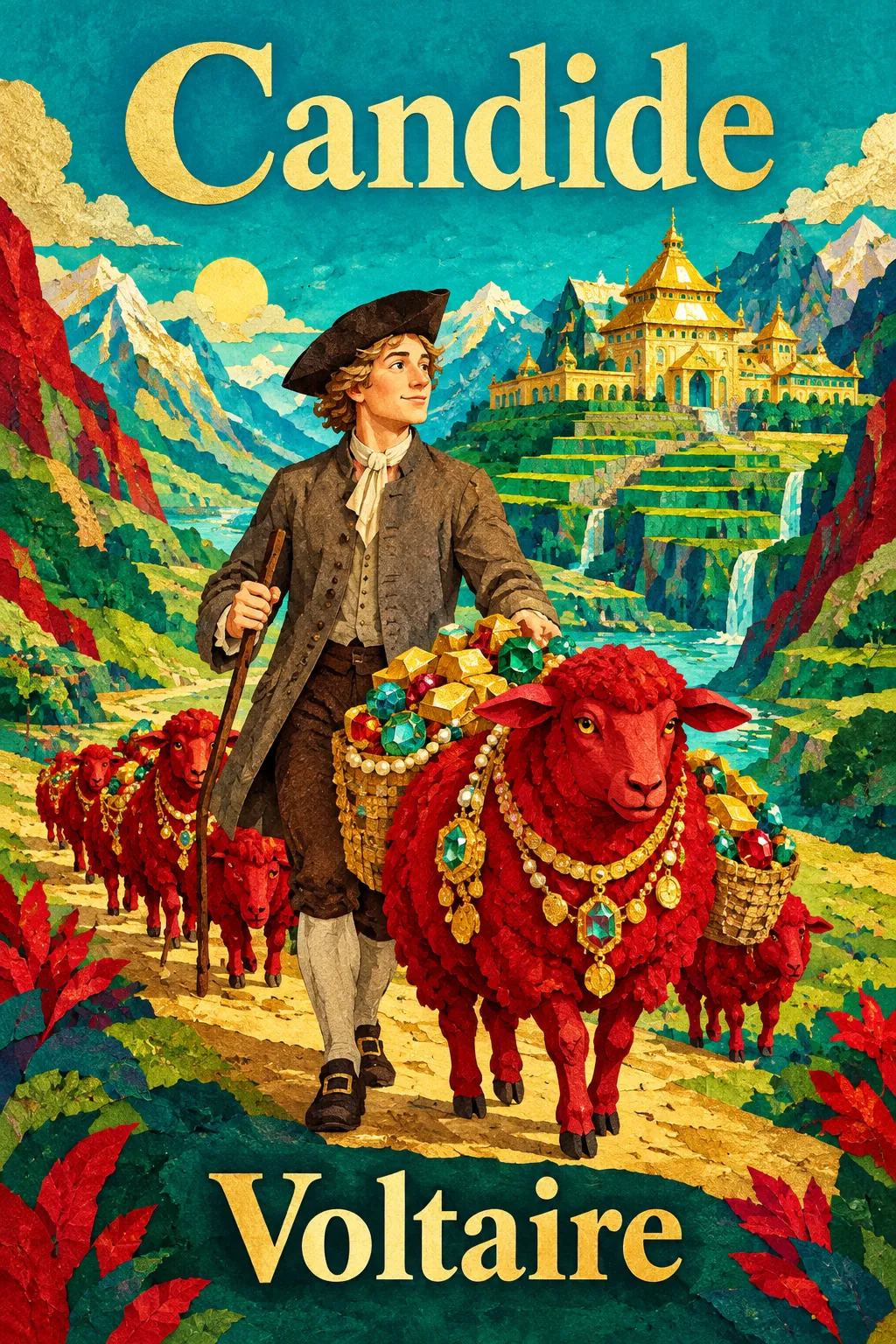
Candide
by Voltaire
Candide is a short satirical novel from 1759 about a kind-hearted young man who is taught that everything happens for the best. Thrown out of his comfortable home in Westphalia, he travels across Europe and the Americas and meets war, earthquakes, slavery, greed and fraud. Each disaster tests his tutor's cheerful philosophy against real suffering. Voltaire uses fast, absurd adventures to attack empty optimism, cruel institutions and the habit of explaining pain away.
The Big Idea
"Voltaire's satire asks whether anyone can honestly say this is the best of all possible worlds, and answers by sending one cheerful young man through war, disaster and cruelty until easy optimism cannot survive."
Key Insights
Optimism meets lived experience
Pangloss insists that everything is for the best, but the book keeps checking that claim against what happens to real people. Voltaire is not saying life is only terrible. He is attacking the habit of using a neat theory to explain suffering away, especially when someone else is the one suffering.
After the Lisbon earthquake, Pangloss still lectures about causes and effects while people lie injured in the street.
Institutions that excuse cruelty
The harshest scenes are caused by systems, not by monsters: armies that flog deserters, courts that hold a ceremony after a disaster, and plantations that run on forced labour. Voltaire shows that cruelty becomes easier when it is routine, official and justified by someone's authority.
In Surinam, the enslaved man tells Candide that this is the price at which sugar is eaten in Europe.
A perfect place is not enough
Eldorado has no priests, no prisons and endless gold, and Candide still wants to leave for the sake of one woman. The book suggests that people look for meaning in relationships and in useful action, not in comfort alone. It also notes that treasure brought out of paradise is quickly lost in the real world.
The red sheep carrying Eldorado's wealth die or are stolen within a few chapters of Candide's departure.
Small work as an answer
At the end, no one solves the problem of evil. The Turkish farmer and the little group on the farm find something smaller: shared tasks that keep boredom, vice and poverty away. Many readers see this as Voltaire's answer to big theories, and others see a slightly ironic shrug. Either way, it moves attention from explanation to action.
Candide's last line about cultivating our garden answers Pangloss's final speech about the chain of events.
Chapter Breakdown
Chapter-by-chapter summary
Spoiler warning: this section covers the whole plot, including the ending.
Candide has 30 short chapters. They are grouped here into eight parts so the journey is easy to follow.
Part 1 (Chapters 1–4): A castle, a kick and a war
Candide grows up in the castle of Baron Thunder-ten-tronckh in Westphalia, a gentle young man raised by the tutor Pangloss to believe that this is the best of all possible worlds and that every effect has a good cause. When the baron catches him kissing his daughter Cunégonde, Candide is kicked out. Hungry and alone, he is tricked into joining the Bulgarian army, flogged as a deserter and marched through a battle that Voltaire describes with bitter, musical irony. He escapes to Holland, where an Anabaptist named Jacques feeds him. There he finds Pangloss ruined by disease and learns that the castle has been destroyed. Why it matters: the opening sets up a cheerful theory that the rest of the book will drag through real suffering.
Part 2 (Chapters 5–10): The Lisbon earthquake
Candide, Pangloss and Jacques sail for Lisbon. A storm drowns Jacques, and the survivors reach shore just as the 1755 earthquake wrecks the city. Instead of simply helping the victims, the authorities decide that a public burning ceremony, an auto-da-fé, will prevent more quakes. Pangloss is hanged and Candide is flogged. An old woman then nurses him and takes him to Cunégonde, who is alive after all. She explains that she was attacked by soldiers and is now shared between a wealthy merchant and the Grand Inquisitor. Candide kills both men, and the three flee to Cadiz. Why it matters: natural disaster and human cruelty arrive together, and Pangloss's explanations start to sound ridiculous.
Part 3 (Chapters 11–13): The old woman's story and a new continent
In Cadiz the old woman tells her own story of captivity, war and bodily injury. Her point is blunt: many people have suffered more than Cunégonde, and most of them still choose to go on living. The three sail to Buenos Aires with Cacambo, a resourceful servant born in the Americas whom Candide has hired. The governor, Don Fernando, wants Cunégonde for himself. When officers arrive hunting the killer of the Inquisitor, Candide has to run again with Cacambo, leaving Cunégonde behind. Why it matters: the old woman offers a second view of suffering, grim but practical, and Cacambo becomes the one companion who actually gets things done.
Part 4 (Chapters 14–16): Jesuits and the Oreillons
Candide and Cacambo travel to Paraguay, where Jesuits run a tightly controlled colony. The commander turns out to be Cunégonde's brother, who survived the attack on the castle. When Candide says he wants to marry her, the brother insults him about his birth, and Candide runs him through with a sword, believing he has killed him. Dressed as Jesuits, the two flee into the wilderness and are captured by the Oreillons, who plan to eat them. Cacambo talks them out of it by explaining that Candide has just killed a Jesuit, which the Oreillons count in his favour. Why it matters: the gentle hero has now harmed several people, and Voltaire shows how quickly reasons for violence get invented and swapped.
Part 5 (Chapters 17–18): Eldorado
Drifting down an underground river in a canoe, the pair arrive in Eldorado, a hidden Andean kingdom where gold and gems lie in the road like gravel. There are no priests, no prisons and no lawyers. People thank God without quarrelling, and the king receives visitors kindly. A palace of sciences is full of mathematical and physical instruments. Candide stays about a month, but he cannot rest without Cunégonde. He leaves with a hundred red sheep loaded with treasure and a royal send-off. Why it matters: Eldorado is the closest the book comes to a perfect society, yet Candide leaves it, showing that comfort alone cannot satisfy him.
Part 6 (Chapters 19–23): Surinam, Martin and Europe
Most of the sheep die on the way. In Surinam, Candide meets an enslaved man missing a leg and a hand, who explains that this is the price of sugar in Europe. For the first time Candide turns against Pangloss's optimism. He sends Cacambo to ransom Cunégonde and picks a gloomy scholar named Martin as his travelling companion. A Dutch captain cheats Candide out of his remaining treasure. In Paris, swindlers take more of his money. In Portsmouth he watches an admiral shot so that others will be encouraged. Then he heads for Venice. Why it matters: with the golden valley behind him, Martin's pessimism and Voltaire's satire of France and England take over.
Part 7 (Chapters 24–27): Venice, the senator and the six kings
In Venice, Candide looks for Cunégonde and Cacambo without luck. He meets Paquette, once a maid at the castle, and the monk Friar Giroflée, who seem happy but turn out to be miserable. The wealthy senator Pococurante has everything and enjoys nothing, scorning Homer, Milton and his own paintings. At a carnival supper, six foreign visitors prove to be deposed kings. Cacambo then appears, now the slave of one of them, and says Cunégonde is in Constantinople. They sail there, and on the galley benches Candide recognises two rowers: Pangloss and Cunégonde's brother, both alive. Why it matters: the book tests whether wealth, religion or leisure can make anyone content.
Part 8 (Chapters 28–30): Constantinople and the garden
Candide buys back the rowers, and each tells how he survived. Cunégonde, now ugly and sharp-tempered, is working as a servant. Candide keeps his promise to marry her, although he no longer wants to, and he has her proud brother sent away when he tries to forbid the match. The little group settles on a small farm but quarrels and gets bored. A dervish refuses to discuss why evil exists. A Turkish farmer says that work keeps away boredom, vice and need. When Pangloss makes one more speech about the best of all worlds, Candide answers with a plain line about cultivating one's garden. Why it matters: the ending turns from big theories to small, shared work.
Characters
Candide
The young hero. Raised in Westphalia, he is trusting, brave when pushed and slow to doubt what he has been taught. His name suggests candour, or plain honesty. He changes from believer to doubter and finally to a practical worker.
Pangloss
Candide's tutor and Voltaire's main target. He explains every disaster as part of a perfect plan, even after disease, hanging and the galleys. His teaching is a mocking, popular version of the optimism associated with the philosopher Leibniz.
Cunégonde
The baron's daughter and the object of Candide's love. She survives captivity and abuse, and the Candide of the early chapters would hardly recognise the woman she becomes: sharp-tempered, tired and still eager to marry him.
The old woman
Cunégonde's companion, who says she is a pope's daughter. She has survived captivity, slavery and war, and she is blunt about it. Her advice is practical rather than hopeful: living on is better than giving up.
Cacambo
Candide's valet, born in the Americas and fluent in several languages. Loyal, quick and calm, he rescues Candide more than once. He is one of the few characters who is simply competent, and he never preaches.
Martin
A poor scholar whom Candide hires as a companion after Surinam. Martin believes the world is mostly evil and says so at every chance. He is a foil to Pangloss, though Voltaire does not let him be fully right either.
Cunégonde's brother
The baron's son, a Jesuit commander in Paraguay. He survives Candide's sword and the galleys, but his snobbery never changes. He keeps refusing to let his sister marry a man of lower birth.
Pococurante
A rich Venetian senator who has the best books, music and art and enjoys none of them. He shows that wealth and taste do not guarantee a satisfied mind.
Writing about this book
A strong essay on Candide starts from one clear question, not from a list of events. Good starting points are below. They are prompts for your own argument, not an answer to copy.
- Voltaire uses fast, absurd plot twists. How does the speed of the story make the cruelty feel sharper, not milder?
- Compare Pangloss and Martin. Why might Voltaire reject both the cheerful and the gloomy view?
- Eldorado looks perfect, yet Candide leaves. What does the book say about happiness and the wish to go home?
- Find two institutions that Voltaire criticises (the army, the church, slave plantations, courts). What does each one do to the people under it?
- What does the garden mean at the end? Is it a retreat, a plan or a joke?
Use one or two short, accurately cited scenes as evidence. Name the chapter and explain what the scene shows, then connect it back to your question. Remember the book is a satire: when a narrator calls something wonderful, check whether Voltaire wants you to agree.
Take Action
Practical steps you can implement today:
-
Question any explanation that makes someone's suffering sound like a good thing in disguise.
-
Compare big theories with real examples before you accept them, and ask who benefits from the theory.
-
Notice who suffers when institutions treat cruelty as routine, and ask who has the power to change it.
-
Choose small, useful work you can actually do, instead of waiting for a perfect world or a perfect answer.
Notable Quotes
"“If this is the best of all possible worlds, what are the others?” (Chapter 6)"
— Voltaire
"“This is the price at which you eat sugar in Europe.” (Chapter 19)"
— Voltaire
"“Optimism is the madness of insisting that all is well when we are miserable.” (Chapter 19)"
— Voltaire
"“Work keeps at bay three great evils: boredom, vice and need.” (Chapter 30)"
— Voltaire
"“We must cultivate our garden.” (Chapter 30)"
— Voltaire
Who Should Read This
Students in upper secondary school and university who need a short Enlightenment text for class, and general readers who enjoy sharp, funny satire. It is also a good first step into 18th-century philosophy, because the story carries the ideas without requiring any background in Leibniz.
Frequently Asked Questions
What is Candide about?
Candide follows a young man who is taught that this is the best of all possible worlds. After being thrown out of his home, he travels through Europe and the Americas and meets war, natural disaster, slavery, religious persecution and fraud. Each event tests the theory he was taught, and by the end he has replaced it with a smaller, practical idea.
Who or what is Voltaire satirising?
His main target is a popular version of philosophical optimism, often linked to Leibniz, which says the world is the best one possible. He also mocks armies, churches, courts, slave owners, rich collectors and many other groups. The humour makes each target easier to see.
What does 'the best of all possible worlds' mean?
It is the claim, taught by Pangloss, that a perfect God would choose the best possible world, so everything that happens must be for the best. Voltaire uses the phrase as a repeated joke. Each new disaster makes the claim harder to believe.
What does 'cultivate our garden' mean at the end?
The line is open to more than one reading. Most readers take it to mean that people should stop arguing about huge questions and do useful, practical work close to home. Others hear a gentle joke about giving up. In both readings the focus moves from theory to action.
Is Candide hard to read, and how long is it?
It is short, usually well under 150 pages in print, with 30 brief chapters and fast plotting. The language is plain and funny. Most students find the history and the philosophy behind the jokes harder than the story itself, which is why a plot summary and a short note on Leibniz help.
Check Your Understanding
Pick an answer for each question to see if you were right.
-
Who teaches Candide that this is the best of all possible worlds?
Pangloss — Pangloss is Candide's tutor and the voice of the optimism that Voltaire mocks.
-
Which real event strikes Lisbon soon after Candide arrives?
The earthquake of 1755 — Voltaire uses the 1755 Lisbon earthquake to test Pangloss's optimism against real disaster.
-
What is special about Eldorado?
Gold and gems lie around like gravel and there are no priests or prisons — Eldorado is the closest thing to a perfect society in the book, yet Candide still chooses to leave.
-
Who is the pessimistic scholar who travels with Candide?
Martin — Martin believes the world is mostly evil and acts as a foil to Pangloss.
-
What does Candide say we must do in the last chapter?
Cultivate our garden — The closing line shifts attention from large theories to practical, shared work.
About Voltaire
Voltaire (1694–1778) was the pen name of François-Marie Arouet, a French writer and leading figure of the Enlightenment. He wrote plays, histories, letters and philosophical tales, and he campaigned against religious intolerance and unjust trials. Candide, published in 1759, is the best known of his stories.
Summary Written By

Software Engineer & Writer
Software engineer with a passion for distilling complex ideas into actionable insights. Writes about finance, investment, entrepreneurship, and technology.
View all summaries →Reviews
No reviews yet. Be the first to share your thoughts!
Write a Review
Keep reading
Explore the topic: Personal DevelopmentSummaries

Educated by Tara Westover
Tara Westover
A memoir about a young woman born to survivalists in Idaho who, despite having no formal schooling, teaches herself to…

Atomic Habits: An Easy & Proven Way to Build Good Habits & Break Bad Ones
James Clear
No matter your goals, Atomic Habits offers a proven framework for improving–every day. James Clear, one of the world’s leading…
Think and Grow Rich
Napoleon Hill
What if the secrets to wealth and success weren’t hidden in complex financial strategies, but within the power of your…
Melbourne
Alex Ng
Sophie Cunningham's Melbourne is a deeply personal exploration of Australia's cultural capital, weaving together history, architecture, weather patterns, and personal…
Articles

The Enlightenment Explained: Ideas, Thinkers and Legacy
The Enlightenment was an 18th-century European movement that trusted reason and evidence over tradition and authority. Its thinkers, from Locke…

World History 1700–1918: Revolutions, Industry, Empire and War
Between 1700 and 1918, revolutions, factories, empires and a world war reshaped societies across Europe, the Americas, Asia and Africa.…

Best Stoicism Books for Beginners: Where to Start and Why
Looking for the best stoicism books for beginners? Discover a clear reading route comparing ancient classics like Marcus Aurelius with…