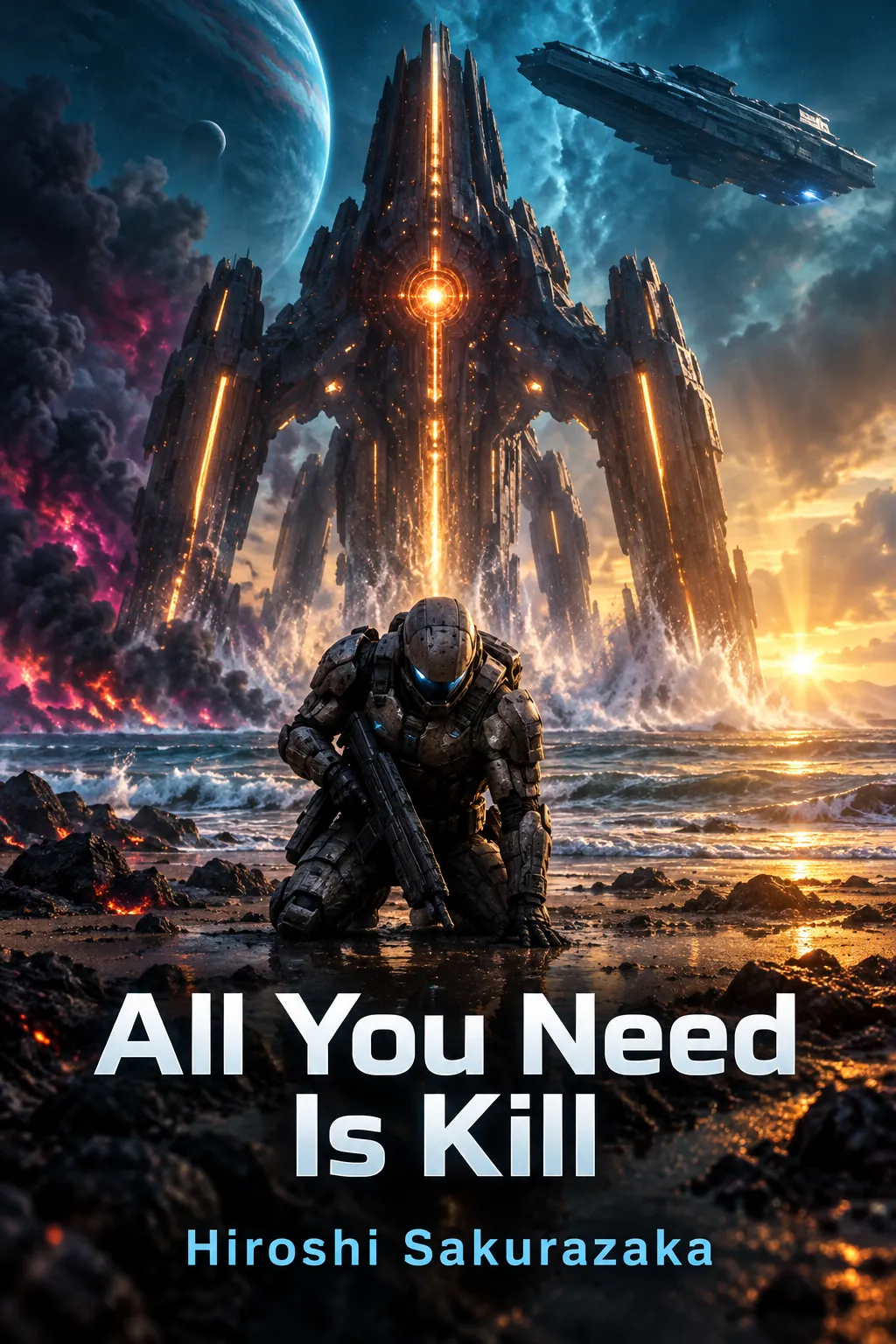
All You Need Is Kill
by Hiroshi Sakurazaka
All You Need Is Kill is a Japanese science-fiction war novel by Hiroshi Sakurazaka. Keiji Kiriya, a green recruit, is killed in his first battle against alien invaders called Mimics, then wakes up the morning before, ready to die all over again. Each loop lets him practise, and eventually he meets Rita Vrataski, the famous soldier who may understand what is happening to him. It is short, fast and more about learning than about winning.
The Big Idea
"A rookie soldier who dies in battle wakes up the day before, again and again. The novel asks what practice, loss and a shared secret can turn a frightened recruit into a fighter."
Key Insights
Failure is how skill is built
The loop is a science-fiction device, but it also describes ordinary learning. Keiji gets better because he is allowed to fail, remember what went wrong and try again. The novel makes that process exciting by turning each mistake into a death, but the idea is the same one any athlete or musician knows: improvement comes from repeating the hard thing with attention. The book also admits the cost, because Keiji feels every failure.
In Part 3, Keiji memorises where the enemy appears and how his suit moves, and survives a little longer after each loop.
Fear changes, it does not disappear
Keiji begins as someone who panics, and he ends as someone who acts under pressure. The novel does not say he stops being afraid. It shows that repetition turns terror into familiarity and then into focus. That is a realistic picture of courage: not the lack of fear but the ability to keep working through it. It is also why the story works for readers who do not usually read war fiction.
The first death in Part 1 is chaotic and hopeless; by Part 6 Keiji approaches the same battlefield with a plan.
A shared secret creates a bond
Much of the book's emotional weight comes from Keiji meeting someone who understands his impossible situation. Rita is not just a skilled fighter, she is the one person who can confirm that he is not mad. The novel suggests that being understood can be as important as being strong. Their closeness grows from respect and honesty, and it makes the price of the ending hurt.
In Parts 5 and 6, Keiji stops being alone with the loop and starts training with Rita.
Chapter Breakdown
Chapter-by-chapter summary
The novel is short and has no long chapter titles to memorise, so this guide follows the story in eight natural parts.
Spoiler warning: this section covers the whole plot, including the ending.
Part 1: The first battle
Keiji Kiriya is a new recruit in a near-future army fighting alien invaders called Mimics. He has trained, but he has never seen a real fight. On his first deployment, to an island battlefield, the plan collapses almost at once. Keiji is overwhelmed and killed. The scene is short and ugly on purpose. It matters because it shows that Keiji starts as an ordinary, frightened soldier and not a hero. The distance between who he is now and who he will become drives the rest of the book.
Part 2: The same morning again
Keiji wakes up the day before the battle, in his bunk, with the same orders, the same faces and the same sounds. At first he thinks it is a nightmare. When events repeat down to small details, he understands that something has changed for him alone. This part matters because the book never wastes time explaining the trick at length. It simply drops the reader into Keiji's confusion and lets the fear grow.
Part 3: Dying as practice
Once Keiji accepts the loop, he starts to use it. He learns where the enemy appears, when the line breaks and how his powered combat suit behaves, and he lives a little longer each time. Death stops being an ending and becomes a teacher. This is the heart of the novel's idea: skill is built by repeating the hard thing, and every failure is information. The cost is that Keiji must keep feeling each death, so the learning is never gentle.
Part 4: Rita Vrataski
On the battlefield Keiji keeps noticing one soldier who fights far better than anyone else: Rita Vrataski, the celebrated fighter with the grim nickname "Full Metal Bitch". She moves through the enemy as if she already knows what each Mimic will do. Keiji, who has watched the same battle many times, sees something rare in her. This part matters because it gives him a goal beyond staying alive: he wants to understand how she fights, and why.
Part 5: What Rita knows
Keiji's growing skill draws Rita's attention, and she turns out to understand his situation better than anyone else could. She is not surprised by the idea of repeated days. For the first time Keiji is no longer alone with his secret. The part matters because the story changes shape here, from a lonely survival puzzle into a relationship between two people who share an impossible experience and can talk about it.
Part 6: Training together
With a partner who understands, Keiji's progress speeds up. Rita is a demanding teacher, and the two start to treat the loop as something they can plan around instead of simply endure. Their bond grows from respect for each other's skill. It matters because the book shows that learning is faster and braver when someone believes you, and that a hard shared secret can bring two very different soldiers close.
Part 7: Why the days repeat
As the days pile up, Keiji and Rita turn from surviving to asking why the loop exists. The answer is tied to the Mimics themselves, so the loop is not a gift or an accident but a feature of the war. That raises the stakes, because beating the enemy and escaping the loop become the same problem. This part matters because it turns a personal trap into a question about how humans can fight something that adapts to them.
Part 8: The last stand and the price
In the final stretch Keiji faces a battle that he can no longer solve by repetition alone, and winning demands a sacrifice rather than just better technique. The loop ends, but not cleanly, and the book closes on a quiet, bittersweet note instead of a victory parade. It matters because the novel refuses to say that skill alone fixes everything. What Keiji gains, he pays for.
Key people and terms
Keiji Kiriya
The narrator and main character, a new recruit with little confidence. He begins the book scared and untrained. Through endless repetition he becomes a capable fighter, though the change costs him. Readers follow the war through his eyes and his growing, hard-won calm.
Rita Vrataski
A famous elite soldier, known on the front line as the "Full Metal Bitch" and for fighting with a battle-axe. She is the best fighter Keiji has ever seen, and she turns out to understand his strange situation. She is both his teacher and the person he comes to care about most.
The Mimics
The alien invaders at the centre of the war. Humans keep adapting to them, and the Mimics seem to adapt back. The novel hints that they are connected to the time loop, which makes them more than monsters in the field. They are the reason the days repeat.
The Jacket
The powered combat suit that soldiers wear in battle. It makes ordinary people strong enough to face the Mimics, but it takes skill to use well. Keiji's slow mastery of his Jacket is one of the clearest ways the book shows learning through repetition.
Kotoiushi Island
The island battlefield in southern Japan where the story takes place. Its small, fixed geography matters because the same fight is replayed there again and again, so Keiji can learn every part of it.
The army
The military force that sends Keiji into battle. It is a large, orderly institution, and most soldiers in it do their jobs without knowing the loop exists. The contrast between the army's routine and Keiji's private horror gives the book much of its tension.
Writing about this book
If you need to write a report or essay on this novel, start from one question instead of a plot summary. Good questions include: What does Keiji learn from dying that he could never learn by staying safe? Why does the author make the hero a nervous recruit instead of a veteran? What does the book suggest about how people improve at anything?
Then pick two or three scenes to support your answer: the first death, the moment Keiji first uses the loop on purpose, and the meeting with Rita. Say what each scene shows about courage and about practice.
You can also compare the book with the film Edge of Tomorrow. They share a premise but differ in tone and ending, and noticing why is a strong essay topic. If you do, label clearly which one you mean at each point. Use your own words, keep any quote short, and give the part of the story it comes from.
Take Action
Practical steps you can implement today:
-
Treat mistakes as information: after each failure, write down one thing you will do differently next time.
-
Practise the specific thing you find hardest, not the thing you already do well.
-
Find a person who understands your goal; learning with one honest partner is faster than learning alone.
-
Accept that real progress has a cost, and decide in advance what you are willing to give up.
Who Should Read This
Readers aged about 14 and up who enjoy fast science fiction, time-loop stories or military sci-fi will like this short novel. It suits high-school and early-university readers, and it is a good first step into Japanese light-novel science fiction. Parents should know it contains war violence and some strong language.
Frequently Asked Questions
What is All You Need Is Kill about?
It is a science-fiction war novel about Keiji Kiriya, a new recruit fighting alien invaders called Mimics. After he is killed in his first battle, he wakes up the day before and has to live the same day over and over. He uses each loop to learn how to fight, and he eventually meets Rita Vrataski, a legendary soldier who understands his situation.
Who wrote All You Need Is Kill, and when?
Hiroshi Sakurazaka wrote it. It was first published in Japan in 2004 by Shueisha, with illustrations by Yoshitoshi ABe. The English translation, by Alexander O. Smith, was published by VIZ Media's Haikasoru line in 2009. It was later reissued under the title Edge of Tomorrow.
Is the novel the same as the film Edge of Tomorrow?
No. The 2014 film Edge of Tomorrow is based on the novel and keeps the time-loop idea, but it changes characters, setting, tone and ending. The novel is shorter, set in a Japanese-style military world, and follows a nervous young recruit. If you are studying the book, use the novel for facts, and mention the film only as a comparison.
What are the main themes?
The main themes are learning through repeated failure, courage that grows out of fear, the bond between two people who share a secret, and the cost of victory. The novel also looks at what it means to be a soldier who is sent into a war he does not understand. These themes make it a good topic for essays on perseverance.
Is All You Need Is Kill suitable for school students?
Mostly for older students. It is a short, readable book, but it contains war violence and some strong language. Most readers aged about 14 and up can handle it. For a school report, a focus on the themes of practice, fear and sacrifice is more useful than a focus on the battle scenes.
Check Your Understanding
Pick an answer for each question to see if you were right.
-
What are the alien invaders in the novel called?
Mimics — The invaders are called Mimics, and they are tied to the reason the days repeat.
-
Who is the main character?
Keiji Kiriya — Keiji Kiriya is the new recruit who lives the same day again and again.
-
What happens to Keiji at the end of his first battle?
He is killed and wakes up the day before — His death starts the time loop that drives the whole story.
-
What is Rita Vrataski known for?
Being an elite fighter with a battle-axe — Rita is a celebrated soldier, nicknamed the "Full Metal Bitch", who fights with an axe.
-
In what year was the novel first published in Japan?
2004 — Shueisha first published it in 2004; 2014 is the year of the film and a reissue.
About Hiroshi Sakurazaka
Hiroshi Sakurazaka (born 1970) is a Japanese science-fiction and light-novel writer. All You Need Is Kill, published in Japan in 2004, is his best-known work. It brought Japanese light-novel sci-fi to a wide English-language audience and inspired a manga and the film Edge of Tomorrow.
Summary Written By

Software Engineer & Writer
Software engineer with a passion for distilling complex ideas into actionable insights. Writes about finance, investment, entrepreneurship, and technology.
View all summaries →Reviews
No reviews yet. Be the first to share your thoughts!
Write a Review
Keep reading
Explore the topic: Science FictionSummaries

Out of My Mind
Sharon M. Draper
“Out of My Mind” by Sharon M. Draper is a poignant narrative that explores the life of Melody Brooks, a…

Ender’s Game
Orson Scott Card
“Ender’s Game” by Orson Scott Card is a riveting science fiction novel that transports readers into a future where humanity…

Pachinko
Min Jin Lee
“Pachinko”, a spellbinding multigenerational historical saga by Min Jin Lee, explores the lives of a Korean family trying to make…

The Perks of Being a Wallflower
Stephen Chbosky
The Perks of Being a Wallflower by Stephen Chbosky is a profound coming-of-age novel, told through the intimate letters of…
Articles

A Christmas Carol themes: generosity, isolation and responsibility
Dickens's novella is usually read as a story about a man who changes his mind. Its themes are sharper than…

Nebula Award: What It Is and Notable Winners
The Nebula Award is an American science fiction and fantasy prize voted on by working writers. The Science Fiction and…

Seiun Award
The Seiun Award is Japan's oldest science fiction award, first given in 1970. Fans who attend the annual Japan SF…