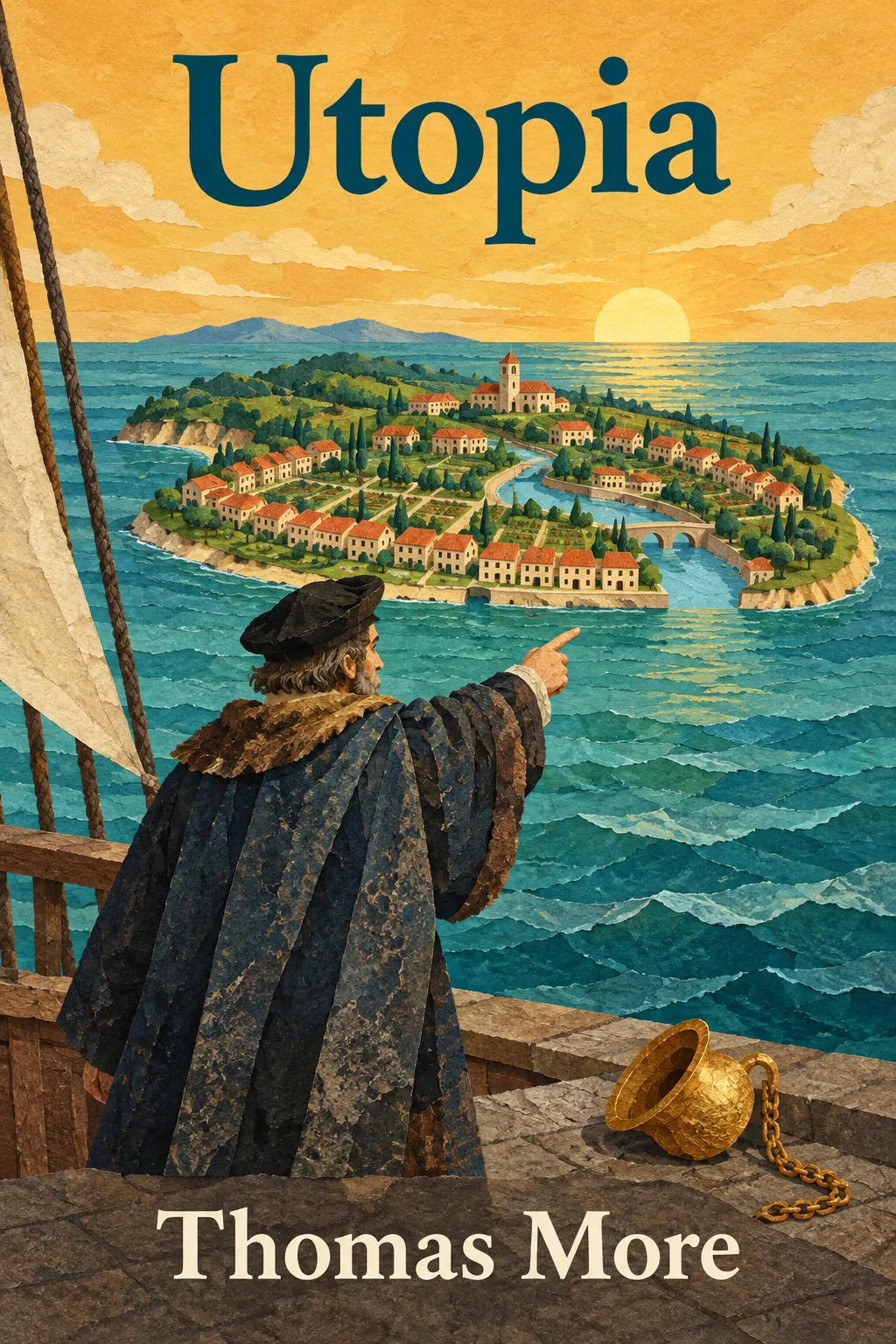
Utopia
by Thomas More
Utopia is a short 1516 book by the English lawyer and statesman Thomas More. A fictional traveller, Raphael Hythloday, describes the island of Utopia, where property is shared, everyone works about six hours a day, and cities are planned to a single pattern. By setting this calm island beside the greed, harsh punishments and power games of Europe, More invites readers to judge their own society. Whether he wants Utopia copied, laughed at or simply thought about is still argued today.
The Big Idea
"More imagines an island with no private property and short working days, then leaves readers to ask whether it is a model to copy or a mirror held up to the corrupt Europe of his own time."
Key Insights
Poverty makes criminals
More argues that harsh punishment cannot cure crime when need is the cause. Discharged soldiers, farmers pushed off their land and workers with no trade have little choice but to steal, and then the law hangs them. A better government would remove the pressure instead of building more gallows. This view of crime as socially caused was unusual in 1516 and still echoes in debates about justice and welfare.
In Book 1, Hythloday tells the dinner guests that hanging a man for petty theft makes no sense, since the thief may as well kill to avoid being caught. Utopia in Book 2 solves the problem by giving everyone work and enough to live on.
Shared property, shared peace
The book claims that private property breeds greed, envy and war, because people measure themselves by what they own. In Utopia nobody owns land or goods, so there is little to fight over and no reason to hoard. More lets readers judge whether this would work or whether, as the character More objects, people would simply stop working.
Utopians take what they need from public storehouses and pay nothing. Doors are not locked, and homes are even exchanged by lot every ten years, so no family grows attached to a house.
Work, leisure and the mind
Utopia's six-hour day rests on a simple point: if everyone works, nobody has to work too long. In Book 1 More blames idle nobles and their servants for much of the waste; in Book 2 leisure is for learning, not for show. The idea feels modern, but More ties it to useful work and a disciplined life, not simply to rest.
Citizens may rise early for public lectures, and many spend free hours studying, though nobody is forced to. Music, gardens and games fill the evenings.
Satire or blueprint?
Readers have argued for 500 years about how seriously More means it. The name means “no place”, the traveller's name hints at nonsense, and the final lines have the narrator doubting the practical side. Yet the criticism of Europe is sharp and sincere. The best reading may be that Utopia is a thought experiment: not a plan, but a way of seeing what is wrong at home.
The narrator ends by saying he wishes for many Utopian customs rather than expects them in Europe, which can be read as both a hope and a shrug.
Chapter Breakdown
Chapter-by-chapter summary
Spoiler warning: this section covers the whole book, including how it ends.
Opening letter and setting: Antwerp, 1515
More opens with a letter to his friend Peter Giles and then steps into the story as a character. On a diplomatic trip to Flanders, he meets Giles in Antwerp, and Giles introduces a weathered traveller named Raphael Hythloday, who sailed with Amerigo Vespucci and kept going on his own. The three sit in a garden to talk. Mixing real people with an invented one is More's first trick: the book feels like a true report, which makes the strange island seem plausible while quietly hinting that the whole thing may be a joke. It matters because every later claim comes through Hythloday, not More himself.
Book 1: Should a wise man serve a king?
Giles praises Hythloday's wisdom and asks why he does not serve a king. Hythloday answers that kings care more about winning new lands than ruling well, and that advisers who tell the truth are ignored while flatterers rise. More replies that a philosopher should still work within the system and do what good he can, like an actor who plays the part the play needs. Hythloday refuses: honest advice would be laughed out of court. This opening debate sets the book's central worry. Is it better to stay pure and useless, or to compromise and be useful? More never settles it.
Book 1: Hanged thieves and hungry sheep
Hythloday recalls a dinner in England at the table of Cardinal Morton, where a lawyer praised hanging thieves. Hythloday objected that execution is too harsh for theft and does nothing to stop it, because poor people steal to eat. He blames the causes: soldiers discharged after wars with no trade, and landlords who enclose farmland for sheep, so that, as he puts it, sheep seem to eat people. Punish the crime without fixing the hunger, he says, and you make thieves first and then hang them. It matters because Book 2 is built as the answer to these specific English problems.
End of Book 1: Doubts about private property
Pressed to say what would really work, Hythloday points to the Utopians and says that while money and private property exist, justice and happiness are out of reach. A few rich people take the most, and everyone else is left with worry and hard work. More objects that if nobody owns anything, nobody will bother to work. Hythloday answers that More simply has not seen such a place. The two agree to continue after dinner, and Book 1 ends there. The argument is the hinge of the book: everything Hythloday describes next is meant to test this one claim about property.
Book 2: The island and its cities
After dinner, Hythloday describes the island. It is shaped like a crescent, and a king named Utopus conquered it and cut a channel through the neck of land to make it a true island. There are 54 city-states, all with the same language, laws and layout, and none is more than a day's walk from the next. Streets are wide, houses are alike, and doors are never locked. The capital, Amaurot, sits on a river. The sameness has a purpose: with little to show off, there is little to envy. The idea of designing a whole country to one pattern appears here.
Book 2: Work and daily life
Everyone in Utopia works, men and women alike. Farming is a shared skill, and each person also learns one trade. The working day is six hours, three before lunch and three after, with the rest left for sleep, meals, music and study. Lectures before dawn are open to all, though nobody is forced to attend. Households eat in large halls, and goods are collected from public storehouses without payment, since there is enough for everyone. Elected officials called syphogrants and tranibors manage the work. Because nobody sits idle, six hours are enough to supply the whole island.
Book 2: Gold, travel, crime and slavery
Gold and silver have no special value in Utopia. Chamber pots and the chains for slaves are made from them, and children play with pearls until they outgrow them. When foreign ambassadors arrive covered in gold chains, the Utopians take them for slaves or fools. Travel between cities needs a permit, and wandering without one is punished. Slavery exists as a punishment for serious crimes and for foreigners condemned abroad. Hythloday presents all this as sensible, yet modern readers often find the slavery and the controls on movement hard to square with the happy picture, which is part of why the book stays disputed.
Book 2: War, religion and the ending
The Utopians dislike war and call it fit for beasts, but they fight to defend themselves and their allies, often hiring foreign soldiers and using trickery to avoid bloodshed. Religion is varied and tolerated: people may worship as they like, but not insult others, and those who deny life after death or divine providence are barred from public office. Hythloday finishes his tale. More privately thinks that many Utopian customs are absurd, yet admits he wishes some of them could exist in Europe. It matters because the last lines leave the reader to decide what to make of it all.
Characters
Thomas More (the narrator)
The author and also a character. In the story he is a sensible lawyer on a diplomatic trip, doubtful about Hythloday's radical ideas. In real life he became Lord Chancellor of England in 1529 and was executed in 1535 for refusing to accept Henry VIII as head of the Church.
Raphael Hythloday
An invented Portuguese sailor and scholar who spent five years in Utopia. His first name recalls an angel who guides travellers, and his surname, from Greek, hints at a peddler of nonsense. He argues against private property and refuses to serve kings.
Peter Giles
A real friend of More from Antwerp, a scholar and town clerk who also knew Erasmus. In the book he introduces Hythloday and vouches for him, which adds a touch of realism to the frame story.
Cardinal John Morton
A real Archbishop of Canterbury and Lord Chancellor, in whose household More served as a boy. In Book 1 his dinner table is the setting for the debate on hanging thieves, and he is shown as more open to ideas than the courts Hythloday avoids.
Utopus
The legendary conqueror who gave the island its name, its shape and the base of its laws. He is said to have civilised a rough people and made religious tolerance a rule. The Utopians treat him as their founder, much like a founding hero in many real countries.
Syphogrants and tranibors
Elected officials of Utopia. A syphogrant represents a group of thirty households, and a tranibor oversees ten syphogrants. They organise work and run the towns, forming the network that keeps the island's shared life running.
Writing about this book
Utopia suits essays on ideal societies, the limits of reform and satire. Start with one question rather than a summary: is More describing a goal, or poking fun at the idea of perfection? These angles can help:
- The pun in the name: Utopia can mean “no place” and also “good place”. What does More gain from the double meaning?
- Book 1 and Book 2: how does the criticism of England shape the description of the island?
- Hythloday and More: which of the two does the book want you to side with?
- The cost of perfection: look at slavery, travel permits and the lack of privacy. Are they flaws in the design, or flaws in the ideal itself?
- Today: which Utopian ideas, such as shorter working hours and shared resources, sound modern, and which sound uncomfortable?
Use short examples from the text, such as the six-hour day or the golden chamber pots, and say what each one shows. A strong essay takes a clear position and admits what the opposite view gets right.
Take Action
Practical steps you can implement today:
-
Before calling for harsher punishment, ask what pushed people toward the crime. Improving conditions may work better than raising penalties.
-
Read Utopia as a thought experiment, not a travel plan. Comparing it with your own society shows what you take for granted.
-
Notice who does the work and who benefits. The six-hour day depends on everyone sharing labour, not just a few.
-
Read the flaws too. Slavery, travel permits and little privacy show the price an ideal society may carry.
-
Remember the double meaning of the title, “no place” and “good place”, to hold onto the book's central tension.
Notable Quotes
"“…as long as there is any property, and while money is the standard of all other things…” (Book 1)"
— Thomas More
"“…your sheep, which are naturally mild, and easily kept in order, may be said now to devour men and unpeople…” (Book 1)"
— Thomas More
"“They detest war as a very brutal thing.” (Book 2)"
— Thomas More
"“There are many things in the commonwealth of Utopia that I rather wish, than hope, to see followed in our governments.” (Book 2)"
— Thomas More
Who Should Read This
Students of history, politics, philosophy or English literature will find Utopia useful, especially at upper-secondary and university level. It also suits adults curious about where ideas like shorter working hours or shared property first appeared. It is short enough to read in a weekend, though Book 1's sixteenth-century arguments can feel dense to beginners.
Frequently Asked Questions
What is Utopia by Thomas More about?
Utopia is a 1516 book in two parts. Book 1 is a conversation that criticises poverty, harsh punishment and royal ambition in Europe. Book 2 is Raphael Hythloday's account of an island without private property, where everyone works about six hours a day. More leaves open whether the island is a model, a joke or a thought experiment.
What does the word utopia mean?
More made the word from Greek. Ou-topos means “no place” and eu-topos means “good place”, and the title plays on both. The word later came to mean any imagined perfect society, and its opposite, dystopia, was coined in the nineteenth century.
When and where was Utopia first published?
It appeared in Latin in late 1516 in Leuven, in what is now Belgium, with help from More's friends, including Erasmus and Peter Giles. The first English translation, by Ralph Robinson, came out in 1551, after More's death. Modern English editions usually use newer translations from the Latin.
Is Utopia serious or a joke?
Both readings have support. The title, Hythloday's name and More's closing doubts suggest humour and distance. The attacks on poverty, enclosures and harsh law, though, read as sincere. Most scholars treat the book as a thought experiment: More explores ideas through a character without necessarily endorsing everything that character says.
Who is Raphael Hythloday?
Raphael Hythloday is an invented Portuguese sailor who, in the story, travelled with Amerigo Vespucci and then spent five years on Utopia. Most of the book is his account. Because he is a character, his views cannot be assumed to be More's own, and More shows himself disagreeing with him.
Why is Utopia still read today?
It raises questions that remain live: how long people should work, whether property causes inequality, how far a state should punish, and how free a perfect society can be. The word itself, now used for dreams and warnings alike, still comes from this book.
Check Your Understanding
Pick an answer for each question to see if you were right.
-
Who describes the island of Utopia in the story?
Raphael Hythloday — Hythloday is the traveller who spent five years on the island, and Book 2 is mostly his account.
-
How long is the working day in Utopia?
Six hours — Utopians work six hours a day, three before lunch and three after.
-
What does Hythloday blame for theft in England?
Discharged soldiers and landlords who enclose land for sheep — He argues that poverty created by these two causes pushes people to steal.
-
What does the title Utopia pun on?
“No place” and “good place” — The Greek roots can mean both no place and good place.
-
What do Utopians make from gold?
Chamber pots and slaves' chains — Making humble objects from gold teaches them to see it as worthless.
About Thomas More
Thomas More (1478–1535) was an English lawyer, scholar and statesman who served Henry VIII and became Lord Chancellor in 1529. A friend of the humanist Erasmus, he wrote Utopia in 1515–1516, partly during a diplomatic mission to Flanders. He resigned in 1532, refused to accept the king as head of the Church, and was executed in 1535. The Catholic Church later canonised him.
Summary Written By

Software Engineer & Writer
Software engineer with a passion for distilling complex ideas into actionable insights. Writes about finance, investment, entrepreneurship, and technology.
View all summaries →Reviews
No reviews yet. Be the first to share your thoughts!
Write a Review
Keep reading
Explore the topic: Personal DevelopmentSummaries

Educated by Tara Westover
Tara Westover
A memoir about a young woman born to survivalists in Idaho who, despite having no formal schooling, teaches herself to…

Atomic Habits: An Easy & Proven Way to Build Good Habits & Break Bad Ones
James Clear
No matter your goals, Atomic Habits offers a proven framework for improving–every day. James Clear, one of the world’s leading…
Think and Grow Rich
Napoleon Hill
What if the secrets to wealth and success weren’t hidden in complex financial strategies, but within the power of your…
Melbourne
Alex Ng
Sophie Cunningham's Melbourne is a deeply personal exploration of Australia's cultural capital, weaving together history, architecture, weather patterns, and personal…
Articles

The Enlightenment Explained: Ideas, Thinkers and Legacy
The Enlightenment was an 18th-century European movement that trusted reason and evidence over tradition and authority. Its thinkers, from Locke…

World History 1700–1918: Revolutions, Industry, Empire and War
Between 1700 and 1918, revolutions, factories, empires and a world war reshaped societies across Europe, the Americas, Asia and Africa.…
Best Stoicism Books for Beginners: Where to Start and Why
Looking for the best stoicism books for beginners? Discover a clear reading route comparing ancient classics like Marcus Aurelius with…