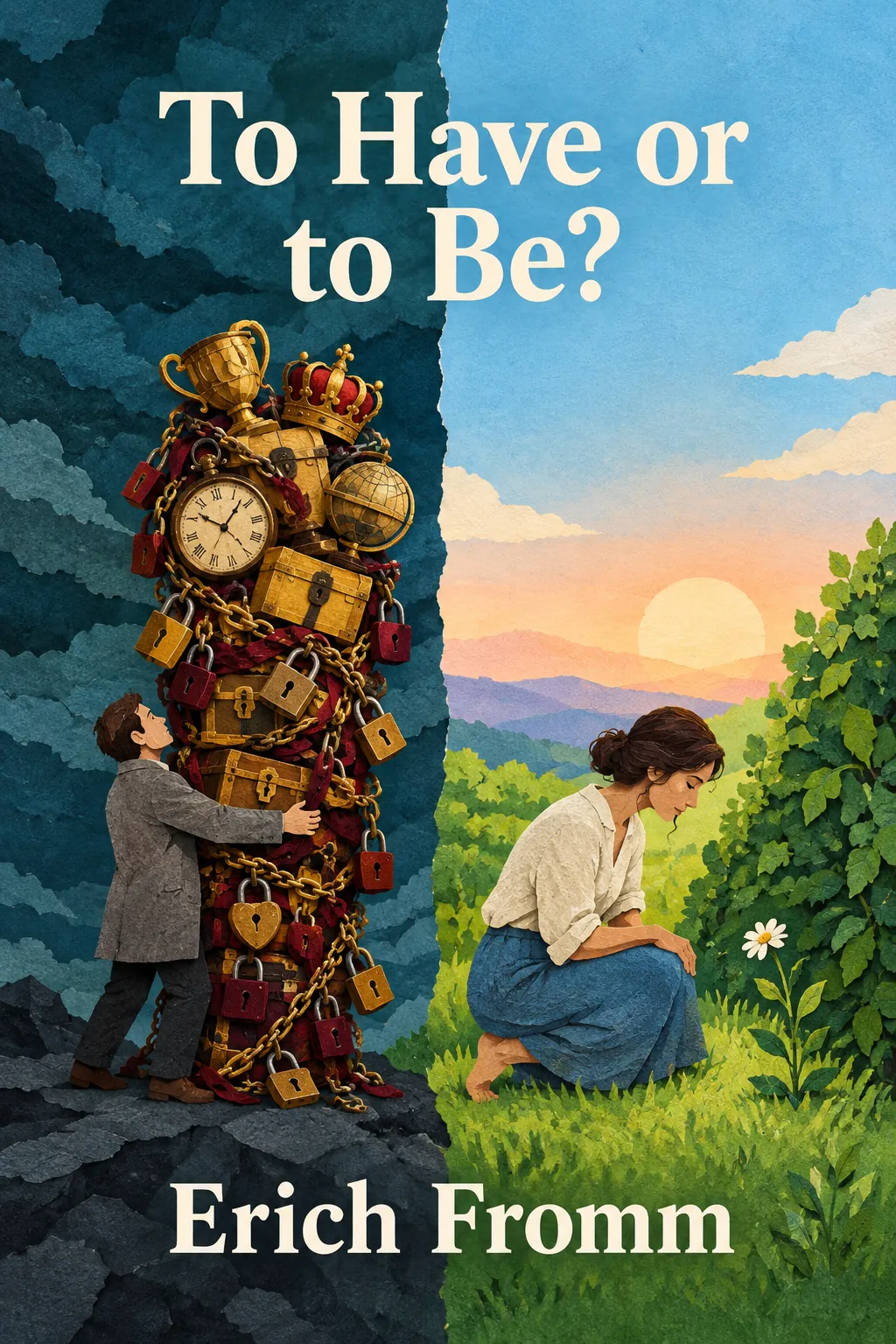
To Have or to Be?
by Erich Fromm
To Have or to Be? (1976) is Erich Fromm's argument that there are two basic ways of living. In the having mode we treat things, knowledge, other people and even ourselves as property to own and hold on to. In the being mode we live through experience, growth and shared activity. Fromm shows both in everyday life, from reading to loving, argues that industrial society rewards having, and sketches a more humane society built on being.
The Big Idea
"Fromm argues that people live in one of two modes: having, where identity rests on possessions and status, or being, where it rests on aliveness, activity and sharing. Modern society, he says, pushes us toward having."
Key Insights
An identity built on possessions is fragile
If I am what I have, then losing what I have means losing myself. Fromm says this explains the permanent low-level anxiety of acquisitive societies. People defend what they own, compare themselves with others and cannot rest. In the being mode, identity rests on one’s own powers and experience, which cannot be repossessed.
A person who describes themselves only by job title feels shaken by every layoff or reorganisation. A person who can say “I like teaching others” keeps a steady sense of self even when the job changes.
Activity is not the same as busyness
Fromm’s idea of activity is the inner use of one’s powers: thinking, loving, creating, noticing. Someone driven by outside demands can be extremely busy and still inwardly passive. Feeling alive depends less on how much you do than on how you use yourself while doing it.
A weekend packed with obligations may leave only tiredness, while an hour spent walking and thinking through one question may leave a clear sense of having lived.
Society trains the character it needs
Every society, Fromm argues, shapes people to want what its economy requires. Industrial societies need buyers and efficient workers, so owning, consuming and achieving come to feel natural and good. Greed is then not only a private weakness but something schools, advertising and workplaces help to grow.
When a new phone appears, the one in your pocket suddenly feels old. That feeling is less a natural need than a dissatisfaction the market has trained into people.
Personal change and social change go together
Fromm thinks that changing only attitudes is not enough, and neither is changing only institutions. People change when they feel their own unhappiness, see another path and choose it. At the same time they need shared structures, such as participation at work and small discussion groups, that make living in the being mode easier.
A workplace where staff can influence decisions makes a being-centred life easier, and people who choose that life will then ask for more such workplaces.
Chapter Breakdown
Chapter-by-chapter summary
The book has an introduction and three parts. The labels below describe each stretch of the argument.
Introduction: The Great Promise and its failure
Fromm opens with what he calls the Great Promise of Unlimited Production, Absolute Freedom and Unlimited Happiness: the belief that ever more production would bring ever more freedom and joy. He says the promise has failed. Wealthier societies still produce anxious, lonely people, and endless growth now threatens the natural environment and invites nuclear disaster. His answer is to look beneath economics and politics at how people actually live. This matters because it sets up the central question, and it turns a gloomy diagnosis into something each reader can test on themselves: is my life organised around having or around being?
Part 1: Understanding the difference between having and being
Fromm explains the two modes through small examples. In everyday speech we say “I have a problem” where “I am troubled” is closer to the truth. He contrasts Tennyson, who plucks a flower to examine it, with Bashō, who simply looks at the plant by the hedge. He then applies the test to learning, remembering, conversing, reading and loving: a student who copies lecture notes versus one who listens and answers back, or a debate played to win versus a conversation held to learn. Chapter 3 finds the same split in the Hebrew Bible, the Gospels and Meister Eckhart. This matters because it presents the split as an old human question, not a modern complaint.
Part 2: What the having mode is
Fromm describes an acquisitive society in which the wish to own shapes how people see themselves. In the having mode, “I am what I have”: my identity rests on property, status, knowledge and even relationships, which I treat as things to keep. That makes life anxious, because anything owned can be lost or taken. He separates existential having, the ordinary need for food, clothes and a home, from the character trait of clinging. This matters because it shows the problem is not property itself but making property the centre of who you are.
Part 2: What the being mode is
The being mode centres on using your own powers. Fromm uses “activity” in an older sense: not busyness, but thinking, loving, creating and paying attention. A person who is frantically busy can still be inwardly passive if outside pressure drives every move. In the being mode, identity does not depend on what you own, so there is less to defend, and giving and sharing come more easily. Fromm admits that being cannot be defined as neatly as possession; it shows in how a person lives. This matters because it gives the reader a positive picture, not only a critique.
Part 2: Security, solidarity and joy (Chapter 6)
Chapter 6 pairs the two modes across several feelings. On security, having promises safety by holding on but cannot escape the fear of loss, while being accepts uncertainty and finds confidence in one’s own powers. On solidarity, having turns people into rivals, while being allows shared enjoyment. On joy and pleasure, Fromm treats pleasure as the satisfaction of a wish to consume and joy as something that grows out of activity. On death, the person who is what they own sees it as total loss. This matters because it shows how the choice changes everyday emotions.
Part 3: Religion, character and society (Chapter 7)
Fromm widens the view from the person to society. He argues that every society shapes a typical social character, so that people want to do what its economy needs. An industrial society needs consumers and efficient workers, so it produces people who find security in owning, buying and achieving. He adds that people need a frame of orientation and something to devote themselves to, and that in the modern West an unspoken devotion to technology and progress fills that role. This matters because it shows greed is not only a personal failing but something social arrangements encourage.
Part 3: Conditions for change and the new society (Chapters 8 and 9)
Chapter 8 names the conditions for change: people must feel their own suffering, see that another way exists, and decide to act. Fromm sketches a “new man” who needs no possessions to feel secure, enjoys sharing and has dropped inflated self-importance. Chapter 9 offers features of a new society, such as workplaces where people take part in decisions, small discussion groups and a guaranteed minimum income. Fromm does not promise success. He ends with hope understood as readiness to act, not as waiting. This matters because it links large social proposals with small personal choices.
Key people and terms
- The having mode: a way of living in which identity comes from owning things, status, knowledge and even people. It brings constant worry about loss and tends to turn others into rivals.
- The being mode: a way of living in which identity comes from using your own powers and sharing in the present moment. It needs less defending, so giving feels natural.
- Existential having: the ordinary need to own what survival requires, such as food, clothing and shelter. Fromm does not criticise it and separates it from clinging to possessions as a personality trait.
- Activity: in Fromm’s older sense, the inner use of one’s powers through thinking, loving, creating and attention. It is not the same as being busy.
- Social character: the shared personality traits a society develops so that its members willingly do what the economy requires. Industrial societies, he says, favour consuming and acquiring.
- Meister Eckhart: the medieval Christian mystic whom Fromm uses as a guide to being. Eckhart taught that spiritual freedom means letting go of possessions and fixed ideas.
- Karl Marx: the nineteenth-century thinker whose early writings Fromm reads as a humanist critique of a life centred on owning, not as a defence of state control.
- Erich Fromm: the author, a psychoanalyst and social psychologist who joins personal character and social structure in a single argument.
Writing about this book
If you are writing an essay or preparing a discussion, start from questions rather than verdicts. Fromm’s own examples work well as tests. Pick one activity from your week, such as studying, chatting with a friend or shopping, and ask whether you were treating it as something to hold or as something to take part in. Then ask what the book would say about it, and where you disagree.
Good angles include the following. Is Fromm fair to modern society, and which of his examples still ring true? Can a person live in the being mode while still needing to earn money and own things? Does his split between two modes help you understand your own habits, or is real life more mixed? How realistic are the changes he proposes for work and income?
Whatever you choose, tie each claim to a specific scene or argument from the book, name the part it comes from, and add an example from your own life or from the news. A clear personal example makes a stronger essay than a general statement about “modern materialism”.
Take Action
Practical steps you can implement today:
-
List what supports your sense of self: possessions, titles or other people’s opinions. Then notice how you feel when you imagine losing each one.
-
In class or conversation, aim to listen and answer, not just collect facts to take away. The difference shows in how well you understand.
-
Separate busyness from activity. At the end of the day, ask when you used your own powers instead of reacting to demands.
-
When you want to buy something, pause and ask whether you need it or want to fill a feeling of lack.
Notable Quotes
"“the Great Promise of Unlimited Production, Absolute Freedom, and Unlimited Happiness” (Introduction)"
— Erich Fromm
"“If I am what I have and if what I have is lost, who then am I?” (Part 2)"
— Erich Fromm
"“… neither has anything nor craves to have something, but is joyous, employs one’s faculties productively …” (Part 2)"
— Erich Fromm
Who Should Read This
Suited to readers from about 16 up, including upper-secondary and university students of psychology, philosophy, sociology or economics. It also helps anyone worn down by constant buying, comparing and busyness. The prose is plain, but it asks for patience with abstract ideas, and some background in religion and Marx helps.
Frequently Asked Questions
What is the main idea of To Have or to Be?
Fromm argues that there are two basic ways of living: the having mode, which rests on owning and holding on, and the being mode, which rests on using one’s own powers and sharing. He says modern industrial society strengthens the first, causing anxiety, loneliness and damage to nature, and he calls for a shift toward the second.
What is the difference between the having mode and the being mode?
In the having mode you define yourself by what you own, from objects to status and knowledge, so you worry about losing it. In the being mode you define yourself by what you actually do, feel and give, so identity is less tied to possessions. Fromm shows the contrast in learning, conversation, reading, faith and love.
Is Fromm against owning things?
No. He accepts what he calls existential having: the normal need for food, clothing, a home and tools. His concern is a character that clings to possessions and builds its whole identity on them. The question is not how much you own but how central owning is to your sense of who you are.
How does it relate to Escape from Freedom and The Art of Loving?
All three are by Fromm. Escape from Freedom (1941) asks why people give up freedom, and The Art of Loving (1956) treats love as a skill and an activity. To Have or to Be? (1976) draws these themes together and turns them into a contrast between two ways of living.
Where should a first-time reader begin?
Start with the introduction on the Great Promise, then read Part 1 for the examples such as Tennyson and Bashō and the everyday cases. Part 2 gives the analysis, and Part 3 widens it to society. Readers short of time can read Part 1 and Chapter 6 first and return to the rest later.
Check Your Understanding
Pick an answer for each question to see if you were right.
-
What does Fromm call the Great Promise?
The belief that unlimited production would bring freedom and happiness — Fromm says modern society promised unlimited production, absolute freedom and unlimited happiness, and that the promise has failed.
-
What does Fromm mean by existential having?
The ordinary need to own things such as food, clothes and a home — Existential having is the normal need for what survival requires, and he separates it from the character trait of clinging.
-
Which poet does Fromm present as simply looking at the flower without picking it?
Bashō — Fromm contrasts Tennyson, who plucks the flower, with Bashō, who just looks at it.
-
In the being mode, what does activity mean?
Using one’s own powers, such as thinking, loving and creating — Fromm uses activity for the inner use of one’s powers, not for busyness.
-
Which thinker does Fromm draw on for the idea of letting go of possessions and fixed ideas?
Meister Eckhart — Fromm turns to Meister Eckhart, the medieval mystic, in his discussion of the religious roots of the having and being split.
About Erich Fromm
Erich Fromm (1900–1980) was a German-born psychoanalyst and social psychologist who left Germany after the Nazis came to power and later worked in the United States and Mexico. He wrote Escape from Freedom (1941) and The Art of Loving (1956). To Have or to Be? (1976) draws his ideas about character and society together.
Summary Written By

Software Engineer & Writer
Software engineer with a passion for distilling complex ideas into actionable insights. Writes about finance, investment, entrepreneurship, and technology.
View all summaries →Reviews
No reviews yet. Be the first to share your thoughts!
Write a Review
Keep reading
Explore the topic: Personal DevelopmentSummaries

Educated by Tara Westover
Tara Westover
A memoir about a young woman born to survivalists in Idaho who, despite having no formal schooling, teaches herself to…

Atomic Habits: An Easy & Proven Way to Build Good Habits & Break Bad Ones
James Clear
No matter your goals, Atomic Habits offers a proven framework for improving–every day. James Clear, one of the world’s leading…

The Psychology of Money
Morgan Housel
Morgan Housel’s insightful exploration of how psychology affects our financial decisions and wealth-building journey.
Think and Grow Rich
Napoleon Hill
What if the secrets to wealth and success weren’t hidden in complex financial strategies, but within the power of your…
Articles

Let Them Theory vs task separation: where responsibility starts
Let Them Theory and task separation both ask you to stop managing other people’s choices, but they start from different…

Scout Mindset vs Growth Mindset: Beliefs and Abilities
Scout mindset checks beliefs against evidence; growth mindset concerns developing abilities. A fictional presentation example shows how to use both…

Spaced repetition vs rereading: how to review a book
Compare the timing of spaced review with the task of recalling or rereading. Work through a fictional example, check mistakes,…