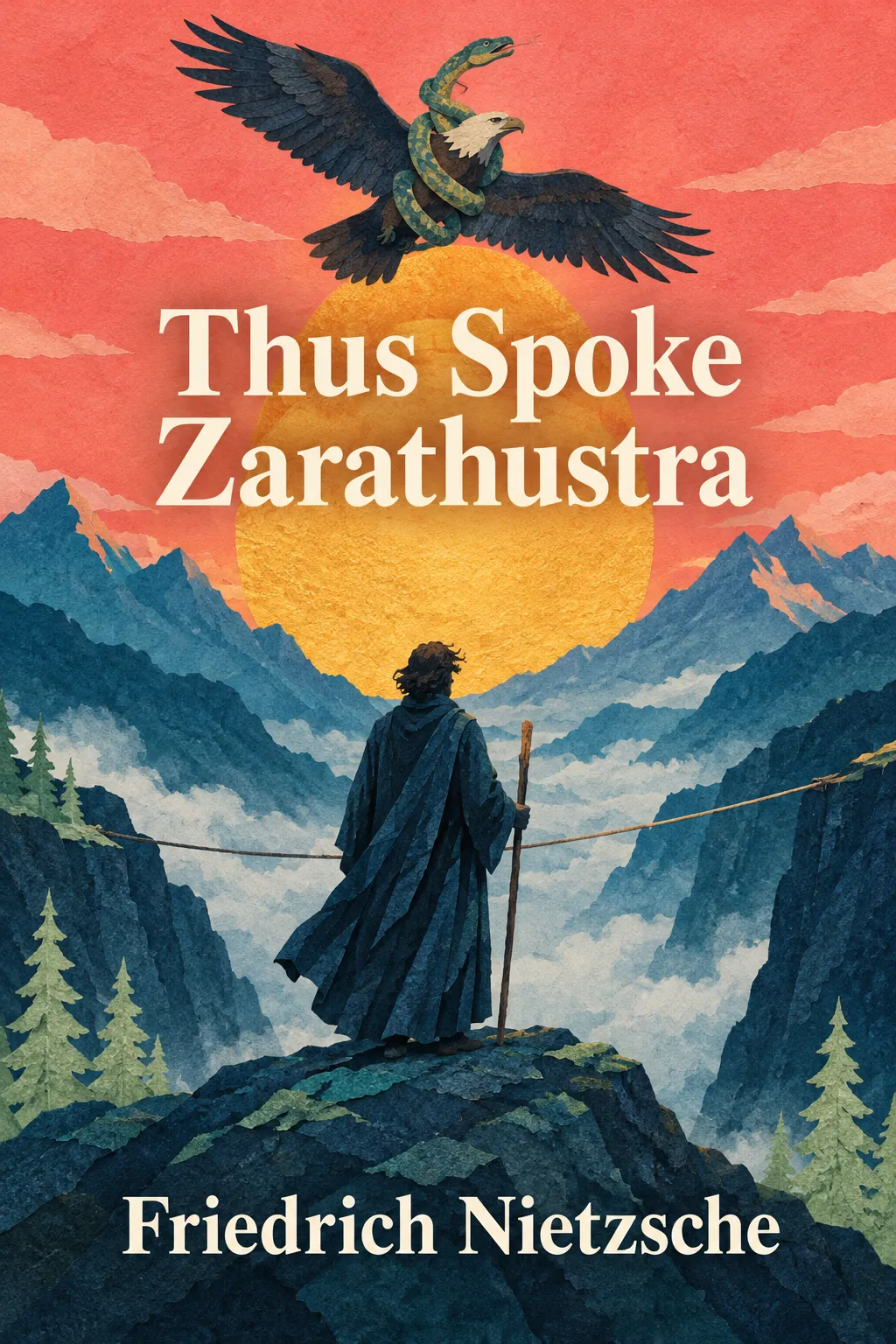
Thus Spoke Zarathustra
by Friedrich Nietzsche
Thus Spoke Zarathustra is Nietzsche's book-length parable about a hermit-prophet who comes down from his mountain to teach that humanity should be overcome, as it once overcame the ape. Across four parts, Zarathustra speaks to crowds, disciples and finally a gathering of “higher men”. He offers three big ideas: the overman as the meaning of the earth, the eternal recurrence as a test of how you live, and self-overcoming as the root of life. Few listen, and he learns to teach through solitude, laughter and song.
The Big Idea
"Humans are a bridge, not a destination. Zarathustra urges people to stop living for another world, give meaning to this one, and become the creators of their own values."
Key Insights
The overman gives meaning to the earth
Zarathustra's first claim is that humanity is not a finished product. People once placed all value in a world beyond death; he asks them to stay faithful to the earth and treat their own lives as the place where meaning is made. The overman is the name for that aim, a goal to work toward rather than a species to wait for.
In the Prologue the crowd laughs at the overman but waits eagerly for the tightrope walker. Zarathustra answers by honoring the walker who risked his life, because the man at least treated effort and danger as something that mattered.
The eternal recurrence is a test of affirmation
The eternal recurrence is the idea that every moment, joy and pain alike, returns again and again in the same form. In the book it works as a test of attitude more than a theory of physics: a person who could welcome the return of their whole life has learned to affirm it. Zarathustra himself needs the whole of Part III to face it.
In “The Convalescent”, the thought of the small man returning makes him sick with disgust, and he collapses for seven days. His animals then sing it back to him, and he starts to accept it.
Life is self-overcoming
In “Of Self-Overcoming”, Zarathustra says life itself reveals its secret: it is that which must always overcome itself. The will to power, in this sense, is the urge to grow and to create, including by destroying what you used to value. A person who stops changing has stopped living in Zarathustra's sense.
The three metamorphoses show the pattern. The spirit first bears the burden like a camel, then fights the dragon “Thou shalt” like a lion, and only then becomes a child who plays and creates.
The giver's solitude
Zarathustra's wisdom comes from solitude, but he does not keep it. He compares himself to a cup that overflows and to a bee with too much honey. The book asks whether a teacher can give without wanting followers, and answers that the best gift is to make people independent.
At the end of Part I he tells his disciples to leave him and find themselves, promising to come back only when they have denied him. In Part IV he leaves the higher men behind at his cave when his real work calls.
Chapter Breakdown
Chapter-by-chapter summary
Spoiler warning: this section covers the whole plot, including the ending.
Prologue: The Prophet Comes Down the Mountain
At thirty, Zarathustra leaves his home and lake for the mountains, where he spends ten years alone. One morning he tells the sun he is like a cup that overflows, and he decides to go down and share his wisdom. In the forest he meets a hermit who has not heard that God is dead. In a town marketplace Zarathustra announces the overman and warns of the last man, a comfortable creature who wants nothing great. The crowd laughs and waits for a tightrope walker instead. When the walker falls to his death, Zarathustra carries the body away to bury it, and resolves to look for companions rather than crowds. This opening sets up the book's main images and its main problem: a teacher who speaks before anyone is ready to listen.
Part I: Speeches in the Town of the Motley Cow
In a town called the Motley Cow, Zarathustra gathers disciples and gives a run of short speeches. He opens with the three metamorphoses: the spirit becomes a camel that carries burdens, then a lion that says “I will”, then a child, who starts something new. Later speeches defend the body against those who despise it, call the state “the new idol”, warn against the noisy flies of the marketplace, and ask what a real friend is. The part closes with the “bestowing virtue”, the generosity of giving, and Zarathustra tells his followers to leave him and find themselves. Only when they have denied him, he says, will he return. The point is the book's first ethic: values are made, not inherited.
Part II: The Blessed Isles and Self-Overcoming
Zarathustra goes back to his mountain, but a dream of a child holding a mirror, which shows a devil's grin, warns him that his teaching is being distorted. He returns to the Blessed Isles to find his friends. In “Of the Tarantulas” he attacks preachers of equality who are driven by revenge. In “Of Self-Overcoming” life itself says it must always overcome itself, and the will to power appears as the drive to create and exceed. “The Night Song” shows his loneliness at being a giver who never receives. “Of Redemption” looks at the pain of “it was”, the past the will cannot change. In “The Stillest Hour” a silent voice orders him to speak and leaves him afraid. The part shows the teacher growing more aware of his own task.
Part III: The Vision, the Riddle and the Recurrence
Zarathustra sails away from the Blessed Isles and tells the sailors a riddle. In “Of the Vision and the Riddle”, he climbs a mountain with the spirit of gravity, a dwarf, on his shoulders. At a gateway called Moment, they discuss time that runs in a circle. Then he sees a shepherd choking on a black snake. The shepherd bites its head off and rises up, laughing. In “The Convalescent”, Zarathustra collapses for seven days, and his animals, the eagle and the serpent, name him the teacher of the eternal recurrence. He faces the thought that even the small man returns. The part ends with “The Seven Seals”, a song of love for eternity. This is where the book's hardest idea becomes personal.
Part IV: The Higher Men
Part IV was first printed privately and reads more like a strange comic story. A soothsayer tempts the old Zarathustra with his last sin, pity for the higher man. Back at his cave he finds a procession of “higher men”: two kings, a magician, the last pope, the ugliest man, a voluntary beggar and others. The ugliest man says he killed God because God pitied humans too much. Zarathustra feeds them but says they are not yet the people he is waiting for. After they worship a donkey in a mock festival, the “Drunken Song” rings out at midnight with joy that wants eternity. At dawn a lion and a flock of doves appear, and Zarathustra leaves his cave to begin his work.
Key people and terms
Zarathustra
The hero, a hermit-prophet named after the ancient Persian prophet Zoroaster. He teaches the overman and the eternal recurrence, yet he doubts, grows lonely, and often fails to be understood. Nietzsche uses him as a character, not as a plain spokesman for every view.
The eagle and the serpent
Zarathustra's animals and companions on the mountain. The eagle stands for pride and the serpent for wisdom. They talk with him in moments of crisis, and in “The Convalescent” they put his eternal recurrence teaching into words for him.
The overman
A goal rather than a species: a person who gives meaning to the earth by creating values instead of waiting for another world. Zarathustra says humanity must be overcome as the ape is overcome by humans. Older English versions say “superman”, which has nothing to do with comic-book heroes.
The last man
The opposite of the overman: a small, content creature who wants comfort, safety and sameness, and who blinks and says “we have invented happiness.” He stands for the danger of a world that has stopped aiming higher.
The tightrope walker
A performer in the marketplace whose rope serves as an image: humanity is a rope between animal and overman. After he falls, Zarathustra honors him for making danger his work and carries the body away for burial.
The eternal recurrence
The thought that everything returns, exactly as before, again and again. Zarathustra calls it his abysmal thought. The book treats it less as cosmology than as a test of whether a person can say yes to life in full.
The will to power
Zarathustra's name for the drive in all living things to grow, to command and to overcome themselves. In “Of Self-Overcoming” it is less plain domination than the urge to create new values and forms, even at the cost of one's old self.
The spirit of gravity
The dwarf who rides Zarathustra's shoulder in “Of the Vision and the Riddle”. He stands for heaviness, doubt and the habit of pulling every idea down into something easy to say. Zarathustra gets rid of him by speaking the thought of recurrence aloud.
The higher men
The guests in Part IV: two kings, a magician, the last pope, a voluntary beggar and others. Each is a modern type who has lost an old faith and is searching for a new one. Zarathustra welcomes them but treats them as stepping stones toward something greater.
The ugliest man
A guest who calls himself the murderer of God, saying he killed God because he could not bear God's pity. He hates being pitied himself. After the night's songs he says he would gladly live life once more.
Famous quotes
Most of the book's best-known lines come from the Prologue.
“God is dead” (Prologue, section 2)
The hermit in the forest has not heard it. The line is a diagnosis: belief in God no longer holds European life together, and a gap opens that Zarathustra wants people to fill with creativity, not comfort.
“Man is something that is to be surpassed” (Prologue, section 3)
Said to the marketplace crowd, this opens the overman idea. Humans are to the overman what the ape is to humans, an embarrassing stage on the way.
“A rope over an abyss” (Prologue, section 4)
Humanity is a crossing, not a destination. The rope is risky from every side: to cross, to look back, to stand still. The value lies in the attempt.
“Chaos … to give birth to a dancing star” (Prologue, section 5)
Said just before the last man appears, it argues that creativity needs disorder. A person with no inner chaos, the book hints, is already settling into the last man's comfort.
Writing about this book
If you must write about Zarathustra for a class, begin with a question rather than a verdict. Three good starting points: What does it mean to “overcome” humanity, and is the overman a person, an ideal or a warning? How does the eternal recurrence change when you read it as a test of how you live instead of a claim about the universe? Why did Nietzsche choose a story, speeches and songs instead of an argument in the normal academic style?
Pick one speech to read closely, such as “Of the Three Metamorphoses” or “Of Self-Overcoming”, and explain its images in your own words. Note where Zarathustra seems to contradict himself, since the book often invites that, and ask whether the contradiction is deliberate. Be careful with famous slogans. “God is dead” is a diagnosis of a culture that no longer believes, not a cheer. Bring in your own experience, for example a value you inherited and later questioned, and say what you made of it. Keep quotations short and cite the part and chapter.
Take Action
Practical steps you can implement today:
-
Ask which of your values you chose and which you inherited, and keep only the ones you can stand behind.
-
Use the eternal-recurrence test on a habit or a decision: would you accept living it again and again?
-
Treat comfort with caution. The last man shows what happens when safety becomes the only goal.
-
Pass on what you learn in a way that frees others to think for themselves, not to repeat you.
-
Read slowly, one speech at a time. Each chapter is a short poem-like unit, and the book rewards rereading.
Notable Quotes
"“God is dead.” (Prologue, section 2)"
— Friedrich Nietzsche
"“I teach you the Superman. Man is something that is to be surpassed.” (Prologue, section 3)"
— Friedrich Nietzsche
"“Remain true to the earth.” (Prologue, section 3)"
— Friedrich Nietzsche
"“Man is a rope stretched between the animal and the Superman—a rope over an abyss.” (Prologue, section 4)"
— Friedrich Nietzsche
"“One must still have chaos in oneself to be able to give birth to a dancing star.” (Prologue, section 5)"
— Friedrich Nietzsche
Who Should Read This
Readers curious about Nietzsche, existentialism or the roots of modern ideas about meaning and values. It suits university students and motivated high-school seniors, ideally with a guide beside them, since the style is poetic, symbolic and often ironic. It is less a systematic argument than a series of speeches, so it works for readers who like images and aphorisms.
Frequently Asked Questions
What is Thus Spoke Zarathustra about?
It follows Zarathustra, a hermit-prophet, as he comes down from his mountain to teach that humanity should be overcome. Over four parts he gives speeches on the overman, the last man, self-overcoming and the eternal recurrence, and finds that few people are ready to understand him.
Who is Zarathustra?
A fictional prophet named after Zoroaster, the ancient Persian religious teacher. Nietzsche gave him a story with moods, doubts and failures, so his words are not simply Nietzsche's own opinions on every topic. Even so, he carries most of the book's central ideas.
What does “God is dead” mean in the book?
It is a statement about culture, not a boast. Belief in the Christian God no longer shapes European life as it once did, and Zarathustra asks what will fill the gap. His answer is that people must create values themselves, or risk drifting into the comfortable emptiness of the last man.
What is the eternal recurrence?
It is the thought that all things return in exactly the same order, forever. Zarathustra calls it his abysmal thought. In the book it works as a test: would you want your life again, with every joy and every pain, an endless number of times?
Is Thus Spoke Zarathustra hard to read?
It is easier to start than many philosophy books because it has a story and short speeches, but the images are dense and often ironic. Reading one chapter at a time, with a guide, helps. Many readers begin with the Prologue and the first part, then continue if they want more.
Check Your Understanding
Pick an answer for each question to see if you were right.
-
How old is Zarathustra when he leaves home for the mountains?
Thirty — He leaves at thirty and spends ten years alone before going down to people.
-
What does the marketplace crowd wait for in the Prologue?
A tightrope walker — The crowd laughs at the overman and waits for the tightrope walker's performance.
-
In which order does the spirit change in the three metamorphoses?
Camel, lion, child — The spirit bears burdens as a camel, claims freedom as a lion, and begins anew as a child.
-
Which animals tell Zarathustra he is the teacher of the eternal recurrence?
An eagle and a serpent — His companions the eagle and the serpent say so in “The Convalescent”.
-
Which guest in Part IV calls himself the murderer of God?
The ugliest man — The ugliest man says he killed God because he could not bear God's pity.
About Friedrich Nietzsche
Friedrich Nietzsche (1844–1900) was a German philosopher who began as a classical philologist. He questioned Christian morality and modern values, and argued that people must create meaning for themselves. Thus Spoke Zarathustra, issued in parts between 1883 and 1885, is his best-known work and presents his ideas through story, speeches and poetry.
Summary Written By

Software Engineer & Writer
Software engineer with a passion for distilling complex ideas into actionable insights. Writes about finance, investment, entrepreneurship, and technology.
View all summaries →Reviews
No reviews yet. Be the first to share your thoughts!
Write a Review
Keep reading
Explore the topic: Personal DevelopmentSummaries

Educated by Tara Westover
Tara Westover
A memoir about a young woman born to survivalists in Idaho who, despite having no formal schooling, teaches herself to…

Atomic Habits: An Easy & Proven Way to Build Good Habits & Break Bad Ones
James Clear
No matter your goals, Atomic Habits offers a proven framework for improving–every day. James Clear, one of the world’s leading…
Think and Grow Rich
Napoleon Hill
What if the secrets to wealth and success weren’t hidden in complex financial strategies, but within the power of your…

Melbourne
Alex Ng
Sophie Cunningham's Melbourne is a deeply personal exploration of Australia's cultural capital, weaving together history, architecture, weather patterns, and personal…
Articles

The Enlightenment Explained: Ideas, Thinkers and Legacy
The Enlightenment was an 18th-century European movement that trusted reason and evidence over tradition and authority. Its thinkers, from Locke…

World History 1700–1918: Revolutions, Industry, Empire and War
Between 1700 and 1918, revolutions, factories, empires and a world war reshaped societies across Europe, the Americas, Asia and Africa.…

Best Stoicism Books for Beginners: Where to Start and Why
Looking for the best stoicism books for beginners? Discover a clear reading route comparing ancient classics like Marcus Aurelius with…