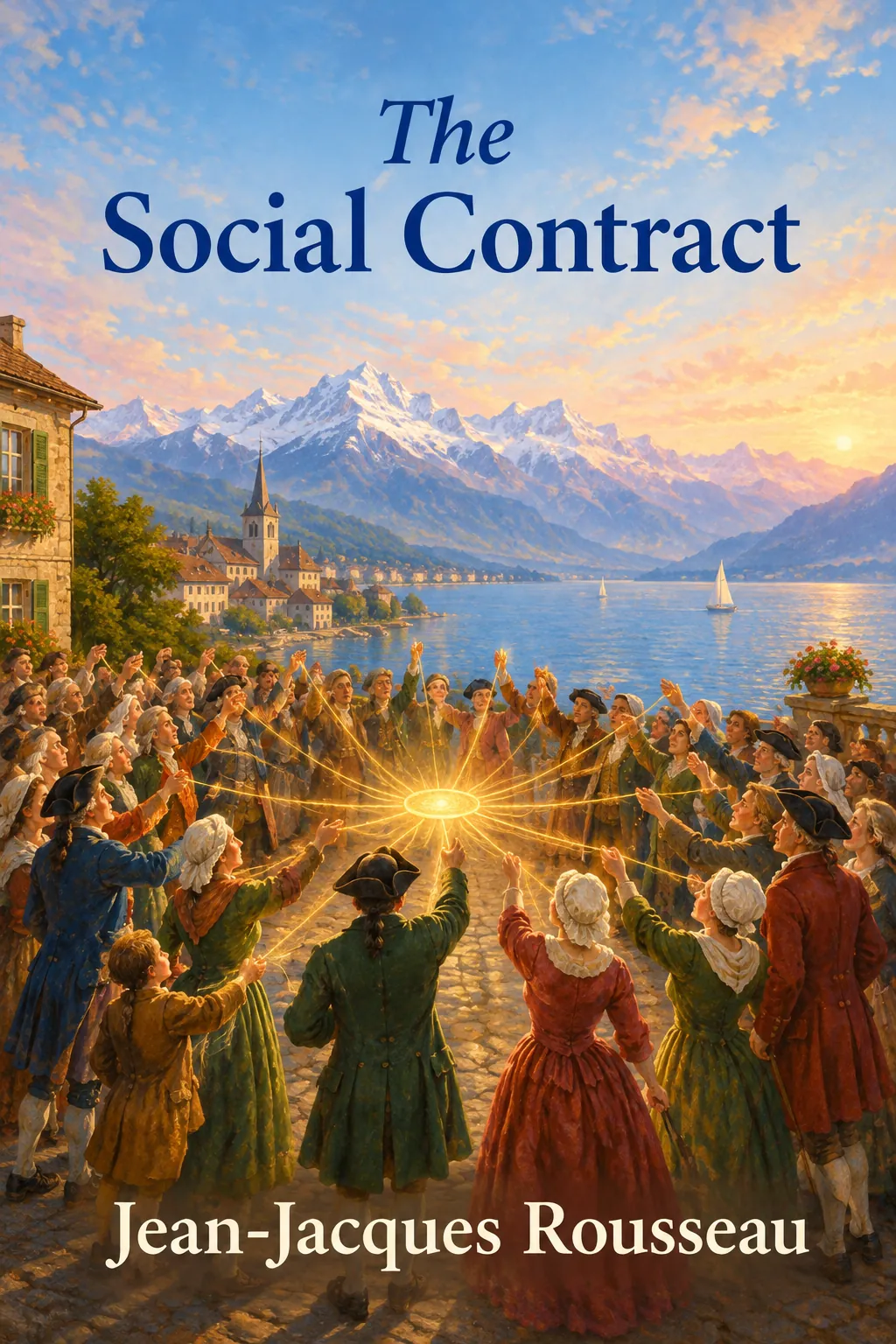
The Social Contract
by Jean-Jacques Rousseau
The Social Contract (1762) is Jean-Jacques Rousseau's short book on how a society can be legitimate. His starting problem: people are born free, yet live under rules. His answer is an agreement in which everyone gives up personal power to the community and receives equal rights in return. Authority then belongs to the people as a whole, guided by the general will. Rousseau also explains what makes laws fair, how governments should serve the people, and why a republic needs active citizens.
The Big Idea
"Rousseau argues that people can stay free in society only if they obey laws they make together, guided by the general will, the shared interest of all, rather than any ruler's private interest."
Key Insights
Freedom means obeying laws you help make
For Rousseau, freedom is not doing whatever you like. Natural freedom depends on strength and is unstable. In the social contract people give it up and gain civil freedom: living under laws they have helped to write. As long as you obey rules made by the community you belong to, you are not obeying any particular person.
A class rota agreed by everyone feels fairer than one imposed by a teacher.
The general will is not a majority vote
Rousseau separates the general will from the “will of all”. The will of all is the total of private wishes. The general will is what remains when competing selfish interests cancel out: the interest everyone shares. A loud majority pursuing its own gain does not express it. Voters approach it only by asking what is good for the whole community.
Choosing a trip that suits everyone, not just your own taste, moves a vote closer to the general will.
Equality protects freedom
Rousseau holds that liberty cannot last without a rough equality. If one citizen can buy another, or must sell himself to survive, they are not equal members of the same community. He does not demand identical wealth; he wants laws that stop economic power from turning into political control over others.
Where only the rich can influence politics, everyone else has less freedom.
Power belongs to the people, not their officials
The right to make laws rests with the people and cannot be given away. Governments only carry out what the people decide. Rousseau warns that handing lawmaking to representatives puts freedom at risk and favours regular assemblies of citizens. Critics doubt this works in large states, but his insistence that politics is everyone's business is still debated.
Voting matters, but so does joining local discussions.
Chapter Breakdown
Chapter-by-chapter summary
The book has four short parts, called books. Book I sets out the basic principle, Book II deals with sovereignty and law, Book III with government, and Book IV with practical institutions.
Part 1: Book I, Why Free People Obey (chapters 1–9)
Rousseau opens with the problem: people are born free but are everywhere in chains. He then rejects the usual excuses for power. Might does not make right, because force only works while it lasts. Slavery cannot be legitimate, since no one can truly give away their own freedom. The solution is the social compact: each person hands all rights to the community, and so no one is above anyone else. The result is a body with a will of its own, the sovereign, and citizens gain civil freedom and property rights in return. This matters because it makes consent, not strength or birth, the only basis of authority.
Part 2: Book II, chapters 1–5, Sovereignty and the General Will
Sovereignty, Rousseau says, is the exercise of the general will, so it cannot be handed over or split up. A people can delegate tasks, but not its right to decide. The general will aims at the common good. It is not the same as the “will of all”, which only adds up private wishes. Rousseau admits that people can be misled: the general will is always right in aim, but a people's debates are not always correct. The sovereign may ask citizens to accept limits only when they bind everyone equally and serve the public. This matters because it sets the test for every law: does it serve all citizens alike?
Part 3: Book II, chapters 6–12, Law, the Legislator and the People
Laws are acts of the general will applied to the whole community, never to one named person. Rousseau says a nation needs a wise founder, the legislator, who shapes its basic laws without ruling it. He also warns that a people must be ready for a given set of laws: size, climate, customs and age all matter. The aims of a good legal system, he says, are freedom and equality, and he wants no citizen rich enough to buy another or poor enough to be forced to sell himself. This matters because Rousseau treats equality as the condition that keeps freedom from turning into privilege for a few.
Part 4: Book III, Government and Its Dangers (chapters 1–18)
Here Rousseau separates the sovereign, which is the people, from the government, the officials who carry out its laws. Governments can be run by one person, a few or many, and each form suits different countries. Government always tends to grow stronger against the sovereign, so it slowly wears the state down. He argues that the people should not give up lawmaking to representatives, and he mocks the English for thinking they are free outside election time. Regular public assemblies are his remedy. This matters because the book explains why Rousseau trusted direct participation more than parliaments.
Part 5: Book IV, chapters 1–5, Voting, Elections and Roman Examples
Rousseau argues that when citizens are honest and simple, the general will is easy to see, and decisions come close to unanimous agreement. Majority voting works only because the first contract itself was unanimous, and the closer a vote comes to unanimity, the safer the decision is. Drawing on the Roman assemblies, he then asks how voting and elections can work in practice, and he describes the tribunate as a guardian of the balance between people and government. This matters because it shows him trying to turn abstract theory into real procedures, the most practical stretch of the book.
Part 6: Book IV, chapters 6–9, Emergency Rule, Censorship and Civil Religion
The final chapters cover special tools. A temporary dictatorship may protect a state in a crisis, as it did in Rome, but only for a short, fixed time. Censorship keeps public opinion in line with shared values. The last major chapter proposes a civil religion: a short list of public beliefs set by the state, such as the sanctity of the social contract and the laws, with tolerance for other faiths that do not clash with civic duty. Citizens who reject these beliefs could be banished. Critics see this as a threat to liberty, and the religious chapter helped draw the condemnation the book met when it appeared. This matters because it shows the tension between shared loyalty and freedom of conscience that runs through the whole book.
Key people and terms
- General will: the shared interest of the whole community, as opposed to what any person or group wants for itself. Rousseau says laws are legitimate only when they express it. It is a standard for judging decisions, not simply the result of a headcount.
- Sovereign: the people as a whole acting as lawmaker. In Rousseau's theory, final authority belongs to the sovereign, not to a king or a parliament, and it can be neither given away nor divided.
- Social contract: the agreement by which individuals join together into a political community. Each gives up personal power to the group and receives equal rights as a citizen. Rousseau treats it as a test for legitimate authority, not as a historical event.
- Will of all: the sum of private wishes. Rousseau separates it from the general will: if everyone votes for personal gain, the total may point in a direction that helps nobody in common.
- Natural and civil freedom: natural freedom is doing whatever one can, limited only by strength. Civil freedom is living under laws one has helped make. Rousseau argues the second is worth more because it is secure and equal.
- Legislator: a wise founder who drafts a nation's laws but holds no power to enforce them. Ordinary people may miss their long-term interest, so a guide helps, but only the people can approve the laws.
- Government: the body of officials who carry out the sovereign's laws. Rousseau sees it as a servant of the people that tends to grow stronger over time and must therefore be watched.
- Civil religion: a short set of public beliefs that Rousseau thinks citizens must accept to be loyal, including respect for the contract and the laws. Critics see it as a limit on freedom of conscience.
- Hobbes, Locke and Montesquieu: Rousseau's main predecessors. Thomas Hobbes (Leviathan, 1651) argued for a strong sovereign, John Locke (Two Treatises, 1689) for rights and limited government, and Montesquieu (The Spirit of the Laws, 1748) for separated powers. Rousseau places sovereignty in the people themselves.
Writing about this book
The Social Contract works well for essays, class discussions and exam answers when you write about one question rather than the whole book. Pick a question, point to a specific book and chapter, and then give your own view with reasons.
- Is a school or club rule closer to the general will, or just to what the majority wants?
- Can obeying a law you helped make really be called freedom? When does it feel that way, and when not?
- Rousseau thinks large gaps in wealth threaten liberty. How would you test that idea today?
- What are the strengths and weaknesses of voting directly compared with electing representatives?
- Should a state ask citizens to share a civic creed, as the civil religion chapter suggests?
Comparing Rousseau with Hobbes or Locke makes an argument stronger. Separate what you accept from what you doubt; that is more convincing than simply agreeing or disagreeing.
Take Action
Practical steps you can implement today:
-
When you meet a rule, ask who made it and whether it serves everyone or only a particular group.
-
Judge a decision by whether it serves the shared good, not only by how many people voted for it.
-
Notice how large gaps in wealth can narrow other people's real choices and weaken their freedom.
-
Take part in decisions that affect you instead of leaving every choice to officials or representatives.
Notable Quotes
"“Man is born free, and everywhere he is in chains.” (Book I, chapter 1)"
— Jean-Jacques Rousseau
"“The strongest is never strong enough to be always the master, unless he transforms strength into right, and obedience into duty.” (Book I, chapter 3)"
— Jean-Jacques Rousseau
"“Whoever refuses to obey the general will shall be compelled to do so by the whole body.” (Book I, chapter 7)"
— Jean-Jacques Rousseau
Who Should Read This
Students of civics, philosophy and European history, especially around the Enlightenment and the French Revolution, aged about 16 and up. Also useful for adults who want to understand where ideas such as popular sovereignty come from. It is short, so it makes a good first classic of political philosophy.
Frequently Asked Questions
What is The Social Contract about?
It is a 1762 book of political philosophy asking when authority over free people can be legitimate. Rousseau's answer is that people agree to form a community in which everyone has equal rights and the whole body, guided by the general will, makes the laws. The book covers sovereignty, law, government, voting and religion in four short books.
What is the general will?
The general will is the shared interest of the whole community. It differs from the will of all, which is only the total of private wishes, and from the opinion of the majority. Rousseau argues that laws are legitimate only when they express it, and that citizens should vote by asking what is good for everyone, not only for themselves.
Who was Rousseau and when did he write the book?
Rousseau (1712–1778) was a thinker born in Geneva who lived mostly in France. The Social Contract appeared in 1762, the same year as his book on education, Émile. Authorities in Paris and Geneva condemned both books, and Rousseau had to leave France for a time.
How is the book linked to the French Revolution?
The 1789 Declaration of the Rights of Man and of the Citizen says law is the expression of the general will, which echoes Rousseau's language. Revolutionaries often cited him, and his remains were moved to the Panthéon in 1794. Historians still debate how direct his influence was.
How does Rousseau differ from Hobbes and Locke?
Hobbes argued that people should obey a strong sovereign to keep order, and Locke defended natural rights and limited government. Rousseau places sovereignty in the people themselves and says it cannot be given away. For him a government is only the people's servant, and citizens should take part in lawmaking directly.
Check Your Understanding
Pick an answer for each question to see if you were right.
-
In which year was The Social Contract published?
1762 — It appeared in 1762, the same year as Rousseau's book Émile.
-
According to Rousseau, who holds sovereignty?
The people as a whole — Sovereignty belongs to the whole people and cannot be given away or divided.
-
What is the difference between the general will and the will of all?
The general will aims at the common good, while the will of all adds up private wishes — The general will looks to shared interest; the will of all is only a sum of individual desires.
-
What does Rousseau think about letting representatives make the laws?
He warns it endangers freedom — In Book III he argues that lawmaking cannot be handed to representatives without losing freedom.
-
Why does Rousseau want to limit extreme differences in wealth?
Because rich citizens can dominate poorer ones and undermine freedom — Large economic gaps let some citizens control others, which breaks the equality freedom needs.
About Jean-Jacques Rousseau
Jean-Jacques Rousseau (1712–1778) was a writer and thinker born in Geneva who spent much of his life in France. He also wrote Émile, on education, and the Confessions. His works on inequality and government shaped modern debates about democracy, equality and the role of the citizen.
Summary Written By

Software Engineer & Writer
Software engineer with a passion for distilling complex ideas into actionable insights. Writes about finance, investment, entrepreneurship, and technology.
View all summaries →Reviews
No reviews yet. Be the first to share your thoughts!
Write a Review
Keep reading
Explore the topic: History Study GuidesSummaries

Educated by Tara Westover
Tara Westover
A memoir about a young woman born to survivalists in Idaho who, despite having no formal schooling, teaches herself to…

Atomic Habits: An Easy & Proven Way to Build Good Habits & Break Bad Ones
James Clear
No matter your goals, Atomic Habits offers a proven framework for improving–every day. James Clear, one of the world’s leading…
Think and Grow Rich
Napoleon Hill
What if the secrets to wealth and success weren’t hidden in complex financial strategies, but within the power of your…

Melbourne
Alex Ng
Sophie Cunningham's Melbourne is a deeply personal exploration of Australia's cultural capital, weaving together history, architecture, weather patterns, and personal…
Articles
The 18th Century: World Events Timeline (1701–1800)
The 18th century is the years 1701 to 1800. It opened with wars over royal inheritances and closed with Napoleon…

Who Was Jean-Jacques Rousseau?
Jean-Jacques Rousseau was a Genevan-born philosopher who argued that society corrupts people who are naturally good, and that political power…
Causes of the French Revolution
The causes of the French Revolution were debt, unfair taxes, bad harvests, new ideas and a political deadlock. France's state…