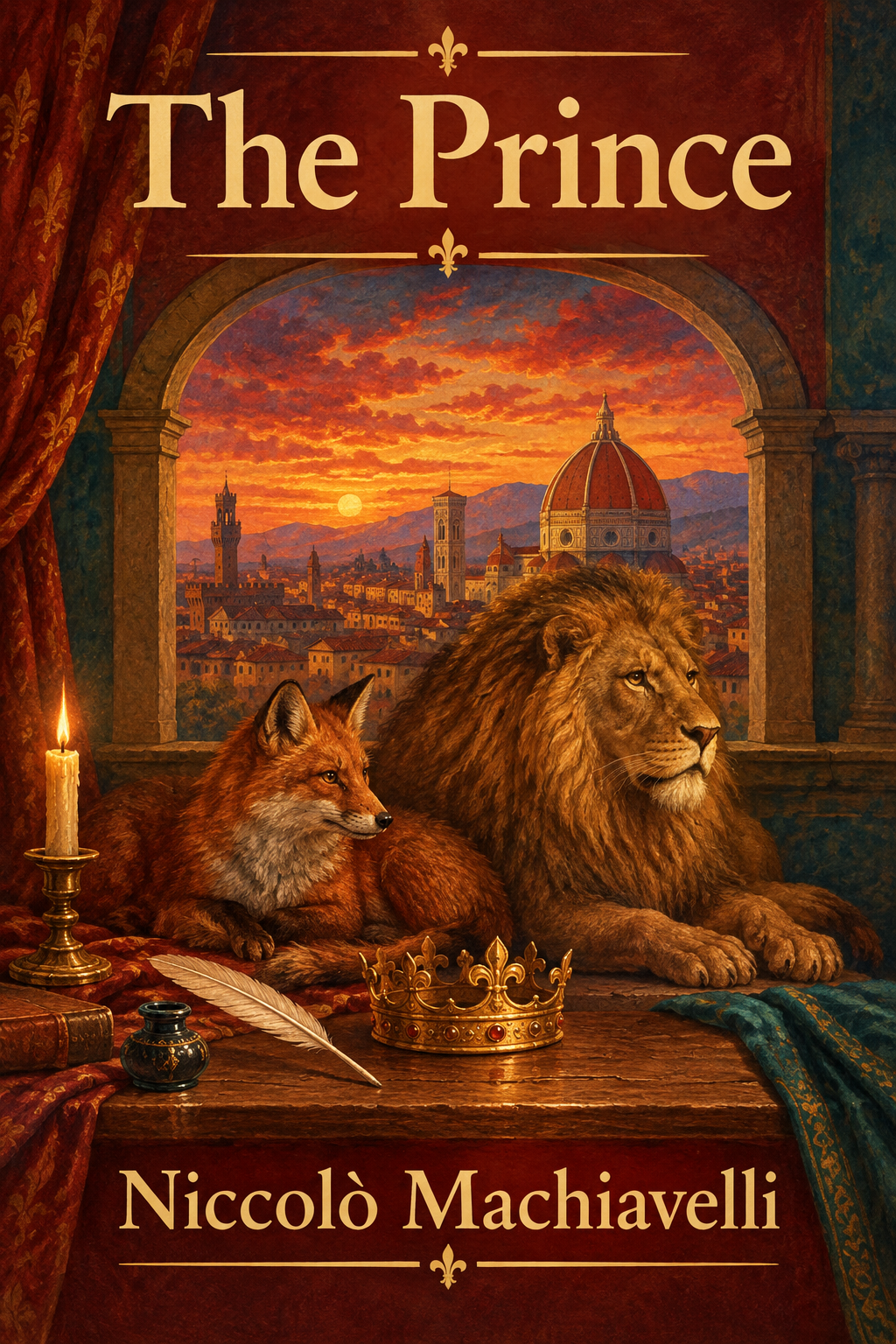
The Prince
by Niccolò Machiavelli
The Prince is a short political handbook written in 1513 by Niccolò Machiavelli, a Florentine official who had just lost his job. It tells a ruler how to win power, keep it and avoid losing it, using real examples from Italy and the ancient world. Its famous claim is that a leader has to deal with the world as it is, where fear, force, reputation and luck matter as much as good intentions.
The Big Idea
"Machiavelli argues that a ruler must judge actions by results and by what really keeps a state secure, not by how rulers ought to behave in an ideal world."
Key Insights
Judge politics as it is, not as it should be
Machiavelli breaks with earlier writers who described ideal rulers. He starts from how people actually behave: they change their minds, follow self-interest and quickly turn on a ruler who fails. A ruler who acts only on ideals can be destroyed by people who do not. He asks for clear eyes, not for cruelty.
In chapter 15 he says it is more useful to follow the real truth of a matter than an imagined picture of it, because how people live is far from how they ought to live.
Fear is safer than love, but hatred is fatal
Chapter 17 says love is held by a chain of obligation that people break when it suits them, while fear rests on dread of punishment that rarely fails. If a ruler can have only one, fear is safer. The condition is that he must avoid being hated, mainly by leaving his subjects’ property and families alone.
Cesare Borgia’s reputation for harshness brought order to the unruly region of Romagna, which Machiavelli sets against the soft rule that let Florence drift into disorder.
Appearances shape power
Chapter 18 says most people judge by what they see rather than what they touch. A ruler therefore needs to look merciful, faithful and religious, while being ready to act otherwise when events demand it. The fox spots traps and the lion scares wolves, and a ruler needs both.
Pope Alexander VI, Machiavelli says, always deceived others and always found people willing to believe him, showing how reputation can outweigh the facts.
Ability meets luck
In chapter 25 Machiavelli judges that fortune decides about half of our actions and leaves the rest to us. Fortune is like a river that floods, so wise people build dams and channels in calm times. He adds that bold people tend to do better against her than cautious ones.
Cesare Borgia planned carefully in chapter 7, yet his father’s death and his own serious illness struck at the same moment, and his state collapsed.
Rely on your own strength
Chapters 12 and 13 warn against hired and borrowed soldiers. Mercenaries fight for pay, not loyalty, and auxiliaries serve another master. Security that depends on other people’s strength is only apparent. A state is safest when it is defended by its own citizens.
Machiavelli points to Carthage, which after its first war with Rome was nearly overpowered by its own hired soldiers.
Chapter Breakdown
Background: why Machiavelli wrote it
Machiavelli served the Florentine republic for fourteen years as a diplomat and secretary. When the Medici family returned to power in 1512, he lost his post. In 1513 he was arrested on suspicion of joining a plot, tortured and then released, and he retired to a farm outside the city. In a letter to a friend he described spending his evenings there reading the ancient authors, and The Prince grew out of those evenings. He later dedicated it to Lorenzo di Piero de’ Medici, hoping to show his skill and return to public service. It was not printed until 1532, five years after his death.
Chapter-by-chapter summary
The book has 26 short chapters, which are grouped here into eight parts.
Chapters 1–2: Kinds of states and inherited rule
Machiavelli sorts states into republics and principalities, then splits principalities into inherited ones and new ones. Chapter 2 covers the easy case, the hereditary ruler. People are used to his family, so he only needs to keep old customs in place and avoid being hated. Even if a stronger power drives him out, he can often come back when the invader stumbles. Why it matters: the book begins with a practical question, not a moral one. What makes rule last?
Chapters 3–5: Conquering and holding new territory
New territory is harder to keep. Chapter 3 deals with “mixed” principalities, where a ruler adds a new region to an old one. Machiavelli advises living in the conquered land or planting colonies there, and crushing powerful locals while protecting weaker ones. He uses the mistakes of Louis XII of France in Italy as a case study. Chapter 4 asks why the Persian lands taken by Alexander the Great did not rebel after his death. Chapter 5 says a city used to its own laws is best held by destroying it, living in it, or letting a few locals govern for you. Why it matters: history is turned into rules of thumb.
Chapters 6–9: How new rulers rise
Here Machiavelli asks how someone rises to rule from nothing. Chapter 6 praises founders such as Moses, Cyrus and Romulus, who rose by their own ability (virtù). Chapter 7 gives the opposite case: Cesare Borgia gained power through his father, Pope Alexander VI, and through luck, then lost it when luck turned, yet Machiavelli still admires his careful planning. Chapter 8 looks at rulers who rose by crime, such as Agathocles of Syracuse, and says that cruelty, if used at all, should be swift and done once. Chapter 9 describes the civil principality, won by the support of the people or the nobles, and finds the people’s goodwill the safer base. Why it matters: it shows how skill and luck mix.
Chapters 10–11: Strength of states and church states
Chapter 10 says a state is strong if its ruler can raise an army and meet an attacker in the field. The free cities of Germany, with walls, supplies and armed citizens, are his example. Chapter 11 turns to church states, which he calls secure and happy because they rest on old religious custom and need no defence. He adds, with some irony, how the papacy grew powerful in his own lifetime under Alexander VI and Julius II. Why it matters: a state’s strength comes from what it can do for itself, a point the military chapters then develop.
Chapters 12–14: Armies
Machiavelli says every state rests on good laws and good arms, and he cares most about arms. Chapter 12 attacks mercenaries as disunited, disloyal and cowardly when it counts, and blames them for Italy’s ruin. Chapter 13 warns against auxiliary troops lent by another ruler and favours an army of the state’s own citizens. Chapter 14 tells the prince to make war his main study, in peace as well as in war, by hunting, learning the land and reading about great commanders. Why it matters: Machiavelli had helped organise a citizen militia for Florence, and the argument comes from that experience.
Chapters 15–19: Character and reputation
These are the most quoted chapters. In chapter 15 he says he will write about how people really live, not how they should. Chapter 16 prefers a name for stinginess to generosity paid for by heavy taxes. Chapter 17 asks whether it is better to be loved or feared: ideally both, but if one must go, fear is safer, as long as the ruler is not hated and leaves his subjects’ property and families alone. Chapter 18 says a ruler may break his word when keeping it would hurt him, and needs both the fox’s cunning and the lion’s strength, while looking virtuous. Chapter 19 says the real dangers are hatred and contempt, and uses Roman emperors who fell as examples.
Chapters 20–23: Practical statecraft
Chapter 20 weighs fortresses and disarming subjects. Arming subjects usually pays, he says, and the best fortress is not to be hated. Chapter 21 uses Ferdinand of Aragon, who won prestige through bold campaigns, and argues that a ruler gains esteem by taking sides openly instead of staying neutral. Chapter 22 says a ruler’s ministers show his judgement. Chapter 23 warns against flatterers and recommends choosing a few wise advisers and letting them speak frankly, but only when asked. Why it matters: these chapters turn the big ideas into daily habits of government.
Chapters 24–26: Italy, fortune and a call to action
Chapter 24 argues that Italian princes lost their states through their own laziness in peacetime, not through bad luck. Chapter 25 asks how far fortune controls events. Machiavelli compares her to a flooding river that can be partly held back by dams built in calm weather, and says fortune favours the bold over the cautious. Chapter 26 ends with an appeal to the Medici to free Italy from foreign armies. Why it matters: the final chapter shows the book is not only a cold manual. It ends in patriotic passion.
Key people and terms
- Niccolò Machiavelli (1469–1527): Florentine diplomat and secretary who served the republic until the Medici returned in 1512. Arrested and tortured in 1513 over a suspected plot, he retired to his country farm and wrote The Prince there.
- Lorenzo di Piero de’ Medici: The young Medici ruler of Florence to whom the book is dedicated. Machiavelli hoped that showing his political knowledge would win him a place in the new government.
- Cesare Borgia (c. 1475–1507): Son of Pope Alexander VI who carved out a state in central Italy in the early 1500s. Machiavelli met him as a diplomat and uses him in chapter 7 as an example of skilful but unlucky state-building.
- Virtù: Italian for skill, drive and force of character, not moral virtue. It is the quality that lets a ruler shape events instead of being pushed around by them. Machiavelli names it again and again as the ruler’s most useful trait.
- Fortuna: Fortune or luck, pictured as a powerful force. Machiavelli thinks it governs about half of what happens, and that prepared, bold people can resist it better than cautious ones. Chapter 25 compares it to a flooding river.
- Mercenaries: Hired soldiers, led in Italy by professional captains called condottieri. Machiavelli says they are disloyal, cowardly and ready to desert, and blames them for Italy’s weakness. He prefers armies made up of a state’s own citizens.
- Fox and lion: The pair of animals in chapter 18 standing for the two qualities a ruler needs: the cunning to spot traps and the strength to scare off wolves. Either one alone is not enough.
- Principality: A state ruled by one person, as opposed to a republic. The book sorts principalities into inherited and new ones and explains how each can be held. The first eleven chapters are mostly about this sorting.
Writing about this book and using its ideas
The Prince works well for essays and discussions because it invites argument. Three questions are a good start. First, is Machiavelli describing how power works, or recommending cruelty? Read chapters 8 and 17 side by side and decide where description ends. Second, what does he mean by virtù, and why is it not the usual moral sense of virtue? Third, how far does his own situation, a jobless official writing to the family that removed him, shape his advice?
Other useful angles: compare the fox-and-lion passage with how a modern leader manages a public image; weigh chapter 25’s claim that fortune governs about half of events against your own view; or ask why a book often called cynical ends with a patriotic plea.
To use its ideas in daily life, read it as a study of incentives. Ask whose cooperation a decision depends on, what those people want and fear, and what happens if the plan fails. In essays, cite specific chapters rather than only the famous lines. The book is a short, strongly one-sided handbook for rulers of 1513, so it is better to test its claims than to treat them as rules for everyone.
Take Action
Practical steps you can implement today:
-
When judging any leader, look at what they do and what results follow, not only at what they say.
-
Prepare in calm times for trouble, as you would build dams before a flood, and keep your plans flexible.
-
Treat reputation as real power, but know that being hated or despised can end it.
-
Rely on people and strengths you have built yourself, not on borrowed help, when the stakes are high.
Notable Quotes
"“It is much safer to be feared than loved, if one of the two has to be wanting.” (Chapter 17)"
— Niccolò Machiavelli
"“One must be a fox to recognize traps, and a lion to frighten wolves.” (Chapter 18)"
— Niccolò Machiavelli
"“How one lives is so far distant from how one ought to live.” (Chapter 15)"
— Niccolò Machiavelli
"“Fortune is the arbiter of one half of our actions.” (Chapter 25)"
— Niccolò Machiavelli
Who Should Read This
Students in upper secondary school and university who meet Machiavelli in politics, history, philosophy or literature classes, readers aged about 15 and up who want a quick map before tackling the text, and anyone curious about why “Machiavellian” became a word for scheming. The book is short, but its Renaissance references are easier with a guide.
Frequently Asked Questions
What is The Prince about?
It is a short guide for rulers on gaining, keeping and losing power. Machiavelli sorts states into types, discusses armies, advisers and reputation, and argues that rulers must judge by results in the real world. The last chapter appeals to Italy’s leaders to drive out foreign armies.
When was The Prince written and published?
Machiavelli wrote the main text in 1513, after losing his post in Florence, and later dedicated it to Lorenzo di Piero de’ Medici. It circulated in manuscript and was first printed in 1532, five years after his death. The Catholic Church placed it on its Index of banned books in 1559.
Is it better to be loved or feared, according to Machiavelli?
Ideally both, he says in chapter 17. Since that is hard to manage, he judges that fear is safer, because love breaks as soon as it stops being useful to people. His key warning is to avoid being hated, which means leaving subjects’ property and families alone.
What does Machiavellian mean, and is it fair?
The word describes someone who manipulates others without scruples. Many readers say it exaggerates the book, which often describes what rulers do instead of praising it, and Machiavelli praised republican liberty in his Discourses. Others think the advice on cruelty and deceit is meant seriously. Scholars still debate it.
Is The Prince hard to read?
The text is short, with 26 brief chapters, and the style is direct. The difficulty comes from references to Renaissance Italy, ancient history and terms such as virtù. A study guide or an edition with notes helps, and most readers can finish the book in an afternoon.
Check Your Understanding
Pick an answer for each question to see if you were right.
-
In which year did Machiavelli write The Prince?
1513 — He wrote it in 1513, after losing his post when the Medici returned to Florence; it was only printed in 1532.
-
Which figure does chapter 7 use as an example of skilful but unlucky state-building?
Cesare Borgia — Cesare Borgia rose through his father’s power and lost his state when his luck turned.
-
What do the fox and the lion stand for in chapter 18?
Cunning to spot traps and strength to scare enemies — A ruler needs the fox’s cunning and the lion’s strength; either one alone is not enough.
-
Which kind of soldiers does Machiavelli distrust most in chapters 12 and 13?
Mercenaries — He calls mercenaries disloyal and cowardly and prefers armies of a state’s own citizens.
-
According to chapter 25, how much of our actions does fortune decide?
About half — He says fortune rules about half of our actions and leaves the rest to us.
About Niccolò Machiavelli
Niccolò Machiavelli (1469–1527) was a Florentine diplomat, civil servant and writer. He served the republic of Florence until the Medici returned in 1512, then wrote The Prince, the Discourses on Livy and a history of Florence. His name later became shorthand for cunning politics, though he also wrote in praise of republics.
Summary Written By

Software Engineer & Writer
Software engineer with a passion for distilling complex ideas into actionable insights. Writes about finance, investment, entrepreneurship, and technology.
View all summaries →Reviews
No reviews yet. Be the first to share your thoughts!
Write a Review
Keep reading
Explore the topic: Personal DevelopmentSummaries

Educated by Tara Westover
Tara Westover
A memoir about a young woman born to survivalists in Idaho who, despite having no formal schooling, teaches herself to…

Atomic Habits: An Easy & Proven Way to Build Good Habits & Break Bad Ones
James Clear
No matter your goals, Atomic Habits offers a proven framework for improving–every day. James Clear, one of the world’s leading…

Think and Grow Rich
Napoleon Hill
What if the secrets to wealth and success weren’t hidden in complex financial strategies, but within the power of your…

Melbourne
Alex Ng
Sophie Cunningham's Melbourne is a deeply personal exploration of Australia's cultural capital, weaving together history, architecture, weather patterns, and personal…
Articles

The Enlightenment Explained: Ideas, Thinkers and Legacy
The Enlightenment was an 18th-century European movement that trusted reason and evidence over tradition and authority. Its thinkers, from Locke…

World History 1700–1918: Revolutions, Industry, Empire and War
Between 1700 and 1918, revolutions, factories, empires and a world war reshaped societies across Europe, the Americas, Asia and Africa.…

Best Stoicism Books for Beginners: Where to Start and Why
Looking for the best stoicism books for beginners? Discover a clear reading route comparing ancient classics like Marcus Aurelius with…