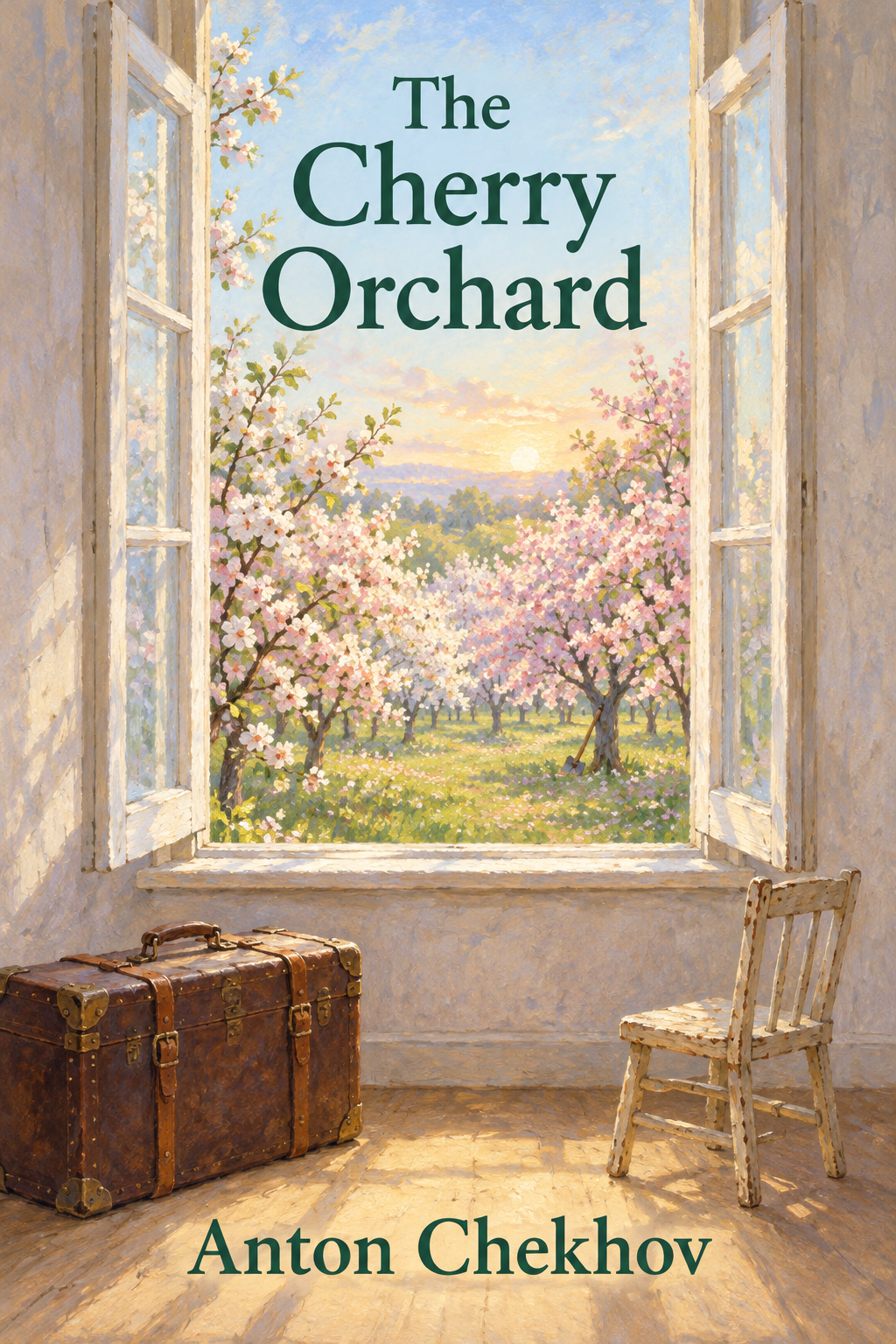
The Cherry Orchard
by Anton Chekhov
The Cherry Orchard is a four-act play by Anton Chekhov, first staged in 1904. Landowner Lyubov Ranevskaya comes home to her Russian estate after years in Paris and learns it will be sold at auction to pay her debts. The merchant Lopakhin, whose father was a serf there, offers a plan: cut down the famous cherry orchard and rent out the land for summer cottages. Her family cannot bear the idea, and cannot offer another. The play follows their delay, and what it costs them.
The Big Idea
"A charming family cannot bring itself to face the sale of its beloved estate, and the practical man who offers a way out is not heard. Chekhov shows an old world fading with sadness and humour at once."
Key Insights
Delay is a decision too
The family knows how to save the estate, yet keeps putting the decision off. Even when Lopakhin explains again and again that cottages would bring a steady income, they cannot accept the idea of cutting down a place full of memories. Chekhov does not scold them for it. He shows how a person can see a problem clearly and still be unable to move, and he makes that both funny and painful.
In Act 1, when Lopakhin explains his plan, Gaev changes the subject and says a rich aunt will surely help.
Beauty with an unfair past
The orchard is breathtaking, but its beauty was built on the work of serfs. Lopakhin's family were not even allowed in the house kitchen. Trofimov says that the trees themselves seem to remember the people once owned here. The play asks the audience to treasure the past and also to look at what lay underneath it, so the loss of the orchard never becomes a simple tragedy.
In Act 2, Trofimov tells Anya that human beings seem to look out at them from every tree in the orchard.
The winner is not a villain
Lopakhin rises from serf's son to owner of the estate, yet his victory is not a clean one. He buys the orchard with pride and clumsy sorrow, and he makes a woman he is grateful to cry. Chekhov refuses to cast the rising class as the enemy of the old one. Each person in the change is allowed to feel real pain, so the audience can hardly blame anyone.
In Act 3 he announces the purchase in a rush of excitement, then orders the band to play on.
Comedy and tragedy in one scene
Chekhov called the play a comedy, but its first director, Stanislavski, is said to have staged it as a heavy tragedy. Both views have support. Losses and farewells are sad, while Gaev's billiard terms and Yepikhodov's mishaps are funny. The mixture is the play's flavour, and reading it as only one thing makes the characters flatter. Try marking where you laughed and where you hurt.
At moments of deep sadness, Gaev still blurts out billiard terms.
Chapter Breakdown
Background
The Cherry Orchard was Anton Chekhov's last play. It opened at the Moscow Art Theatre on 17 January 1904 (Old Style), and Chekhov died that July. It is set in rural Russia around the turn of the twentieth century, about forty years after serfdom ended in 1861. Old landowning families were losing money and influence while merchants and businessmen rose. Chekhov, who was also a doctor, wrote the play while ill with tuberculosis. He called it a comedy, though many productions have played it as a tragedy. The story uses one family's goodbye to show a whole society changing.
Chapter-by-chapter summary
Spoiler warning: this section covers the whole plot, including the ending.
Act 1: The Nursery (a May morning before dawn)
It is May and the cherry trees are in flower. Ranevskaya arrives at her estate after five years in Paris, with her seventeen-year-old daughter Anya. Lopakhin, who has stayed up to meet them, reminds the family that the estate will be auctioned on 22 August unless they act. His plan is to divide the land into plots for summer visitors. Gaev waves it away and imagines that a rich aunt or a loan will save them. Ranevskaya looks around the old nursery and weeps, remembering her young son Grisha, who drowned years ago. Why it matters: the whole problem is set out in one morning, and so is the family's habit of not listening.
Act 2: The Field (a summer evening)
Near an old chapel at sunset, the household talks while the orchard stands in the distance. Lopakhin presses his plan again and says time is short. Ranevskaya hears him, but her mind drifts to her old spending habits and to a lover in Paris who keeps sending telegrams. She even hands a gold coin to a passing stranger. Trofimov, the eternal student, gives a speech saying Russia must face its past and work for a better future, and Anya is deeply moved. Then everyone hears a distant sound like a breaking string, which slowly dies away. Nobody can explain it. Why it matters: the deadline is closing in, and the strange sound hints that something is ending.
Act 3: The Ball (22 August)
On the day of the auction, Ranevskaya throws a dance in the drawing room, though the family can hardly afford it. She waits nervously for her brother Gaev and Lopakhin, who have gone to town. Trofimov tells her to face the truth about the estate, and she lashes out at him. Gaev returns exhausted and silent. Lopakhin follows, flushed with excitement, and announces that he has bought the estate himself. The son of a serf now owns the land where his father and grandfather were not even allowed into the kitchen. While Ranevskaya weeps, he calls for the band to keep playing. Why it matters: the man who offered the rescue is the buyer, and the family's delay has cost them everything.
Act 4: The Departure (October)
It is October. Trunks are piled in the empty nursery and the family is leaving. Lopakhin has long been expected to propose to Varya, but when they are finally alone he finds an excuse and walks away. Anya is hopeful and ready to start a new life, encouraged by Trofimov. Varya takes a job as a housekeeper on another estate. Ranevskaya and Gaev share a last moment in the bare room, then go. Why it matters: each person leaves in a different direction, so the family that once shared one house is scattered.
Act 4, final scene: The Locked House
Firs, the old servant, is accidentally left behind in the locked house and lies down to rest. The sound of the breaking string returns, followed by axes at work on the trees. Why it matters: the ending lets sound, not speech, show an era closing.
Characters
- Lyubov Andreyevna Ranevskaya: the owner of the estate, charming, generous and careless with money. She has just returned from Paris, where she lived after her son's death and a failed love affair. She loves the orchard as a symbol of her childhood, but cannot make the hard choice that would save it.
- Leonid Gaev: her brother, a talkative aristocrat who falls back on billiard terms in emotional moments. He promises to save the estate with schemes and loans, but depends on others for anything practical.
- Yermolai Lopakhin: a successful merchant whose father and grandfather were serfs on the estate. Practical and hardworking, he offers a real plan to save the family. He still feels gratitude to Ranevskaya, and an uneasy pride about how far he has come.
- Anya: Ranevskaya's seventeen-year-old daughter. Hopeful and easily inspired, she follows Trofimov's ideas about a new life and faces the loss of the orchard with more courage than the older generation.
- Varya: Ranevskaya's adopted daughter, aged twenty-four, who runs the household and keeps the keys. Everyone expects her to marry Lopakhin, but it never happens. She is serious, anxious and tired of carrying the family's problems.
- Pyotr Trofimov: a “perpetual student” who once tutored Ranevskaya's drowned son. He speaks warmly about work and progress, though he has no job or money himself. His speeches inspire Anya and irritate Ranevskaya.
- Boris Simeonov-Pishchik: a neighbouring landowner always short of money, who keeps borrowing from Ranevskaya. His luck turns when foreign investors lease his land for its clay. A cheerful, absent-minded man, he shows that luck, not planning, can rescue some people.
- Firs: the eighty-seven-year-old valet who has served the family all his life. He misses the days before serfdom ended and still fusses over Gaev like a child. His fate at the end becomes the play's saddest image.
- Charlotta Ivanovna: Anya's governess, a foreign-born woman who performs card tricks and ventriloquism. She says she does not know where she is from or who she is, which makes her one of the loneliest people on stage.
- Semyon Yepikhodov: the clerk nicknamed “Twenty-two Misfortunes” because of his clumsy accidents. He trips, breaks things and owns a pair of squeaking boots. He provides much of the play's slapstick, while his hopeless love for Dunyasha adds a note of sadness.
- Yasha: a young servant who travelled to Paris with Ranevskaya and came back full of airs. He looks down on Russian life and the old servants, and goes back to Paris with her at the end.
- Dunyasha: a young maid who loves pretty clothes and romance. She brushes off Yepikhodov's proposal and falls for Yasha, showing a younger generation eager to step above its station. Her light, flirty scenes balance the heavy ones.
Writing about this book
A good report on The Cherry Orchard starts with a choice of viewpoint. Decide whether you read the play from the side of Ranevskaya and her family, from Lopakhin's side, or from the younger generation of Anya and Trofimov. Then build your thoughts around a few questions:
- Why does the family refuse the cottage plan? Look for reasons that are about feeling, not only money.
- When Lopakhin buys the orchard, has he won? Look at what he says and does just afterwards.
- How do you hear the breaking string and the axes at the end?
- What is your own “cherry orchard”: a place, habit or memory that is hard to let go?
Chekhov called the play a comedy. Look for the funny moments inside sad scenes and ask why he mixed them. Rather than retelling the plot, pick one scene that stayed with you and connect it to your own experience or to a wider question about change. Quote sparingly, and always say which act you mean.
Take Action
Practical steps you can implement today:
-
When an answer is unwelcome, delay is also a decision. Ask whether you are waiting for a rescue that may never come.
-
Love for a place or a memory is real, but keeping it usually needs a practical plan.
-
Judge people by what they say and do, not by their label: the “winner” Lopakhin is kind, and the “dreamer” Trofimov has no job.
-
Read one scene twice, first for the sadness and then for the jokes. Chekhov often puts both in the same scene.
Notable Quotes
"“All Russia is our orchard.” (Trofimov, Act 2)"
— Anton Chekhov
"“The cherry orchard is mine now!” (Lopakhin, Act 3)"
— Anton Chekhov
"“We are above love.” (Trofimov, Act 3)"
— Anton Chekhov
"“Life has gone by as if I had never lived.” (Firs, Act 4)"
— Anton Chekhov
Who Should Read This
Good for high school and university students reading drama or Russian literature, for anyone writing a report or preparing for a theatre class, and for readers who like quiet, character-driven stories. Ages 14 and up. It is short, mostly dialogue, and can be read in an evening.
Frequently Asked Questions
What is The Cherry Orchard about?
It is about a landowning family that cannot decide how to save its estate from being sold for debt. A merchant suggests a practical but painful plan, the family hesitates, and the play watches time run out. Beneath that, it is about a changing Russia, lost childhoods and the difficulty of letting go.
Is The Cherry Orchard a comedy or a tragedy?
Chekhov described it as a comedy, and it has comic figures such as Yepikhodov. But the story is about loss, and the first director, Konstantin Stanislavski, staged it in a heavier, sadder way. Most readers today see it as both: a play where people laugh and hurt in the same scene.
Who is the main character?
Lyubov Ranevskaya is at the centre, because the sale of her estate drives the plot. But Chekhov spreads attention across a whole group, and Lopakhin has the strongest arc of change. The play is often called an ensemble piece, where no single hero carries the story.
What is the sound of the breaking string?
Twice, in Acts 2 and 4, characters hear a distant sound like a snapped string, with a sad, dying tone. Chekhov never explains it. Readers usually take it as a sign of the old life breaking, and the play leaves each listener to decide what it means.
When was The Cherry Orchard written and first staged?
Chekhov finished it in 1903. The Moscow Art Theatre premiered it on 17 January 1904 (Old Style), with Konstantin Stanislavski among its directors. Chekhov died that July, about six months later, so it was his last play.
How long does it take to read?
It is short: four acts, mostly dialogue. Most readers finish in about two hours, and the plot is simple; the interest lies in small, telling lines. Read one act at a time and check who is speaking, since Russian names have several forms.
Check Your Understanding
Pick an answer for each question to see if you were right.
-
Who buys the estate at the auction?
Lopakhin — Lopakhin, the son of a former serf, buys the estate and announces it in Act 3.
-
What does Lopakhin suggest to save the family?
Cut the orchard into plots for summer cottages — He proposes dividing the land into plots and renting them to summer visitors.
-
Who is accidentally left behind in the locked house?
Firs — The old servant Firs is forgotten when the family leaves in Act 4.
-
Where has Ranevskaya been living before the play begins?
Paris — She returns from five years in Paris at the start of Act 1.
-
Which theatre staged the first production in 1904?
The Moscow Art Theatre — The Moscow Art Theatre premiered the play on 17 January 1904 (Old Style).
About Anton Chekhov
Anton Chekhov (1860–1904) was a Russian doctor, short-story writer and playwright. Born in the port town of Taganrog, he studied medicine in Moscow and wrote stories to earn money. His plays The Seagull, Uncle Vanya, Three Sisters and The Cherry Orchard, staged by the Moscow Art Theatre, helped shape modern drama. He died of tuberculosis in 1904.
Summary Written By

Software Engineer & Writer
Software engineer with a passion for distilling complex ideas into actionable insights. Writes about finance, investment, entrepreneurship, and technology.
View all summaries →Reviews
No reviews yet. Be the first to share your thoughts!
Write a Review
Keep reading
Explore the topic: FictionSummaries

Out of My Mind
Sharon M. Draper
“Out of My Mind” by Sharon M. Draper is a poignant narrative that explores the life of Melody Brooks, a…

Ender’s Game
Orson Scott Card
“Ender’s Game” by Orson Scott Card is a riveting science fiction novel that transports readers into a future where humanity…

Pachinko
Min Jin Lee
“Pachinko”, a spellbinding multigenerational historical saga by Min Jin Lee, explores the lives of a Korean family trying to make…

The Perks of Being a Wallflower
Stephen Chbosky
The Perks of Being a Wallflower by Stephen Chbosky is a profound coming-of-age novel, told through the intimate letters of…
Articles

The Enlightenment Explained: Ideas, Thinkers and Legacy
The Enlightenment was an 18th-century European movement that trusted reason and evidence over tradition and authority. Its thinkers, from Locke…

World History 1700–1918: Revolutions, Industry, Empire and War
Between 1700 and 1918, revolutions, factories, empires and a world war reshaped societies across Europe, the Americas, Asia and Africa.…

A Christmas Carol themes: generosity, isolation and responsibility
Dickens's novella is usually read as a story about a man who changes his mind. Its themes are sharper than…