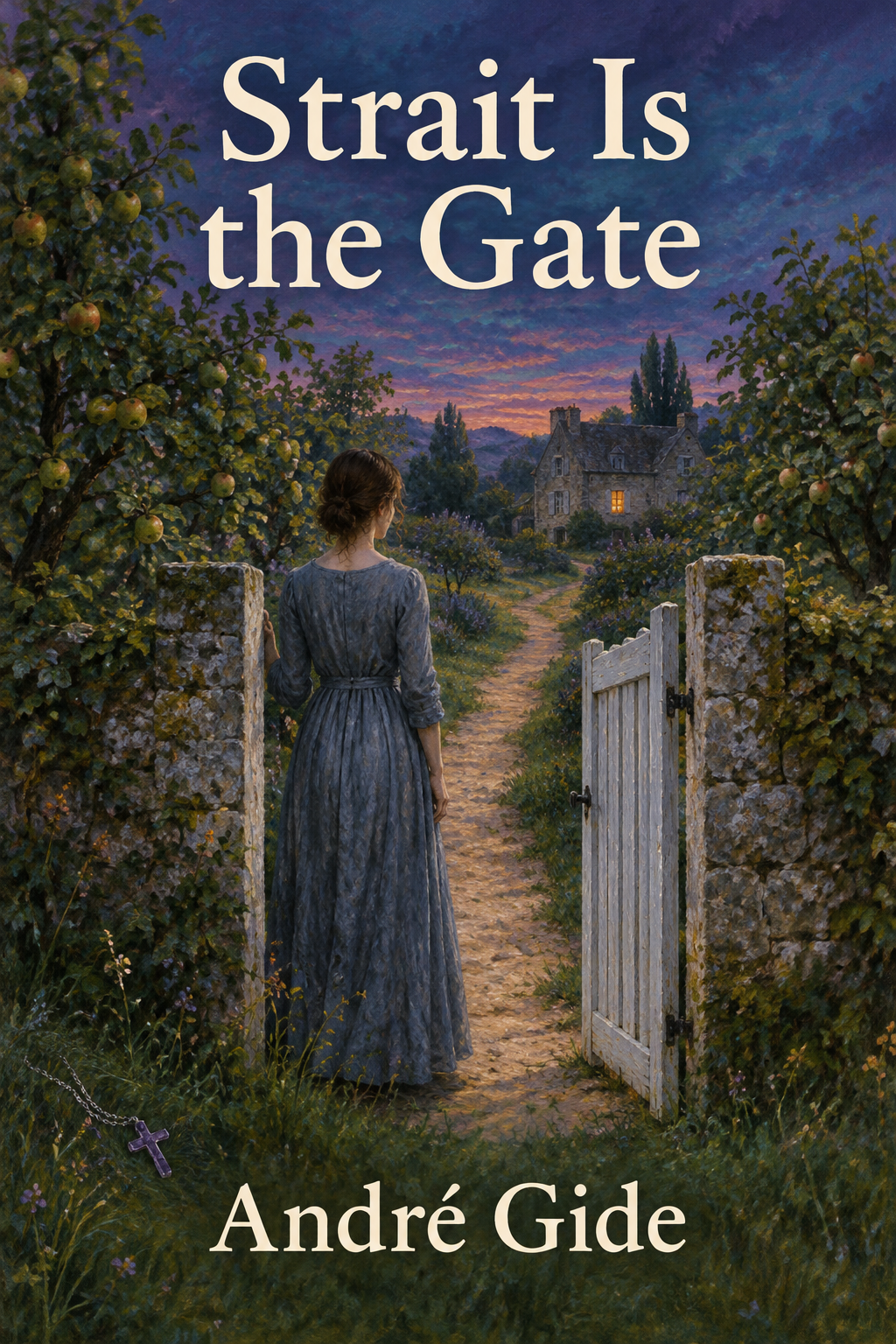
Strait Is the Gate
by André Gide
Strait Is the Gate is a 1909 novel by André Gide about two cousins in Protestant Normandy, Jérôme and Alissa, who fall in love as teenagers. Jérôme wants to marry her. Alissa, shaped by a strict, pious upbringing and by pain inside her family, comes to treat happiness as a temptation and holiness as the narrow path. Jérôme tells the story years later, asking what a person owes to God, to the one they love and to themselves.
The Big Idea
"Jérôme and Alissa love each other, but Alissa comes to believe that real virtue means giving up happiness. Gide shows how a faith built on self-denial can quietly wear love away."
Key Insights
Holiness can become a form of pride
Alissa wants to be good, but her goodness gradually becomes a project that matters more to her than the people around her. Gide does not mock her faith. He shows how a sincere wish to be pure can turn into self-punishment that hurts the very person it was meant to protect. The book asks whether giving something up always means giving it to God.
Alissa steps aside for her sister Juliette, then withdraws from Jérôme herself. Each sacrifice looks generous, yet it leaves everyone, including her, lonelier.
Love is shaped by the pain it grows from
Jérôme's love begins in sympathy for a girl he sees hurt by her mother's behaviour. That origin is both its strength and its limit. He loves Alissa as someone to protect and admire, not always as the real person she is. Alissa, in turn, responds to hurt with retreat. The two never fully see each other.
The scene where Jérôme understands Alissa's shame leads him to devote his life to deserving her, a promise he keeps long after she has stopped asking for it.
One story, two points of view
The book mixes Jérôme's memories with Alissa's diary, so the reader sees what each hid from the other. Jérôme thinks she stopped loving him. The diary shows the opposite. This gap between what we say and what we feel is the novel's quiet tragedy and part of Gide's craft.
Alissa's diary, read after her death, shows how close she felt to Jérôme even while her letters kept him at a distance.
A companion to Gide's other novel
Gide wrote Strait Is the Gate as a counterpart to The Immoralist. In that earlier book, a man throws off all restraint. Here, a woman accepts too much of it. Together they work as a pair of warnings about the two extremes, and Gide does not choose a side. Reading both shows how he thinks about freedom and discipline.
Where Michel in The Immoralist gives up his duties for pleasure, Alissa gives up her pleasure for what she sees as her duty.
Chapter Breakdown
Chapter-by-chapter summary
Spoiler warning: this section covers the whole plot, including the ending. The novel has eight numbered chapters (I–VIII) without titles, followed by Alissa's diary, so the parts below are descriptive labels that group the chapters.
Part 1: A flight and a sermon (Chapter I)
Jérôme Palissier loses his father young and lives in Paris with his devout mother and their English governess, Miss Ashburton. Each summer they visit his uncle Bucolin's estate at Fongueusemare, near Le Havre, where his cousins Alissa, Juliette and Robert live. Jérôme is drawn to Alissa, who is gentle, serious and a little remote. Her mother, Lucile, has dramatic fits that unsettle the house. One Easter Jérôme finds Lucile with a young lieutenant and finds Alissa in tears. Soon Lucile leaves the family with a lover. The following Sunday, Pastor Vautier preaches on the strait gate, and Jérôme takes it as a call to devote his life to Alissa. Why it matters: the desertion and the sermon arrive together, and love and piety begin to knot.
Part 2: A promise made young (Chapter II)
Jérôme describes his love for Alissa as something he felt even as a child, and he works to deserve her. At school he befriends Abel Vautier, the pastor's cheerful, easygoing son. He overhears Alissa asking her father whether Jérôme will make something of himself. Jérôme's mother, near death, blesses their future and dies soon after. The next summer is happy, with Juliette carrying messages between the cousins. But when Jérôme hopes for an engagement, Alissa asks him not to press for one yet. Why it matters: the first delay is gentle, yet it sets the pattern of Alissa holding back.
Part 3: Paris, Swinburne and a confession (Chapter III)
Jérôme and Abel are both at the École Normale in Paris, where Jérôme is reading for his degree. Alissa writes that she is too old for him and asks him to wait, which troubles him badly. Abel urges him to visit, and at Fongueusemare Alissa reassures him with a smile; they spend the day reading Swinburne together. Juliette has received a proposal from Édouard Teissières, a wine merchant from Nîmes. On the train back, Abel confesses that he is in love with Juliette. Why it matters: Abel's hopes, Teissières's offer and Alissa's delay now all pull on the same family.
Part 4: Juliette's choice (Chapters IV–V)
Jérôme writes to Alissa every week and dreads her replies. At Christmas in Le Havre her aunt tells him Alissa has refused to marry before Juliette does. At the Christmas tree Alissa, wearing an amethyst cross, is plainly in distress, and Juliette faints when Teissières takes her hand. Abel tells Jérôme that Juliette loves him, and that Alissa has been sacrificing herself for her sister. Juliette later accepts Teissières. In Chapter V she refuses to speak to Alissa and marries in July. Abel, now a journalist and novelist, publishes a scandalous book, which Alissa disapproves of. Why it matters: Juliette's sacrifice is a way out, but Alissa's becomes a trap.
Part 5: Colder letters and the garden bench (Chapters VI–VII)
Back in Le Havre, Jérôme finds Alissa distant. She writes that they are so far apart and asks him to stop writing for a while. Miss Ashburton dies. At Fongueusemare the two meet in the garden, and Alissa asks him to leave the next day. Her letters turn cool: holiness, she writes, is an obligation, not a choice. The piano is sent away and she reads devotional books. On the bench she tells him he loves a phantom and asks why he will not admit he loves her less. Jérôme leaves for Athens. Why it matters: Alissa has made her sacrifice into a rule, so even the love she wants is no longer allowed.
Part 6: The diary and the lamp (Chapter VIII)
Three years later, after his uncle's death, Jérôme returns to Fongueusemare and meets Alissa at the kitchen-garden door. She offers him her amethyst cross for a future daughter, tells him they must not spoil their love, and they part. Juliette later writes that Alissa has died in a nursing home after leaving the house. Her diary shows she planned to give away her fortune, lived in lodgings under a hidden name, and wished to die before realising again that she was alone. Years later Jérôme visits Juliette in Nîmes, where her youngest daughter is named Alissa. He tells her he hopes never to forget. A servant brings in the lamp. Why it matters: the diary shows Alissa suffered as much as he did.
Characters
- Jérôme Palissier: the narrator, a thoughtful, loyal young man who loves Alissa from boyhood. He tells the story many years later, and his version is shaped by what he wanted to believe.
- Alissa Bucolin: Jérôme's older cousin, serious, kind and deeply religious. She comes to believe that happiness stands between her and holiness, and she lets that belief decide her life.
- Juliette Bucolin: Alissa's younger sister. She is livelier and more open than Alissa, loves Jérôme in secret, and accepts Teissières to escape the situation. Years later she is a mother of several children.
- Robert Bucolin: the brother of Alissa and Juliette. He is a minor figure who attends school with Abel. He later inherits Fongueusemare, sells it and becomes Teissières's partner.
- Lucile Bucolin: the mother of the Bucolin children. After scenes of dramatic fits, she leaves the family with a lover, and her desertion deeply wounds Alissa and pushes her toward self-denial.
- Uncle Bucolin: Lucile's husband and head of the family at Fongueusemare and Le Havre. He is a quiet, reserved man who speaks to Alissa of the affection and esteem he has lacked.
- Miss Ashburton: the English governess who lives with Jérôme and his mother in Paris. She is a calm, steady presence in his boyhood and dies later in the book.
- Abel Vautier: the pastor's son and Jérôme's friend from school. He falls in love with Juliette and later becomes a journalist and novelist, whose scandalous book shocks Alissa.
- Pastor Vautier: the Protestant pastor whose sermon on the strait gate, preached after Lucile's flight, gives the book its title and Jérôme his sense of mission.
- Édouard Teissières: the wine merchant from Nîmes whom Juliette marries. He stands for a calm, ordinary kind of happiness that Alissa rejects.
Writing about this book
You do not need to agree with Alissa or with Jérôme to write about this novel. A strong report starts from a question and tests it against the text. Here are some to try.
- Why does Alissa believe that happiness and holiness cannot go together? Where does the book show that belief growing, and what in her family helps it grow?
- Jérôme narrates the story, but we also read Alissa's diary. How does each one misunderstand the other, and what do you think the author wants you to notice?
- Juliette and Alissa both make a sacrifice. Which one seems wiser, and why?
- The title comes from the Gospels. Is the narrow gate a good thing in this book, a warning, or both?
- If Alissa had said yes, would anyone in the story have been happier?
Pick one scene, such as the garden at night, and read it closely. Say what the characters say, what they leave unsaid, and what you think they feel. Then connect it to one of the questions above. Use your own words and your own opinion, and keep quotations short.
Take Action
Practical steps you can implement today:
-
Ask whether a sacrifice you are making helps the people you love, or only makes you feel disciplined.
-
Say what you feel directly to the people who matter; Jérôme and Alissa lost each other partly through silence and letters.
-
Notice when a belief that once protected you has started to limit you.
-
Remember that one story can look very different from another person's point of view.
Notable Quotes
"“Whatever I hope to become later is for you.” (Jérôme to Alissa, Chapter II)"
— André Gide
"“Jerome, why don’t you simply admit that you love me less?” (Alissa, Chapter VII)"
— André Gide
"“Oh! don’t let us regret the past.” (Chapter VIII)"
— André Gide
"“I should like to die now, quickly, before again realising that I am alone.” (Alissa’s diary)"
— André Gide
Who Should Read This
This novel suits readers from about 16 who want a short, serious book about love and religion, and it works well for French literature classes and book reports. It is a good choice if you liked Jane Eyre or Wuthering Heights, or if you are curious about Gide before starting The Immoralist.
Frequently Asked Questions
What is Strait Is the Gate about?
It is about Jérôme and Alissa, cousins in Protestant Normandy who love each other. Alissa comes to believe that happiness is a distraction from holiness, so she keeps refusing the marriage Jérôme wants. The story is told by Jérôme years later and includes Alissa's diary.
Who wrote Strait Is the Gate and when was it published?
André Gide wrote it. It was published in France in 1909 under the title La Porte étroite. It is often read together with his earlier novel The Immoralist, to which it is a kind of mirror image.
What does the title mean?
The title comes from the Gospels, where the narrow gate stands for the hard path to a good life, while the wide gate leads to destruction. In the novel Pastor Vautier preaches on it, and it becomes Alissa's idea of faith. The book asks whether it is wisdom or a mistake.
Why does Alissa refuse to marry Jérôme?
She does not stop loving him. She believes that earthly happiness would pull her away from God, and she wants to be worthy of a higher calling. Her family's hardships, especially her mother Lucile leaving the family, strengthen that wish.
Who are the main characters in Strait Is the Gate?
The central characters are Jérôme, the narrator, his cousin Alissa, and her sister Juliette. Others include their mother Lucile, who leaves the family, the governess Miss Ashburton, Jérôme's friend Abel, the pastor's son who later becomes a writer, and Pastor Vautier.
Check Your Understanding
Pick an answer for each question to see if you were right.
-
Who narrates the main story of Strait Is the Gate?
Jérôme — Jérôme tells the story, looking back on his love for Alissa.
-
Where is the Bucolin family's country estate?
Fongueusemare, near Le Havre — Fongueusemare is the family estate in Normandy where Jérôme spends his summers.
-
What does Abel Vautier, the pastor's son, later become?
A journalist and novelist — Abel, who loves Juliette, becomes a writer whose scandalous book shocks Alissa.
-
Where does the title come from?
The Gospels — It comes from Jesus' words about the narrow gate in Luke and Matthew.
-
What does Jérôme find after Alissa's death?
Her diary — Her diary shows how much she suffered and how much she loved him.
About André Gide
André Gide (1869–1951) was a French writer born in Paris and raised in a strict Protestant household, with family roots in Normandy. He co-founded the literary magazine La Nouvelle Revue Française and won the Nobel Prize in Literature in 1947. Strait Is the Gate (1909) is one of his best-known novels.
Summary Written By

Software Engineer & Writer
Software engineer with a passion for distilling complex ideas into actionable insights. Writes about finance, investment, entrepreneurship, and technology.
View all summaries →Reviews
No reviews yet. Be the first to share your thoughts!
Write a Review
Keep reading
Explore the topic: FictionSummaries

Out of My Mind
Sharon M. Draper
“Out of My Mind” by Sharon M. Draper is a poignant narrative that explores the life of Melody Brooks, a…

Ender’s Game
Orson Scott Card
“Ender’s Game” by Orson Scott Card is a riveting science fiction novel that transports readers into a future where humanity…

Pachinko
Min Jin Lee
“Pachinko”, a spellbinding multigenerational historical saga by Min Jin Lee, explores the lives of a Korean family trying to make…

The Perks of Being a Wallflower
Stephen Chbosky
The Perks of Being a Wallflower by Stephen Chbosky is a profound coming-of-age novel, told through the intimate letters of…
Articles

The Enlightenment Explained: Ideas, Thinkers and Legacy
The Enlightenment was an 18th-century European movement that trusted reason and evidence over tradition and authority. Its thinkers, from Locke…

World History 1700–1918: Revolutions, Industry, Empire and War
Between 1700 and 1918, revolutions, factories, empires and a world war reshaped societies across Europe, the Americas, Asia and Africa.…

A Christmas Carol themes: generosity, isolation and responsibility
Dickens's novella is usually read as a story about a man who changes his mind. Its themes are sharper than…