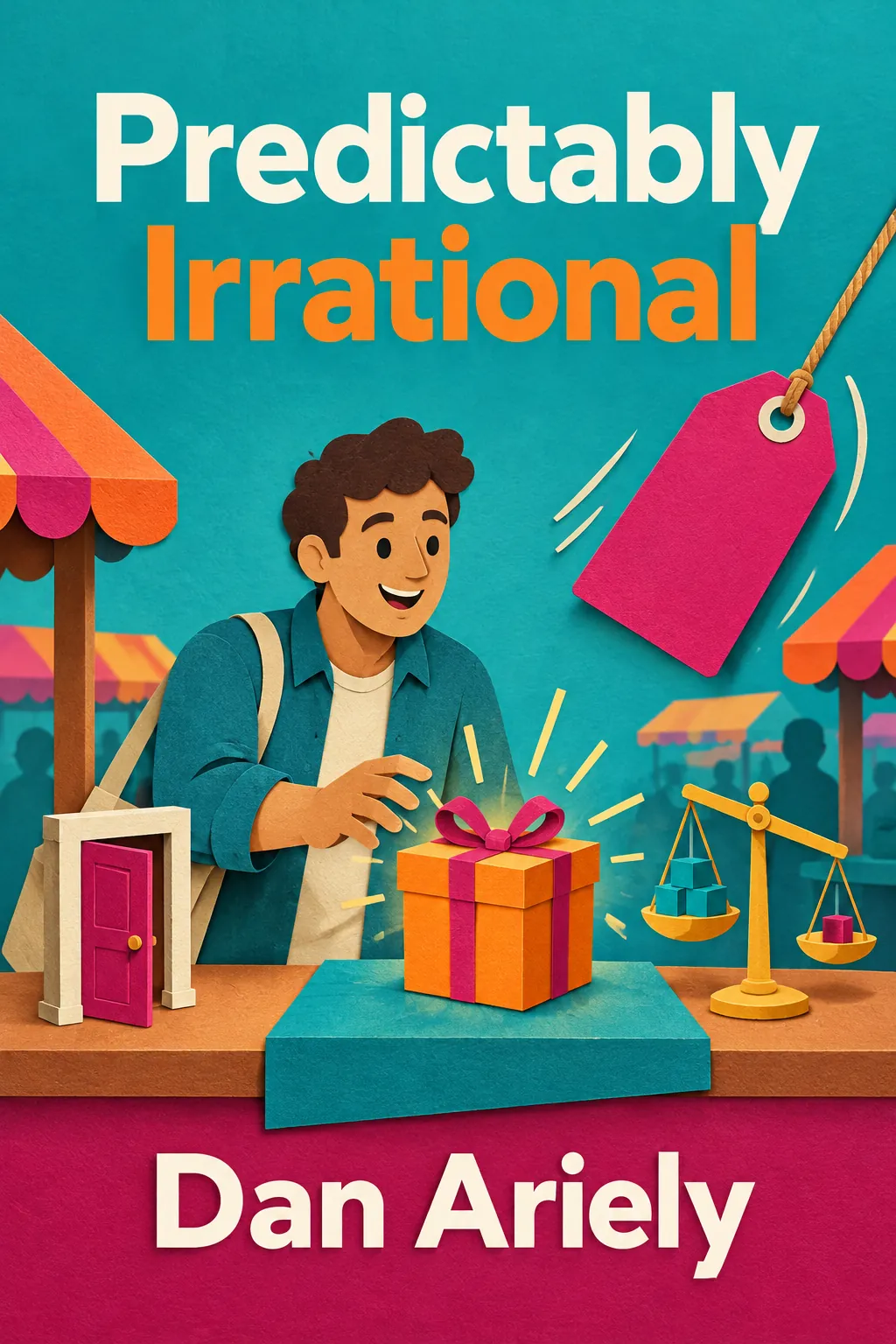
Predictably Irrational
by Dan Ariely
Predictably Irrational is a popular book on behavioral economics by Dan Ariely, a professor who studies decision-making. Ariely argues that people are not the calm, rational calculators economists often assume. Through playful experiments with students, he shows how free offers, anchors, decoy options, expectations and emotions push our choices off course, and how the errors follow patterns we can learn to predict. The book is not about being stupid. It is about understanding our habits so we can set up better choices.
The Big Idea
"People do not decide the way economic theory says they do, but their mistakes are not random. Dan Ariely shows that we misjudge value, effort and honesty in the same ways again and again."
Key Insights
We judge by comparison
People rarely measure value on its own. They compare an option with whatever sits next to it, with the first number they saw, or with what they expect. That is why decoys, anchors and labels move decisions without anyone noticing. A useful habit is to pull an option out of its setting and ask whether you would still want it alone.
Adding a useless print-only magazine plan changed the result: 84 of 100 students took the bundle with the decoy, but only 32 did without it.
Free and owned things grip us
Zero price and ownership both distort judgment. Free feels like pure gain with no risk of regret, and owning something makes giving it up feel like a loss. Companies use free samples and trials to trigger both feelings at once. Writing down what you gain and lose in plain money terms makes the pull easier to see.
Duke students who won basketball tickets asked more than ten times what other students would pay for the same seats.
Money is not always the best motivator
Relationships run on social norms, where people help out of goodwill, and on market norms, where people trade for pay. Bringing money into a favor can switch the first set off and leave only the second. Before offering a reward, it helps to ask which rulebook the other person thinks they are in. Thanks and meaning often work better than a small payment.
Lawyers asked to help older people for about thirty dollars an hour mostly said no, yet they agreed to help for free.
Mistakes are predictable, so we can plan for them
Our errors follow patterns, which means we can build defenses in advance. Calm, early decisions protect a hurried or excited future self, and rules we cannot easily bend beat good intentions. This is the hopeful core of the book: understanding the pattern is the first step to designing around it. Savings plans that move money automatically work for the same reason.
Students who got fixed, evenly spaced deadlines earned better grades on three papers than students who could hand everything in at the end.
Chapter Breakdown
Chapter-by-chapter summary
The book is a series of experiments rather than a story, so this section follows its main topics in order. Chapter titles and numbering differ between editions, so each part is labelled by topic.
Part 1: Relativity and the decoy
We rarely judge things on their own. We compare. Ariely shows this with a magazine offer: web only for $59, print only for $125, print plus web for $125. Of 100 MIT students, 16 chose web only, none chose print only, and 84 chose the bundle. When he removed the useless print-only option, 68 chose web only and just 32 chose the bundle. The print-only plan was a decoy that made the bundle look like a bargain. It matters because sellers, and our own minds, steer us by what sits beside an option.
Part 2: Anchors and arbitrary coherence
The first price we see sticks. Ariely asked students to write down the last two digits of their Social Security number, then to bid on items such as wine and chocolate. Students with higher numbers bid noticeably more. Once a first price is in our heads, later prices feel consistent with it, even though the starting point was random. He calls this arbitrary coherence. The story of black pearls, made to look precious by displaying them beside costly gems, shows the same mechanism. Prices tell us less about value than we think.
Part 3: The pull of zero
Free is not just a very low price. When students chose between a Lindt truffle at 15 cents and a Hershey's Kiss at 1 cent, most took the truffle. Cut each price by one cent, so the Kiss was free, and most switched to the Kiss. The real gap between the two had not changed. Zero removes the feeling of a possible loss, so a free item feels like pure gain. This helps explain the pull of free shipping and of freebies we hardly want. Zero deserves extra suspicion.
Part 4: Social norms and market norms
We live by two rulebooks. In social exchanges people help out of goodwill. In market exchanges they expect to be paid. Lawyers asked to advise older people in need for about $30 an hour mostly refused, yet agreed to help for free. Mixing the rulebooks causes trouble: when an Israeli day care fined parents for picking up children late, more parents arrived late, not fewer, because the fine turned a duty into a price. Money, Ariely says, is often the costliest way to motivate people.
Part 5: Emotion and arousal
When calm, we cannot imagine how we will act when excited. Ariely and his colleague George Loewenstein asked male Berkeley students questions about sexual preferences and risky choices twice, once in a calm state and once while aroused by a laptop. Their answers changed sharply, and they accepted options they had earlier rejected. The topic matters less than the gap between the two states. We plan for our calm selves and then fail to prepare for our heated ones. Anger, hunger and excitement work the same way.
Part 6: Procrastination and self-control
We mean to save, study and exercise, and then we put it off. In one class experiment, students wrote three papers under different deadline rules. Those given fixed, evenly spaced deadlines earned the best grades. Those who chose their own deadlines did worse than that, and those with one deadline at the end did worst. Choosing deadlines at all showed they knew their weakness. The lesson is that commitments we cannot easily change let today's calm self protect us from tomorrow's tempted one.
Part 7: The high price of ownership
Owning something raises its value in our eyes. At Duke University, tickets to a popular basketball game were given out by lottery. Students who won asked more than ten times as much to sell as students without tickets were willing to pay. Owners focus on what they would lose by selling, while buyers focus on what they would gain. This helps explain why people cling to old stocks, houses and clutter, and why free trials turn into purchases. Asking what you would pay if you did not own it yet brings some calm.
Part 8: Keeping doors open
Options feel free, but they cost attention and effort. In a computer game, players earned money by clicking on one of three doors. A door left unvisited for a while slowly vanished, so players burned clicks racing back to keep every door open, even when the doors paid little, and they earned less overall. Ariely sees the same habit in people who hesitate to commit to one path. Closing a door is sometimes the wisest move, because it frees energy for the goal that matters most.
Part 9: The effect of expectations
What we expect shapes what we experience. At an MIT pub, students compared two beers: an ordinary one and a version with a few drops of balsamic vinegar, nicknamed MIT Brew. Students told about the vinegar before tasting mostly disliked it. Those who learned of it only afterward, or never, often preferred it. The taste was identical; the information that arrived first changed the experience. Brand names, reviews and descriptions quietly write the experience we later report as our honest opinion.
Part 10: The power of price and placebo
Price works as a signal of quality. In a test where people received electric shocks, participants were given a pill described as a new painkiller. Those told it cost full price reported more relief than those told it had been discounted, though both pills were placebos. A higher price raised expectations, and expectations changed how much pain people felt. Ariely points out that placebos can bring real relief, which is why a label or a price tag can matter far more than it should.
Part 11: Dishonesty and the fudge factor
Most people are not criminals, yet many cheat a little. In puzzle tests that paid for each correct answer, some participants could shred their answer sheets and report their own scores. They claimed a bit more than they had earned, but only a bit, and changing the chance of being caught made little difference. Asking people to recall the Ten Commandments before the test reduced cheating. Ariely calls this the personal fudge factor: we cheat only as far as we can still see ourselves as honest.
Part 12: What to do with all this
The closing pages argue that predictable mistakes are an opportunity. If we know where people go wrong, we can design better savings plans, rules, products and classrooms around real human behavior instead of an imaginary rational customer. Ariely also urges readers to test their own habits, because experiments, not assumptions, show how we actually behave. That curious, experimental attitude holds the whole book together.
Key people and terms
Dan Ariely
The author, a behavioral economist. Badly burned as a teenager, he became curious about how patients and doctors make choices about pain, and that curiosity grew into the experiments in this book. Most of his studies use university students as participants.
George Loewenstein
A behavioral economist and Ariely's collaborator on the arousal studies. His work on how emotion bends judgment sits behind the book's argument that calm people cannot predict how they will act when excited.
Decoy effect
An option nobody picks that makes another option look better. The print-only magazine plan is the book's best example: it exists mainly to make the print-plus-web bundle look like a bargain, and it works.
Arbitrary coherence
The idea that a first price, even a random one, becomes the anchor for later judgments. Once we accept a starting price, we compare everything to it and feel consistent, although the starting point meant nothing.
Social norms and market norms
Two sets of rules for exchange. Social norms run on goodwill and favors; market norms run on prices and pay. Mixing them, for example by offering a small payment for a favor, can damage the relationship.
Personal fudge factor
The amount of cheating a person allows while still feeling honest. People cheat a little, not a lot, so they can keep seeing themselves as decent. Reminders of morality shrink the fudge factor.
Ownership effect
People value what they own more than what they could buy. In the Duke ticket lottery, owners asked far more to sell than other students would pay to buy.
Writing about this book
Predictably Irrational works well for book reports and essays because it invites you to compare the experiments with your own habits. Start by picking the one experiment that stuck with you most, then ask whether you would have reacted the same way. If you would not, explore why; that tension makes a stronger essay than simple agreement.
Questions to think about:
- What does “rational” mean here, and does Ariely show that people are foolish, or only that they are human?
- Which of your own habits looks like procrastination, ownership or the pull of free?
- If mistakes are predictable, what should schools, shops or governments do differently?
- Most studies used university students. How might that shape the conclusions?
Keep the retelling short. Choose one or two experiments, report the numbers accurately, and spend most of your words on your own thinking. A closing paragraph explaining how the book changed one choice you make, such as how you shop or plan your study time, gives the piece a clear ending.
Take Action
Practical steps you can implement today:
-
When options are lined up, judge each one alone and ask, “Would I want this by itself?” That blunts decoys and anchors.
-
Treat “free” as a signal to slow down. Write out what you would pay, and what you would lose, before you accept.
-
Beat procrastination with deadlines you cannot move, set while you are calm, instead of trusting your future self.
-
Before paying someone for a favor, consider whether thanks would keep the goodwill that money might destroy.
-
Before keeping something you own, ask what you would pay for it if you did not have it yet.
Notable Quotes
"“Zero is not just another discount. Zero is an emotional hot button—a source of irrational excitement.” (on zero cost)"
— Dan Ariely
"“Money, as it turns out, is often the most expensive way to motivate people.” (on social and market norms)"
— Dan Ariely
"“We are not only irrational, but predictably irrational—that our irrationality happens the same way, again and again.” (Introduction)"
— Dan Ariely
Who Should Read This
Students and general readers meeting behavioral economics for the first time, and anyone who shops, saves or sells for a living. It suits readers from about age 15 up. There is no math to speak of, only short experiments told in plain language. Readers who want the full theory can follow it with Thinking, Fast and Slow.
Frequently Asked Questions
What is Predictably Irrational about?
It is Dan Ariely's 2008 book on behavioral economics. Using experiments, mostly with students, he shows that people misjudge prices, effort, ownership and honesty in consistent ways. The main message is that these errors follow patterns, so they can be understood and planned for instead of simply regretted.
What does “predictably irrational” mean?
It means that people do not decide with perfect logic, but their errors are not random. The same biases, such as being drawn to free offers or overvaluing what we own, show up again and again, so a careful observer can predict them.
What are the key ideas of Predictably Irrational?
The key ideas are relativity and decoys, anchoring, the pull of zero price, social versus market norms, the effect of emotion, procrastination, ownership, expectations, the power of price, and a personal fudge factor for dishonesty. Each comes with an experiment that makes it concrete.
How is it different from Thinking, Fast and Slow?
Both explain how human judgment goes wrong. Daniel Kahneman builds a broad theory of two thinking systems, drawing on decades of research. Ariely keeps closer to short, lively experiments and everyday cases. Many readers start with Ariely for the examples and move on to Kahneman for the framework.
Check Your Understanding
Pick an answer for each question to see if you were right.
-
In the magazine experiment, what was the print-only plan for?
To make the print-plus-web bundle look like a better deal — Almost nobody picked it, but its presence made the bundle look like a bargain.
-
When the Hershey's Kiss became free, what did most students do?
Switched to the Kiss — Zero removes the sense of loss, so free feels like pure gain even though the price gap stayed the same.
-
What happened when the day care fined parents for late pickup?
More parents were late — The fine turned a social duty into a price, so more parents were willing to pay and arrive late.
-
What does Ariely's “personal fudge factor” describe?
How much people cheat while still seeing themselves as honest — People cheat a little, but not enough to damage their picture of themselves as honest.
-
Which deadline arrangement produced the best grades?
Fixed, evenly spaced deadlines — Fixed deadlines protected students from their own tendency to put things off.
About Dan Ariely
Dan Ariely is a behavioral economist known for experiments on how people make decisions. Born in New York in 1967 and raised in Israel, he has taught at MIT and Duke University. Predictably Irrational (2008) was his first book for general readers, followed by The Upside of Irrationality and The Honest Truth About Dishonesty.
Summary Written By

Software Engineer & Writer
Software engineer with a passion for distilling complex ideas into actionable insights. Writes about finance, investment, entrepreneurship, and technology.
View all summaries →Reviews
No reviews yet. Be the first to share your thoughts!
Write a Review
Keep reading
Explore the topic: Personal DevelopmentSummaries

Educated by Tara Westover
Tara Westover
A memoir about a young woman born to survivalists in Idaho who, despite having no formal schooling, teaches herself to…

Atomic Habits: An Easy & Proven Way to Build Good Habits & Break Bad Ones
James Clear
No matter your goals, Atomic Habits offers a proven framework for improving–every day. James Clear, one of the world’s leading…

The Psychology of Money
Morgan Housel
Morgan Housel’s insightful exploration of how psychology affects our financial decisions and wealth-building journey.
Think and Grow Rich
Napoleon Hill
What if the secrets to wealth and success weren’t hidden in complex financial strategies, but within the power of your…
Articles

Let Them Theory vs task separation: where responsibility starts
Let Them Theory and task separation both ask you to stop managing other people’s choices, but they start from different…

Scout Mindset vs Growth Mindset: Beliefs and Abilities
Scout mindset checks beliefs against evidence; growth mindset concerns developing abilities. A fictional presentation example shows how to use both…

Spaced repetition vs rereading: how to review a book
Compare the timing of spaced review with the task of recalling or rereading. Work through a fictional example, check mistakes,…