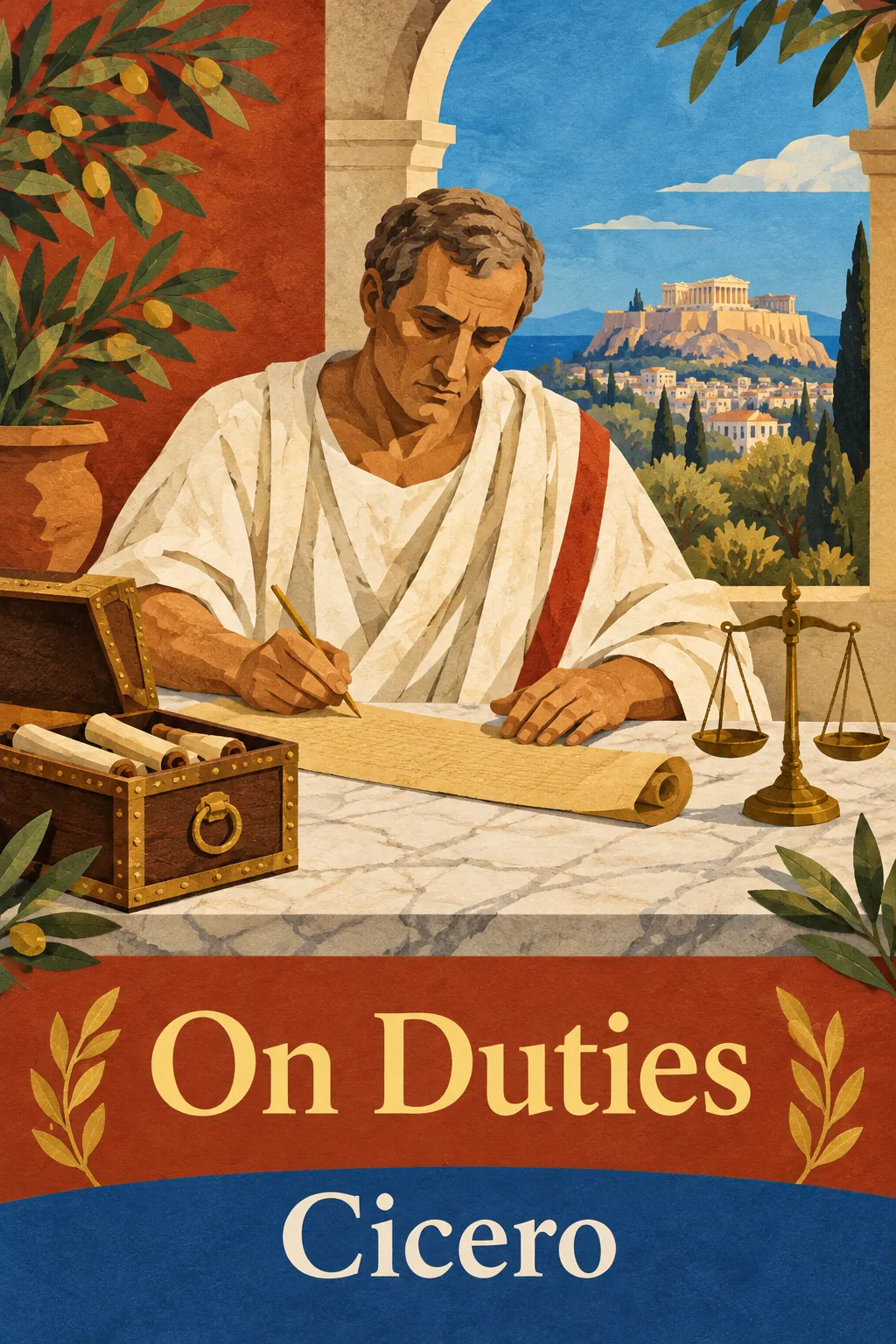
On Duties
by Cicero
On Duties is a practical guide to living well, written by the Roman statesman Cicero in 44 BC as a letter-style treatise to his son Marcus. Cicero asks what we owe to others and to ourselves in each role we hold. He builds the answer on four virtues (wisdom, justice, courage and self-control) and then tackles hard cases where honesty seems to cost us. His verdict is firm: nothing truly useful can be wrong, and nothing wrong can be truly useful.
The Big Idea
"Cicero argues that being useful and being good are never truly opposed: what looks like a profitable shortcut through wrongdoing always costs more than it gains, so duty should guide every choice."
Key Insights
Right and useful never truly clash
Cicero holds that a wrong act can never be genuinely useful. When wrongdoing seems to pay, he says, we are only counting the short term and ignoring lost trust, shame and the damage done to our own character. The conflict between profit and principle is a mistaken calculation, not a real fork in the road.
In the Rhodes grain story, the merchant who hides the approaching ships may earn more today, but he breaks the trust that a decent community depends on, and Cicero counts that as a loss.
Justice has two faces
Most people think injustice means harming someone. Cicero adds a second kind: standing by when you could have protected a person and chose not to. Justice is therefore active as well as restrained, because we are born into a community, not into isolation. This widens duty from avoiding harm to taking part.
A student who watches a classmate being bullied and says nothing, though speaking up would be safe, fits Cicero's second kind of injustice, even though he never touched anyone.
Duty depends on your roles
Cicero does not offer one rule for everyone. He shows that duties differ with our relationships and roles (citizen, child, parent, friend) and with the particular person we are, with our own talents and limits. Knowing our roles lets us rank competing demands calmly.
A gifted speaker and a quiet scholar may both serve their city well, each in a different way. Cicero warns against forcing yourself into someone else's role instead of panicking when duties collide.
Trust is the strongest power
In Book 2 Cicero argues that fear makes a poor foundation. People obey tyrants only while they must, and the tyrant never sleeps easy. Lasting influence comes from being trusted, and trust is built by fairness, kept promises and generous service. Power without trust is fragile.
Cicero warns politicians who buy popularity by cancelling debts: the applause comes quickly, but the confidence of honest citizens does not return, and the whole community is weaker for it.
Chapter Breakdown
Chapter-by-chapter summary
Part 1: A Father's Letter to a Distant Son (Book 1, opening)
Late in 44 BC, with Caesar dead and the republic in turmoil, Cicero had been pushed out of real power. His son Marcus was studying philosophy in Athens, so Cicero wrote him a long, fatherly guide to living well. He says he follows the Greek Stoic Panaetius, but he adapts him freely for Roman life. Cicero also separates two levels of duty: the “perfect” duty only a wise person could fulfil, and the “ordinary” duty that decent people can manage. This split matters because it makes the book usable by everyone, not just by saints.
Part 2: The Four Sources of Goodness (Book 1, wisdom and justice)
Cicero says every duty grows from four parts of moral goodness: wisdom, justice, courage and self-control. On wisdom, he praises the search for truth but warns against rushing to conclusions or wasting time on puzzles that help no one. Justice is the heart of the book. He names two kinds of injustice: harming others, and watching harm happen when you could stop it. Keeping promises and respecting property belong here too. He repeats a line he credits to Plato, that we are not born for ourselves alone. Duty starts with the fact that we live among other people.
Part 3: Courage, Fitting Behaviour and Roles (Book 1, second half)
Courage, for Cicero, covers more than battle. It also means standing up to injustice in public life. But courage without justice is just violence, and courage chasing fame is not the real thing. Next he turns to propriety, acting in a way that fits. We each play four roles at once: a reasoning human being, a person with our own temperament, someone in particular circumstances, and someone who has chosen a path in life. He advises against copying others at the cost of your own nature. Finally he ranks our duties: country first, then parents, then children and household, then relatives and friends. Duty, he shows, depends on relationships, and the strongest claims come first.
Part 4: What Is Truly Useful? (Book 2)
Book 2 asks what is truly useful. Cicero's answer is surprisingly human: the most useful thing in life is other people's cooperation, and that comes from trust, respect and goodwill. Rulers who govern through fear, he warns, live in fear themselves. He is hard on politicians who cancel debts or hand out land to win popularity. On generosity, he prefers help given through effort and time over cash, and he says not to give so much that you ruin yourself or your family. The lesson is that reputation and influence grow slowly, from honest and caring acts.
Part 5: When Right and Useful Seem to Clash (Book 3, opening)
Book 3 takes on the hardest question: what if the right thing and the profitable thing seem to clash? Cicero notes that Panaetius never wrote this part, so he builds it himself. His starting point is that a wrong act can never truly be useful; the clash is an illusion created by short-term thinking. To test this he uses the story of the ring of Gyges, a ring that makes its wearer invisible. If you could do wrong and never be found out, would you? Cicero says a good person would not, because goodness does not depend on being watched. The test separates real character from reputation.
Part 6: Hard Cases from Business and Daily Life (Book 3, middle)
Cicero then tests his idea on business cases. In the best known, a grain merchant from Alexandria reaches a starving Rhodes and knows that more ships are close behind. Should he say so, or sell high? Two Stoic teachers disagree. Diogenes of Babylon allows silence if no law is broken. Antipater of Tarsus says a seller must share what he knows for the good of everyone. Cicero sides with Antipater. He adds other examples, such as selling a house with a hidden flaw. His point is that what the law permits and what a decent person does are different things.
Part 7: Promises, Oaths and Regulus (Book 3, ending)
The last theme is promises and oaths. Cicero's model is Regulus, a Roman general captured by Carthage in the First Punic War. According to tradition, Carthage sent him to Rome on oath to return if no prisoner exchange was agreed. In the Senate he argued against the exchange, then went back to Carthage as he had sworn, and was reportedly put to a cruel death. Cicero does not call this a bad bargain. He treats it as proof that keeping faith outweighs personal suffering. He closes by telling Marcus that nothing contrary to virtue can ever be a real benefit.
Key people and terms
- Cicero (106–43 BC): Roman lawyer, orator and consul in 63 BC. Pushed out of power by Caesar and later hunted by Mark Antony, he wrote On Duties in his final year. He was killed in December 43 BC.
- Marcus Cicero: Cicero's son and the person the book is addressed to. He was studying in Athens under the philosopher Cratippus when his father wrote, so the whole book reads like a long letter of advice.
- Panaetius: A Stoic philosopher from Rhodes in the second century BC. His work on appropriate acts is the main model for Books 1 and 2, though Cicero rewrites it for Roman readers and fills the gap in Book 3.
- Diogenes of Babylon and Antipater of Tarsus: Two Stoic teachers whose argument about the Rhodes grain merchant drives a key part of Book 3. Diogenes tolerates silence if the law is kept; Antipater demands full disclosure. Cicero backs Antipater.
- Regulus: Marcus Atilius Regulus, a Roman general in the First Punic War. Cicero holds him up as the model of someone who kept an oath at terrible personal cost, and as proof that keeping your word can matter more than staying safe.
- Honestum: Latin for what is morally right and admirable. It is the book's central standard: an act is a duty if it fits the four virtues of wisdom, justice, courage and self-control.
- Utile: Latin for the useful or advantageous. Books 2 and 3 ask whether it can ever pull against honestum, and Cicero's firm answer is no, because real advantage always includes trust and good standing.
Applying On Duties in real life
This book works best when you test it on choices you actually face. Here are questions the text raises:
- When a shortcut would pay off but involves hiding something, could you do it openly? Cicero treats the urge to hide as a warning.
- Is there someone you could protect or help and are choosing to ignore? That, for Cicero, is the second kind of injustice.
- Which of your roles (student, child, friend, team member) is making a claim on you right now, and which claim is strongest?
- Are you treating “it is not against the rules” as the same as “it is fine”?
If you are writing about the book for school or a discussion group, pick one of Cicero's claims, such as “the useful and the right never conflict”, and test it against a modern case: a sports team, an online shop, a group chat. Say whether you agree and why. Take the best objection seriously too: can a person really lose out and still say they chose well? Finish by saying what you would do. The question is ancient, but it has not changed.
Take Action
Practical steps you can implement today:
-
Before a tempting shortcut, ask whether you could do it openly. If you would hide it, treat that as a warning, not a detail.
-
Help when you can. Cicero counts silence in the face of preventable harm as a form of injustice.
-
List your roles and rank their claims, starting with the widest and strongest bonds, so conflicts feel less confusing.
-
Build influence slowly through honesty and reliable service, since trust lasts longer than fear or flattery.
-
Do not confuse what is legal with what is decent; the law sets a minimum, not a standard of character.
Notable Quotes
"“We are not born for ourselves alone.” (Book 1, on justice)"
— Cicero
"“Injustice is of two kinds: doing harm, and failing to protect others from harm when you can.” (Book 1)"
— Cicero
"“Never less idle than when at leisure, never less alone than when alone.” (Book 3, opening, a saying of Scipio)"
— Cicero
"“Nothing that is wrong can ever be useful.” (Book 3, the core principle)"
— Cicero
Who Should Read This
Readers of Stoicism who want the Roman world behind Seneca and Marcus Aurelius, students of ethics, law or politics, and anyone facing a choice where honesty seems expensive. The ideas are clear enough for older teens (about age 15 and up), though a modern translation with notes helps with the Roman background.
Frequently Asked Questions
What is On Duties by Cicero about?
On Duties (De Officiis) is a three-book guide to right conduct. Book 1 covers moral goodness and the four virtues, Book 2 covers what is truly useful, and Book 3 asks what to do when the two seem to clash. Cicero's answer is that real usefulness never contradicts goodness.
When did Cicero write On Duties, and why?
He wrote it in the autumn and early winter of 44 BC, after Caesar's assassination had left him out of power. He addressed it to his son Marcus, who was studying in Athens, and it was one of his last works before he was killed in December 43 BC.
What are the four virtues in On Duties?
Wisdom (seeking truth), justice (keeping society and promises sound), courage (greatness of spirit) and self-control or propriety (order and fitness in what we do). Cicero treats every duty as flowing from one of these four, with justice given the most space.
Does Cicero think doing the right thing ever costs you?
It can cost you something in the short term, and he admits it, as the story of Regulus shows. But he argues that the cost is outweighed by trust, self-respect and a good name, so nothing truly useful is lost. Whether that holds in every case is something readers still debate.
How does On Duties connect to Seneca and Marcus Aurelius?
Cicero wrote about a century before Seneca and over two hundred years before Marcus Aurelius. He was not a strict Stoic, but he borrowed from the Stoic Panaetius, and later Roman Stoics shared his stress on serving the community. Reading Cicero first shows where that Roman ethic of duty began.
Check Your Understanding
Pick an answer for each question to see if you were right.
-
To whom did Cicero address On Duties?
His son Marcus — Marcus was studying in Athens, and the book is written as advice to him.
-
Which pair names two of the book's four virtues?
Wisdom and justice — The four virtues are wisdom, justice, courage and self-control.
-
What two kinds of injustice does Cicero name?
Harming others, and failing to protect them when able — Cicero says injustice includes both doing harm and standing by when you could prevent it.
-
In the Rhodes grain story, who says the seller must share what he knows?
Antipater of Tarsus — Antipater demands full disclosure, and Cicero sides with him.
-
What does Cicero conclude about the right and the useful?
They cannot truly conflict — Cicero argues that real usefulness always includes goodness, so a wrong act is never truly useful.
About Cicero
Marcus Tullius Cicero (106–43 BC) was a Roman lawyer, orator and statesman who served as consul in 63 BC. He wrote widely on rhetoric, politics and philosophy, bringing Greek ideas into Latin. After Caesar's death he opposed Mark Antony and was killed in 43 BC. On Duties, his last major work, remained a standard text on ethics for centuries.
Summary Written By

Software Engineer & Writer
Software engineer with a passion for distilling complex ideas into actionable insights. Writes about finance, investment, entrepreneurship, and technology.
View all summaries →Reviews
No reviews yet. Be the first to share your thoughts!
Write a Review
Keep reading
Explore the topic: Personal DevelopmentSummaries

Educated by Tara Westover
Tara Westover
A memoir about a young woman born to survivalists in Idaho who, despite having no formal schooling, teaches herself to…

Atomic Habits: An Easy & Proven Way to Build Good Habits & Break Bad Ones
James Clear
No matter your goals, Atomic Habits offers a proven framework for improving–every day. James Clear, one of the world’s leading…

Think and Grow Rich
Napoleon Hill
What if the secrets to wealth and success weren’t hidden in complex financial strategies, but within the power of your…

Melbourne
Alex Ng
Sophie Cunningham's Melbourne is a deeply personal exploration of Australia's cultural capital, weaving together history, architecture, weather patterns, and personal…
Articles

The Enlightenment Explained: Ideas, Thinkers and Legacy
The Enlightenment was an 18th-century European movement that trusted reason and evidence over tradition and authority. Its thinkers, from Locke…
World History 1700–1918: Revolutions, Industry, Empire and War
Between 1700 and 1918, revolutions, factories, empires and a world war reshaped societies across Europe, the Americas, Asia and Africa.…

Best Stoicism Books for Beginners: Where to Start and Why
Looking for the best stoicism books for beginners? Discover a clear reading route comparing ancient classics like Marcus Aurelius with…