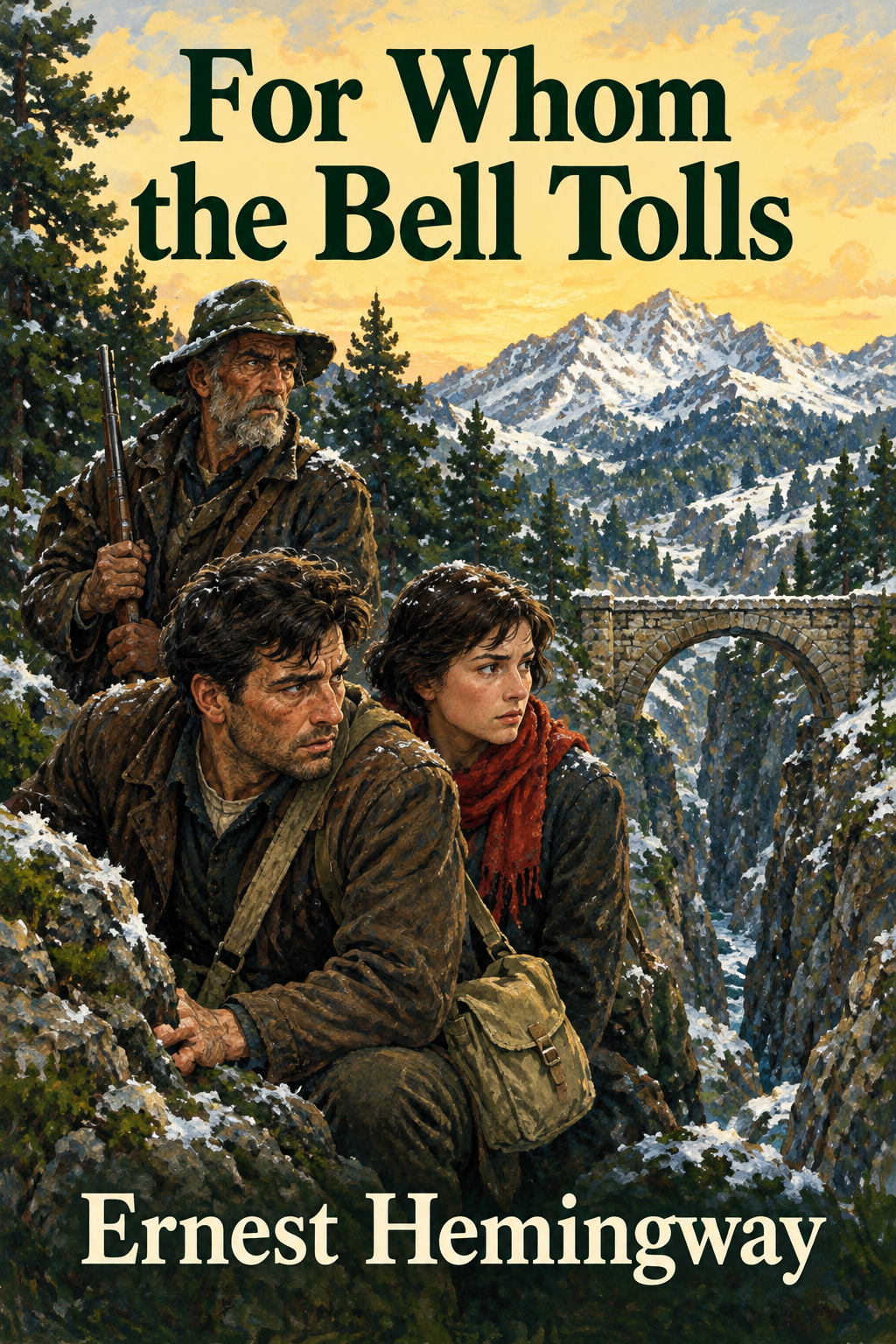
For Whom the Bell Tolls
by Ernest Hemingway
For Whom the Bell Tolls is a novel about an American explosives expert fighting for the Spanish Republic in 1937. Robert Jordan is sent behind enemy lines to blow up a bridge at the exact moment an attack begins. He has to depend on a band of guerrillas whose leader no longer wants to fight. Over a few tense days he faces doubt, loyalty, a sudden love for a young woman named Maria, and the question of what one life is worth.
The Big Idea
"Hemingway argues that no one stands alone. In a few days in the Spanish mountains, Robert Jordan learns that duty, love and death tie one life to many others."
Key Insights
No one stands alone
The title and the epigraph by John Donne state the book's central claim: every person is part of a larger whole, so each death shrinks everyone. Jordan begins as a solitary specialist who trusts only his craft. Over a few days he is pulled into the lives of Anselmo, Pilar, Maria and even Pablo, and he finds that his choices bind him to them. By the end he speaks as one of a group, not as a lone fighter.
Jordan's farewell to Maria, where he tells her that the one who stays is also the one who goes, shows the idea at its simplest.
Duty and doubt can live together
Jordan believes in the Republic, but he also sees its lies, its cruelty and its muddle. The novel never mocks his loyalty. It shows a man who keeps a promise to a cause even after he knows the cause is flawed. Hemingway asks whether commitment means more when it is clear-eyed than when it is blind. His talks about Karkov and the delay caused by Marty show how far the leadership falls short. That tension drives every decision he makes.
He still sends Andrés with the warning and still prepares the bridge, though he knows the order may be pointless.
Cruelty belongs to both sides
Hemingway refuses to make one side clean. Pilar's account of the village killings shows ordinary people turning savage, and Maria's story shows what the Nationalists did to her family. Jordan's sympathy for the Republic does not let him look away from either. The book treats war as a machine that damages everyone it touches, whatever flag they follow. This is why the novel reads as honest rather than as propaganda. Readers often notice that Pablo is cruel, brave and cowardly in turn.
Pilar tells the village story with both horror and pride, and the reader is left to decide what to feel.
A short life can be a full life
Jordan has only days, and the days feel complete. His love for Maria, his friendship with Anselmo and his sense of purpose are packed into a handful of hours. Hemingway suggests that the quality of a life does not depend on its length. Jordan's last thoughts, that the world is worth fighting for, are not gloomy. They are an act of love for being alive, and he holds on to them when it matters most.
Jordan's thought near the end that the world is a fine place and worth the fighting for sums up the book's mood.
Chapter Breakdown
Chapter-by-chapter summary
Spoiler warning: this section covers the whole plot, including the ending. The novel has 43 numbered chapters without titles, so the story is grouped here into seven natural parts.
Part 1: The bridge and the mountain camp
Robert Jordan, an American who taught Spanish at the University of Montana, is now an explosives expert working for the Republic. In May 1937 he slips behind enemy lines in the Guadarrama mountains. General Golz has ordered him to destroy a bridge at the moment a Republican offensive begins. Anselmo, an old hunter, guides him to a guerrilla band hiding in a cave. Its leader, Pablo, is sullen and wants to avoid trouble, so his wife Pilar quietly runs the camp. Jordan also meets Maria, a young woman rescued from a train after Nationalists shaved her head. Why it matters: the deadline, the reluctant ally and the doubtful mission that drive the whole book are all in place.
Part 2: Pilar's story and Jordan's family
Pilar describes how Pablo led the killing of the village's fascists on the first days of the war. He made prisoners run between two lines of villagers with flails, then had them thrown from a cliff. She tells it with horror and a grim kind of pride. Jordan thinks about his own family: his grandfather fought in the American Civil War, and his father shot himself, which Jordan has never forgiven as cowardice. Why it matters: Hemingway shows that cruelty belongs to both sides, and that Jordan carries his own private fear about courage and death.
Part 3: Love and the problem of Pablo
Jordan and Maria fall in love almost at once. Maria lost her parents and was assaulted by Falangist soldiers, and beside Jordan she slowly begins to feel whole again. To Jordan their nights together feel like a whole lifetime squeezed into a few days. Pilar watches over them and reads Jordan's palm, but refuses to say what she saw. Meanwhile Jordan studies the bridge and quietly considers whether he should kill Pablo, who threatens the plan. Why it matters: the love story is the book's argument that a short life can still be a full one.
Part 4: El Sordo, Madrid memories and the snow
Jordan visits El Sordo, the deaf leader of another guerrilla band, who agrees to help with horses and men. Jordan remembers his months in Madrid, including the Russian journalist Karkov, who spoke frankly about how politics and power work inside the Republic. Then an unseasonable snowfall sets in. Tracks in the snow now threaten to give every hidden band away. Why it matters: Jordan believes in the cause but sees its lies and muddle clearly, and the weather turns that unease into real danger.
Part 5: El Sordo's last stand and Pablo's betrayal
A cavalry patrol follows tracks to El Sordo's hilltop. His small band is trapped and fights to the end, and Nationalist planes finally bomb the hill. Jordan and the others hear the distant battle and can do nothing. On the night before the attack, Pablo disappears with the detonators and exploder Jordan needs. He returns later, ashamed, with a few men and horses, but he has thrown the equipment into the gorge. Jordan improvises with grenades and wire. Why it matters: one man's fear can threaten everyone's life.
Part 6: The message to General Golz
Jordan realises the enemy seems to know about the offensive. He writes to Golz asking him to cancel or delay the attack and sends young Andrés with the message. Andrés crosses the lines but is held up by André Marty, a suspicious political commissar. When the message finally reaches Golz, it is too late to stop the attack, and Golz knows it. Why it matters: the novel shows how suspicion and procedure can make a sound warning useless.
Part 7: The bridge and Jordan's last stand
When the attack begins, Jordan and Anselmo blow the bridge. Anselmo is killed by a piece of flying steel. During the retreat a tank shell bursts near Jordan's horse, which falls and breaks his leg. He cannot ride on, so he persuades Maria to go with Pilar and tells her they are not really parted. He stays behind with a light machine gun, watching the road for an approaching officer. Why it matters: Jordan's choice to stay for the others is where the title's idea becomes action.
Characters
Robert Jordan
An American dynamiter and former Spanish teacher from Montana. He is skilled, thoughtful and tired of slogans, and he is sent to blow up the bridge. He remains loyal to the cause even after he has seen its flaws.
Maria
A young Spanish woman whose parents were killed and whose head was shaved by Nationalists. She is fragile and frightened at first. Her love for Jordan gives her, and him, a reason to value the present.
Pablo
The former leader of the guerrilla band. He was brave once but now drinks, fears the coming mission and cares most about his horses. He is cruel, cowardly and surprisingly loyal at different moments.
Pilar
Pablo's wife and the camp's real leader. She is tough, sharp-tongued and a gifted storyteller, and she reads palms. She tells the book's most vivid history of the war's early violence.
Anselmo
An elderly hunter who guides Jordan. He is gentle and steady, and he hates killing even though he does it for the cause. He stays beside Jordan at the bridge.
El Sordo
The deaf leader of a neighbouring guerrilla band. He is calm, practical and brave, and his last stand on the hilltop is among the book's most memorable scenes.
Agustín
A foul-mouthed guerrilla who is loyal to Jordan and eager for action. He despises Pablo's caution and says what other fighters are thinking.
Fernando
A slow, serious guerrilla with formal manners. His solemn speech and refusal to hurry are a source of dry humour in the camp.
General Golz
The Republican general who plans the offensive and gives Jordan his orders. He is blunt and weary, and he knows how often plans fail.
Karkov
A Russian journalist in Madrid. He appears mainly in Jordan's memories and talks with sharp honesty about how politics works inside the Republic.
Writing about this book
A good essay on this novel picks one question and follows it through specific scenes. These angles are a starting point, not an essay to copy.
- The title and epigraph. Reread the passage by John Donne and ask how Jordan changes from a solitary specialist into someone tied to others. Which scenes show that change?
- Time. The story covers only a few days, yet they feel complete. How does Hemingway make a short time feel long? Look at the love scenes and the waiting scenes.
- Two sides, one war. Compare Pilar's village story with Maria's. What does the author want you to notice about cruelty?
- Doubt and duty. Jordan knows his side is flawed but keeps his promise anyway. Is that admirable, foolish or both?
- Style. Notice the plain sentences and the English that imitates Spanish speech. How does it change your sense of the characters?
Whichever angle you choose, quote briefly, name the scene, and explain why it matters in your own words.
Take Action
Practical steps you can implement today:
-
Commit to a goal even when you can see its flaws, but keep your eyes open about what it costs.
-
Notice how your choices affect people far beyond your own circle.
-
Treat time as limited: say what you mean and spend it on the people you love.
-
When a plan is falling apart, look for a smaller step you can still do well.
Notable Quotes
"“No man is an island, entire of itself.” (Epigraph, John Donne)"
— Ernest Hemingway
"“…never send to know for whom the bell tolls; it tolls for thee.” (Epigraph, John Donne)"
— Ernest Hemingway
"“The world is a fine place and worth the fighting for…” (Chapter 43)"
— Ernest Hemingway
Who Should Read This
Readers aged about sixteen and up who want a clear guide to Hemingway's longest and most political novel. It suits students of the Spanish Civil War, high-school and college literature classes, and anyone who finds the long dialogue and many Spanish names hard to follow. Use it as a refresher before the novel or a reference after it.
Frequently Asked Questions
What is For Whom the Bell Tolls about?
It follows Robert Jordan, an American explosives expert fighting for the Spanish Republic in 1937. He must blow up a bridge in the mountains when an offensive begins, working with a guerrilla band that is divided about the mission. Along the way he falls in love with Maria and faces questions about duty, fear and death.
Where does the title come from?
The title comes from a passage by the English poet John Donne, which Hemingway prints at the start of the book. Donne writes that no person is isolated and that a death anywhere concerns everyone, so we should not ask for whom the bell tolls. The line gives the novel its central idea.
Is the story based on real events?
The setting is real: the Spanish Civil War, which ran from 1936 to 1939. Hemingway reported on it as a journalist in 1937 and 1938. Jordan, the guerrilla band and the bridge mission are fictional, though some historical figures and events appear in the background.
How long does the story take?
The story covers only a few days in late spring 1937. Hemingway uses this short time to build tension and to make Jordan's love for Maria and his friendship with Anselmo feel intense. Memories and long conversations fill in the characters' pasts.
What are the main themes?
The main themes are the connection between all people, duty against doubt, the cruelty found on both sides of a war, and the idea that a short life can be a full one. Courage, fear and death also run through the book, especially in Jordan's thoughts about his father.
Is the book hard to read?
It is long, with many characters and some slow conversations. Hemingway also writes the Spanish characters' speech in a formal English that imitates Spanish, using words like thee and thou, which can feel odd at first. A summary of characters and parts makes the story much easier to follow.
Check Your Understanding
Pick an answer for each question to see if you were right.
-
What is Robert Jordan's job in the story?
Dynamiter (explosives expert) — Jordan is an American explosives expert sent to destroy a bridge.
-
Whose writing gives the novel its title?
John Donne — The title comes from a passage by John Donne printed at the start of the book.
-
Which character reads Jordan's palm?
Pilar — Pilar reads Jordan's palm and then refuses to say what she saw.
-
What is Jordan ordered to destroy?
A bridge — He must blow up a bridge at the moment a Republican offensive begins.
-
In which year is the novel set?
1937 — The story takes place in May 1937, during the Spanish Civil War.
About Ernest Hemingway
Ernest Hemingway (1899–1961) was an American novelist and short-story writer known for plain, tightly controlled prose. He reported on the Spanish Civil War as a journalist in 1937 and 1938, and drew on that experience for this novel, published in 1940. He received the Nobel Prize in Literature in 1954.
Summary Written By

Software Engineer & Writer
Software engineer with a passion for distilling complex ideas into actionable insights. Writes about finance, investment, entrepreneurship, and technology.
View all summaries →Reviews
No reviews yet. Be the first to share your thoughts!
Write a Review
Keep reading
Explore the topic: FictionSummaries

Out of My Mind
Sharon M. Draper
“Out of My Mind” by Sharon M. Draper is a poignant narrative that explores the life of Melody Brooks, a…

Ender’s Game
Orson Scott Card
“Ender’s Game” by Orson Scott Card is a riveting science fiction novel that transports readers into a future where humanity…

Pachinko
Min Jin Lee
“Pachinko”, a spellbinding multigenerational historical saga by Min Jin Lee, explores the lives of a Korean family trying to make…

The Perks of Being a Wallflower
Stephen Chbosky
The Perks of Being a Wallflower by Stephen Chbosky is a profound coming-of-age novel, told through the intimate letters of…
Articles
The Enlightenment Explained: Ideas, Thinkers and Legacy
The Enlightenment was an 18th-century European movement that trusted reason and evidence over tradition and authority. Its thinkers, from Locke…
World History 1700–1918: Revolutions, Industry, Empire and War
Between 1700 and 1918, revolutions, factories, empires and a world war reshaped societies across Europe, the Americas, Asia and Africa.…

A Christmas Carol themes: generosity, isolation and responsibility
Dickens's novella is usually read as a story about a man who changes his mind. Its themes are sharper than…