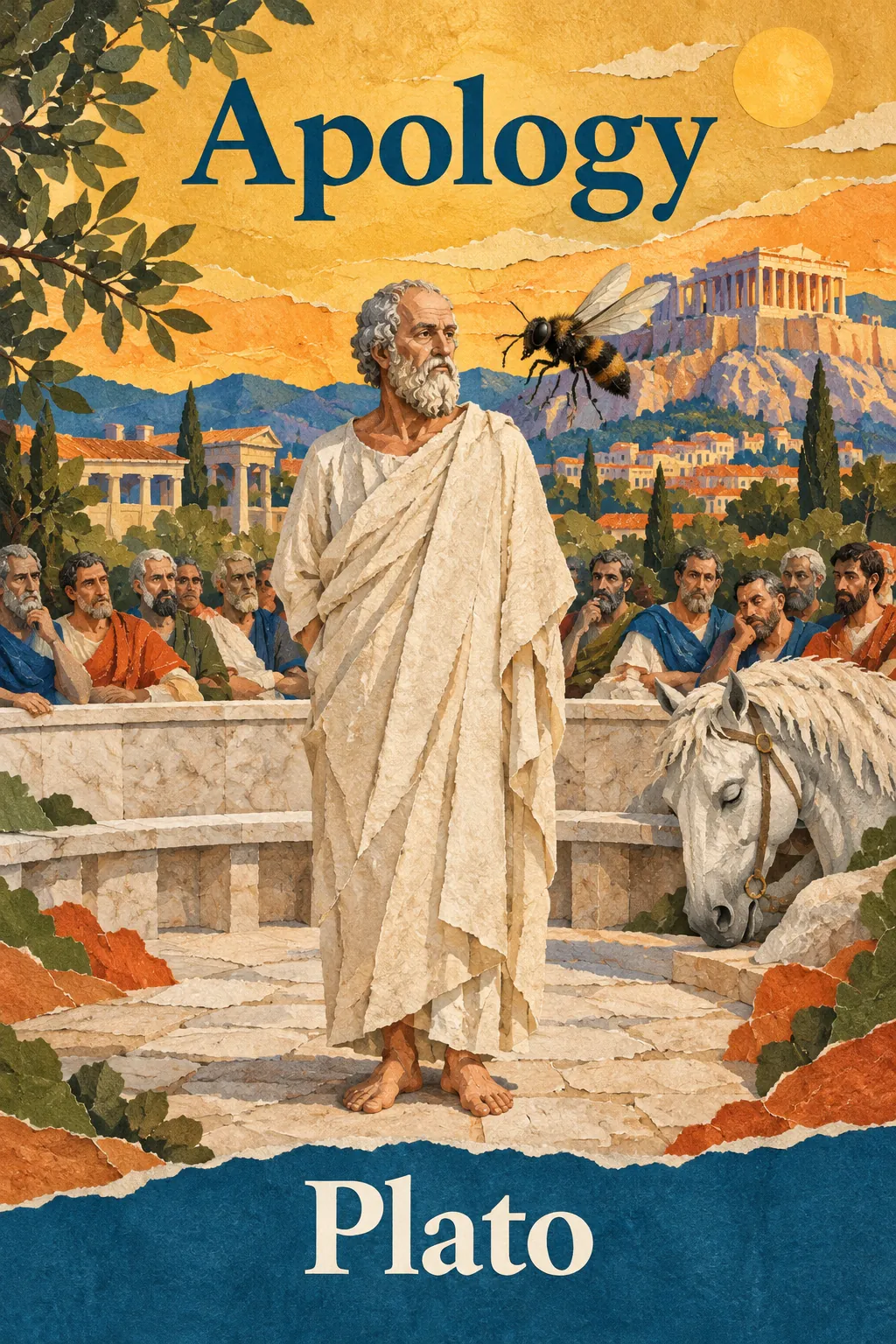
Apology
by Plato
Plato's Apology is the speech Socrates gave in 399 BC, when an Athenian jury of several hundred citizens tried him for not honouring the city's gods and for corrupting the young. Socrates does not beg. He explains that his questioning of the powerful began with a puzzling oracle, that it serves Athens like a gadfly stinging a sleepy horse, and that he would rather die than give up the examined life.
The Big Idea
"Socrates, on trial for his life, argues that living well means questioning yourself and others about what matters, and that doing wrong is worse than suffering death."
Key Insights
Wisdom starts with admitting what you do not know
The oracle's message leads Socrates to a modest conclusion: he is wiser than others only because he does not pretend to know what he does not. Real understanding begins when you notice the gap between what you believe and what you can actually explain. This is not a lack of knowledge but an honest habit.
The politicians he questions feel sure they understand justice and virtue, yet cannot defend their answers when he asks simple follow-up questions.
The examined life
For Socrates, asking what is good, and testing your answers in conversation with others, is the most important work a person can do. Staying busy with money, status and comfort is not enough if you never check where your life is heading. Examination is also a shared activity, done by talking, not just thinking alone.
He spends every day in the marketplace putting the same questions to rich and poor, young and old, and to himself, which leads to his best-known line about life.
Goodness of the soul matters more than wealth or reputation
Socrates argues that doing wrong harms the person who does it more than any outside punishment can. So a good person should care first about acting justly, and only after that about money, honour or safety. He says it is a person's character, not their possessions, that makes other good things valuable.
He spent his life poor, yet refuses to give up his work to buy his freedom, because that would mean choosing safety over justice.
Conscience can outrank the crowd and the state
Socrates says he will obey the god before he obeys the jury. This is not a call to ignore the law, but a claim that some duties come before approval or safety. The speech asks when a person must stand firm, even alone, and what price that may carry.
Under the Thirty, the regime that briefly ruled Athens, he refused an order to arrest an innocent man, Leon of Salamis, and simply went home.
Fear of death is a claim to knowledge
Socrates says that fearing death means thinking you know it is the worst of evils, though no one has come back to say so. He considers two possibilities, a dreamless sleep or a meeting with the great dead, and finds both acceptable. Fear often rests on an assumption we have never examined.
After his sentence he tells the jurors who voted to acquit that his inner voice never warned him against his path, so it must be a good one.
Chapter Breakdown
Chapter-by-chapter summary
Spoiler warning: this section covers the whole speech, including the verdict and the death sentence. The Apology has no chapters, so we divide it into six natural parts, with the standard reference numbers (such as 17a) that editions print in the margin.
Part 1: Not a Clever Speaker (17a–18a)
Socrates opens by warning the jury that his accusers speak so smoothly that he almost forgot himself. He, by contrast, will tell the plain truth in the everyday words he uses in the marketplace. At seventy, he says, he has never stood in a court before, so the jury should forgive his manner and judge only whether his case is just. Why it matters: the opening sets up the central contrast of the speech, the polished persuader against the honest questioner, and tells us Socrates cares more about truth than about winning.
Part 2: The Old Accusers and the Oracle (18a–24b)
Socrates says the dangerous charges are the old rumours, repeated for years: that he studies the sky and the earth and makes the weaker argument defeat the stronger. He denies being a natural scientist or a paid teacher like the sophists. Then he explains where his reputation came from. His friend Chaerephon asked the oracle at Delphi whether anyone was wiser than Socrates, and it said no. Puzzled, Socrates questioned politicians, poets and craftsmen. They thought they knew important things and did not; he at least knew that he did not know. Why it matters: this is the origin of his mission, and it explains why so many powerful people disliked him.
Part 3: Cross-Examining Meletus (24b–28a)
Socrates turns to the formal charges and questions his chief accuser, Meletus, on the spot. Meletus claims Socrates corrupts the young, yet when pressed he says that everyone in Athens improves them except Socrates, which makes no sense. Socrates then shows that Meletus calls him both a complete atheist and a man who introduces new divine beings, which contradicts itself. If he harmed anyone, he adds, it was by accident, and that calls for teaching, not punishment. Why it matters: the exchange shows the Socratic method in action and exposes how thin the case against him is.
Part 4: Why He Will Not Stop (28b–35d)
Socrates compares himself to the hero Achilles, who accepted death rather than live in disgrace. He kept his post as a soldier, and he will keep the post the god gave him: examining himself and others. Even if the jury offered to free him on condition that he stop philosophising, he would refuse. Athens, he says, is like a large, sluggish horse and he is the gadfly sent to wake it. He explains that he never entered politics because an honest man in public life would soon be killed. He also refuses to weep or bring his children forward to win pity. Why it matters: this long middle shows what he values above safety.
Part 5: Verdict and Penalty (35e–38b)
The jury votes to convict, but Socrates says he is surprised that the vote was so close. The accusers ask for death, so it falls to Socrates to propose an alternative. What he truly deserves, he says, is free meals in the town hall, an honour given to Olympic victors, because he has served the city. He rejects prison and exile, since he would only keep questioning people elsewhere, and finally suggests a fine that friends including Plato will guarantee. He adds that an unexamined life is not worth living. Why it matters: he chooses consistency with his way of life over a deal to save himself.
Part 6: The Death Sentence and Farewell (38c–42a)
The jury sentences him to death. Socrates first speaks to those who voted against him and warns that younger, harsher critics will follow. Then he speaks kindly to those who voted to acquit. His inner voice, which usually stops him from wrong actions, stayed silent all day, so he takes it that death is not an evil. Death is either a dreamless sleep or a journey to meet the great dead, and neither is to be feared. He asks only that his sons be corrected if they put wealth before goodness. He ends by saying it is time to go: he to die, they to live, and only the god knows which is better. Why it matters: his calm in the face of death is the proof of what he has argued.
Characters
- Socrates: The seventy-year-old Athenian philosopher on trial. He claims no wisdom, only awareness of his own ignorance, and spends his days questioning people in public places. He speaks plainly, uses irony, and trusts an inner voice that warns him away from wrong choices.
- Meletus: The young accuser who brought the charges, speaking for the poets. Under cross-examination he cannot explain who improves the young. Plato shows him as someone who accused a man of serious crimes without ever having thought the matter through.
- Anytus: A powerful politician who joined the prosecution on behalf of craftsmen and public figures. Socrates treats him as the voice of the people he embarrassed with his questions, and says that men like Anytus and Meletus cannot truly harm a good person.
- Chaerephon: Socrates' old friend, who asked the oracle at Delphi whether anyone was wiser than Socrates. He had already died by the time of the trial, so Socrates mentions that his brother can confirm the story. His question set Socrates' mission in motion.
- Aristophanes: The comic playwright whose play The Clouds showed a Socrates hanging in a basket and studying the heavens. Socrates points to it as one source of the old rumours about him, which he says are harder to answer than the new charges.
- Plato: The author and a pupil of Socrates. The text places him in the courtroom and names him as one of the friends ready to guarantee the fine. Scholars debate how closely the written speech follows what Socrates actually said.
- The jurors: A large panel of ordinary Athenian citizens chosen by lot, who decide guilt and then the penalty. Socrates calls them “men of Athens” and speaks differently to those who convict him and those who vote to free him.
Writing about this book
Start from one clear question rather than a retelling. Teachers already know the plot; they want to see your thinking. Possible starting points:
- Was Socrates right to refuse to stop philosophising when it put his life at risk?
- Is admitting what you do not know a real kind of wisdom, or a clever pose?
- Plato wrote the speech, so how far should we trust it as a picture of Socrates?
Choose one theme and support it with one short scene: the oracle story, the questioning of Meletus, the gadfly image or the farewell. Compare it with a modern case, such as a whistleblower or campaigner who speaks against the accepted view and pays a price. Say whether you agree with Socrates and why, and give the strongest argument for the opposite side. A good report shows where you were convinced, where you doubted, and which example from your own life made the idea clearer.
Take Action
Practical steps you can implement today:
-
Admit what you do not know. Learning starts there, and it makes your confident views easier to test.
-
Before arguing with someone who disagrees, ask them a real question. You will learn their reasons and check your own.
-
Judge a decision by whether it was right, not only by whether it was popular or safe.
-
Be able to explain in plain words why you hold your most important beliefs, even if everyone around you disagrees.
-
Check whether a fear rests on facts or on an assumption you have never examined.
Notable Quotes
"“The unexamined life is not worth living for a human being.” (Part 5, 38a)"
— Plato
"“I seem to be wiser than this man by this small thing: I do not think I know what I do not know.” (Part 2, 21d)"
— Plato
"“Wealth does not bring excellence; excellence brings wealth and every other good, to individuals and to the city.” (Part 4, 30b)"
— Plato
"“Nothing bad can happen to a good person, either in life or after death.” (Part 6, 41d)"
— Plato
Who Should Read This
High-school and university students in ethics, philosophy or ancient history, and general readers who want a first Plato text. The Apology is short, has a single speaker and a clear story, so it suits readers aged about 15 and up who want to see why Socrates is still cited today.
Frequently Asked Questions
What is Plato's Apology about?
It is Plato's version of the speech Socrates gave in 399 BC defending himself against charges of impiety and corrupting the young. In it Socrates explains his way of life, questions his accuser, and calmly accepts a death sentence rather than give up philosophy. It is the best-known account of his trial.
Why is it called Apology if Socrates never says sorry?
The Greek word apologia means a formal defence in court, not an expression of regret. Socrates defends his conduct and refuses to admit wrongdoing. The English title comes from the Latin form of the Greek word, which is why it can mislead modern readers.
What were the charges against Socrates?
He was accused of not recognising the gods the city recognised, of introducing new divine beings, and of corrupting the young. The accusers asked for death. Socrates argues that the accusations contradict each other and that the real cause is the resentment of people he had questioned.
What does “gadfly” mean in the Apology?
A gadfly is a biting insect. Socrates uses it for himself: the god has attached him to Athens, like a stinging fly to a large, sleepy horse, to rouse, persuade and challenge people all day long. He means his questioning is a service to the city, though an irritating one.
Did Socrates really say “I know that I know nothing”?
Not in those words. The closest idea is in the oracle story, where he says he is wiser only in not thinking he knows what he does not know. The famous short phrase is a later summary. Plato's Socrates does claim to know some things, such as that doing wrong is bad.
Is the Apology an exact record of the trial?
Nobody can say for sure. Plato was a young man at the time and wrote the speech down as a portrait of his teacher. Another follower, Xenophon, wrote a different Apology. Many scholars treat Plato's text as a faithful picture of Socrates' character and ideas rather than a transcript.
Check Your Understanding
Pick an answer for each question to see if you were right.
-
In what year was Socrates tried?
399 BC — The trial took place in 399 BC, shortly after the end of the Peloponnesian War.
-
How does Socrates describe his role in Athens?
A gadfly stinging a sleepy horse — He says the god placed him in Athens like a gadfly to wake the city, which he compares to a large, sluggish horse.
-
What penalty does Socrates first suggest for himself?
Free meals at public expense — He says that, honestly, he deserves free meals in the town hall, an honour normally given to Olympic victors.
-
Why does Socrates say he need not fear death?
No one knows it is bad, and it is either dreamless sleep or a journey to meet the dead — He argues that fearing death assumes knowledge nobody has, and that both possibilities he considers are good.
-
Who is the main accuser that Socrates cross-examines?
Meletus — Socrates questions Meletus directly and shows that his charges are inconsistent.
About Plato
Plato (about 428–348 BC) was an Athenian philosopher and a devoted follower of Socrates. He wrote dialogues on justice, knowledge and the good life, and founded the Academy, often called the first university in the Western world. The Apology is his account of his teacher's trial.
Summary Written By

Software Engineer & Writer
Software engineer with a passion for distilling complex ideas into actionable insights. Writes about finance, investment, entrepreneurship, and technology.
View all summaries →Reviews
No reviews yet. Be the first to share your thoughts!
Write a Review
Keep reading
Explore the topic: Personal DevelopmentSummaries

Educated by Tara Westover
Tara Westover
A memoir about a young woman born to survivalists in Idaho who, despite having no formal schooling, teaches herself to…

Atomic Habits: An Easy & Proven Way to Build Good Habits & Break Bad Ones
James Clear
No matter your goals, Atomic Habits offers a proven framework for improving–every day. James Clear, one of the world’s leading…

Think and Grow Rich
Napoleon Hill
What if the secrets to wealth and success weren’t hidden in complex financial strategies, but within the power of your…

Melbourne
Alex Ng
Sophie Cunningham's Melbourne is a deeply personal exploration of Australia's cultural capital, weaving together history, architecture, weather patterns, and personal…
Articles

The Enlightenment Explained: Ideas, Thinkers and Legacy
The Enlightenment was an 18th-century European movement that trusted reason and evidence over tradition and authority. Its thinkers, from Locke…

World History 1700–1918: Revolutions, Industry, Empire and War
Between 1700 and 1918, revolutions, factories, empires and a world war reshaped societies across Europe, the Americas, Asia and Africa.…

Best Stoicism Books for Beginners: Where to Start and Why
Looking for the best stoicism books for beginners? Discover a clear reading route comparing ancient classics like Marcus Aurelius with…