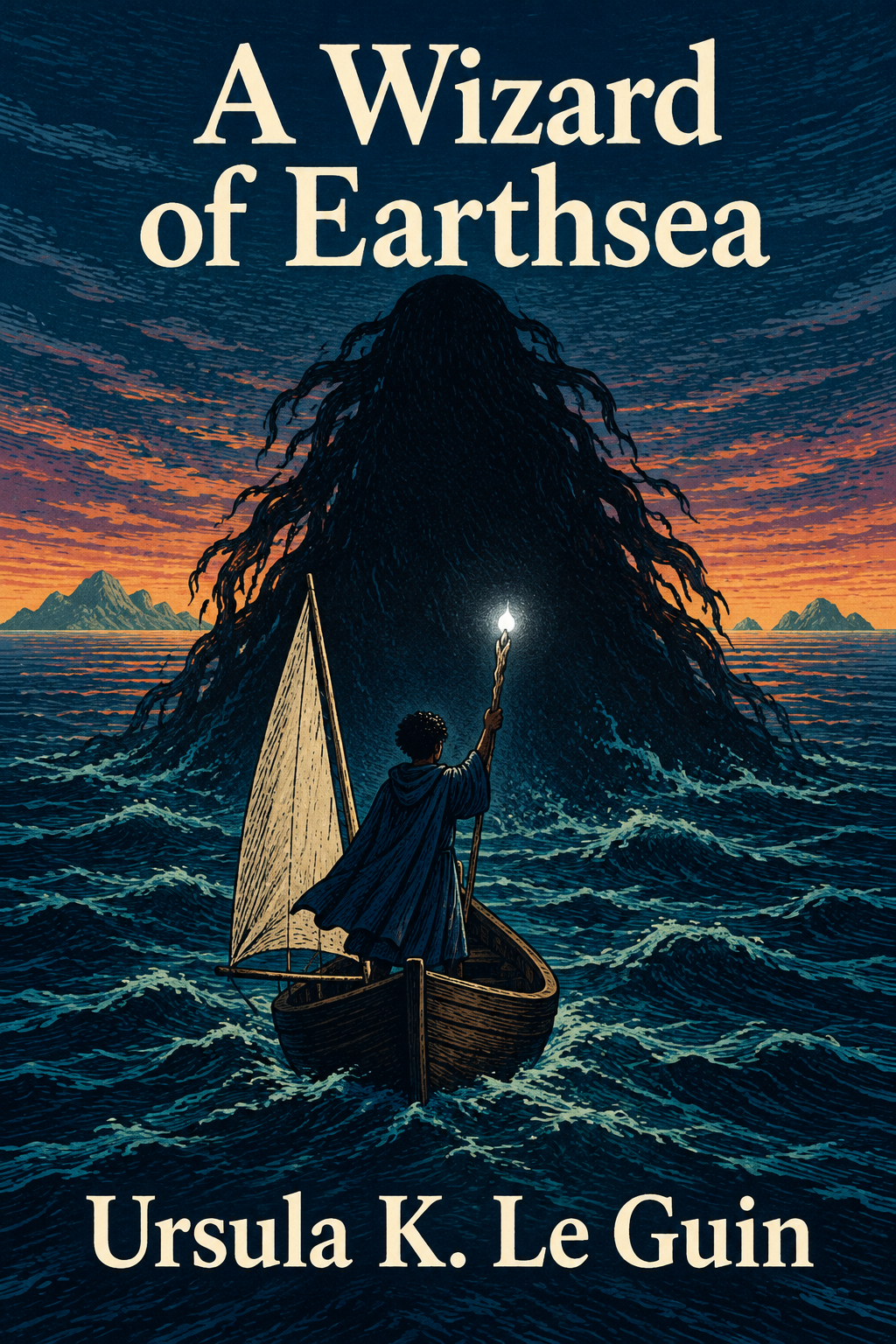
A Wizard of Earthsea
by Ursula K. Le Guin
A Wizard of Earthsea is a coming-of-age fantasy about a young wizard who must live with the results of his own pride. Ged, a bronze-smith's son on the island of Gont, has a huge natural talent for magic and goes to the wizards' school on Roke. Desperate to beat a rival, he casts a forbidden spell and tears open the world, letting out a shadow creature that hunts him across the islands of Earthsea. The story follows him from runaway to hunter.
The Big Idea
"A gifted, proud boy unleashes a nameless shadow while showing off, then spends his youth running from it. Le Guin's question is simple: can you outrun a darkness you made yourself, or must you turn and face it?"
Key Insights
True names and identity
In Earthsea everything has a true name in the Old Speech, and knowing that name gives power over it. So people hide their true names and share them only with those they trust. The book treats a name as the core of who you are: to know yourself is to know your own name.
Vetch gives Ged his true name, Estarriol, as a gift of trust after Ged's disaster. Ged beats the dragon Yevaud by knowing his name, not by force.
Balance and responsibility
Magic in Earthsea is never free. Every spell shifts the Equilibrium, the balance of the world, so a wise mage acts only when there is real need. Le Guin turns magic into a lesson about consequences: the more power you have, the more careful you must be.
The Master Hand warns Ged that changing even one pebble can upset the balance. Ged forgets this when he calls up the dead on Roke Knoll, and the world tears.
Facing your shadow
The shadow is born from Ged's pride, anger and fear, and it grows stronger while he runs. The book suggests that the dark parts of ourselves cannot be cut away or outrun. They have to be faced and accepted.
Everything changes after Ogion tells Ged to turn around. Once Ged becomes the hunter, the shadow is the one that flees.
Pride and patience
Ged is impatient to be great. Ogion's slow lessons bore him, and Jasper's scorn makes him reckless. In this book, growing up means learning patience and humility, not gaining more power.
Ged leaves Ogion for Roke because he wants faster results, and then pays a heavy price for that speed. After his wound, he becomes a quieter and more careful student.
Chapter Breakdown
Chapter-by-chapter summary
Spoiler warning: this section covers the whole plot, including the ending.
Chapter 1: Warriors in the Mist
The boy Duny grows up in the village of Ten Alders on Gont, an island known for its wizards. His mother is dead, and his father, a bronze-smith, is hard on him. When his aunt, the village witch, sees him copy her words to call the goats, she starts teaching him the little magic she knows. He is so good at calling hawks that people nickname him Sparrowhawk. When raiders from the Kargad Lands attack Gont, Duny, about twelve years old, raises a thick fog that confuses the warriors and saves the village. The spell leaves him dazed and empty until the mage Ogion comes and heals him. When Duny comes of age at thirteen, Ogion gives him his true name: Ged. Why it matters: we meet a talent far bigger than its owner's wisdom, and that gap drives the whole book.
Chapter 2: The Shadow
Ged becomes Ogion's apprentice and lives with him at Re Albi. He expects to learn great spells. Instead he gets long silent walks, the names of herbs, and chores. Ogion teaches that real power comes from knowing the true names of things, and that it should be used rarely. Bored, and stung when the daughter of the lord of Re Albi teases him, Ged searches Ogion's books for a spell to summon spirits. As he reads it, a shapeless darkness gathers by the door and whispers to him. Ogion comes back and breaks the spell. He then lets Ged choose: stay and learn slowly, or go to the school for wizards on Roke. Ged chooses Roke. Why it matters: the shadow appears for the first time, drawn by Ged's pride, and Ged chooses speed over patience.
Chapter 3: The School for Wizards
Ged sails to Roke, and the school's door opens only when he tells the Doorkeeper his true name. He makes friends with Vetch, a plain, kind student from the East Reach. He also quickly makes an enemy of Jasper, a polished older student who looks down on him. Ged learns fast. The Master Hand teaches that illusion is easy but real change is serious, because even changing a single pebble shifts the Equilibrium, the balance of the world. Ged takes in the lesson but not its spirit, and his rivalry with Jasper keeps growing. Why it matters: Le Guin lays down the rules of her magic, where knowledge brings responsibility instead of the freedom to do anything.
Chapter 4: The Loosing of the Shadow
Pushed by Jasper's scorn, Ged agrees to a contest of skill one night on Roke Knoll. He casts a spell to call up the spirit of a woman who died long ago, a figure from legend. The spell works, but it also tears a rift in the world. A shadow-beast leaps through and claws his face, leaving scars. The old Archmage Nemmerle closes the rift and drives the creature away, and the effort kills him. Ged lies near death for weeks. When he recovers, he learns that the shadow is loose and wants him, and that only Roke's protections keep it away. Vetch visits and tells Ged his own true name, Estarriol, an act of complete trust. Why it matters: Ged's pride costs a great man his life and creates an enemy that partly comes from Ged himself.
Chapter 5: The Dragon of Pendor
Ged finally receives his wizard's staff and takes a humble post in the Ninety Isles. His job is to protect the poor village of Low Torning from dragons that have taken over the nearby island of Pendor. He makes friends with Pechvarry, a boatbuilder. When Pechvarry's little son falls gravely ill, Ged cannot save him. He follows the child's spirit too far toward the land of the dead and sees the shadow waiting for him there. He returns, weakened, and realises the shadow could bring danger to the village. So he sails to Pendor to deal with the dragons first. After killing several young dragons, he faces the old dragon Yevaud, who offers to tell him the shadow's name. Ged refuses the bargain. Instead he names the dragon and makes him swear never to attack the islands. Why it matters: for the first time, Ged puts duty before his own interest.
Chapter 6: Hunted
After Ged leaves the Ninety Isles, the shadow hunts him more openly. He wanders north, frightened and sleeping badly. A stranger he meets on his travels tells him that at the Court of the Terrenon on Osskil he will find help against the shadow. A rough local man named Skiorh guides him across the moors. On the way, Skiorh's face goes blank: the shadow has entered his body and taken control of it, turning him into a gebbeth, a living puppet. Ged runs for his life through the snow and reaches the gates of the Court just ahead of it. Why it matters: the shadow can now use other people, so running away is no longer safe.
Chapter 7: The Hawk's Flight
Inside the castle, Ged is welcomed by Serret, the lady of the Terrenon. She is the same girl who teased him into summoning spirits back at Re Albi. Serret and her husband Benderesk show him the Terrenon, an ancient stone that holds one of the Old Powers of the earth. Serret urges him to speak to it and gain enough power to master the shadow. Ged senses that the stone wants to own him, and he refuses. Serret tries to escape and is killed by the stone's servants, who then come for Ged. He turns into a hawk and flies south over the sea all the way to Gont. He lands at Ogion's feet, lost in the bird's shape, and Ogion brings him back to himself. Ogion's advice is simple: stop running, turn around, and hunt the hunter. Why it matters: Ged turns down easy power, and the book reaches its turning point.
Chapter 8: Hunting
Ged leaves Gont in a small boat, and this time he is the one chasing the shadow. When he finally meets it at sea, it flees from him. During the chase his boat is wrecked, and he washes up on a tiny sandy island where an old man and an old woman live alone. They were left there as small children and can barely share a language with him. Before he leaves, the woman gives him half of a broken metal ring, a puzzling gift that the next book in the series explains. Ged follows the shadow from island to island and keeps hearing about a man who looks just like him. Why it matters: the roles of hunter and hunted have reversed, and Ged learns that the shadow can take on his own shape.
Chapter 9: Iffish
On the island of Iffish in the East Reach, Ged finds Vetch again. Vetch is now the wizard of his home island and lives with his younger sister Yarrow and his younger brother. He welcomes Ged warmly. When Ged explains that he is going east to face the shadow, Vetch insists on coming, even after Ged warns that it could cost him his life. Yarrow asks simple, sharp questions about magic and names, and Ged glimpses the quiet, ordinary life he has never had. Why it matters: friendship gives Ged the support he needs, and the question of what the shadow really is comes close to an answer.
Chapter 10: The Open Sea
Ged and Vetch sail east past the last known islands into empty ocean. Eventually the sea seems to turn into dry sand, and Ged steps out of the boat to walk toward the shadow. It comes to meet him, taking on faces from his past along the way. At the same moment, man and shadow speak one name: Ged. They come together, and the shadow merges into him. Vetch, watching, fears his friend is lost, but Ged comes back laughing and whole. The narrator explains that Ged has neither won nor lost. By naming the shadow with his own name, he has made himself complete. The two friends sail home. Why it matters: the climax replaces a battle with self-knowledge, which is the heart of the book.
Characters
Ged (Duny, Sparrowhawk)
The hero, a boy from Gont with great natural power and a quick temper. His birth name is Duny, people know him as Sparrowhawk, and he shares his true name, Ged, only with people he trusts. His pride lets the shadow loose. His growth lies in owning what he did.
Ogion
The mage of Re Albi who names Ged and becomes his first teacher. Ogion says little and rarely uses magic for his own comfort, because he believes power should be used sparingly. His advice to turn and hunt the shadow changes the course of the story.
Vetch (Estarriol)
Ged's best friend at Roke, a dark-skinned, plain-spoken young man from the East Reach. He is not the most brilliant student, but he is loyal and steady. He tells Ged his true name and later sails with him to the edge of the world, which shows what real friendship can cost.
Jasper
A proud older student at Roke from a wealthy family, who treats Ged as a country boy. Jasper is talented and cold, and his sneers push Ged into the fatal contest. He is less a villain than a mirror of Ged's own vanity.
Archmage Nemmerle
The very old head of the wise men of Roke. He seals the rift Ged tore open and dies from the strain. His final act of protection weighs on Ged for the rest of the book.
Serret
The daughter of the lord of Re Albi, who taunts young Ged into his first summoning. She later becomes the lady of the Court of the Terrenon on Osskil, tempts Ged to use the ancient stone, and dies trying to escape its servants.
Pechvarry
A boatbuilder in Low Torning who becomes Ged's friend during his first post. His son's death, and Ged's failed attempt to follow the boy's spirit, show Ged how close the shadow has come.
Yevaud
The old dragon of Pendor, clever and greedy. He offers to reveal the shadow's name if Ged leaves him in peace. Ged refuses and names the dragon instead, one of the best-known scenes in the book.
The shadow
A shapeless, nameless creature that comes through the rift Ged opens. It hunts him, can take over other people's bodies, and grows stronger the longer he runs. What it really is remains the book's central mystery until the last chapter.
Writing about this book
A Wizard of Earthsea works well for essays because its fantasy plot carries a clear human question. Strong angles include:
- What is the shadow? Track when it appears, what draws it closer, and why it flees once Ged chases it. Is it a monster, a part of Ged, or both?
- Names and trust: compare how true names are used by Ged, Vetch and Yevaud. What does the book suggest about who should know your true self?
- The courage not to act: find scenes where using magic causes harm and scenes where holding back is the wise choice.
- Who the hero is: Le Guin made Ged and most people of the Archipelago dark-skinned, an unusual choice in fantasy of the late 1960s. Why might that matter?
Questions to start your own thinking: When have you wanted to prove yourself so badly that you made a mistake? Is Ged's ending a victory? What might have happened if he had accepted Yevaud's offer?
Use one or two specific scenes as evidence rather than retelling the plot. A good essay explains what those scenes mean, both in the story and to you.
Take Action
Practical steps you can implement today:
-
Before acting out of pride or anger, ask what the act will cost later, and who else might pay for it.
-
Running from a mistake usually makes it bigger. Turning to face it is what takes away its power.
-
Trust shows in what you risk for someone, as when Vetch shares his true name and sails into danger with Ged.
-
Real skill grows through patience and practice, not through one dramatic show of talent.
Notable Quotes
"“Only in silence the word, only in dark the light, only in dying life: bright the hawk's flight on the empty sky.” (The Creation of Éa, opening verse)"
— Ursula K. Le Guin
"“To hear, one must be silent.” (Chapter 2)"
— Ursula K. Le Guin
"“Manhood is patience. Mastery is nine times patience.” (Chapter 2)"
— Ursula K. Le Guin
"“To light a candle is to cast a shadow.” (Chapter 3)"
— Ursula K. Le Guin
Who Should Read This
Good for readers aged about 11 and up, and a common choice for middle school and early high school English classes. Fantasy fans will enjoy the wizards and dragons, and anyone interested in growing up, guilt and self-knowledge will find much more. It is also a good place to start before watching the Ghibli film or reading the later Earthsea books.
Frequently Asked Questions
Is the Ghibli film Tales from Earthsea based on this book?
Only loosely. Studio Ghibli's 2006 film, directed by Goro Miyazaki, draws mainly on the third book, The Farthest Shore, mixed with elements of later books and Hayao Miyazaki's picture story Shuna's Journey. The hero is a prince named Arren, and Ged appears as an older wizard. Young Ged's story and his hunt for the shadow, told in this book, are not in the film.
In what order should I read the Earthsea books?
Read them in publication order: A Wizard of Earthsea (1968), The Tombs of Atuan (1971), The Farthest Shore (1972), Tehanu (1990), Tales from Earthsea (2001, a story collection) and The Other Wind (2001). The first three can be read as a trilogy, and the later three revisit the world many years on.
What is the shadow in A Wizard of Earthsea?
Spoiler: the shadow is a nameless darkness that Ged lets loose through his own pride. In the last chapter he calls it by his own name, Ged, and it merges with him. Most readers take it as the dark side of Ged himself: his pride, anger and fear, which he must accept rather than destroy.
What age is A Wizard of Earthsea for?
It was published for young readers and suits ages about 11 and up. The prose is calm and the ideas are deep, so teenagers and adults get a lot from it too. If the many names and islands feel confusing at first, keep the character list on this page nearby.
Why are true names so important in Earthsea?
In Earthsea, knowing the true name of something gives you power over it. That is why wizards study names, and why people reveal their own true name only to someone they trust completely. A true name stands for who a person really is, which is why the ending turns on a name.
Check Your Understanding
Pick an answer for each question to see if you were right.
-
Who gives Ged his true name?
Ogion — Ogion names him when he comes of age at thirteen and then takes him as his apprentice.
-
Why does Ged cast the spell that lets the shadow loose?
To beat Jasper in a contest of pride — Stung by Jasper's scorn, Ged calls up a spirit of the dead to prove his power, and the spell tears open the world.
-
How does Ged deal with the dragon Yevaud?
He names him and makes him swear never to attack the islands — Ged turns down the bargain and uses the dragon's true name to make him swear to leave the islands alone.
-
Who sails with Ged on the final voyage east?
Vetch — Vetch insists on joining his friend, even though Ged warns him it may cost his life.
-
Which Earthsea book is the Ghibli film mainly based on?
The Farthest Shore — The 2006 film draws mainly on the third book, The Farthest Shore, not on young Ged's story.
About Ursula K. Le Guin
Ursula K. Le Guin (1929–2018) was an American writer of fantasy and science fiction, born in Berkeley, California. Her novels The Left Hand of Darkness and The Dispossessed won major awards, and her six Earthsea books set a standard for thoughtful fantasy. A Wizard of Earthsea, the first of them, is widely read in schools as a story about growing up.
Summary Written By

Software Engineer & Writer
Software engineer with a passion for distilling complex ideas into actionable insights. Writes about finance, investment, entrepreneurship, and technology.
View all summaries →Reviews
No reviews yet. Be the first to share your thoughts!
Write a Review
Keep reading
Explore the topic: FictionSummaries

Out of My Mind
Sharon M. Draper
“Out of My Mind” by Sharon M. Draper is a poignant narrative that explores the life of Melody Brooks, a…

Ender’s Game
Orson Scott Card
“Ender’s Game” by Orson Scott Card is a riveting science fiction novel that transports readers into a future where humanity…

Pachinko
Min Jin Lee
“Pachinko”, a spellbinding multigenerational historical saga by Min Jin Lee, explores the lives of a Korean family trying to make…

The Perks of Being a Wallflower
Stephen Chbosky
The Perks of Being a Wallflower by Stephen Chbosky is a profound coming-of-age novel, told through the intimate letters of…
Articles

The Enlightenment Explained: Ideas, Thinkers and Legacy
The Enlightenment was an 18th-century European movement that trusted reason and evidence over tradition and authority. Its thinkers, from Locke…

World History 1700–1918: Revolutions, Industry, Empire and War
Between 1700 and 1918, revolutions, factories, empires and a world war reshaped societies across Europe, the Americas, Asia and Africa.…

A Christmas Carol themes: generosity, isolation and responsibility
Dickens's novella is usually read as a story about a man who changes his mind. Its themes are sharper than…