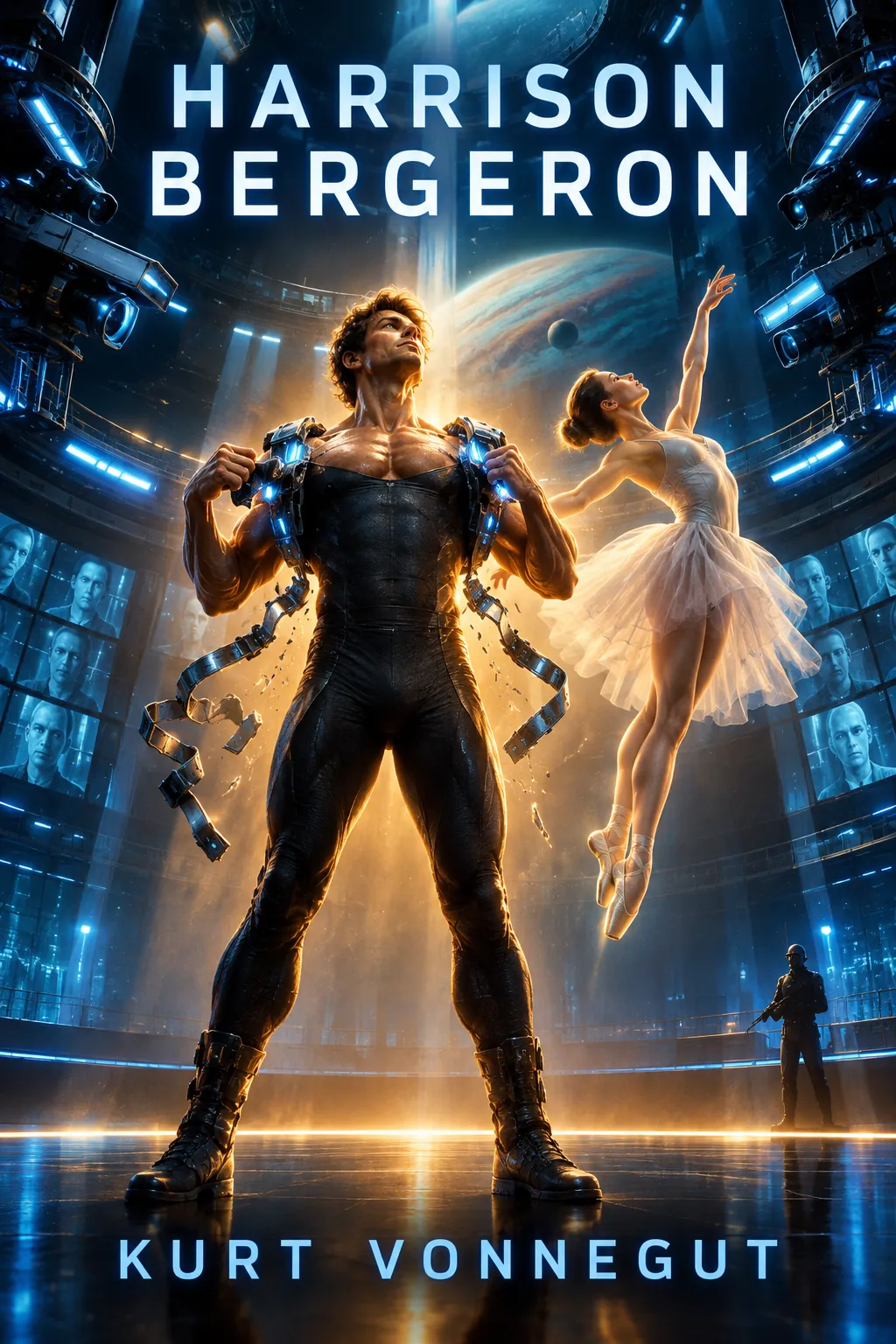
Harrison Bergeron
Tác giả: Kurt Vonnegut
“Harrison Bergeron” is a 1961 short story by Kurt Vonnegut, set in the year 2081, when the government forces equality by handicapping anyone who is smart, strong or beautiful. We follow George and Hazel Bergeron, who watch television at home while their gifted fourteen-year-old son, Harrison, is held by the authorities. The story is a dark joke about what happens when “fair” means “the same,” and it asks what is lost along the way.
Ý Tưởng Chính
"In 2081 the government makes everyone equal by dragging the gifted down, and Vonnegut asks what that kind of equality costs everyone, including the people it claims to protect."
Những Hiểu Biết Cốt Lõi
Equality is not sameness
The story’s central joke is that its government has taken a good idea, fairness, and followed it to an absurd end. By treating every difference as an injury, it ends up harming everyone, including the people it says it protects. Vonnegut does not say that equality is bad. He shows that measuring fairness by the lowest level destroys what makes a society worth sharing.
The “equality” of 2081 is delivered with weights, masks and radios, so the dull and the brilliant are both made miserable.
The attack on thinking
The handicaps do not only limit the body. The most disturbing one is George’s ear radio, which interrupts thought itself. A population that cannot concentrate cannot question anything, and cannot protest. Vonnegut presents a quieter kind of control than censorship, in which no idea needs to be banned because nobody can finish one.
George starts to reason about his situation, but a loud noise shatters his thought each time.
People enforce the system themselves
The Handicapper General appears only at the end, yet the rules are already working inside the home. George refuses to take off his weights because he is afraid of punishment and of competition. Hazel, who needs no handicap, drifts away from her own sadness. The story suggests that a regime lasts longest when ordinary people do its work for it.
When Hazel suggests a small act of rebellion, George talks himself out of it.
A satire with more than one reading
Readers disagree about the target. Some see an attack on government interference, while others see a satire on exaggerated fears of equality. The story’s details support both views, since the state is violent while Harrison himself behaves like a tyrant. For exams, the safest approach is to state a reading and then show where the text supports it.
Harrison demands that everyone obey him at once, so he is not a perfect champion of freedom.
Tóm Tắt Chương
Chapter-by-chapter summary
Spoiler warning: this section covers the whole plot, including the ending.
The story is only a few pages long and has no numbered chapters, so we have split it into its natural parts.
Part 1: The year everyone is equal
The story opens in 2081, after amendments to the Constitution have made everyone equal in every way. Nobody may be smarter, faster, stronger or better looking than anyone else.
Agents of the Handicapper General enforce this by fitting people with weights, masks and mental handicaps. The narrator describes all of this in a calm, almost cheerful voice, as if it were ordinary news.
The law is not enforced by a single dramatic crackdown. It is a daily routine, carried out by officials whom people accept as part of normal life.
Why it matters: Vonnegut starts with a joke-like premise, which lets him ask how far “equal” can go before it stops making sense. The calm tone also trains the reader to notice how easily a strange rule can feel normal.
Part 2: George and Hazel at home
George and Hazel Bergeron are watching ballet on television. Hazel has perfectly average intelligence and cries easily, while George is above average, so he wears a radio in his ear that sends out sharp noises to scatter his thoughts.
George also carries a heavy bag of weights around his neck, so even sitting in a chair is tiring. The dancers on screen are weighed down too, and none of them is allowed to look better than the others.
Their fourteen-year-old son, Harrison, was taken away some time ago, and they can barely hold the memory in mind. Hazel sometimes feels that something sad has happened, but the feeling slips away before she can name it.
When Hazel suggests George take some of the weights off, he refuses, because he fears the penalties and a return to competition. She says that he would only be resting, and that it would not matter for a short while, but he talks himself out of it.
Why it matters: ordinary people have absorbed the rule so deeply that they police themselves. Nobody is standing over George, and he still obeys.
Part 3: The news bulletin
The ballet is interrupted by a news announcer who has a speech problem and cannot get through the bulletin. He struggles and struggles, and in the end he hands the paper to a ballerina.
She reads it in a lovely voice and then apologises for it. In this world, a beautiful voice is something to be sorry about.
The bulletin says Harrison has escaped from jail and is dangerous. His photograph shows a giant young man, about seven feet tall, loaded with scrap metal, heavy headphones and glasses built to half-blind him and give him headaches.
Why it matters: the state treats a gifted boy as a monster, and the story builds him into a legend before he appears. The announcer and the ballerina also show how the handicap rules reach even the news.
George and Hazel see their son’s photograph on the screen. Neither of them seems to recognise the full meaning of what they are seeing.
Part 4: Harrison takes the studio
Harrison bursts into the television studio and calls himself Emperor. He tears off his handicaps and the heavy straps break like paper.
He demands that everyone obey him at once. The studio goes silent, and the people in it, including the guards, are frozen with fear.
He orders the musicians to play and picks one ballerina as his Empress, removing her mask and weights as well. He makes a sort of coronation out of the moment.
Why it matters: his rebellion is theatrical, and he claims power for himself rather than abolishing it, which makes him a complicated hero. Readers can admire his courage and still doubt his motives.
Part 5: The dance
Freed of their handicaps, the musicians play with real skill, though not perfectly. Harrison and the ballerina begin to dance, and the narrator describes them leaping so high they seem to ignore gravity.
The dance is imaginative and joyful, and the pair seems to defy the laws of motion as well as the laws of the state. They spin, bend and rise until they seem to float.
They kiss in the air, near the ceiling.
Why it matters: this is the only moment of beauty in the story, and it shows exactly what the handicaps have been hiding.
Part 6: The shooting
Diana Moon Glampers, the Handicapper General, walks in carrying a shotgun and kills both Harrison and the ballerina with two shots. The scene is over in seconds.
She then orders the musicians to put their handicaps back on, and warns them that they have ten seconds to do it. The rebellion ends almost as quickly as it began.
Why it matters: the state that promised fairness answers with a gun, which reveals what its equality really rests on.
The violence is shocking because the story has been so light until this moment.
Part 7: Back in the living room
At home, the television picture has gone dark. Hazel is crying but does not remember why, and George, whose own radio has just fired off again, returns from the kitchen with a beer.
Hazel says she can tell something sad happened on the screen. George cannot remember what it was either, and she remarks that it must have been a very sad thing.
Both quickly forget what they saw. Why it matters: the ending shows the regime’s deepest victory, which is that even grief about a lost child cannot last.
Characters
- George Bergeron: a clever man whose mind is chopped up by a radio, and who is too afraid to take off his weights. He sees that something is wrong, but he cannot hold the thought long enough to act.
- Hazel Bergeron: an average, kind woman who forgets her sadness within moments. She needs no handicap, and she has a gentle, silly warmth that makes the ending hurt more.
- Harrison Bergeron: their gifted fourteen-year-old son, who escapes and declares himself Emperor. He is a genius and an athlete, and he is also arrogant.
- Diana Moon Glampers: the Handicapper General, who ends the rebellion with a shotgun. Her comic name hides a cold, efficient enforcer.
- The ballerina: a dancer chosen as Harrison’s Empress. She first appears as the woman who apologises for her voice, and she ends as half of the story’s one great moment.
- The announcer: a television newsreader with a speech difficulty who tries to read the bulletin. He is not a villain, only another person caught in the system.
- The musicians: studio players who are briefly freed to play at their best. They are told to put their handicaps back on as soon as the shots are fired.
Writing about this book
Many teachers set this story because it is short, quick to read and full of ideas. Start by choosing a clear claim, for example that the story criticises equality enforced as sameness, rather than equality itself.
Then give two or three pieces of evidence: George’s radio, Hazel’s forgetfulness, Harrison’s dance and the shooting. Each time, explain how the detail supports your claim, instead of just retelling it.
Look at Vonnegut’s tone as well. The story is funny in places, such as the announcer’s apology, yet the humour turns dark, and that contrast is worth a paragraph.
Finally, test your own argument by considering a different reading. Harrison also calls himself an Emperor, so you could ask whether the story warns against arrogance as well as against the state.
Quote briefly, one sentence at most, and name the part of the story you are quoting. Use the sample answers on this page to compare your work, and write your own version before looking at them.
Plan your essay before you write. A simple structure is a thesis, three body paragraphs and a short conclusion that returns to the question.
Keep your paragraphs focused on one idea each. If you notice that a paragraph has turned into a plot retelling, cut it back and add a sentence that explains what the detail shows.
Hành Động Ngay
Các bước thực tế bạn có thể thực hiện ngay hôm nay:
-
Ask whether a rule creates fair chances or only the same results.
-
Notice who benefits when people stop thinking for themselves.
-
When you read satire, separate what is exaggerated from what is being criticised.
-
Write essays on this story with a claim first, then short evidence, then your own comment.
Trích Dẫn Đáng Nhớ
"“The year was 2081, and everybody was finally equal.” (Part 1)"
— Kurt Vonnegut
"“I am the Emperor!” (Part 4)"
— Kurt Vonnegut
"“Gee—I could tell that one was a doozy.” (Part 7)"
— Kurt Vonnegut
Ai Nên Đọc Cuốn Này
Anyone studying Vonnegut or dystopian fiction, especially students aged about 14 to 18 who need a short set text. It also suits adults who want a ten-minute story with a big argument. It is brief, funny and easy to read, but the ending is violent.
Về Kurt Vonnegut
Kurt Vonnegut (1922–2007) was an American writer born in Indianapolis. He survived the bombing of Dresden as a prisoner of war in World War II and later drew on that experience for Slaughterhouse-Five (1969). His novels and stories mix science fiction, dark comedy and plain speech to ask what people owe one another.
Tóm Tắt Được Viết Bởi

Kỹ sư phần mềm & Nhà văn
Kỹ sư phần mềm với niềm đam mê chuyển đổi ý tưởng phức tạp thành hiểu biết thực tiễn. Viết về tài chính, đầu tư, khởi nghiệp và công nghệ.
Xem tất cả tóm tắt →Đánh Giá
Chưa có đánh giá nào. Hãy là người đầu tiên chia sẻ suy nghĩ của bạn!
Viết Đánh Giá
Đọc tiếp
Khám phá chủ đề: Tác giả và giải thưởng sci-fiTóm tắt sách

Tóm Tắt Sách Vượt Qua Giới Hạn (Out of My Mind)
Sharon M. Draper
“Out of My Mind” by Sharon M. Draper is a poignant narrative that explores the life of Melody Brooks, a…

Tóm Tắt Sách Ender’s Game
Orson Scott Card
“Ender’s Game” by Orson Scott Card is a riveting science fiction novel that transports readers into a future where humanity…

Tóm Tắt Sách Pachinko (Pachinko)
Min Jin Lee
“Pachinko”, a spellbinding multigenerational historical saga by Min Jin Lee, explores the lives of a Korean family trying to make…

Tóm Tắt Sách Những Ưu Ái Của Kẻ Vô Hình (The Perks of Being a Wallflower)
Stephen Chbosky
The Perks of Being a Wallflower by Stephen Chbosky is a profound coming-of-age novel, told through the intimate letters of…
Bài Viết

Kurt Vonnegut
Kurt Vonnegut (1922–2007) là nhà văn Mỹ pha trộn khoa học viễn tưởng, hài đen và lối nói giản dị…

Chủ đề A Christmas Carol: lòng hào phóng, sự cô lập và trách nhiệm
Truyện ngắn của Dickens thường được đọc như câu chuyện về một người đàn ông thay đổi suy nghĩ. Nhưng…
Susanoo và con rắn tám đầu Yamata no Orochi (Bát Kỳ Đại Xà)
Trong Kojiki, thần bão Susanoo bị đuổi khỏi thiên giới, đến vùng Izumo và biết rằng con rắn tám đầu…