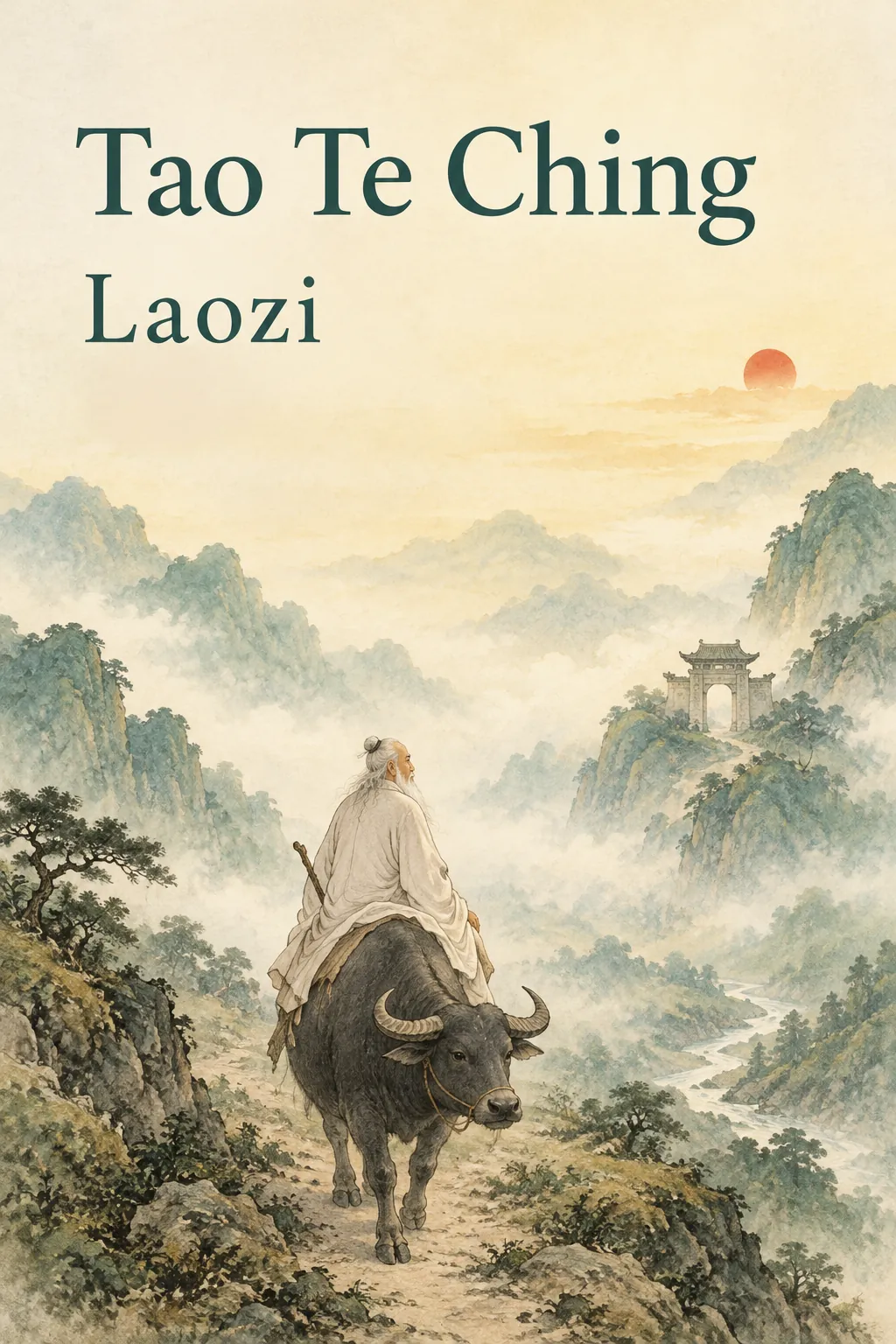
Tao Te Ching
by Laozi
The Tao Te Ching is a short Chinese classic of 81 brief chapters, traditionally credited to Laozi. It asks what it means to live in step with the Dao, the unnamed source and pattern of all things. Its answer is surprising: do less, want less, and yield like water. Leaders should govern lightly, and people should return to simplicity. The poems are terse and open-ended, so each reading finds something new.
The Big Idea
"The Tao Te Ching says the best way to live and lead is to follow the Dao, the natural way of things: act without forcing, stay humble like water, and let things unfold."
Key Insights
The Way is beyond words
Chapter 1 begins by saying that any description of the Dao falls short of the real thing, because a name fixes something that is always moving. The book still uses words, but treats them as hints to be tested against experience, not as rules to memorize.
Think of explaining how to ride a bicycle. You can list instructions for hours, yet you only understand once you feel the balance yourself. The text points toward that kind of knowing, which is why its chapters read like riddles rather than lessons.
Strength in softness
Water, an infant and a young shoot are soft, yet they outlast stone, steel and dry branches. Chapters 8, 43, 76 and 78 repeat the point: the rigid breaks, the yielding survives. Softness here is not weakness but flexibility with persistence.
A river does not fight a boulder. It goes around it, wears it down over years, and keeps moving. Someone who handles an angry colleague by listening first, instead of arguing, is using the same principle. Over time the gentle thing often wins by giving the other side nothing to push against.
The use of emptiness
In chapter 11 the useful part of a wheel hub, a pot and a room is the empty space inside. What we can see and own depends on what we cannot, the way a flute makes music through its hollow. The idea invites readers to value gaps, pauses and openness along with things.
A calendar packed from morning to night leaves no space for anything unexpected. A free afternoon is not wasted time: it is the room where rest, thinking and surprise can happen. A good conversation also needs its silences.
Wu wei is not doing nothing
Wu wei, acting without forcing, is the book's answer to ambition. It does not mean doing nothing. It means acting at the right time and in harmony with how things are, rather than pushing against them. Chapter 37 says the Dao does nothing, yet nothing is left undone.
A good gardener does not pull on seedlings to make them grow. She prepares the soil, waters, and waits. A teacher who creates the right conditions and then lets students find answers is practicing the same restraint.
Lead lightly
Chapters 17, 57 and 60 argue that the best ruler is barely noticed. Too many rules, taxes and orders make people poorer and more evasive. A leader who keeps things simple earns trust and lets people do their own work.
Compare a manager who checks every step of a project with one who sets a clear goal, provides support, and steps back. The second team usually feels the result is its own, which is just what chapter 17 describes. Cooking a small fish makes the point: handle it too much and it falls apart.
Chapter Breakdown
Chapter-by-chapter summary
The book has 81 chapters in the standard Wang Bi order. Here they are grouped into eight parts.
Part 1: Chapters 1–8, The unnamed Way
The book opens by admitting that words fail. Chapter 1 says the Dao that can be spoken is not the constant Dao, and the name that can be named is not the constant name. From the nameless comes the origin of heaven and earth; from the named come the ten thousand things. Chapters 2 to 7 show how opposites such as beautiful and ugly, long and short, depend on each other, and introduce the sage who works without claiming credit. Chapter 8 gives the first famous image: the highest good is like water, which helps everything and settles in the low places others avoid. Why it matters: the opening tells you how to read the rest, as pointers rather than definitions.
Part 2: Chapters 9–16, Emptiness and stillness
Chapter 9 warns that a bowl filled to the brim spills, and advises withdrawing once the work is done. Chapter 11 turns on a clever observation: thirty spokes meet at a hub, but the empty space in the hub makes the wheel useful; a pot works because of its hollow, a room because of its doorways and windows. Usefulness comes from what is not there. Chapters 12 to 15 criticize chasing bright colors, loud sounds and rich tastes, and describe the wise as careful, alert and plain. Chapter 16 asks the reader to reach the utmost emptiness and hold firmly to stillness, because everything returns to its root. Why it matters: the book treats emptiness and rest as sources of strength, not as failure.
Part 3: Chapters 17–25, Ruling lightly
Chapter 17 ranks rulers: the best is barely noticed, and when the work is done the people say it happened naturally. Chapters 18 and 19 claim that talk of benevolence and duty appears only after the great Way is lost, and urge people to cut back cleverness and greed. Chapter 22 teaches that bending leads to staying whole. Chapter 25 gives the Dao its most direct portrait: something formless that existed before heaven and earth, silent and alone, which the author calls the Way only for want of a better name. Humans follow earth, earth follows heaven, heaven follows the Dao, and the Dao follows what is naturally so. Why it matters: this chain places human life inside nature rather than above it.
Part 4: Chapters 26–37, Soft power
Chapter 26 says the heavy is the root of the light and stillness the master of restlessness. Chapter 31 treats weapons as tools of ill omen, to be used only when unavoidable, and says even a victory should be handled like a funeral. Chapter 33 offers a pair of lines on self-knowledge: knowing others is wisdom, knowing yourself is clarity. Chapter 34 pictures the great Dao flowing everywhere, nourishing all things without claiming to be their master. Chapter 37 closes the first half: the Dao always does nothing, yet nothing is left undone, and a ruler who stays simple lets the world settle on its own. Why it matters: this is the book's main claim about power, that restraint works better than force.
Part 5: Chapters 38–48, Virtue and reversal
Chapter 38 opens the second half, often called the De section: the highest virtue does not show itself as virtue, and that is why it is real. Chapter 40 says that reversal is the movement of the Dao and weakness is its use. Chapter 42 gives a brief account of creation: the Dao gave birth to one, one to two, two to three, and three to the ten thousand things. Chapter 43 says the softest thing in the world overcomes the hardest. Chapter 44 claims that knowing when you have enough keeps you out of trouble. Chapter 48 contrasts study, which adds something each day, with the Way, which drops something each day. Why it matters: these chapters turn ordinary ambition upside down.
Part 6: Chapters 49–60, Governing by trust
Chapter 49 describes a sage with no fixed mind who takes the people's mind as his own and treats the good and the not-good alike with kindness. Chapter 56 says those who know do not speak and those who speak do not know. Chapter 57 argues that the more rules and sharp tools a state has, the poorer its people become, while a ruler who stays quiet finds that people reform themselves. Chapter 58 observes that misfortune leans on fortune and fortune hides in misfortune. Chapter 60 offers a famous kitchen image: governing a large state is like cooking a small fish, so do not keep poking it. Why it matters: the book's politics are about trust and light handling, not control.
Part 7: Chapters 61–72, Small steps and three treasures
Chapter 63 advises taking on difficult things while they are still easy and great things while they are still small. Chapter 64 follows with one of the best-known lines in the book: a journey of a thousand miles begins under your feet. Chapter 66 explains why rivers and seas rule the hundred streams: they lie lower than all of them. Chapter 67 names three treasures the author keeps: compassion, frugality, and not daring to put oneself first. From compassion comes courage, from frugality generosity, and from humility leadership. Why it matters: these chapters turn the book's abstract ideas into habits of daily life.
Part 8: Chapters 73–81, Softness and the small village
Chapter 76 notes that living people are soft and supple while the dead are stiff; the hard and strong belong to death. Chapter 78 returns to water: nothing is softer, yet nothing beats it at wearing down the hard. Chapter 80 sketches a small country where people need few tools, enjoy their food, and live so close to their neighbors that they hear each other's dogs and roosters, yet grow old without visiting. Chapter 81 ends with a quiet claim: the sage does not hoard, heaven's Way benefits without harming, and the sage's Way is to act without contending. Why it matters: the book finishes on gentleness, not on a final rule.
Key people and terms
Laozi
The traditional author. Early Chinese histories describe him as an archive keeper of the Zhou court who left the state and was asked to write his teaching down at a mountain pass. The book is more likely a collection that grew over generations, and his life is wrapped in legend.
The Dao (the Way)
The unnamed source and pattern of everything. It cannot be fully described, yet it works in all things like a path they naturally follow. The word literally means “road” or “way”. Living in harmony with it is the book's goal.
De (virtue)
Often translated as virtue or power. It is the quality that comes into a person or thing when it follows the Dao. In the book it is not moral showiness but a quiet, natural strength. The second half of the text takes its name from it.
Wu wei
Literally “non-action”. It means acting without forcing, scheming or clinging, so that results come naturally. It is not laziness: the book says that when this is practiced, nothing is left undone.
Ziran
Usually rendered as naturalness or “so of itself”. Rivers, plants and seasons simply grow in their own way. The book holds this up as the Dao's own pattern, and as the model for how rulers should let people live.
The sage
The book's ideal person and ruler. The sage works without claiming credit, takes the lowest place, wants little and puts others first. Not a hero of action, but someone whose calm influences everyone around.
Pu (the uncarved block)
A piece of wood not yet cut into anything. The book uses it for the simple original state of things and of people before desire and cleverness arrive. Returning to the uncarved block means returning to simplicity.
Wang Bi
A third-century scholar whose commentary became the standard reading of the text. The common 81-chapter order, with the Dao section first, follows the edition he commented on; older tomb manuscripts such as Mawangdui place the De section first.
Writing about this book
A report on the Tao Te Ching works best when you pick one idea and follow it through several chapters instead of covering all 81. Here are starting points, not answers.
- Water: compare chapters 8, 43, 66 and 78. What does water do that people usually do not? Does the book want us to copy it?
- Leadership: read chapters 17, 57 and 60. Would a light-handed leader work in a school club or a company today? When might it fail?
- Language: chapter 1 distrusts names. Where in your own life does a label hide more than it shows?
- Contrast: compare wu wei with a modern slogan such as “work hard and never give up”. Where do they agree, and where do they clash?
Quote briefly and give the chapter number. Say what you think and why. The text is old, poetic and open to several readings, so say which reading you are using, and test it against at least one other chapter.
Take Action
Practical steps you can implement today:
-
Notice where you push too hard. Try one day of doing the task with less force and see what changes.
-
Leave empty space on purpose: a free hour, a clear desk, a quiet minute before you answer.
-
When you disagree, be like water: go around, stay patient, and let time do the work instead of pressure.
-
Begin with the next small step. Large goals are built from tiny ones, as chapter 64 says.
-
Before chasing more, ask whether you already have enough; the book links knowing enough with staying out of trouble.
Notable Quotes
"“The Way that can be spoken of is not the constant Way.” (Chapter 1)"
— Laozi
"“The highest good is like water. It benefits all things and does not compete.” (Chapter 8)"
— Laozi
"“A journey of a thousand miles begins under your feet.” (Chapter 64)"
— Laozi
"“Those who know do not speak; those who speak do not know.” (Chapter 56)"
— Laozi
"“Knowing others is wisdom; knowing yourself is clarity.” (Chapter 33)"
— Laozi
Who Should Read This
Good for high-school and university students in philosophy, ethics or world-history classes, and for anyone curious about Daoism or Chinese thought. It suits readers from about age 14 up. The text is short, but the poems are dense, so this guide helps most before a first read or as a companion to a translation.
Frequently Asked Questions
Who wrote the Tao Te Ching?
Tradition credits Laozi, an old master said to have lived around the 6th century BCE. Many modern scholars think the text took shape over time, with partial copies from about 300 BCE and a fuller early copy from about 168 BCE found in tombs. Either way, the book has long been attributed to Laozi.
What does Tao Te Ching mean?
Dao means way or path, De means virtue or power, and Jing means classic or scripture. So the title is roughly The Classic of the Way and Its Power. Tao and Dao are two spellings of the same word: Tao is the older Wade-Giles spelling and Dao is the modern pinyin.
How long is it and how is it organized?
It has 81 short chapters and about 5,000 Chinese characters, so it can be read in about an hour. The usual version has two parts: chapters 1 to 37 on the Dao and chapters 38 to 81 on De. The names come from the first word of each part and are not strict topic labels.
What is wu wei?
Wu wei means acting without forcing. The book does not praise laziness; it recommends acting at the right moment and in step with how things work, so effort is not wasted. Its image is water, which moves without struggle and still shapes the land.
Is the Tao Te Ching a religion?
It is the root text of philosophical Daoism and was later honored in religious Daoism, where Laozi is revered. But the book itself gives no fixed creed or rules of worship. It is a collection of short poetic sayings about how to live and how to govern.
Which translation should I read?
Many English translations exist, and they differ noticeably because the Chinese is terse and open to several readings. Choose one with notes, compare two versions of a chapter you like, and treat the differences as part of the book's character. This guide gives its own summaries and does not follow any single translation.
Check Your Understanding
Pick an answer for each question to see if you were right.
-
What does “Dao” mean in the book's title?
The Way — Dao literally means road or way, and the book is about living in harmony with it.
-
According to chapter 11, what makes a wheel hub, a pot or a room useful?
Its empty space — The chapter argues that usefulness comes from the hollow or open part, not only from the solid material.
-
In chapter 8, what is the highest good compared to?
Water — Water helps all things without competing and settles in low places.
-
What does wu wei describe?
Acting without forcing — Wu wei means acting in harmony with how things are instead of pushing against them.
-
How many chapters does the usual version of the Tao Te Ching have?
81 — The standard text has 81 short chapters, split into the Dao part (1–37) and the De part (38–81).
About Laozi
Laozi, whose name means “Old Master”, is the traditional author of the Tao Te Ching and a founding figure of Daoism. Early Chinese histories place him in the Zhou era and describe him as an archive keeper, but his life is mostly legend. Whoever shaped the text, the book has been translated into many languages and is read around the world.
Summary Written By

Software Engineer & Writer
Software engineer with a passion for distilling complex ideas into actionable insights. Writes about finance, investment, entrepreneurship, and technology.
View all summaries →Reviews
No reviews yet. Be the first to share your thoughts!
Write a Review
Keep reading
Explore the topic: Personal DevelopmentSummaries

Educated by Tara Westover
Tara Westover
A memoir about a young woman born to survivalists in Idaho who, despite having no formal schooling, teaches herself to…

Atomic Habits: An Easy & Proven Way to Build Good Habits & Break Bad Ones
James Clear
No matter your goals, Atomic Habits offers a proven framework for improving–every day. James Clear, one of the world’s leading…
Think and Grow Rich
Napoleon Hill
What if the secrets to wealth and success weren’t hidden in complex financial strategies, but within the power of your…
Melbourne
Alex Ng
Sophie Cunningham's Melbourne is a deeply personal exploration of Australia's cultural capital, weaving together history, architecture, weather patterns, and personal…
Articles

The Enlightenment Explained: Ideas, Thinkers and Legacy
The Enlightenment was an 18th-century European movement that trusted reason and evidence over tradition and authority. Its thinkers, from Locke…

World History 1700–1918: Revolutions, Industry, Empire and War
Between 1700 and 1918, revolutions, factories, empires and a world war reshaped societies across Europe, the Americas, Asia and Africa.…

Best Stoicism Books for Beginners: Where to Start and Why
Looking for the best stoicism books for beginners? Discover a clear reading route comparing ancient classics like Marcus Aurelius with…