Robinson Crusoe
by Daniel Defoe
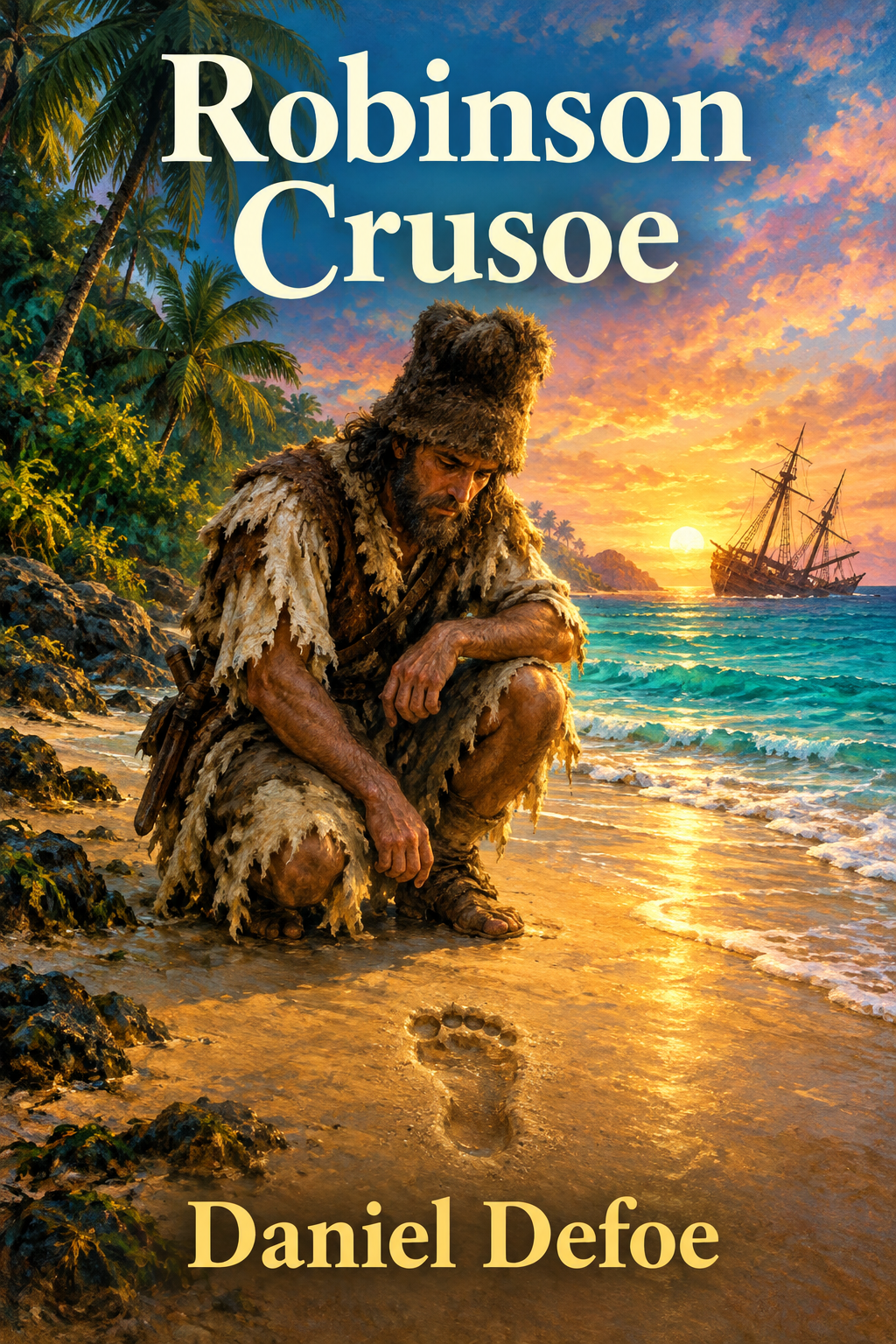
Robinson Crusoe is a 1719 novel by Daniel Defoe about a young Englishman who ignores his father's advice and goes to sea. After pirates, slavery and a sugar plantation in Brazil, a storm wrecks his ship and leaves him alone on a tropical island. Told in his own voice, the book follows his work to stay alive: building a home, growing food, keeping a journal and wrestling with fear and faith. Then one day he finds a single footprint in the sand.
The Big Idea
"Robinson Crusoe shows one man rebuilding a life from salvaged tools, steady work and prayer, and asks what a person really needs once everything else is taken away."
Key Insights
Work makes a life
Robinson survives not by luck alone but by patient, repeated labour. He builds, plants, bakes, herds goats and makes pots, failing many times before succeeding. Defoe presents work as something that steadies the mind as well as feeding the body, and as the way a person turns a hostile place into a home. The island becomes bearable the moment Robinson stops waiting for rescue and starts making decisions each day.
His first loaf of bread follows months of failed grain, a hand-built oven and trial and error.
Fear and faith in solitude
Robinson begins his exile angry at his fate, blames himself, then slowly finds meaning in his survival. His fever, his reading of the Bible and his daily prayers shift his mind from despair to gratitude. The book asks whether suffering can be a teacher, and it shows that faith, for Robinson, is a practical tool for staying sane, not only a belief. His calm is hard won and often interrupted by new fears.
After the fever he starts a habit of listing what he has to be thankful for.
Counting what you have
One of the book's best-known habits is Robinson's ledger of good and evil. He writes down what is wrong with his situation and sets beside it what is right. The method does not change the facts, but it changes how he sees them. Defoe, a merchant's son, treats the mind like an account book, and the lesson is that gratitude is a skill that can be practised even in the worst conditions.
Beside 'cast on a desolate island' he sets 'alive, when all his shipmates drowned'.
Mastery, ownership and empire
Robinson sees himself as lord of the island, and he treats Friday as a loyal servant to be taught and changed. The book never questions this, and it also treats slavery in Brazil as ordinary business. Modern readers often read it as an early story of colonial attitudes, in which an Englishman claims land, names people and decides what is civilised. Reading that side of the book alongside the survival story makes it richer and more troubling.
He renames the rescued man Friday and teaches him to call him 'Master'.
Chapter Breakdown
Chapter-by-chapter summary
Spoiler warning: this section covers the whole plot, including the ending. The original novel has no chapter titles, so the story is split here into its natural parts.
Part 1: Running Away to Sea
Robinson is born in York in 1632 to a merchant family whose father came from Germany. His father begs him to stay in the safe middle of society, which he calls the happiest place to live. Robinson refuses, and in 1651 he boards a ship at Hull. A storm nearly sinks it, and he swears to go home, but the fear fades as soon as the weather clears. He sails again. This matters because the whole book grows out of this one act of disobedience, which Robinson later reads as the start of his punishment and, in the end, his education.
Part 2: Pirates, Slavery and Brazil
On a later voyage, pirates from Salé on the North African coast capture Robinson's ship, and he becomes a slave. After about two years he escapes in a small boat with a boy called Xury. They sail down the African coast until a Portuguese ship picks them up. The captain buys the boat, and Xury agrees to serve him for ten years before being freed. In Brazil, Robinson buys land and grows sugar and tobacco. This part matters because it shows his luck, his business sense and his casual attitude to selling another person's service, which modern readers question.
Part 3: The Shipwreck
After four years in Brazil, Robinson joins a voyage to Africa to bring back enslaved workers for neighbouring planters. A storm wrecks the ship, and every other man drowns. Robinson is washed ashore on 30 September 1659 and spends the first night in a tree. Over the next days he builds a raft and carries food, tools, guns, gunpowder, sails and rope from the stranded ship before the sea breaks it up. This matters because those salvaged goods make survival possible, and his habit of listing what he has, good and bad, becomes the way he fights despair.
Part 4: Building a Life
Robinson chooses a spot against a cliff, builds a wall of stakes and a tent, and enlarges a cave behind it. He cuts a notch in a post every day to keep the calendar and keeps a journal until the ink runs out. He hunts and then herds goats, makes pots and bread, and by chance finds barley sprouting from husks he had shaken out of a bag. He sews clothes from goatskin and teaches a parrot, Poll, to speak. This part matters because it turns the island into a workshop and shows that patient labour can create a kind of order and comfort.
Part 5: Fever and Faith
Robinson falls ill with a fever and has a terrifying dream. For the first time he opens the Bible he rescued from the ship, reads a verse about calling on God in trouble and begins to pray. He starts to see his island as a place where he has been spared rather than punished. Soon after, he explores the island, finds a fertile valley and builds a second home there. His large canoe turns out too heavy to launch, and a smaller boat is swept out by a current. This part matters because it is the moral turning point of the book.
Part 6: The Footprint
After many years alone, Robinson is walking towards his boat when he sees the print of a bare human foot in the sand. He runs home in terror, barricades his fort and hardly sleeps for several nights, wondering if it belongs to a devil, a savage or himself. He later finds the remains of a cannibal feast on the shore. He plans to attack the visitors, then questions whether he has any right to judge or kill them. This matters because the first sign of other people breaks the safety he built and tests his conscience.
Part 7: Friday
When a group of captors brings prisoners to the island, one man breaks free and runs towards Robinson's side of the island. Robinson shoots his pursuers and saves him. He names the man Friday, after the day of the rescue, and teaches him English and his own faith. Friday becomes a loyal companion who learns quickly, and for the first time in years Robinson has someone to talk to. This matters because their friendship, and the way Robinson treats Friday as a servant to be taught, is the part of the book that readers now discuss most.
Part 8: Rescue and Return
Robinson and Friday save two more prisoners, Friday's father and a Spanish sailor. Before a plan to leave can be finished, an English ship arrives carrying a captain held prisoner by his own mutinous crew. Robinson and Friday help the captain retake the ship, and in return he offers them passage. Robinson leaves after 28 years, 2 months and 19 days. Back in England, he finds his parents dead but learns that his Brazilian plantation has made him rich. This matters because the ending rewards his patience, and it shows the island has changed him but not his wish to prosper.
Characters
- Robinson Crusoe: The narrator, born in York. He is restless, practical and stubborn, and he keeps lists, journals and accounts. Over 28 years alone he changes from a young runaway into a careful, prayerful and self-reliant man.
- Friday: A man rescued from a rival group on the island. He is quick, cheerful and loyal. He learns English, helps Robinson rebuild a boat and becomes his only close companion, though Robinson sees himself as master and teacher.
- Xury: The young servant who escapes with Robinson from slavery in North Africa. He is brave, practical and loyal, and he volunteers to risk his own life for Robinson before they are rescued at sea.
- The Portuguese captain: The kind sea captain who rescues Robinson and Xury and helps Robinson settle in Brazil. Years later he looks after Robinson's money, which makes the final return home possible.
- Robinson's father: A prosperous merchant who warns his son against a life at sea. His advice sets up the book's central theme of wanting more than one has, and Robinson often recalls it in his lonely years.
- The captain's widow: The widow of the ship's captain who befriended Robinson on his first voyage to Africa. She safely keeps his money in London and represents the honest, steady side of his old life.
- The Spaniard: One of the prisoners Robinson and Friday rescue. He is reasonable and careful, and he agrees to go and bring his shipwrecked countrymen to join Robinson's plan to leave.
- Friday's father: The second rescued prisoner. Friday is overjoyed to find him alive, and his joy shows Robinson a family bond that mirrors the one he abandoned in England.
- The English captain: The captain of the ship that arrives near the end. His own crew has seized his ship, and Robinson earns his gratitude by helping him regain control and by securing passage home.
- Poll: Robinson's parrot, taught to say his name. Poll is a small piece of comfort in the long solitude, and the sound of his own name startles Robinson back to life.
Writing about this book
A report on Robinson Crusoe works best when it follows one question through the story rather than retelling every event. These starting points may help you decide.
- Crusoe lists the good and the evil of his situation. What does this habit say about how he copes with fear, and is it a sign of strength or of avoiding feeling?
- He calls himself a king of the island. What does the book accept and what does it ignore in his treatment of Friday, Xury and the enslaved workers in Brazil?
- Compare Robinson at the start with Robinson at the end. Which of his beliefs changed, and which stayed the same?
- Can a person be truly alone if they keep a calendar, a journal and a prayer? What do these routines protect?
Choose one question, pick two or three scenes as evidence, and say in your own words what you think. Your own view matters more than a perfect summary.
Take Action
Practical steps you can implement today:
-
When things go wrong, write down what you have next to what you lack, and let the list steer your next small step.
-
Treat a big problem as many small jobs. Robinson's island became a home one tool, one wall and one crop at a time.
-
Keep a simple record, such as a calendar or journal, so that days in hard times do not blur together.
-
Notice whose voice is missing from a story you admire, and ask how Friday or Xury might have told it.
Notable Quotes
"“I was born in the year 1632, in the city of York, of a good family.” (Part 1)"
— Daniel Defoe
"“I learned to look more upon the bright side of my condition, and less upon the dark side.” (Part 5)"
— Daniel Defoe
"“The print of a man's naked foot on the shore, which was very plain to be seen on the sand.” (Part 6)"
— Daniel Defoe
Who Should Read This
Good for readers aged about 13 and up, from middle school through university, who want a classic adventure and a survival story with big questions about work and faith. The 1719 prose is long-winded, so younger readers may prefer an abridged edition. Useful for students writing about early English novels.
Frequently Asked Questions
Is Robinson Crusoe a true story?
No, it is fiction, though it drew on real castaway stories. Many people link it to Alexander Selkirk, a Scottish sailor rescued in 1709 after four years alone on a Pacific island. Defoe's island, however, is in the Caribbean, and the characters and events are his invention. The book was presented as a true account to feel more believable.
How long is Robinson Crusoe on the island?
By his own count, 28 years, 2 months and 19 days. He arrives on 30 September 1659 after the shipwreck. For many years he is completely alone, until he finds a footprint and later rescues the man he calls Friday. Others arrive in the final stage of the story, just before he leaves.
Who is Friday in Robinson Crusoe?
Friday is the man Robinson saves from captors who plan to kill him. Robinson names him after the day of the rescue and teaches him English. Friday becomes his loyal companion and helps him prepare to leave. Many modern readers see their relationship as unequal, because Robinson acts as his master, teacher and religious guide.
When was Robinson Crusoe published and who wrote it?
Daniel Defoe published it in April 1719, when he was in his late fifties. It was an immediate success and is often called one of the first English novels. It was followed by two sequels, The Farther Adventures of Robinson Crusoe in 1719 and Serious Reflections of Robinson Crusoe in 1720.
What are the main themes of Robinson Crusoe?
The main themes are self-reliance, work, faith and providence, loneliness, and ownership and power. Many readers also discuss colonialism, since Robinson claims the island and treats Friday as a servant. The book asks what a person really needs when everything else is taken away, and the answers are tools, routine, company and meaning.
Check Your Understanding
Pick an answer for each question to see if you were right.
-
What does Robinson's father advise him to do at the start of the book?
Stay in the safe middle station of life — His father praises the middle station as the happiest and begs him not to go to sea.
-
Who escapes from slavery with Robinson in a small boat?
Xury — Xury, a boy, escapes with Robinson and sails with him down the African coast.
-
What does Robinson find on the shore that frightens him after many years alone?
A single human footprint — The print of a bare foot in the sand shows him he is not alone.
-
How does Friday get his name?
Robinson rescued him on a Friday — Robinson names him after the day of the week on which he saved his life.
-
About how long does Robinson live on the island?
28 years — By his own count, he spends 28 years, 2 months and 19 days there.
About Daniel Defoe
Daniel Defoe (c. 1660–1731) was an English writer, merchant and journalist who wrote pamphlets, newspaper pieces and political tracts before turning to fiction in his late fifties. Robinson Crusoe, published in 1719, was his first novel and an immediate success. It helped set the pattern for first-person realism in English fiction, and was followed by Moll Flanders and A Journal of the Plague Year.
Summary Written By

Software Engineer & Writer
Software engineer with a passion for distilling complex ideas into actionable insights. Writes about finance, investment, entrepreneurship, and technology.
View all summaries →Reviews
No reviews yet. Be the first to share your thoughts!
Write a Review
Keep reading
Explore the topic: FictionSummaries

Out of My Mind
Sharon M. Draper
“Out of My Mind” by Sharon M. Draper is a poignant narrative that explores the life of Melody Brooks, a…

Ender’s Game
Orson Scott Card
“Ender’s Game” by Orson Scott Card is a riveting science fiction novel that transports readers into a future where humanity…

Pachinko
Min Jin Lee
“Pachinko”, a spellbinding multigenerational historical saga by Min Jin Lee, explores the lives of a Korean family trying to make…

The Perks of Being a Wallflower
Stephen Chbosky
The Perks of Being a Wallflower by Stephen Chbosky is a profound coming-of-age novel, told through the intimate letters of…
Articles

The Enlightenment Explained: Ideas, Thinkers and Legacy
The Enlightenment was an 18th-century European movement that trusted reason and evidence over tradition and authority. Its thinkers, from Locke…
World History 1700–1918: Revolutions, Industry, Empire and War
Between 1700 and 1918, revolutions, factories, empires and a world war reshaped societies across Europe, the Americas, Asia and Africa.…

A Christmas Carol themes: generosity, isolation and responsibility
Dickens's novella is usually read as a story about a man who changes his mind. Its themes are sharper than…