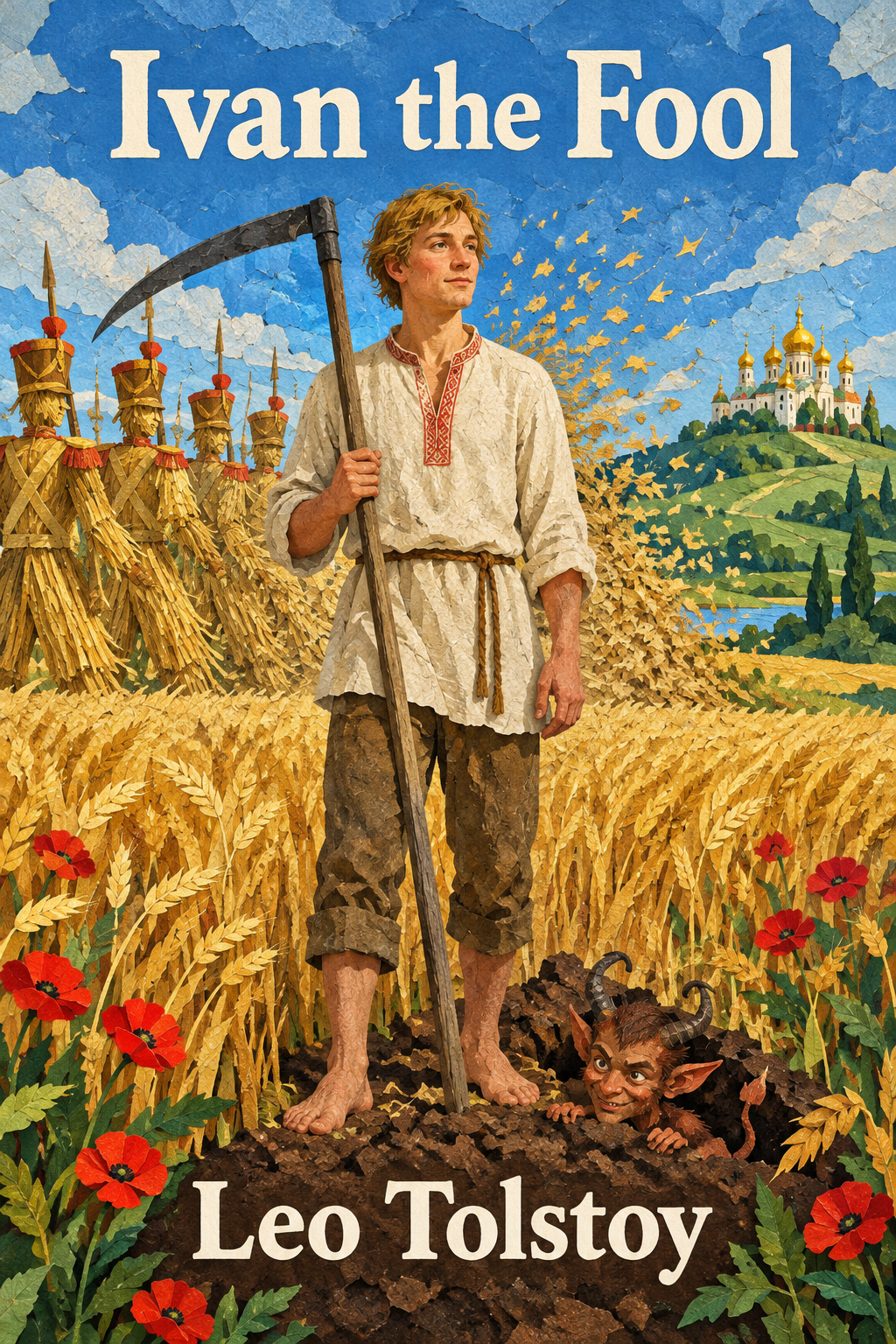
Ivan the Fool
by Leo Tolstoy
Ivan the Fool is Leo Tolstoy's 1886 fairy tale about a rich peasant's three sons and their deaf-mute sister. Two clever brothers, Semyon the soldier and Taras the merchant, leave home to win power and wealth. Ivan, the simple one, stays on the farm and works. An Old Devil sends three imps to turn the brothers against one another, and each imp goes after a different son. The story asks which kind of life holds up when soldiers, gold and cunning all push against it.
The Big Idea
"Tolstoy's fairy tale says real strength comes from honest work and shared labour, not from armies or money, and asks what happens when a fool refuses to play the devil's game."
Key Insights
Honest work is the real power
In Ivan's kingdom, whoever works with their hands eats at the table and everyone else eats the leftovers. Tolstoy treats honest labour as a firmer base for society than rank, money or force, and the tale never wavers from that idea.
Ivan leaves the palace for the fields, his wise ministers leave, and the fools who stay keep everyone fed.
Ambition and greed do the devil's work
The imps never defeat Semyon and Taras directly. They stir up what the brothers already want, which is glory for one and profit for the other. The story suggests that temptation only works on someone who wants what it offers.
Semyon's imp makes him eager for victory, while Taras's imp makes him buy more than he can pay for.
Violence needs willing soldiers
The Devil can invent armies and weapons, but he cannot make people fight. When Ivan's subjects refuse to enlist and welcome an invader with food, the whole plan of war falls apart.
The neighbouring king's soldiers cannot fight people who only feed them, so his army disbands.
Who is the real fool?
The clever brothers lose their wealth and kingdoms, while the fool ends up safe and respected. Tolstoy turns the word upside down: the cleverness that serves greed is the real foolishness, and plain goodness is the sturdier kind of sense.
The Devil lectures from a tower about working with the head, yet he cannot even feed himself.
Chapter Breakdown
Chapter-by-chapter summary
Spoiler warning: this section covers the whole plot, including the ending.
Part 1: Three brothers and a mute sister (chapter 1)
A rich peasant has three grown sons and a daughter. Semyon is a soldier, Taras is a stout merchant, Ivan is called the Fool, and the sister, Malanya, cannot hear or speak. Semyon goes off to serve the king and Taras goes to town to trade, and each takes his share of the family property. Ivan tells them to take whatever they want. He keeps only an old mare and stays to work the land with his parents and sister. This matters because the whole tale rests on this contrast: the brothers chase status and wealth, while Ivan stays beside work he can do with his own hands.
Part 2: The Old Devil sends three imps (chapter 2)
The Old Devil wants the brothers to turn on one another, so he sends three imps, one for each son. Semyon's imp spoils the army's gunpowder and conjures straw soldiers for the enemy, and Semyon is disgraced. Taras's imp feeds his greed until he is buying goods on credit and drowning in debt. This matters because the devil never beats the clever brothers by force. Their own hunger for rank and money does the work, and the imps only give it a push.
Part 3: Ivan catches the imps (chapters 3–5)
Ivan's imp spits in his drink and hardens the soil, but Ivan keeps ploughing, and finally pulls the imp out of the furrow. To be freed, the imp hands over three magic roots, and one cures Ivan's stomach. The other imps then flood his hayfield, dull his scythe and block his tree-felling. Ivan out-works each of them, and each buys freedom with a gift: a rhyme that turns straw into soldiers, and a trick that turns oak leaves into gold. Meanwhile both brothers come home broke, and their wives will not sit at the table with Ivan. This matters because Ivan wins by plain, stubborn labour, not by cleverness.
Part 4: The feast and the brothers' kingdoms (chapters 6–7)
Ivan holds a feast, scatters gold among the villagers and makes straw soldiers to entertain them. His brothers then ask for help. Ivan makes Semyon an army, and Semyon conquers a kingdom. He gives Taras gold from leaves, and Taras grows rich in trade. But Ivan stops after seeing the harm: the soldiers have led to a death, and the gold has cost a family its cow. The brothers go off to rule as kings. This matters because Ivan treats power like a toy and puts it down as soon as it hurts someone.
Part 5: The princess and Ivan's kingdom (chapters 8–9)
Ivan's sick dog eats one of the roots and recovers. When the king's daughter falls ill, the king promises her hand to whoever can cure her. On the way, Ivan gives his last root to a beggar woman with a crippled arm. Even so, the princess recovers as he steps onto the palace threshold. Ivan marries her and becomes king, but he goes back to peasant work. His wise ministers leave, the fools stay, and everybody works and shares. When people complain, Ivan answers that even a king must eat. Meanwhile Semyon rules by conscription and Taras by taxes. This matters because Ivan's kingdom has no army, and no one needs one.
Part 6: The Old Devil attacks the brothers' kingdoms (chapter 10)
When the imps do not return, the Old Devil finds only holes in the ground and takes charge himself. He shows up before Semyon as a general, pushing mass conscription and new weapons. Semyon marches against the Indian king, who answers with a frightening new weapon, and Semyon loses his kingdom. He comes to Taras as a merchant and buys up goods and labour, until the king can neither eat well nor finish his palace. This matters because both brothers fall to the same kind of trap, which looks like progress and feeds their own appetites.
Part 7: The Devil in Ivan's land (chapters 11–12)
The Devil, again a general, tries to raise an army in Ivan's kingdom, but nobody wants to be a soldier. A neighbouring king invades, and the people meet his troops with food instead of weapons, so his army falls apart. Next the Devil poses as a fine gentleman and offers gold for labour, but the people use coins only for jewellery and toys. He refuses to work and refuses charity, so he has to eat at one house after another. Malanya checks everyone's palms for calluses, and the Devil has none. From a tower he lectures people about working with the head, then, weak with hunger, tumbles down the steps and vanishes into a hole in the ground. The tale ends with its rule: whoever has callused hands eats at the table, and everyone else eats the leftovers. This matters because the Devil is beaten by a community that does not want what he sells.
Characters
- Ivan the Fool. The youngest son, called a fool because he is simple, trusting and willing to work. He asks for nothing, gives away what he has and never fights back. His power comes from steady labour, and he treats magic gifts as toys.
- Semyon the Warrior. The soldier. He leaves to serve the king, wants rank and glory, and trusts armies to solve problems. His imp and then the Old Devil push him from war to war until he loses his kingdom.
- Taras the Belly. The stout merchant. He chases profit, buys on credit and later taxes his people. His greed makes him easy prey, first for his imp and then for the Devil dressed as a merchant.
- Malanya. Ivan's deaf-mute sister. She works quietly at home and in the fields. Near the end she is the one who exposes the Devil by checking whether guests have calluses on their hands.
- The Old Devil. The head of the devils. He wants the family to fall apart, sends imps, and when they fail, tries again as a general, a merchant and a gentleman. He is stopped by people who will not play his game.
- The three imps. Young devils, one for each brother. They ruin the clever two through ambition and greed, but Ivan catches all three with plain hard work, and each one buys its freedom with a gift.
- The princess. The king's daughter, who falls ill. Her father promises her hand to whoever cures her. She recovers as Ivan arrives and marries him, so Ivan becomes king, though he keeps living like a farmer.
Writing about this book
A short story with a fairy-tale shape is easy to retell, so a good assignment goes past the plot. Start with one clear question and let the story answer it. A few starting points:
- Why does Tolstoy make the hero a fool? Compare what the clever brothers gain with what they lose.
- The imps never use force. What do they use instead, and why does it work on Semyon and Taras but not on Ivan?
- Ivan gives up magic as soon as he sees harm. Is that weakness or wisdom?
- The ending says who eats at the table. Is that rule fair? Would it work in a school, a company or a country?
- Tolstoy wrote it in 1885 and published it in 1886. Which parts of the tale still feel current, such as armies, money, taxes and clever talk?
Pick one scene, such as the feast, the Indian war or the Devil's speech from the tower, and show with specific details how it supports your answer. Add what you honestly think, even if you disagree with Tolstoy, and say why. Your own reasoning is the part that makes the writing yours.
Take Action
Practical steps you can implement today:
-
Judge a plan by whether it needs force or greed to keep going, and be wary if it does.
-
Notice what you want, because that is the first place temptation will push.
-
Put a tool down as soon as you see it hurting someone, even if it is useful.
-
Ask who is actually doing the work before you decide who deserves the reward.
Notable Quotes
"“Let him take what he wants.” (Chapter 1)"
— Leo Tolstoy
"“I'll make you as many as you like.” (Chapter 7)"
— Leo Tolstoy
"“But even a king must eat.” (Chapter 9)"
— Leo Tolstoy
Who Should Read This
Ivan the Fool suits middle and high school readers, students writing a book report, and adults who enjoy short, thoughtful tales. It takes about twenty minutes to read and works well as a first taste of Tolstoy before War and Peace.
Frequently Asked Questions
Who is Ivan the Fool?
Ivan is the youngest son of a rich peasant in Leo Tolstoy's 1886 fairy tale. People call him a fool because he is simple, trusting and gives away what he has. In truth, his plain habits of hard work and sharing make him the one who survives the devil's tricks.
What is Ivan the Fool about?
It follows three brothers whom the Old Devil and his three imps try to ruin. Semyon, a soldier, and Taras, a merchant, fall to ambition and greed. Ivan, who simply works the land, beats the imps and later runs a kingdom with no army, where those who work with their hands eat at the table.
Who are the main characters in Ivan the Fool?
The main characters are Ivan, his brothers Semyon the Warrior and Taras the Belly, their deaf-mute sister Malanya, the Old Devil and three imps. The king's daughter, whom Ivan cures and marries, appears in the middle of the story. Each brother stands for a different way of living.
What does Ivan the Fool teach?
The tale argues that honest work, sharing and refusing violence are stronger than armies and money. It also shows how greed and the wish for glory make people easy to trick. Tolstoy wrote it to say that a simple, hardworking life can be wiser than clever schemes.
When was Ivan the Fool written, and is it a real folk tale?
Tolstoy wrote it in 1885 and it was published in 1886. It borrows its shape from Russian folk tales, with a simple youngest son, magic gifts and a devil, but Tolstoy made it up himself to carry his own ideas about work, war and money.
Check Your Understanding
Pick an answer for each question to see if you were right.
-
What does Ivan keep when his brothers leave home?
An old mare — Ivan lets his brothers take what they want and keeps only an old mare.
-
How does Ivan get a gift from each imp?
He keeps working and catches them — Ivan's steady work lets him catch each imp, and each buys its release with a gift.
-
Why does Ivan stop making soldiers and gold?
He sees the harm they cause — He sees that the soldiers led to a death and the gold cost a family its cow, so he refuses to make more.
-
How does Malanya expose the Devil?
She checks his hands for calluses — Malanya checks everyone's palms for calluses, and the Devil has none, so he gets only leftovers.
-
What rule ends the story?
Those with callused hands eat at the table — Whoever works with their hands sits at the table, and everyone else eats what is left.
About Leo Tolstoy
Leo Tolstoy (1828–1910) was a Russian novelist and moral thinker, best known for War and Peace and Anna Karenina. In the 1880s he turned to short stories, fairy tales and essays on work, violence and faith. Ivan the Fool is one of his best-known folk-style tales.
Summary Written By

Software Engineer & Writer
Software engineer with a passion for distilling complex ideas into actionable insights. Writes about finance, investment, entrepreneurship, and technology.
View all summaries →Reviews
No reviews yet. Be the first to share your thoughts!
Write a Review
Keep reading
Explore the topic: FictionSummaries

Out of My Mind
Sharon M. Draper
“Out of My Mind” by Sharon M. Draper is a poignant narrative that explores the life of Melody Brooks, a…

Ender’s Game
Orson Scott Card
“Ender’s Game” by Orson Scott Card is a riveting science fiction novel that transports readers into a future where humanity…

Pachinko
Min Jin Lee
“Pachinko”, a spellbinding multigenerational historical saga by Min Jin Lee, explores the lives of a Korean family trying to make…

The Perks of Being a Wallflower
Stephen Chbosky
The Perks of Being a Wallflower by Stephen Chbosky is a profound coming-of-age novel, told through the intimate letters of…
Articles

The Enlightenment Explained: Ideas, Thinkers and Legacy
The Enlightenment was an 18th-century European movement that trusted reason and evidence over tradition and authority. Its thinkers, from Locke…

World History 1700–1918: Revolutions, Industry, Empire and War
Between 1700 and 1918, revolutions, factories, empires and a world war reshaped societies across Europe, the Americas, Asia and Africa.…

A Christmas Carol themes: generosity, isolation and responsibility
Dickens's novella is usually read as a story about a man who changes his mind. Its themes are sharper than…