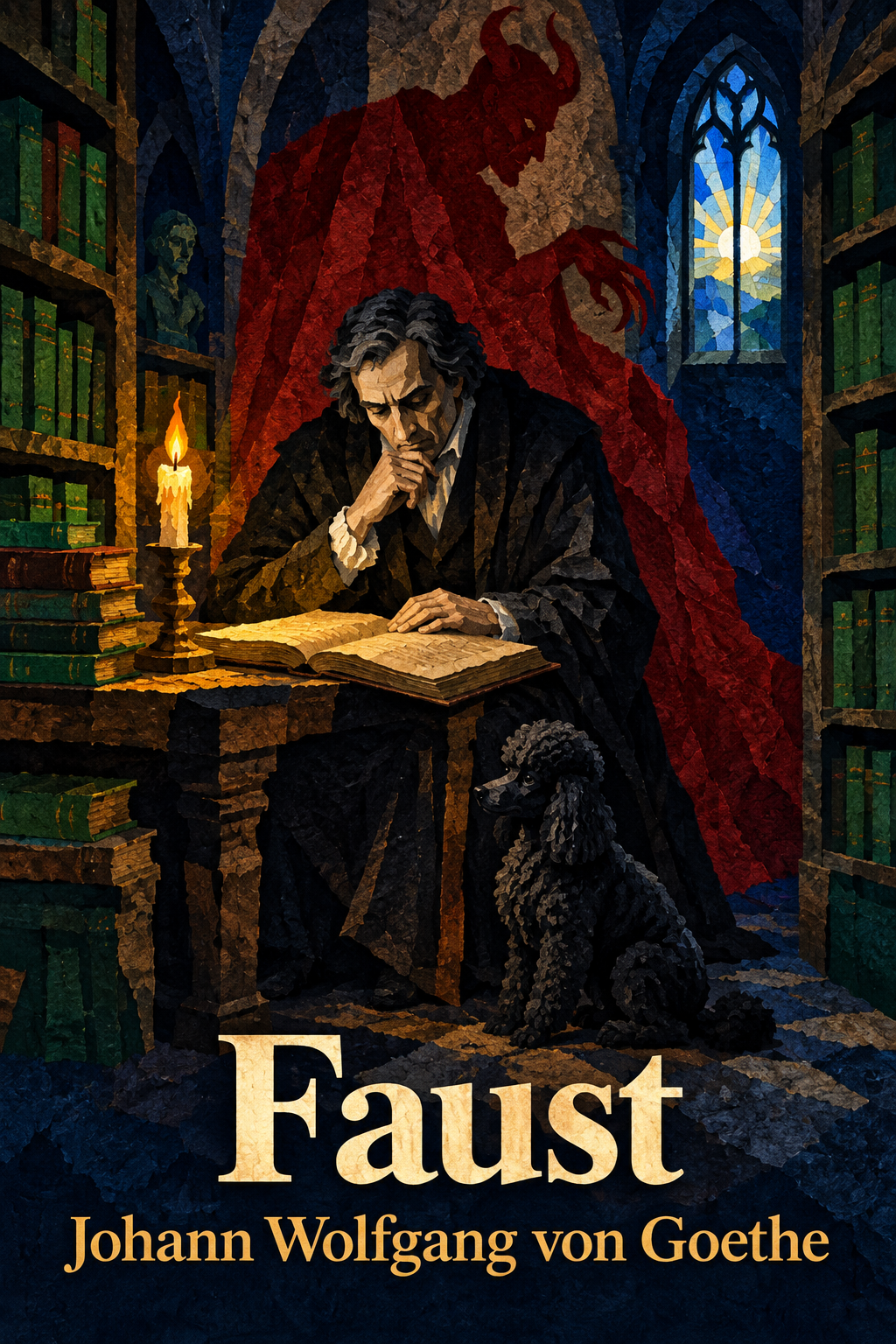
Faust
by Johann Wolfgang von Goethe
Faust is Goethe's two-part verse drama about a scholar who has mastered every subject and still feels he knows nothing. He makes a wager with the devil Mephistopheles: if the devil can ever give him a moment so perfect that he wants it to last, Faust loses his soul. Part One follows Faust into love and its human cost; Part Two widens into politics, art and ambition. The play asks whether striving itself can redeem a flawed person.
The Big Idea
"Goethe's Faust argues that a restless, striving mind will err and do harm, yet the longing to keep growing, never settling for one perfect moment, is what makes a person human."
Key Insights
Striving and error go together
Goethe's God says people go astray as long as they strive. The play treats mistakes as the price of wanting more, not as proof that wanting is wrong. Faust is neither hero nor villain; he is a person whose hunger for experience drives both achievement and damage. That is why his final judgement is generous, yet the play never excuses what he does along the way.
Faust abandons Gretchen to her fate in Part One, yet he spends his last years trying to build something useful. Both facts stay true, and the play asks readers to hold them together.
The bet is against dissatisfaction
The pact is unusual because Faust does not ask for pleasure, wealth or power as such. He bets that nothing will ever satisfy him. Goethe explores a modern restlessness: the feeling that any moment worth keeping would be the end of growth. The devil must find a moment so complete that Faust wants it to stop.
Faust is bored by the Leipzig tavern, thrilled and then hurt by love, and never says “stay” to either. Even at the end he speaks only of a moment he can imagine, not one he has.
Knowledge needs experience, and experience needs care
Faust's opening complaint is that books cannot explain life. He leaves the study for experience, but the play does not simply praise action over learning. Wagner, who trusts books, is shown as small, yet Faust's leaps into experience leave a trail of damage. Goethe suggests real understanding needs thought, lived experience and humility together.
Faust tries to retranslate the opening of the Gospel of John and settles on “In the beginning was the Deed.” Later, as a ruler, he learns that deeds have victims.
Progress has a price someone else pays
Part Two follows Faust from private feeling to public projects: paper money, war, land reclamation. Each success carries a cost borne by someone else. Goethe was writing at the start of the industrial age, and the play looks hard at ambition that treats people as obstacles.
The burned cottage of Philemon and Baucis is the clearest case. Faust's dream of a free people is real, but it is built beside a death caused by his own plan.
Chapter Breakdown
Chapter-by-chapter summary
Spoiler warning: this section covers the whole plot, including the ending.
Section 1: Prologue in Heaven and the Wager
Goethe opens with a theatre manager, a poet and a clown arguing about what the stage is for. The scene then moves to heaven, where the devil Mephistopheles tells God that humans are wretched and that the respected scholar Faust is no exception. God replies that people go astray as long as they keep striving, and allows the devil to try. On earth, Faust sits in his study, worn out. He has mastered philosophy, law, medicine and theology and still feels he knows nothing. He turns to magic, lifts a cup of poison, and is stopped by the sound of Easter bells. The wager matters because it turns the whole play into a test: can a restless person who fails still be worth saving?
Section 2: The Pact
On Easter Sunday Faust walks outside the town gate with his assistant Wagner. A black poodle follows them home and, in the study, turns into Mephistopheles, who calls himself the spirit that always denies. They make a deal. The devil will serve Faust in this life; if Faust ever says to a passing moment, “Stay, you are so beautiful,” he is finished and will serve the devil afterwards. Faust, sure that nothing will ever satisfy him, signs in blood. A rowdy tavern in Leipzig bores him, and a witch's kitchen gives him a potion that makes him young again. This section matters because the pact is not about pleasure. It is a bet against Faust's own endless dissatisfaction.
Section 3: Meeting Gretchen
Faust, young again, sees Margarete, called Gretchen, a modest girl coming home from church, and is struck at once. Mephistopheles hides a casket of jewels in her room and occupies her neighbour Marthe so that the two can meet. Gretchen is flattered and then won over by Faust's warmth. Ashamed of using her, Faust withdraws to a forest cave, but the devil drags him back. In the garden she asks him plainly whether he believes in God, and he answers with grand, vague words that never say yes or no. The scene matters because Gretchen's directness shows how much Faust talks around what he really wants.
Section 4: Guilt and the Death of Valentin
To let the lovers meet at night, Gretchen gives her mother a sleeping drink, and the mother dies. Soon Gretchen is pregnant, and the town begins to talk. Her brother Valentin, a soldier, insults her in public. Faust, helped by Mephistopheles, fights him in the street and kills him, and Valentin dies cursing his sister. In the cathedral, Gretchen is tormented by an evil spirit and faints. Nothing here is a single huge crime. Small choices pile up until they cannot be undone, and that slow build is what makes Gretchen's story the emotional centre of Part One.
Section 5: Walpurgis Night and the Dungeon
Mephistopheles takes Faust to Walpurgis Night, a witches' gathering on the Brocken mountain, hoping to distract him. Faust instead sees a vision of Gretchen and learns she is in prison for drowning her newborn child and faces execution. He rages at the devil and demands to be taken to her. In the dungeon Gretchen is half out of her mind, yet she refuses to escape and gives herself up to judgement. Mephistopheles says she is condemned, but a voice from above says she is saved. Faust leaves with the devil, and Part One ends. The contrast matters: Gretchen faces what she did, while Faust runs.
Section 6: Part Two, Acts 1–2: The Court and Greece
Part Two was published in 1832, after Goethe's death. Faust wakes in a meadow, healed by spirits, and enters the Emperor's court, where the treasury is empty. Mephistopheles solves it by issuing paper money backed by treasure said to lie buried in the ground. At a carnival the Emperor asks to see Helen of Troy and Paris, so Faust descends to the realm of the Mothers and brings back their phantoms. Struck by Helen's beauty, he grabs at her and the vision explodes. Meanwhile Wagner creates a tiny artificial being, Homunculus, who guides the party to a Classical Walpurgis Night in ancient Greece. Part Two matters because it moves from one love story to money, art and history.
Section 7: Part Two, Acts 3–4: Helen and the War
In Greece, Faust seeks the real Helen, and with Mephistopheles' help she comes to his medieval castle. They unite, and their son Euphorion is born. The boy longs to fly, leaps from the ground and falls dead. Helen follows him to the underworld, leaving only her robe and veil. Back in the present, Faust looks out at the sea and plans to win land from it. When a rival threatens the Emperor, Mephistopheles' three mighty men win the battle, and Faust is rewarded with the coastline. This matters because Faust changes from someone who admires beauty to someone who builds, and the play asks what building costs.
Section 8: Part Two, Act 5: The Last Years
Years later, Faust rules a thriving land reclaimed from the sea. An old couple, Philemon and Baucis, refuse to leave their cottage, which blocks his plan. Faust wants them moved, but Mephistopheles and his men burn the cottage and the couple die. Four grey women appear, and Care breathes on Faust, making him blind. Hearing digging, he thinks workers are draining the land and imagines a free people living on it; at that thought he says he could tell the moment to stay, and he falls dead. The sounds were the Lemurs digging his grave. Mephistopheles claims the soul, but angels scatter roses, drive the devils off and carry it upward, with Gretchen among those who plead for him. Faust is saved not for being good but for never ceasing to strive.
Characters
- Faust: A learned doctor in a German town who has studied every subject and still feels empty. He bets the devil that nothing can satisfy him. He is brilliant, restless and at times selfish; the play follows him from love to power to a late attempt to do something lasting for others.
- Mephistopheles: The devil, who appears as a poodle, a student and a nobleman. Witty, cynical and practical, he gives Faust what he asks for and tests him constantly. He calls himself the spirit that always denies, yet his schemes keep driving the story forward.
- Gretchen (Margarete): A modest young woman who lives with her mother. She falls in love with Faust and is destroyed by what follows: her mother's death, her brother's death and her child's death. In prison she accepts responsibility instead of escaping, and she becomes the play's moral centre.
- Wagner: Faust's assistant, a diligent scholar who trusts books and method. He is a foil to Faust's restless idealism. In Part Two he creates Homunculus in a laboratory, believing he is making life by science.
- Valentin: Gretchen's brother, a soldier. He tries to defend her honour and is killed by Faust in a duel. His dying curse on his sister adds to the public shame that crushes her.
- Marthe Schwerdtlein: Gretchen's worldly neighbour, a widow. She is courted by Mephistopheles and gives Faust and Gretchen a place to meet. Her practical, slightly comic manner contrasts with Gretchen's innocence and with the seriousness of what follows.
- Helen of Troy: The legendary beauty of ancient Greece, whose abduction started the Trojan War. In Part Two Faust calls her up and then finds her himself. She stands for ideal beauty, which he can touch but not keep.
- Homunculus: A tiny artificial man made by Wagner and living in a glass flask. He glows with intelligence but longs for a real body. He guides Faust to ancient Greece and ends by shattering in the sea, in a burst of light.
Writing about this book
Faust is long, so a strong report picks one scene or one question instead of trying to cover everything. Here are some angles that work.
- What kind of moment would make you say “Stay”? Compare Faust's answer with a time in your own life when you wanted something to last.
- Who is responsible for Gretchen's tragedy: Faust, Mephistopheles, the town, or Gretchen herself? Point to specific scenes.
- Is it ever acceptable to hurt people while pursuing a worthwhile goal? Use the burned cottage in Part Two as evidence.
- Does continuous striving really justify saving someone? Say whether the ending persuades you and why.
Choose one scene that stuck with you, say what you felt, and explain why. Keep quotations short, put ideas in your own words, and avoid copying summaries or study notes.
Take Action
Practical steps you can implement today:
-
Knowledge alone does not answer life's questions; pair thinking with experience, and ask what your own restlessness is really asking for.
-
When you chase a big goal, ask who pays for it. Gretchen and Philemon and Baucis show costs that ambition tends to ignore.
-
Never stopping is not the same as being blameless. Keep growing, and also own the damage your mistakes cause.
-
Read a long classic scene by scene, setting one question for each section instead of trying to absorb the whole at once.
Notable Quotes
"“Man errs as long as he strives.” (Prologue in Heaven)"
— Johann Wolfgang von Goethe
"“Two souls, alas, live in my breast.” (Outside the City Gate)"
— Johann Wolfgang von Goethe
"“In the beginning was the Deed.” (Study)"
— Johann Wolfgang von Goethe
"“Stay a while, you are so beautiful!” (Study)"
— Johann Wolfgang von Goethe
"“Whoever strives on and on, we can redeem.” (Part Two, Act 5)"
— Johann Wolfgang von Goethe
Who Should Read This
Students from about age sixteen, readers of German literature, and anyone curious about the legend behind the phrase “selling your soul.” Part One is the usual school text; Part Two is dense with myth and allegory and suits university students and keen readers. Use this guide as a map before or alongside a translation.
Frequently Asked Questions
What is Faust about?
Faust is Goethe's two-part play about a scholar who is bored with learning and bets the devil that nothing can ever satisfy him. Part One is a personal tragedy centred on his love for Gretchen. Part Two is a larger, stranger journey through an empire, ancient Greece and a project to claim land from the sea.
What is the deal in Faust?
There are two linked deals. In the Prologue in Heaven, Mephistopheles wagers with God that he can lead Faust astray. In the study, Faust and the devil agree that the devil serves him in this life, and that if Faust ever asks a moment to stay because it is so beautiful, the devil wins his soul.
Do I need to read Part Two?
Part One stands on its own and is what most schools set. Part Two is symbolic and packed with Greek myth, politics and allegory, so it reads differently. Readers who want Faust's full story should read it, ideally with notes, while students writing a short report can focus on Part One.
Who is Gretchen in Faust?
Gretchen, short for Margarete, is the young woman Faust loves in Part One. Her story, from innocent flirtation to disaster, is widely seen as the emotional heart of the play. Her blunt question about whether Faust believes in God is so famous that it is often called the Gretchen question.
Was Faust a real person?
A wandering magician-scholar named Johann Georg Faust lived around 1480 to 1540, and stories about him spread after his death. A German chapbook about him appeared in 1587. Goethe took the old legend but changed it: his Faust is a seeker whose fate stays open, not a plain warning against sin.
Check Your Understanding
Pick an answer for each question to see if you were right.
-
Who makes a wager with God about Faust in the Prologue in Heaven?
Mephistopheles — Mephistopheles says he can lead Faust astray, and God allows him to try.
-
What words would cost Faust his soul if he said them to a moment?
“Stay, you are so beautiful” — Faust agrees that if he ever asks a moment to stay because it is so beautiful, the devil wins.
-
Who is Gretchen's brother, killed by Faust in a duel?
Valentin — Valentin, a soldier, defends his sister's honour and dies cursing her.
-
How does Mephistopheles fix the Emperor's empty treasury in Part Two?
Paper money backed by buried treasure — He invents paper notes guaranteed by treasure said to lie buried in the Emperor's land.
-
What large project does Faust lead in the final act?
Winning land back from the sea — He turns coastal land won from the sea into a thriving domain, and his last vision is of a free people living there.
About Johann Wolfgang von Goethe
Johann Wolfgang von Goethe (1749–1832) was a German poet, playwright, novelist and scientist, born in Frankfurt. He also served the duke of Weimar as a statesman. He worked on Faust for about sixty years, from his early twenties until the year before his death, and it is regarded as the central work of German literature.
Summary Written By

Software Engineer & Writer
Software engineer with a passion for distilling complex ideas into actionable insights. Writes about finance, investment, entrepreneurship, and technology.
View all summaries →Reviews
No reviews yet. Be the first to share your thoughts!
Write a Review
Keep reading
Explore the topic: FictionSummaries

Out of My Mind
Sharon M. Draper
“Out of My Mind” by Sharon M. Draper is a poignant narrative that explores the life of Melody Brooks, a…

Ender’s Game
Orson Scott Card
“Ender’s Game” by Orson Scott Card is a riveting science fiction novel that transports readers into a future where humanity…

Pachinko
Min Jin Lee
“Pachinko”, a spellbinding multigenerational historical saga by Min Jin Lee, explores the lives of a Korean family trying to make…

The Perks of Being a Wallflower
Stephen Chbosky
The Perks of Being a Wallflower by Stephen Chbosky is a profound coming-of-age novel, told through the intimate letters of…
Articles

The Enlightenment Explained: Ideas, Thinkers and Legacy
The Enlightenment was an 18th-century European movement that trusted reason and evidence over tradition and authority. Its thinkers, from Locke…

World History 1700–1918: Revolutions, Industry, Empire and War
Between 1700 and 1918, revolutions, factories, empires and a world war reshaped societies across Europe, the Americas, Asia and Africa.…

A Christmas Carol themes: generosity, isolation and responsibility
Dickens's novella is usually read as a story about a man who changes his mind. Its themes are sharper than…