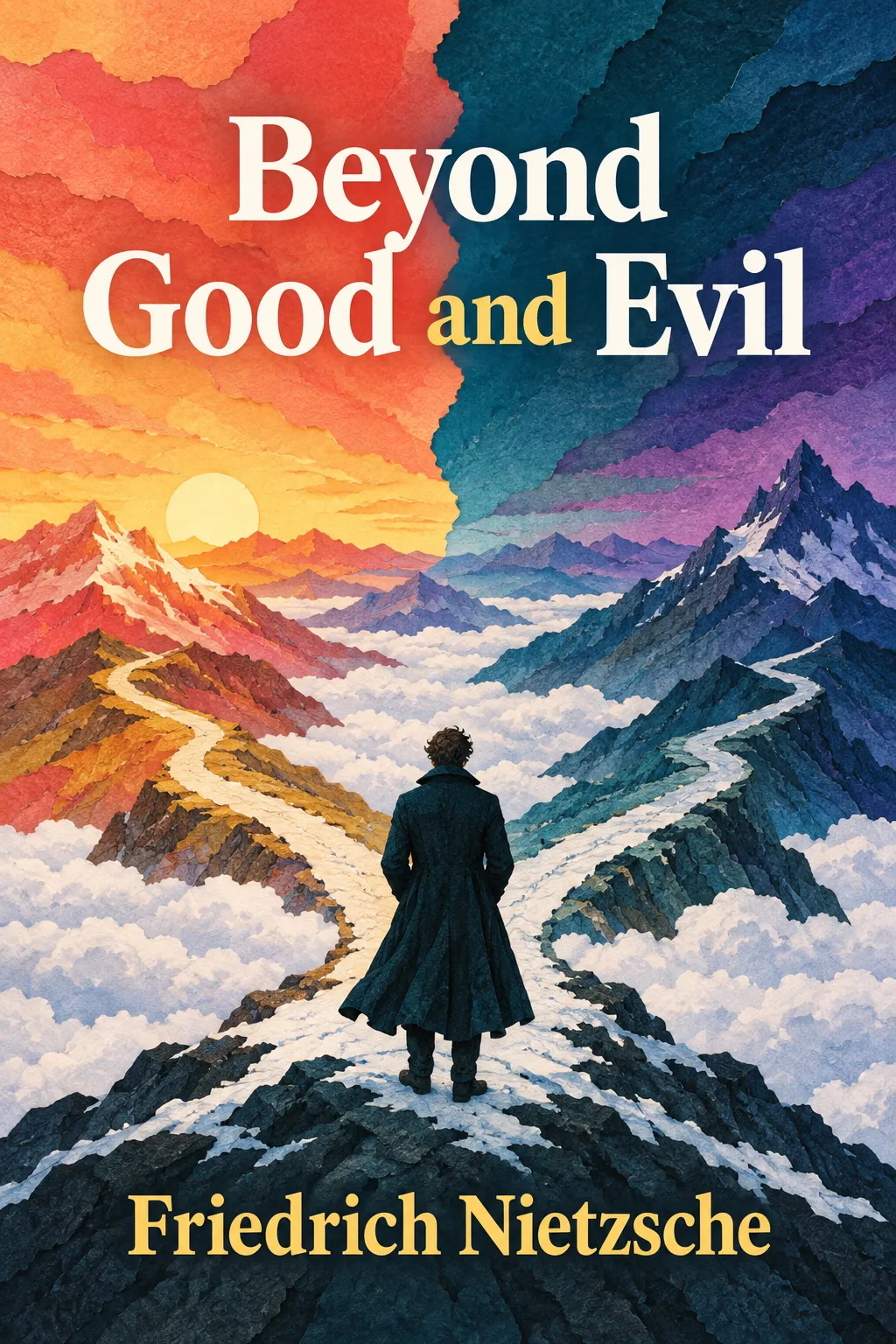
Beyond Good and Evil
by Friedrich Nietzsche
Beyond Good and Evil (1886) is Friedrich Nietzsche's short, sharp book of nearly three hundred aphorisms. It asks why philosophers claim to seek pure truth while defending their own prejudices, and why Europe treats its inherited morality as the only possible one. Nietzsche offers a different view: values grow from drives and the will to power, moralities come in kinds, and the thinkers of the future must be bold free spirits who look at life from many angles.
The Big Idea
"Nietzsche argues that philosophers' favourite beliefs about truth, good and evil are disguised preferences, and that a freer kind of thinker must test every value, including morality itself, from several perspectives."
Key Insights
Philosophies reveal their authors
Nietzsche suggests that behind each great system sits a person with needs, fears and habits. A philosopher who says he follows pure reason is often defending something he already wanted to believe, and the logic arrives later to dress it up. Reading a philosophy therefore means asking who needs it to be true and what that need protects.
When Descartes treats 'I think' as a plain fact, Nietzsche asks who the 'I' is, what 'thinking' is, and why we assume a doer behind every deed.
Truth from many angles
Nietzsche denies that anyone sees the world from nowhere. Every view is a perspective shaped by drives, so the better route to understanding is to use more perspectives, not to claim a single correct one. This is not relativism for its own sake: he still wants discipline, evidence and a hard intellectual conscience.
A scholar who calls himself purely objective, he says, is often a mirror: polite, passive and unable to say what he himself wants. A thinker with many eyes learns more from the same facts.
Morality has a history
Moral rules look eternal, but Nietzsche treats them as the result of long training by particular peoples for particular needs. In part 9 he separates master morality, built on self-respect, from slave morality, built on the experience of the powerless. The point is not that one is simply right; it is that 'good' has meant different things in different hands.
Where a noble type calls himself 'good' and the common 'bad', the resentful type calls the strong 'evil' and himself 'good'. The same words, turned around, carry opposite values.
Beyond good and evil is not beyond right and wrong
The title is easy to misread as permission to do anything. Nietzsche says he wants to go beyond the narrow pair of 'good' and 'evil' as inherited moral labels, and to ask what value actions and people really have. That asks for more thought about morality, not less. He expects the free spirit to be harder on himself than the crowd is.
In his own maxim, whatever is done out of love lies beyond good and evil: the usual labels fail to describe it, yet no one would call it careless.
Chapter Breakdown
Chapter-by-chapter summary
The full title is Beyond Good and Evil: Prelude to a Philosophy of the Future. The book has a preface, nine parts and a closing poem, and it contains 296 numbered aphorisms. Each aphorism can be read alone, so the summary below follows the flow of the parts.
Part 1: On the Prejudices of Philosophers
The preface opens with a joke that is also a challenge: supposing truth is a woman, have philosophers been clumsy suitors? Nietzsche then asks a question few thinkers asked before him: why do we want truth at all, and why not untruth? He notices that philosophers love to split the world into opposites such as truth and error, or selfless and selfish, as though good things could never grow from bad ones. He doubts that Descartes' 'I think' is as certain as it looks, and he proposes the will to power as a better key to what drives living things. Why it matters: the whole book rests on this suspicion that a philosophy is a confession of its author.
Part 2: The Free Spirit
Here Nietzsche sketches the kind of thinker he admires. A free spirit is not a rebel for show; he is someone who can live with doubt, wear masks, and test beliefs by trying them out. Nietzsche says the mind prefers simple pictures and often falsifies the world to feel at home in it, and he argues that a judgement can be false and still useful for life. He also praises 'perhaps' as the word of new philosophers, because it refuses to settle too early. Why it matters: this part shows the method of the book, which is to experiment with ideas instead of defending a system.
Part 3: The Religious Mood
Nietzsche studies religion as a human phenomenon, neither as a believer nor as a mocker. He asks what drives a person toward saintliness and self-denial, and he reads the history of Christian faith as a long series of sacrifices: first human beings, then instincts and nature, and finally, in his phrase, God himself for the sake of 'nothing'. He admits that religion has trained and comforted many people, and that rulers and educators have used it as a tool. Yet he believes modern Europe is losing its faith without noticing what that loss will cost. Why it matters: it sets up his claim that Europe's morality grew out of Christian habits.
Part 4: Maxims and Interludes
This part is a break from argument: more than a hundred short sayings, jokes and observations on love, friendship, vanity, women and men, and the habits of the mind. Some are cruel, some are gentle, and many are famous. Here are the warning about fighting monsters and staring into the abyss, and the remark that whatever is done out of love lies beyond good and evil. The entries read like sparks thrown off while thinking. Why it matters: it shows that Nietzsche thinks in psychological observations, and that the book's title is about motives, not about permission to do wrong.
Part 5: On the Natural History of Morals
Nietzsche turns to morality as a thing to be studied, as a botanist studies plants. He notes that Europe has many moral systems but one dominant instinct: the herd's wish for safety, equality and obedience, wearing the costume of conscience. He calls every morality a kind of 'tyranny against nature' that trains a people through long discipline, and he points out that this discipline produced much of what we call culture. He does not say morality should vanish; he says it should be examined. Why it matters: from here on, a moral rule is a fact about people to be explained, not a commandment that explains itself.
Part 6: We Scholars
Here Nietzsche argues with the scientists and scholars of his day. He respects careful work but worries about narrow specialists and tidy 'objective' men who act as mirrors and have no will of their own. He contrasts them with the true philosopher, who is a commander and lawgiver and says 'thus it shall be', creating values rather than recording facts. Scholarship, in his view, serves philosophy and cannot replace it. Why it matters: it explains his demand that the philosophers of the future must dare to create, and it shows his suspicion of any claim to look at the world from nowhere.
Part 7: Our Virtues
Nietzsche questions the virtues his own readers are proud of, such as honesty, pity and a broad historical sense. He suggests that modern Europeans are drawn to the suffering of others and to comfort, and that this softness can hide a lack of backbone. He also admits that honesty is a stubborn virtue that may turn against the believer himself. The part ends with several remarks about women that are strongly opinionated and widely criticised today as prejudiced; they are best read as evidence of his own blind spots. Why it matters: it shows him applying his suspicion to himself and his readers, not only to others.
Part 8: Peoples and Fatherlands
This part turns to politics and culture. Nietzsche is sharp about German nationalism, about the heavy mood he sees in German music and thought, and about the anti-Semites of his time, whom he rejects. He imagines a 'good European' who stands above petty national rivalries, and he expects Europe's peoples to mix and move toward greater unity. He also comments on the French, the English and other nations in sweeping terms that reflect nineteenth-century stereotypes more than careful analysis. Why it matters: it shows that Nietzsche, whom nationalists later tried to claim, scorned nationalism in his own time.
Part 9: What Is Noble?
The longest and most famous part asks what makes a human type noble. Nietzsche says higher cultures have usually grown out of societies with ranks and a distance between people. He then separates two moral types. In master morality, 'good' means proud, strong and self-affirming, and 'bad' means common. In slave morality, the weak, afraid and resentful call their oppressors 'evil' and gentleness 'good'. Real societies mix the two. The noble soul, he says, has reverence for itself. Why it matters: this contrast is the seed of his next book, On the Genealogy of Morals, and the most quoted idea in the work.
Aftersong: From High Mountains
A verse aftersong closes the book. In it, Nietzsche speaks as a wanderer on a high mountain, mourning friends who did not follow him and welcoming new ones who will. The mood is warmer than anything in the preceding pages, and it explains who the book is written for: readers not yet born, or not yet found. The poem is short and formal, and rhymed in the German original. Why it matters: the poem shows that the book's severity serves a hope for companions in thinking.
Key people and terms
- Friedrich Nietzsche (1844–1900). German philosopher and former professor of classical philology at Basel. He wrote Beyond Good and Evil in 1885–86 after leaving university for health reasons, as a shorter, more direct restatement of ideas from Thus Spoke Zarathustra.
- Will to power. Nietzsche's guess that the basic drive of living things is to grow, discharge strength and overcome resistance, not merely to survive. He offers it as a hypothesis for explaining psychology and morality, and it is easy to misread as a simple lust for domination.
- Perspectivism. The idea that knowledge always comes from a position, with particular drives and interests behind it. Nietzsche does not conclude that every view is equally good; he asks for more eyes, more angles, and honesty about which one we are using.
- Free spirits. The kind of independent thinkers Nietzsche hopes for and addresses. They are curious, willing to doubt, tolerant of risk and not tied to party, nation or creed. He calls them tempters and experimenters rather than a finished group.
- Philosophers of the future. The book's subtitle promises a prelude to their philosophy. They are creators of values, hard on themselves, and at ease with uncertainty. Nietzsche does not name them; he describes what they would have to be able to do.
- Master and slave morality. Two basic types of moral valuation described in part 9. Master morality starts from the proud self and its sense of worth; slave morality starts from suffering and fear of the strong. Nietzsche says the two often mix inside a single person.
- Herd morality. His name for the morality of the average, which prizes safety, equality, pity and obedience. He thinks modern Europe treats it as the only morality and counts democratic movements among its expressions.
- Good Europeans. The people Nietzsche hopes will think beyond nation-states. He sees Europe's cultures blending, and he mocks the nationalism that stands in the way, especially in Germany. He puts himself among them.
- René Descartes. French philosopher of the seventeenth century, known for 'I think, therefore I am'. In part 1 Nietzsche questions how certain that starting point really is, using it as an example of a philosopher mistaking a habit of grammar and thought for a plain fact.
Applying the book
Nietzsche is a good tutor for essays and for ordinary thinking because he keeps asking one question: why does someone want to believe this? Try it on a rule you grew up with, a news story you liked, or a belief you share with your friends. Ask what it protects and who gains.
For an essay or discussion, three approaches work well:
- Pick one aphorism and explain its claim in your own words, then test it on a modern example.
- Compare master and slave morality with a school or workplace and decide where the contrast helps and where it oversimplifies.
- Take the book's warning about 'objectivity' and ask what a fair investigation would need instead.
Questions to think about: Is Nietzsche's attack on pity fair? Can a person question every value and still act? What would a free spirit owe to other people? Be careful to separate what the book says from what later movements claimed in his name, and quote the text rather than slogans.
Take Action
Practical steps you can implement today:
-
Ask what a belief protects before asking whether it is true, especially when it is your own.
-
Look at a question from several angles before you decide, and notice which angle you prefer.
-
Treat moral rules as things with a history, and ask what needs they were built to serve.
-
Test your values by living with them honestly; do not lean on a crowd or a label to justify them.
Notable Quotes
"“Supposing that Truth is a woman—what then?” (Preface)"
— Friedrich Nietzsche
"“And if thou gaze long into an abyss, the abyss will also gaze into thee.” (Part 4, aphorism 146)"
— Friedrich Nietzsche
"“That which is done out of love always takes place beyond good and evil.” (Part 4, aphorism 153)"
— Friedrich Nietzsche
Who Should Read This
Readers who want a first serious step into Nietzsche after his shorter or more famous quotes, and who enjoy short aphorisms and sharp argument. It suits university students in philosophy, ethics or the history of ideas and motivated upper secondary students, but it asks for patience: the style is dense and ironic, and many entries need rereading.
Frequently Asked Questions
What is Beyond Good and Evil about?
It is a collection of 296 aphorisms in nine parts, published in 1886, that questions philosophers' claims to pure truth, studies the psychology behind morality, and sketches the free-thinking philosophers of the future. Its best-known idea is the split between master and slave morality in part 9.
What does 'beyond good and evil' mean?
It means moving past the habit of treating 'good' and 'evil' as fixed opposites handed down by religion or custom. Nietzsche wants readers to ask where those labels came from and what they serve. He does not say that nothing matters; he says values should be examined and, if needed, created.
What is the will to power in this book?
In Beyond Good and Evil it is a hypothesis: that the basic drive of living things is to expand and overcome resistance, with self-preservation as a result rather than the goal. Nietzsche uses it to explain thinking, morality and religion psychologically. He offers it as a test, not as a proven law, and does not equate it with a wish to rule others.
Is Beyond Good and Evil hard to read?
It is shorter than most of his books, but the aphorisms are dense, ironic and often disagree with each other on purpose. A good plan is to read the preface and part 9 first, then dip into parts 1, 5 and 7. Using notes or a study guide helps with references to Descartes, Kant and nineteenth-century Europe.
Where does it fit among Nietzsche's books?
It came after Thus Spoke Zarathustra and before On the Genealogy of Morals (1887), which Nietzsche presented as a follow-up that explains his claims about morality in more detail. Beyond Good and Evil gives the broad outline; the Genealogy follows the history of 'good' and 'evil' in three essays.
Check Your Understanding
Pick an answer for each question to see if you were right.
-
When was Beyond Good and Evil first published?
1886 — Nietzsche published the book in 1886, after Thus Spoke Zarathustra and before On the Genealogy of Morals.
-
Which contrast is central to part 9, 'What Is Noble?'
Master morality and slave morality — Part 9 separates a morality that starts from the proud self from one that starts from the experience of the weak.
-
What is the book's subtitle?
Prelude to a Philosophy of the Future — The subtitle points ahead to the free-thinking philosophers Nietzsche hopes will come.
-
Which later book did Nietzsche present as a follow-up on morality?
On the Genealogy of Morals — The Genealogy of Morals (1887) develops the book's claims about the history of good and evil.
-
What does Nietzsche's 'free spirit' do?
Tests beliefs from many angles — The free spirit experiments with ideas and looks at life from many perspectives instead of defending one creed.
About Friedrich Nietzsche
Friedrich Nietzsche (1844–1900) was a German philosopher and classical scholar who became a professor at Basel at 24. Ill health forced him to leave the university in 1879, and he wrote his major books while travelling through Switzerland, Italy and France. He suffered a mental collapse in 1889. His work on morality, truth and culture has shaped philosophy, literature and psychology.
Summary Written By

Software Engineer & Writer
Software engineer with a passion for distilling complex ideas into actionable insights. Writes about finance, investment, entrepreneurship, and technology.
View all summaries →Reviews
No reviews yet. Be the first to share your thoughts!
Write a Review
Keep reading
Explore the topic: Personal DevelopmentSummaries

Educated by Tara Westover
Tara Westover
A memoir about a young woman born to survivalists in Idaho who, despite having no formal schooling, teaches herself to…

Atomic Habits: An Easy & Proven Way to Build Good Habits & Break Bad Ones
James Clear
No matter your goals, Atomic Habits offers a proven framework for improving–every day. James Clear, one of the world’s leading…
Think and Grow Rich
Napoleon Hill
What if the secrets to wealth and success weren’t hidden in complex financial strategies, but within the power of your…

Melbourne
Alex Ng
Sophie Cunningham's Melbourne is a deeply personal exploration of Australia's cultural capital, weaving together history, architecture, weather patterns, and personal…
Articles

The Enlightenment Explained: Ideas, Thinkers and Legacy
The Enlightenment was an 18th-century European movement that trusted reason and evidence over tradition and authority. Its thinkers, from Locke…

World History 1700–1918: Revolutions, Industry, Empire and War
Between 1700 and 1918, revolutions, factories, empires and a world war reshaped societies across Europe, the Americas, Asia and Africa.…

Best Stoicism Books for Beginners: Where to Start and Why
Looking for the best stoicism books for beginners? Discover a clear reading route comparing ancient classics like Marcus Aurelius with…