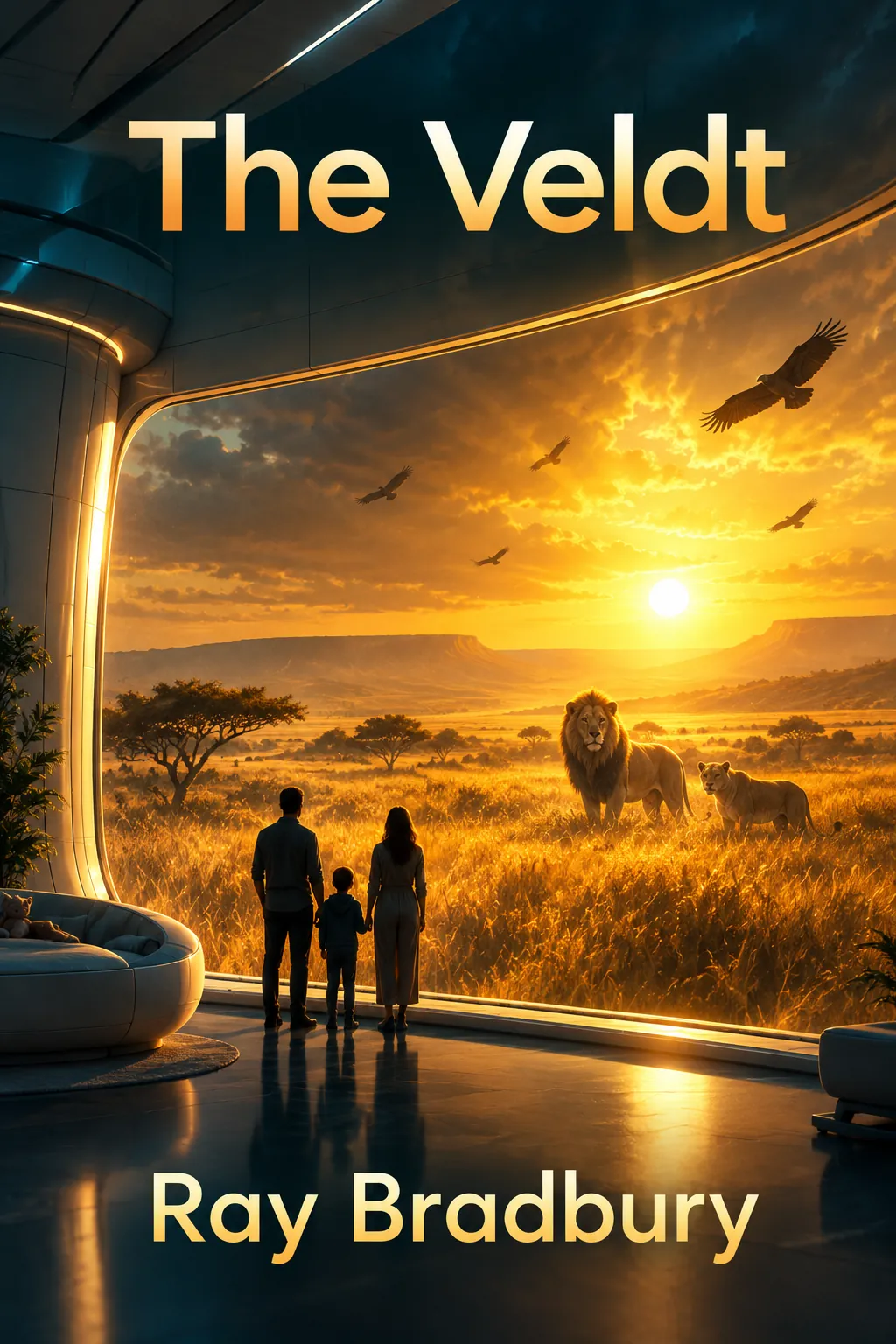
The Veldt
oleh Ray Bradbury
Ray Bradbury's “The Veldt” is a 1950 short story about a family whose automated house does everything for them, including looking after the children. The parents grow uneasy when the nursery, a room that turns the children's thoughts into lifelike scenes, keeps showing the same African grassland with lions feeding in the distance. George and Lydia Hadley must decide whether the house has made their children too dependent on it, and what it costs to switch it off.
Ide Utama
"When machines do the work of parenting, children may come to love the machine more than their parents. Bradbury asks what a family loses when comfort replaces effort and no one ever hears no."
Wawasan Utama
Convenience can take a parent's place
The Happylife Home does the cooking, cleaning and bedtime songs, so Lydia is left with nothing to do and the children turn to the house instead of to her. Bradbury is less afraid of the machine than of what people stop doing once the machine does it for them.
Lydia's complaint that she has too much time to think shows how a person can lose her place in a family even when life becomes easier.
The nursery is a mirror of the mind
The room shows whatever the children imagine, so it reveals their inner world rather than creating it. The same African grassland with lions and vultures appears again and again, which tells the reader what the children are brooding over.
When the Hadleys step into the room, the scene they see matches the children's wishes, not the parents' hopes.
A child who is never refused
Every wish the children have is granted by the house, and so the parents' first real refusal triggers a furious reaction. The story suggests that saying no is part of caring for a child, not a failure of kindness.
Peter's rage and Wendy's pleading when the nursery is to be shut show how little practice they have had at accepting limits.
Technology is a tool, people are the problem
The house never decides to harm anyone. It simply does what it is asked, and the harm comes from the children's wish and the parents' absence. That makes the story a warning about how we use machines, not a claim that machines are evil.
The room produces lions only because the children keep asking for them, and no adult is there to ask why.
Fear built quietly
Bradbury relies on heat, familiar screams and a calm final question rather than gore. The calm tone is what makes the ending disturbing, since the reader has to supply the worst part.
The closing offer of a cup of tea is chilling because nothing in it sounds frightened.
Rincian Bab
Chapter-by-chapter summary
Spoiler warning: this section covers the whole plot, including the ending.
The story has no chapters, so we split it into seven natural parts.
Part 1: A house that does everything
George and Lydia Hadley live in the Happylife Home, a house that cooks, cleans, dresses the family and even sings the children to sleep. It cost a fortune, and George thinks it was worth every cent.
Lydia is less sure. With nothing left for her to do, she feels pushed out of her own family, and she says so.
Why it matters: Bradbury asks his central question right away, which is what a parent is for when a machine can do the work.
Part 2: Africa in the nursery
Lydia is worried about the nursery, a room whose walls show whatever the children imagine, complete with heat, smells and sound. When the Hadleys step inside, they find the scene they always find: a sunburnt African grassland, vultures overhead and lions feeding in the distance.
Screams drift across the grass, and they sound oddly familiar. George tries to laugh it off as one more clever trick of the room.
Why it matters: the nursery is a mirror of the children's minds, and what it shows again and again is death.
Part 3: The psychologist's advice
The next morning, after Peter has lashed out at his father over the nursery, George brings in a psychologist, David McClean. McClean's verdict is blunt: the room and the house have taken the parents' place in the children's feelings.
He tells George to turn everything off and start again, and to let him treat the children.
Why it matters: this is the voice of reason, and it shows where Bradbury sees the problem, in the family relationship rather than the gadget.
Part 4: George decides to switch it off
Convinced, George decides to turn off the nursery, and he and McClean switch it off together. The children scream, cry and throw things, and Peter tells his father he wishes he were dead.
Lydia sees how hard it hits them, but for the first time in the story the parents are acting together.
Why it matters: it is the first time anyone in the Hadley home says no to the children, and everything that follows is the price of that word.
Part 5: One last visit
Lydia asks George to let the children have one more visit to the nursery. George, torn between firmness and kindness, agrees to one minute, and then it will be off for good.
He goes on to shut down the rest of the house, and while the parents dress, the children call to them from the nursery.
Why it matters: the scene shows how hard it is to refuse children who have never been refused, and it shows George's weakness as well as his love.
Part 6: Locked in
George and Lydia go into the nursery to fetch the children, and the door locks behind them. The lions move in on them under the hot sun.
As the parents scream, they realise that the screams they heard earlier were their own voices. Bradbury never describes the attack; he lets the fear do the work.
Why it matters: the screams were the parents' own, which means the children had already shaped the room around their parents' deaths.
Part 7: Tea with the lions
David McClean returns and walks to the nursery. He finds Wendy and Peter eating lunch, while lions and vultures feed in the distance, and understands at once what has happened to the Hadleys.
Wendy calmly asks whether he would like a cup of tea. The story ends there, with the question hanging in the air.
Why it matters: the horror is not only the lions but the children's calm over lunch, which suggests they feel nothing for the people they have lost.
Characters
- George Hadley: The father, who paid a great deal for the house and believes it makes family life easier. He senses trouble but prefers a firm decision to a long talk, and that habit costs him dearly.
- Lydia Hadley: The mother, who feels the house has taken her place. She is the first to fear the nursery, and her instincts are right even when George waves them away.
- Wendy Hadley: A ten-year-old girl with a sweet, reasonable manner. She knows how to ask for what she wants, and she acts as the quieter leader of the two children.
- Peter Hadley: Wendy's ten-year-old brother, openly angry and defiant. When the nursery is threatened, he shows how much of himself he has put into it.
- David McClean: The psychologist who diagnoses the problem. He sees the danger clearly but arrives too late to prevent it.
- The nursery and the Happylife Home: The house is almost a character of its own. It grants every wish without judgement, and that is exactly what makes it dangerous.
Writing about this book
If you are writing about “The Veldt” for class, start with a claim you can defend, such as: Bradbury shows that technology becomes dangerous when it replaces human responsibility.
Then choose three pieces of evidence, for example Lydia's feeling of being useless, the nursery's unchanging scene, and the children's calm at the end.
- Claim: the house, not the lions, is the real threat.
- Evidence: what the nursery shows, and how often.
- Commentary: why a child who has never heard no might act this way.
Use short quotations and explain them in your own words. You can compare the story with Fahrenheit 451, where comfort and entertainment also dull people.
Do not spend your introduction retelling the plot. A strong essay explains why the ending works: children who have never been refused, and a house that grants every wish.
Check what your teacher wants, because some questions ask about character, others about setting or symbolism.
Ambil Tindakan
Langkah praktis yang bisa Anda terapkan hari ini:
-
Do not let any device take over the parts of family life that need people, such as bedtime, meals and conversation.
-
Say no to children when it is needed, because limits are part of love.
-
Pay attention to what children keep coming back to, since it may show what is on their minds.
-
Ask what a gadget saves you from doing, and whether you wanted to keep that task.
Kutipan Menarik
"“Maybe I don't have enough to do.” (Part 1, Lydia)"
— Ray Bradbury
"“Nothing's too good for our children.” (Part 1, George)"
— Ray Bradbury
"“You've let this room and this house replace you and your wife in your children's affections.” (Part 3, McClean)"
— Ray Bradbury
Siapa yang Harus Membaca Ini
Middle and high school students who have been assigned “The Veldt”, and anyone who likes short, sharp science fiction. It reads quickly and works well for essays on technology, parenting and setting. Parents and teachers will find plenty to talk about too.
Tentang Ray Bradbury
Ray Bradbury (1920–2012) was an American writer best known for Fahrenheit 451 and The Martian Chronicles. He moved easily between science fiction, fantasy and horror, and his short stories, including The Veldt, made him one of the most widely read authors in American schools.
Ringkasan Ditulis Oleh

Software Engineer & Writer
Software engineer with a passion for distilling complex ideas into actionable insights. Writes about finance, investment, entrepreneurship, and technology.
Lihat semua ringkasan →Ulasan
Belum ada ulasan. Jadilah yang pertama berbagi pemikiran Anda!
Tulis Ulasan
Lanjut membaca
Jelajahi topik: Penulis dan Penghargaan Sci-FiRingkasan

Out of My Mind
Sharon M. Draper
“Out of My Mind” karya Sharon M. Draper adalah kisah menyentuh tentang kehidupan Melody Brooks, seorang gadis muda penderita cerebral…

Ender’s Game
Orson Scott Card
“Ender’s Game” karya Orson Scott Card adalah novel fiksi ilmiah memikat yang membawa pembaca ke masa depan saat umat manusia…

Pachinko
Min Jin Lee
“Pachinko”, sebuah saga sejarah lintas generasi yang memikat karya Min Jin Lee, mengisahkan perjuangan sebuah keluarga Korea dalam mengarungi gejolak…

The Perks of Being a Wallflower
Stephen Chbosky
The Perks of Being a Wallflower karya Stephen Chbosky adalah novel coming-of-age yang mendalam, dikisahkan melalui surat-surat pribadi Charlie, seorang…
Artikel

Ray Bradbury
Ray Bradbury (1920–2012) adalah penulis Amerika yang mengubah fiksi ilmiah menjadi puisi tentang manusia. Ia paling dikenal lewat Fahrenheit 451,…

Tema A Christmas Carol: kemurahan hati, isolasi dan tanggung jawab
Novela Dickens biasanya dibaca sebagai kisah seorang pria yang mengubah pikirannya. Tema-temanya lebih tajam dari itu: kemurahan hati sebagai praktik,…
Narcissus dan Echo
Narcissus dan Echo adalah mitos Yunani tentang pemuda tampan yang jatuh cinta pada bayangannya sendiri dan seorang nimfa yang hanya…