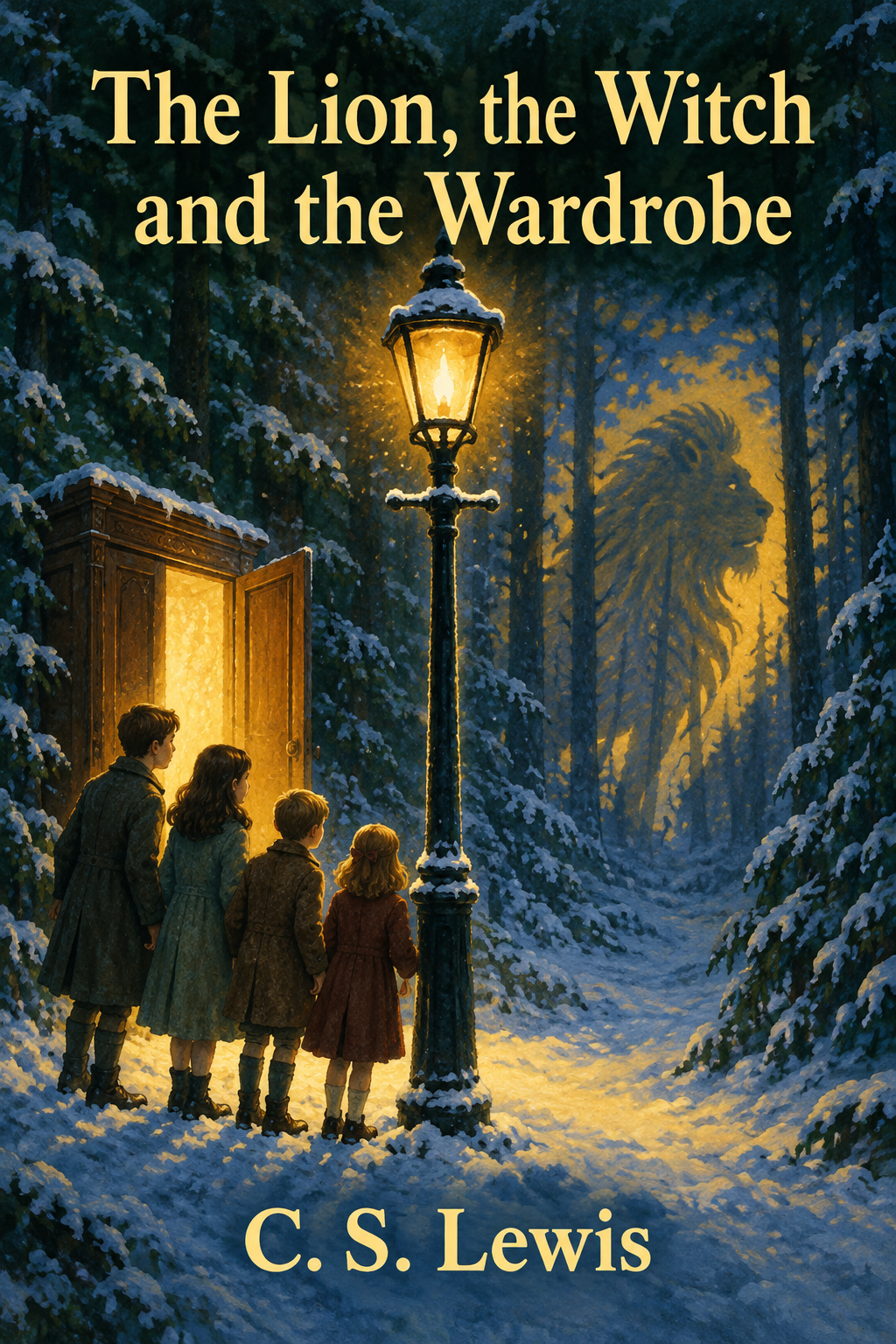
The Lion, the Witch and the Wardrobe
by C. S. Lewis
The Lion, the Witch and the Wardrobe is a children's fantasy by C. S. Lewis about four siblings sent away from wartime London who find a wardrobe leading to Narnia. The land lies under the spell of the White Witch, where it is always winter and never Christmas. The children are drawn into a struggle between her and the great lion Aslan, and each must decide whom to trust and what courage costs.
The Big Idea
"Four children find a hidden door to a land under a witch's endless winter, and learn that courage, loyalty and forgiveness matter more than being clever or safe."
Key Insights
Temptation works on what you already lack
The Witch does not force Edmund to betray his family. She offers sweets, a title and a feeling of being special, which is just what a boy who feels bullied by his older brother wants. Lewis shows that betrayal often starts with a small hurt and a convenient excuse.
Edmund denies Lucy's story partly to look clever, and partly because he is already thinking of the Queen's promise.
Honest witnesses deserve a hearing
Lucy is the first to find Narnia and the last to be believed. The Professor's questions are the book's gentle argument: if a person is usually truthful and not mad, her strange story deserves to be taken seriously before it is dismissed. Belief here is not gullibility; it is careful listening.
Peter and Susan learn the truth by stepping through the wardrobe, but the Professor has already told them not to rule it out.
Forgiveness can be costly
Narnian law says a traitor's life belongs to the Witch, and Aslan does not pretend otherwise. He does not cancel the rule; he pays it himself. The Deeper Magic suggests that willing sacrifice outweighs the law of punishment, and mercy is shown as something that costs the giver.
Edmund is spared because Aslan takes his place at the Stone Table. Many readers hear an echo of the Easter story, since Lewis was a Christian writer.
Children can grow into responsibility
The Pevensies arrive as evacuees who just want a game of hide-and-seek, and leave Narnia as kings and queens. Peter's first fight, Susan's care for others, Edmund's repentance and Lucy's healing cordial each give a child a real job to do.
At Cair Paravel they reign for years, yet when they step back through the wardrobe they are children again with no time lost.
Chapter Breakdown
Chapter-by-chapter summary
Spoiler warning: this section covers the whole plot, including the ending.
Chapter 1: Lucy Looks into a Wardrobe
The four Pevensie children, Peter, Susan, Edmund and Lucy, are sent from London to an old Professor's country house to escape wartime air raids. On a rainy day Lucy hides in a large wardrobe and steps out into a snowy wood with a lamp-post, where she meets a faun carrying an umbrella and parcels. Why it matters: the story starts in an ordinary house, so the magic feels like something anyone could stumble into.
Chapter 2: What Lucy Found There
The faun, Mr Tumnus, takes Lucy home for tea and explains that Narnia is ruled by the White Witch, who has made it always winter and never Christmas. He then confesses he was ordered to hand over any human he found, and he cannot do it. He guides Lucy back to the lamp-post. Why it matters: a kind creature chooses conscience over fear, and the Witch's power becomes real.
Chapter 3: Edmund and the Wardrobe
Lucy rushes back to tell the others, but no time has passed at home, and the wardrobe looks ordinary. Nobody believes her. Later, during hide-and-seek, Lucy goes in again and Edmund follows. In the snowy wood he meets a tall woman on a sledge who calls herself the Queen of Narnia. Why it matters: Edmund's mean streak is about to be used against him.
Chapter 4: Turkish Delight
The Queen gives Edmund a hot drink and enchanted Turkish Delight, a sweet that makes him want more and more. She learns that he has a brother and two sisters, and promises to make him a prince if he brings them to her house. Lucy appears, and the two return through the wardrobe. Why it matters: the Witch has found his weak spot, greed and wounded pride.
Chapter 5: Back on This Side of the Door
Edmund lies and says Lucy was only pretending, which makes her cry. Worried, Peter and Susan consult the Professor, who asks how they know she is wrong when she is usually truthful, and tells them to use logic. Soon, hiding from the housekeeper Mrs Macready, all four slip into the wardrobe. Why it matters: Edmund's lie is his first step toward betrayal, and the Professor shows that unlikely is not impossible.
Chapter 6: Into the Forest
All four children reach Narnia, and Peter and Susan finally believe Lucy. At Mr Tumnus's cave they find the place wrecked and a notice saying he has been arrested for treason against the Queen. A robin leads them on, and a beaver beckons from behind a tree. Why it matters: the story turns from wonder to danger, while Edmund grows quietly uneasy.
Chapter 7: A Day with the Beavers
Mr Beaver leads the children to his dam, where Mrs Beaver serves fish and marmalade roll. He whispers that the great lion Aslan is said to have returned, and that an old rhyme says two Sons of Adam and two Daughters of Eve will end the Witch's reign. At Aslan's name, each child feels something different. Edmund feels dread. Why it matters: Aslan enters as hope, but he means something different to each of them.
Chapter 8: What Happened After Dinner
After dinner the Beavers explain that Aslan, the true king, is gathering his friends at the Stone Table. Asked whether he is safe, Mr Beaver says he is not safe, but he is good. The children worry about Mr Tumnus, who is probably in the Witch's house. Then they notice Edmund has slipped out. Why it matters: Aslan is both awe-inspiring and kind, and Edmund has made his choice.
Chapter 9: In the Witch's House
Edmund trudges through the snow to the Witch's castle, expecting a reward. In the courtyard he sees creatures she has turned to stone. She is furious that he came alone, gives him only bread and water, and sets out in her sledge with him to catch the others. Why it matters: Edmund starts to see that the friendly Queen was a lie.
Chapter 10: The Spell Begins to Break
While the Witch pursues, the other children and the Beavers hurry across the frozen land toward Aslan. Bells ring, and Father Christmas appears, a sign that the Witch's winter is weakening. He gives Peter a sword and shield, Susan a bow, arrows and a horn, and Lucy a dagger and a small bottle of healing cordial. Why it matters: Christmas has come back to Narnia, and the children are given tools for what lies ahead.
Chapter 11: Aslan Is Nearer
The snow melts and spring begins. The Witch's sledge sticks in the slush. The children and the Beavers press on and reach Aslan's camp, where they see him for the first time: a huge golden lion they find both frightening and impossible to look away from. Why it matters: the Witch's winter is ending and hope has a face.
Chapter 12: Peter's First Battle
Aslan welcomes the children and tells Peter that he will have a part in the battle. Soon the Witch's wolf captain, Maugrim, attacks Susan; Peter draws his sword and kills him. Aslan names him Sir Peter Wolf's-Bane. Aslan also sends his creatures to rescue Edmund. Why it matters: Peter takes his first step from older brother to leader, and Edmund's rescue begins.
Chapter 13: Deep Magic from the Dawn of Time
Edmund is brought back and talks with Aslan alone. What was said stays private, but he returns sorry and apologises to the others. The Witch arrives and claims Edmund's life under the Deep Magic, the ancient law that every traitor belongs to her. Aslan speaks with her alone, then announces she has given up her claim. Why it matters: a bargain has been made, and its price is still hidden.
Chapter 14: The Triumph of the Witch
That night Aslan walks sadly to the Stone Table. Susan and Lucy, unable to sleep, follow him, and he lets them come until the last stretch of the way. Surrounded by the Witch's followers, he allows them to bind him, shave his mane and kill him with a knife. The girls watch and weep. Why it matters: it is the darkest moment, and Aslan gives his own life in place of Edmund's.
Chapter 15: Deeper Magic from Before the Dawn of Time
As day breaks, field mice gnaw through the ropes that bound Aslan. A loud crack splits the Stone Table, and Aslan stands alive. He explains that the Witch knew the Deep Magic but not the Deeper Magic from before time: when a willing victim who has done no treachery dies in a traitor's place, death itself begins to work backward. Why it matters: sacrifice turns out to be stronger than the law of punishment.
Chapter 16: What Happened About the Statues
Aslan carries the girls on his back to the Witch's castle, where he breathes on the stone statues in the courtyard and brings them back to life. A giant among them breaks open the gate, and the freed creatures race to join the battle with Peter's army. Why it matters: the statues show how many lives the Witch destroyed, and their release is the true start of spring.
Chapter 17: The Hunting of the White Stag
With Aslan's arrival the battle turns, the Witch is defeated and her army scatters. Lucy's cordial heals the wounded, Edmund among them. At Cair Paravel the four children are crowned kings and queens and rule for many years. One day, chasing a white stag, they find the lamp-post and tumble out of the wardrobe as children, with no time passed. Why it matters: what they became in Narnia stays with them.
Characters
Lucy Pevensie
The youngest of the four siblings and the first to enter Narnia. She is honest, kind and brave, and keeps telling the truth even when nobody believes her. She cares deeply about Mr Tumnus and later receives a healing cordial from Father Christmas.
Edmund Pevensie
The second-youngest sibling. He starts out jealous and sulky, teases Lucy, and is easily tempted by the Witch's sweets and promises. His betrayal puts everyone in danger, but he is also the character who changes the most.
Peter Pevensie
The eldest child. He tries to look after the younger ones and is given a sword and shield by Father Christmas. In Narnia he must grow from a responsible older brother into a leader and a fighter.
Susan Pevensie
The second-eldest, practical and cautious. She worries about getting everyone home safely, and is given a bow, arrows and a horn. Her good sense steadies the group, though she is slow to believe in magic.
Aslan
The great lion and true king of Narnia, said to have returned from over the sea. Other characters speak of him with awe, as powerful and good. His choice at the Stone Table is the centre of the story.
The White Witch
She calls herself the Queen of Narnia and has kept the land in winter for a hundred years, turning enemies to stone. She tempts children and insists on the old law. Her name, Jadis, appears on the notice about Mr Tumnus's arrest.
Mr Tumnus
A gentle faun who meets Lucy at the lamp-post. He was told to catch humans for the Witch but is too kind to do it. He is arrested for it, and his fate pushes the children to act.
Mr and Mrs Beaver
A warm, practical couple who shelter the children at their dam and guide them toward Aslan. Mr Beaver knows the old rhyme and distrusts the Witch, while Mrs Beaver keeps everyone fed.
The Professor
The old scholar who owns the country house. He asks the children to think logically about Lucy's story instead of dismissing it. He is a small figure, but the first adult who takes her seriously.
Writing about this book
A good report picks one idea and follows it through the story. Do not retell all seventeen chapters; use a few scenes as evidence.
Ideas to explore
- How does the Witch tempt Edmund, and which moment shows he regrets it?
- Why does the Professor take Lucy seriously when her siblings do not?
- What does Aslan's choice at the Stone Table say about justice and forgiveness?
- How do the four children change between the first chapter and the last?
- Why might Lewis set the story during a war?
Before you write, ask yourself which character you understand best, and why. Then link one scene to your own life with a specific, honest example. Use your own words and your own examples; a report that only repeats this guide will not show what you think.
Take Action
Practical steps you can implement today:
-
Notice what tempts you most; the Witch wins Edmund by offering exactly what he feels he lacks.
-
Listen to an honest person even when their story sounds strange, then check it for yourself.
-
When you have wronged someone, say sorry plainly and accept help to put things right.
-
Courage often means doing the next right thing while you are still afraid, as Lucy and Susan do.
Notable Quotes
"“Always winter and never Christmas; think of that!” (Chapter 2)"
— C. S. Lewis
"“Who said anything about safe? 'Course he isn't safe. But he's good. He's the King, I tell you.” (Chapter 8)"
— C. S. Lewis
"“Once a king or queen in Narnia, always a king or queen.” (Chapter 17)"
— C. S. Lewis
Who Should Read This
Readers from about age eight or nine who like portal fantasy and talking animals, students writing about betrayal, courage or sacrifice, and adults returning to a childhood favourite. It is a short novel in 17 chapters with a few frightening moments, including a death scene, so read it with younger children.
Frequently Asked Questions
What is The Lion, the Witch and the Wardrobe about?
It follows four siblings who find a wardrobe leading to Narnia, a land locked in winter by the White Witch. They meet the lion Aslan, and one of them betrays the others. The book is about temptation, courage and forgiveness.
Who are the main characters?
The main characters are the four Pevensie children (Peter, Susan, Edmund and Lucy), the lion Aslan, the White Witch, the faun Mr Tumnus and Mr and Mrs Beaver. The Professor who owns the house plays a smaller part.
Is it a Christian allegory?
Lewis was a Christian, and many readers see echoes of the Easter story in Aslan's sacrifice and return. The book also works as an adventure without that reading, and readers take different things from it.
Which Narnia book should I read first?
This one was published first, in 1950, and is usually numbered book one, including in the Japanese Shinchosha edition. The Magician's Nephew, published in 1955, comes earlier in story order, but this book is a good place to start.
Check Your Understanding
Pick an answer for each question to see if you were right.
-
Where are the Pevensie children sent to stay?
With an old Professor in the country — They are evacuated from London to the Professor's large country house.
-
What does the White Witch use to tempt Edmund?
Turkish Delight — The enchanted Turkish Delight makes Edmund want more, and she promises to make him a prince.
-
Who first tells the children about Aslan?
Mr Beaver — Mr Beaver tells them at his dam that Aslan has returned to Narnia.
-
What does Father Christmas give Lucy?
A bottle of healing cordial — Lucy receives a small dagger and a bottle of healing cordial.
-
Which old law gives the Witch a claim on Edmund?
The Deep Magic — The Deep Magic says every traitor's life belongs to the Witch.
About C. S. Lewis
C. S. Lewis (1898–1963) was born in Belfast and taught medieval and Renaissance literature at Oxford and later Cambridge. He was also a Christian writer and broadcaster, known for Mere Christianity and The Screwtape Letters. The Chronicles of Narnia, seven children's novels, began with this book in 1950 and remain his most widely read fiction.
Summary Written By

Software Engineer & Writer
Software engineer with a passion for distilling complex ideas into actionable insights. Writes about finance, investment, entrepreneurship, and technology.
View all summaries →Reviews
No reviews yet. Be the first to share your thoughts!
Write a Review
Keep reading
Explore the topic: FictionSummaries

Out of My Mind
Sharon M. Draper
“Out of My Mind” by Sharon M. Draper is a poignant narrative that explores the life of Melody Brooks, a…

Ender’s Game
Orson Scott Card
“Ender’s Game” by Orson Scott Card is a riveting science fiction novel that transports readers into a future where humanity…

Pachinko
Min Jin Lee
“Pachinko”, a spellbinding multigenerational historical saga by Min Jin Lee, explores the lives of a Korean family trying to make…

The Perks of Being a Wallflower
Stephen Chbosky
The Perks of Being a Wallflower by Stephen Chbosky is a profound coming-of-age novel, told through the intimate letters of…
Articles
The Enlightenment Explained: Ideas, Thinkers and Legacy
The Enlightenment was an 18th-century European movement that trusted reason and evidence over tradition and authority. Its thinkers, from Locke…
World History 1700–1918: Revolutions, Industry, Empire and War
Between 1700 and 1918, revolutions, factories, empires and a world war reshaped societies across Europe, the Americas, Asia and Africa.…

A Christmas Carol themes: generosity, isolation and responsibility
Dickens's novella is usually read as a story about a man who changes his mind. Its themes are sharper than…