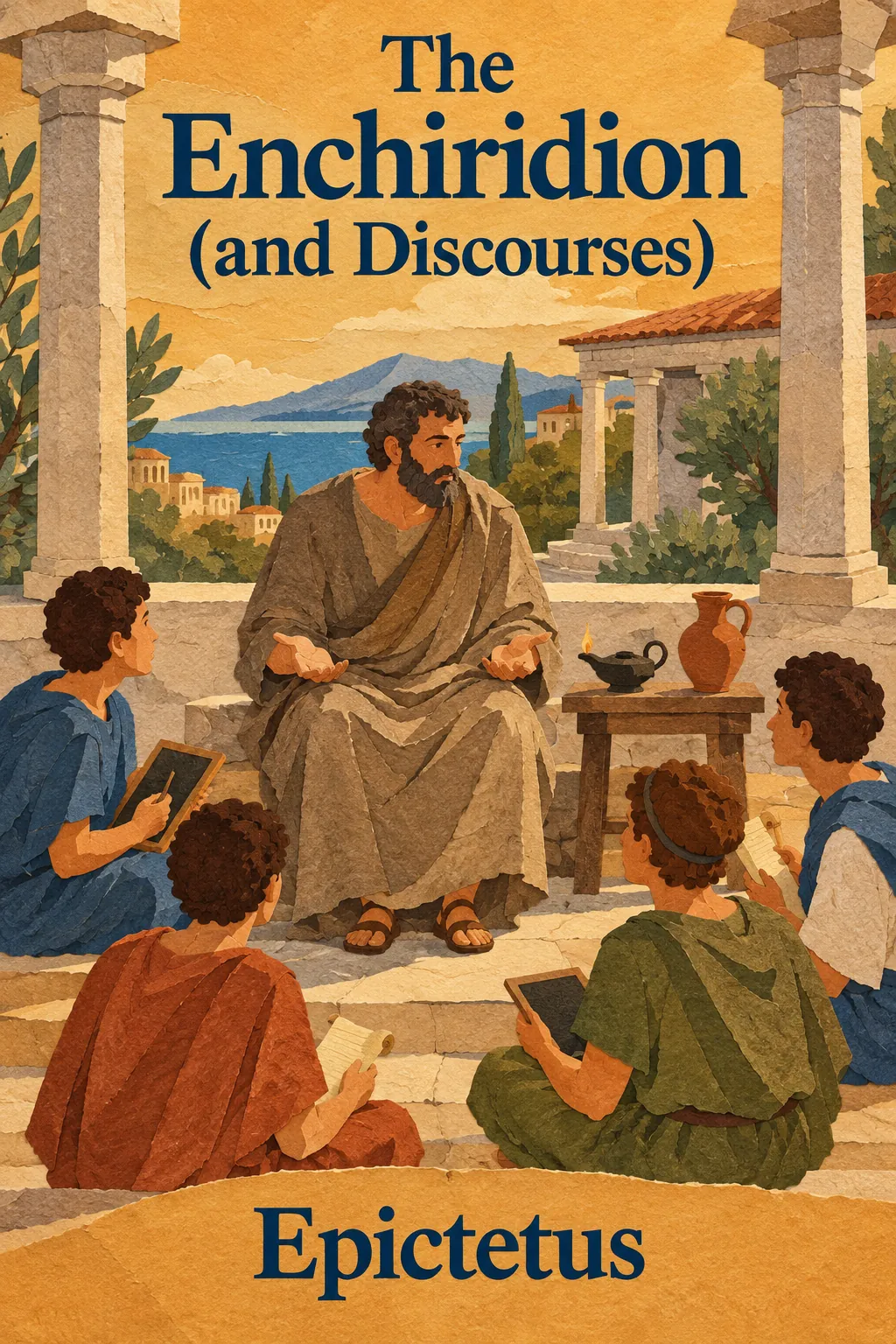
The Enchiridion (and Discourses)
by Epictetus
The Enchiridion is a short handbook of Stoic philosophy, a collection of 53 brief chapters drawn from the teaching of Epictetus, a former slave who became a famous teacher in the Roman Empire. Its one big claim is simple: only your own judgments and choices are truly yours to control. Your body, reputation, wealth and other people's actions are not. Train yourself to see the difference, and most anger, fear and envy lose their grip. The rest of the book gives practical drills for doing that every day.
The Big Idea
"Some things are up to you: your judgments, wishes and actions. Everything else is not. Epictetus says calm and freedom come from caring fully about the first group and letting go of the second."
Key Insights
Control is the only dividing line
Epictetus asks one question about any worry: is this up to me? Your effort, your choices and your judgments pass. The outcome of an exam, someone's opinion of you and the weather do not. Spending energy on the second pile guarantees frustration, because you are trying to run a part of the world that never answers to you.
Before a job interview, you cannot control the hiring decision. You can control your preparation, your honesty and how you handle a no. Put your effort there, and accept the result calmly.
Events don't upset us; our judgments do
The book's boldest claim is that the sting in an insult or setback comes from the story we attach to it. Death, Epictetus says, is not terrible in itself; the belief that it is terrible is what frightens people. This is not denial. It asks you to pause and check what you are telling yourself before you react.
A friend cancels plans. “They don't respect me” is a judgment; “they cancelled” is the fact. Notice the gap, and you can choose a calmer response, perhaps simply asking what happened.
Play your role well
Chapter 17 compares life to a play. You do not pick the part, whether short or long, rich or poor, leader or helper. Your task is to perform it well. This takes the sting out of comparison, because someone else's role was never yours to compete for. Envy makes little sense once you see it that way.
A new employee cannot be the manager today. They can be the most reliable, honest and curious person on the team, and that is a role worth doing well, whatever the title says.
Practise small, starting now
Philosophy here is training, not theory. Chapter 3 begins with a cup: remind yourself that it is breakable, and you will stay calm when it breaks. Then move up to bigger things. Chapter 51 adds that putting the work off is itself a choice, and it is up to you to stop.
Tonight, when a message annoys you, wait ten seconds and name the impression: “This looks like an insult.” Then ask whether it truly harms you. Repeat daily.
Chapter Breakdown
Chapter-by-chapter summary
The Enchiridion has 53 very short chapters, so they are grouped here into six parts. It is non-fiction advice, so nothing below spoils a plot. The Discourses, the longer record of the same teaching, explain the reasoning behind many of these rules.
Chapters 1–8: What is up to you
Chapter 1 sets out the whole philosophy. Some things depend on us: our opinions, impulses, wishes and aversions. Others do not: our body, property, reputation and office. Mix them up and you will feel blocked, angry and anxious; sort them correctly and no one can truly force or harm you. Chapters 2 to 4 turn this into practice. Aim your wants only at what you control, and before any activity, remind yourself of its real nature, whether that is a cup you like or an outing to the baths. Chapter 5 gives the key diagnosis: it is our judgments about events, not the events themselves, that disturb us. Chapters 6 to 8 add that you should not take pride in what is not yours, and should wish events to happen as they do happen. Why it matters: peace of mind depends on how you see things, not on getting your way.
Chapters 9–20: Setbacks, roles and insults
Illness hampers the body, not your will, and a limp slows the leg, not your choices (chapters 9 and 10). Whatever happens, ask what ability you have to meet it. Chapter 11 says never to say “I have lost it”, only “I have given it back”. Chapters 12 to 14 argue that calm comes from putting your own conduct in order, not from trying to manage other people. Chapter 15 uses a dinner table: take what is passed to you politely, and wait for what has not yet arrived. Chapter 17 gives the famous actor image: you do not choose your part, but playing it well is your job. Chapter 20 says an insult hurts only when you judge it to be harm. Why it matters: it moves the power over your feelings back to you.
Chapters 21–32: Other people, honour and duty
These chapters ask how to live among others. Keep death and exile before your eyes, says chapter 21, so that ordinary troubles never feel unbearable. Chapters 24 and 25 deal with watching someone else get the honour, invitation or attention you did not. The person who got it paid a price, such as flattery or time, and you chose not to. Chapter 29 tells you to think through the whole task before you start, as an athlete knows how hard training will be. Chapter 30 says duties come from relationships: a parent, a sibling or a neighbour each calls for fitting behaviour, whatever the other person does. Chapters 31 and 32 cover religious practice and divination: do your own part and accept the result. Why it matters: another person's success takes nothing away from your character.
Chapters 33–42: Rules for daily conduct
Chapter 33 is the longest and reads like a list of house rules: set a pattern for your character, speak little, avoid gossip, do not laugh too easily, and keep your head at parties. Chapter 34 deals with pleasure: when one tempts you, pause and compare how you will feel during it with how you will feel afterwards. Chapter 39 uses a foot and a shoe: the body sets the measure of what you need to own, and going past it has no limit. Chapter 41 warns against spending too much time on the body, such as exercise, food and drink. Chapter 42 asks you to see wrongdoers as mistaken rather than wicked, because they act on what looks right to them. Why it matters: character is built by ordinary habits.
Chapters 43–49: Judgment and humility
Chapter 43 says every situation has two handles, one by which you can carry it and one by which you cannot. If a brother wrongs you, pick up the handle “he is my brother” rather than “he is unfair”. Chapter 44 points out a faulty comparison: “I am richer, so I am better” mixes up your wealth with yourself. Chapter 45 asks you to judge only after you know why someone acted. Chapter 46 advises you not to call yourself a philosopher but to let your actions show it. Chapter 48 contrasts the untrained person, who expects help or harm from outside, with the learner, who looks to himself. Chapter 49 warns that being able to explain a famous Stoic book is not the same as living by it. Why it matters: wisdom is shown in conduct, not talk.
Chapters 50–53: Start now
Chapter 50 says to treat the rules you have chosen as laws. Chapter 51 asks how long you plan to wait before expecting the best of yourself. Socrates became who he was by following reason alone, and even if you are not yet Socrates, you can live as someone who wants to be. Chapter 52 names the parts of philosophy: first, applying principles in real life, such as not lying; then showing why they are true; then checking the arguments that support them. The first, putting principles into practice, matters most. The final chapter closes with a few short quotations, including a prayer from the Stoic Cleanthes to follow fate willingly and the words of Socrates that his accusers can kill him but cannot truly harm him. Why it matters: it ends the book on acceptance and on guarding your own character.
Key people and terms
- Epictetus. Born around 50 CE in Hierapolis in Phrygia, he was enslaved in Rome, later freed, and taught philosophy. In the 90s CE Emperor Domitian expelled philosophers from Rome, and Epictetus opened a school in Nicopolis, Greece, where he taught until his death around 135 CE.
- Arrian. A Greek student who attended Epictetus's classes in Nicopolis and wrote down what he heard. He produced the Discourses, of which four of eight books survive, and the Enchiridion, a short extract of the essentials. Later he became a Roman official and historian.
- Epaphroditus. Epictetus's owner in Rome, a former slave who rose to serve the emperor Nero as a secretary. According to tradition, his household is where Epictetus came into contact with the Stoic teacher Musonius Rufus.
- Musonius Rufus. A Roman Stoic teacher whose lectures Epictetus attended. He taught that philosophy is a way of living, not only a subject to discuss, a view that runs through the whole Enchiridion.
- Socrates. Epictetus's model of the philosopher. Chapter 51 urges the reader to live like him, and the final chapter quotes his calm claim that accusers can kill him but not harm him.
- Chrysippus. A leading early Stoic who wrote a vast number of works on logic. Chapter 49 warns that being able to explain his writings is not the same as living by Stoic ideas.
- Cleanthes. An early head of the Stoic school. His prayer to Zeus and Destiny, asking to be led wherever fate leads and to follow without hesitation, is quoted near the end of the book.
- Prohairesis. Greek for the power of choice, often translated as will, moral purpose or reasoned choice. It is the one thing Epictetus says is wholly ours, and it is what he wants you to protect above all else.
- Impressions. The first appearance of an event in the mind, such as “this is an insult”. Epictetus says you can test an impression before you agree with it. Training that pause is the core exercise of the book.
- The dichotomy of control. A modern name, not Epictetus's own, for the split in chapter 1 between what is up to us and what is not. Much of the handbook shows how to apply it to illness, insults, money and grief.
- Duties. The fitting actions that come from roles such as parent, citizen or friend. Stoic calm does not mean coldness: you still act well toward others while accepting what you cannot decide.
Fifteen ideas to remember
- Sort every worry by asking whether it is up to you (chapter 1).
- Direct your wants only at what you can control (chapter 2).
- Remember the real nature of the things you enjoy (chapter 3).
- Before a task, picture its likely annoyances (chapter 4).
- Judgments, not events, trouble us (chapter 5).
- Do not take pride in what is not yours (chapter 6).
- Wish events to happen as they happen (chapter 8).
- Illness blocks the body, not the will (chapter 9).
- Say “returned”, not “lost” (chapter 11).
- Play the part you were given, and play it well (chapter 17).
- An insult wounds only if you judge it harmful (chapter 20).
- Do not resent honours others receive (chapter 25).
- Think about the whole task before you begin (chapter 29).
- Treat wrongdoers as mistaken, not wicked (chapter 42).
- Carry each situation by the handle you can hold (chapter 43).
Writing about this book
This is a good book for a philosophy class, an ethics essay or a personal reflection. Instead of retelling it, choose one idea and test it. Three questions can start you off. First, take a recent frustration and sort it into the part you controlled and the part you did not. What changes? Second, where do you disagree with Epictetus? Is it fair to say an insult hurts only when we judge it harmful, especially for people facing real injustice? Third, how does it change your reading to know that a man who had been enslaved gave this advice?
A strong essay or presentation picks one chapter, such as 5, 17 or 43, explains it in plain words, and then tests it against a real situation from your own life or from history. For depth, compare it with another thinker: Marcus Aurelius, who read Epictetus; Buddhist ideas about attachment; or modern cognitive therapy, which also holds that thoughts shape feelings. Say what you think the book gets right and where it might ask too much. Avoid listing all 53 chapters; depth on one idea beats a tour of everything.
Take Action
Practical steps you can implement today:
-
List what is bothering you, then split it into “up to me” and “not up to me”. Pick one action from the first list for today.
-
When something stings, pause and name it as an impression: “This looks like an insult.” Then check whether it truly harms you.
-
Say “I returned it” instead of “I lost it” the next time something is taken from you, and notice how the feeling shifts.
-
Choose one role today and play it well, whether student, friend, worker or sibling, without comparing it to anyone else's part.
Notable Quotes
"Of things some are in our power, and others are not. (Enchiridion 1, tr. George Long)"
— Epictetus
"Men are disturbed, not by things, but by the principles and notions which they form concerning things. (Enchiridion 5, tr. Elizabeth Carter)"
— Epictetus
"Wish the things which happen to be as they are. (Enchiridion 8, tr. George Long)"
— Epictetus
"Remember that you are an actor in a drama, of such a kind as the author pleases to make it. (Enchiridion 17, tr. Elizabeth Carter)"
— Epictetus
Who Should Read This
Readers from about age 14 up, from high-school ethics students to adults. It suits anyone stuck on worry, anger or comparison, and anyone new to Stoicism who wants a short, readable starting point. The text is brief and plain, so it also works for a school presentation or a first philosophy course.
Frequently Asked Questions
What is the Enchiridion about?
It is a short Stoic handbook of 53 brief chapters on how to stay steady in daily life. Its main lesson is to separate what is up to you, such as your judgments and choices, from what is not, such as your reputation or health. The rest applies that rule to insults, loss, ambition, duty and habit.
What does “Enchiridion” mean?
It is Greek for something that fits in the hand, so it means a handbook or manual. Many people also know the word from a sword in the cartoon Adventure Time, but that has nothing to do with this book. Readers looking for the philosophy usually add Epictetus's name to the search.
What is the difference between the Enchiridion and the Discourses?
The Discourses are longer records of Epictetus's classroom talks, with questions, arguments and stories; four of the original eight books survive. The Enchiridion is a compact extract of the main ideas, arranged as rules to remember. Both come from his student Arrian. Read the Enchiridion first, then the Discourses for the reasoning behind it.
Did Epictetus write the Enchiridion himself?
No. Epictetus taught by speaking and left no writings of his own. His student Arrian recorded the lectures and then compiled the Enchiridion from them. That is why the voice is direct and spoken, and why the book feels like advice from a teacher rather than an essay.
Does the dichotomy of control mean you should do nothing?
No. It tells you where to put your effort. You act fully on what is in your power, such as preparing, speaking honestly and keeping promises, and you stop fighting results you cannot command. Calm acceptance applies to outcomes, not to your own responsibilities.
Which English translation should I read?
Several older translations are in the public domain, including Elizabeth Carter (1758), Thomas Wentworth Higginson (1865) and George Long (1877), and are free online. Modern translations use plainer English, which many first-time readers find easier to follow.
Check Your Understanding
Pick an answer for each question to see if you were right.
-
Roughly how many short chapters does the Enchiridion have?
53 — The usual numbering has 53 very short chapters.
-
Who wrote down Epictetus's teaching?
Arrian — His student Arrian recorded the lectures and compiled the Enchiridion from them.
-
According to chapter 5, what disturbs people?
Their judgments about events — Epictetus says it is the opinions we form about things, not the things themselves.
-
In chapter 17, life is compared to what?
A play in which you have an assigned role — You do not choose your part, but you can play it well.
-
What does chapter 11 suggest saying instead of “I have lost it”?
I have given it back — Thinking of loss as returning something softens grief over what was never fully in your control.
About Epictetus
Epictetus (about 50 to 135 CE) was born in Phrygia, enslaved in Rome, and later freed. He became one of the most respected Stoic teachers of the Roman Empire and taught in Nicopolis, Greece. He wrote nothing himself. His student Arrian recorded his lectures, and Marcus Aurelius later praised his influence.
Summary Written By

Software Engineer & Writer
Software engineer with a passion for distilling complex ideas into actionable insights. Writes about finance, investment, entrepreneurship, and technology.
View all summaries →Reviews
No reviews yet. Be the first to share your thoughts!
Write a Review
Keep reading
Explore the topic: Personal DevelopmentSummaries

Educated by Tara Westover
Tara Westover
A memoir about a young woman born to survivalists in Idaho who, despite having no formal schooling, teaches herself to…

Atomic Habits: An Easy & Proven Way to Build Good Habits & Break Bad Ones
James Clear
No matter your goals, Atomic Habits offers a proven framework for improving–every day. James Clear, one of the world’s leading…

Think and Grow Rich
Napoleon Hill
What if the secrets to wealth and success weren’t hidden in complex financial strategies, but within the power of your…

Melbourne
Alex Ng
Sophie Cunningham's Melbourne is a deeply personal exploration of Australia's cultural capital, weaving together history, architecture, weather patterns, and personal…
Articles

The Enlightenment Explained: Ideas, Thinkers and Legacy
The Enlightenment was an 18th-century European movement that trusted reason and evidence over tradition and authority. Its thinkers, from Locke…

World History 1700–1918: Revolutions, Industry, Empire and War
Between 1700 and 1918, revolutions, factories, empires and a world war reshaped societies across Europe, the Americas, Asia and Africa.…

Best Stoicism Books for Beginners: Where to Start and Why
Looking for the best stoicism books for beginners? Discover a clear reading route comparing ancient classics like Marcus Aurelius with…