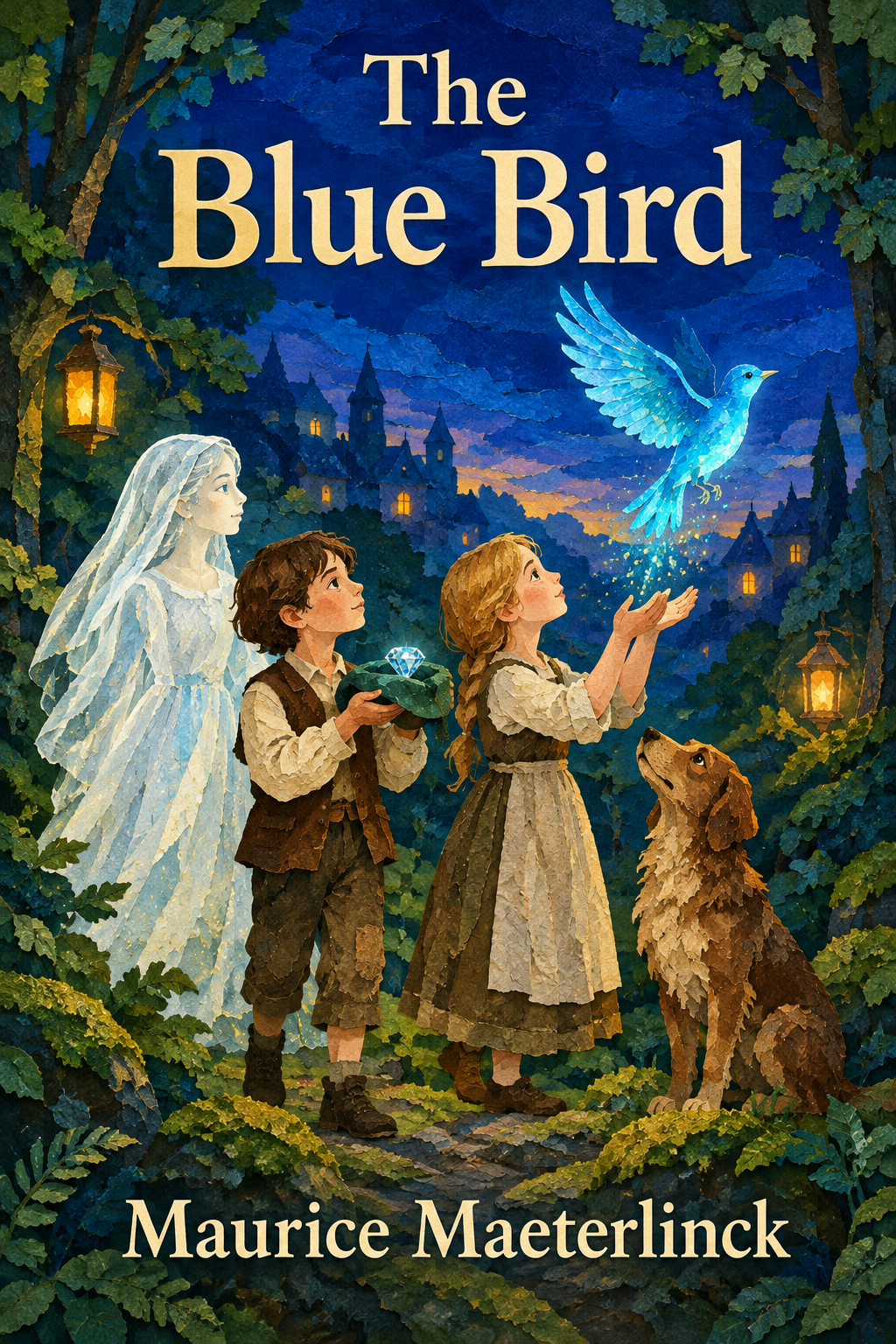
The Blue Bird
by Maurice Maeterlinck
The Blue Bird is a fairy play by Belgian writer Maurice Maeterlinck, first staged in 1908. On Christmas Eve, a fairy asks two poor woodcutter's children, Tyltyl and Mytyl, to find the blue bird that will cure a sick child and bring happiness. With a magic hat, the spirit of Light and their talking dog and cat, they search the Land of Memory, the Palace of Night, a forest and the Kingdom of the Future. Every bird they catch changes.
The Big Idea
"The Blue Bird asks where happiness really lives, and sends two children through memory, night and the future to find out."
Key Insights
Happiness is closer than it looks
The children cross memory, night, forest and the future, yet the moments that move them are ordinary ones: grandparents remembered, a mother's love, the quiet Great Joys. Maeterlinck does not treat happiness as a trophy stored in a faraway palace. It is easy to miss because it is familiar.
In the Palace of Happiness, the loud Luxuries crowd the banquet, but when the diamond is turned they flee, and the silent Great Joys take their place, followed by the Joy of Maternal Love.
Memory keeps the people we love close
In the Land of Memory the dead are not gone; they wake whenever a living person thinks of them. The play offers this as comfort rather than doctrine, and it makes remembering feel like an active gift, not a sad habit. Children can grasp it because a grandparent's voice or kitchen can feel present for years.
Tyltyl and Mytyl find their grandparents peaceful in their old cottage, happy to be visited, and the grandfather's blackbird looks blue there.
Look closer and ordinary things come alive
The magic diamond does not create anything new. It reveals what was already there: the soul in bread, the dance of fire, the voice of water. Maeterlinck invites readers to treat everyday objects with attention and respect, and to ask what lies beneath the surface of a familiar room.
When Tyltyl turns the diamond in the cottage, Bread, Sugar, Fire, Water and Milk step out as characters, and the Cat and Dog gain voices that show who is loyal and who is not.
Happiness does not like to be captured
Every blue bird the children catch changes once it is taken away from its place. Whatever they grab does not last. The play suggests that happiness is closer to something shared and lived than something owned, and that even the best moments slip away if we try to pin them down.
In the Palace of Night the children catch many blue birds in a dream-garden, but the birds lie lifeless, and Light tells them they did not catch the one able to live in broad daylight.
Chapter Breakdown
Chapter-by-chapter summary
Spoiler warning: this section covers the whole plot, including the ending.
Part 1: The Woodcutter's Cottage and the Fairy's Home
On Christmas Eve, Tyltyl and his little sister Mytyl lie in bed, watching a rich family's party through the window. The old fairy Bérylune arrives and says she must have the blue bird for her very ill little girl. She gives Tyltyl a green hat with a diamond: turn it, and the soul hidden inside everything becomes visible. Bread, Sugar, Fire, Water and Milk step out as people, the dog and cat gain voices, and Light joins the trip. The Cat quietly dislikes the whole idea. Why it matters: the quest is as much about learning to see the familiar world in a new way as about catching a bird.
Part 2: The Land of Memory
The first stop is a misty land where the dead live on as long as someone remembers them. Tyltyl and Mytyl visit their grandparents, who are cheerful and glad to see them, and meet the brothers and sisters who died young. The grandfather's blackbird looks blue here, but once the children step back into ordinary light it turns black. Why it matters: the scene turns death into something gentle and makes memory an act of love, while giving the first hint that a blue bird does not stay blue when it is taken away.
Part 3: The Palace of Night
Night guards the secrets and terrors of the world behind a ring of heavy doors. Tyltyl opens them one by one and finds frightening things, but no bird. When the great middle door opens, it reveals a dream-garden bathed in night light, where blue birds hover. The children catch as many as they can, but the birds lie lifeless. Light tells Tyltyl that they did not catch the one able to live in broad daylight. Why it matters: some prizes belong to the dark and cannot be carried out into real life.
Part 4: The Forest
In the forest, the trees and animals gather to judge Tyltyl, because people have hunted them and cut them down. The Cat sides openly with them against the children, while the Dog, freed from his bonds, fights fiercely at Tyltyl's side. Tyltyl cries out for help as the attack grows. At dawn Light arrives, and when Tyltyl turns the diamond the souls of the trees and animals fall silent. The Dog is hurt, and no blue bird is found here either. Why it matters: it shows that the natural world has its own claims, and it separates the loyal friend from the one who betrays.
Part 5: The Palace of Happiness
The children now enter a hall of Happinesses. The big, noisy Luxuries feast and try to pull the children into their banquet, and the Dog, Bread and Sugar join in. Light tells Tyltyl to turn the diamond. The hall becomes a bright cathedral, the Luxuries shrink and flee, and the silent, radiant Great Joys appear. Then the Joy of Maternal Love arrives and greets the children. Why it matters: the play separates showy comfort from deeper joy.
Part 6: The Graveyard
At midnight in the graveyard, Tyltyl turns the diamond, expecting the dead to rise. Instead, white growth rises from the tombs and the graveyard turns into a flowering garden as dawn comes, and Tyltyl concludes that there are no dead. No blue bird appears here. Why it matters: the scene gives the play's gentlest answer to death.
Part 7: The Kingdom of the Future
The next realm is the home of the unborn Blue Children, who work on inventions and wait to carry what they will bring into the world. Time, a tall old man with a scythe and an hourglass, opens the doors and sends them off on a ship toward Earth. Tyltyl and Mytyl are not blue, and Time tries to stop them. Light says she has the Blue Bird hidden under her cloak, and she slips away with the children. Why it matters: the future belongs to those not yet born, and happiness may be something they must make rather than something already waiting.
Part 8: The Awakening
Light says goodbye and the children go back through a door. Next morning their mother wakes them in their own beds. They insist they have been on a long journey, and their parents think they are ill. Tyltyl then notices that the family's pet dove looks much bluer than when he left. The neighbour, Mme Berlingot, who looks like the Fairy, comes in, and Tyltyl gives her the cage for her sick little girl. The girl then arrives with the dove and recovers at once, running and dancing, but she hesitates to hand the bird back to Tyltyl, and in that moment the dove flies away. Tyltyl turns to the audience and asks them to give it back if they find it. Why it matters: happiness was in the home all along, and it grows when it is given away.
Characters
Tyltyl
A woodcutter's son and the leader of the quest. He is brave, curious and a little reckless, and he carries the diamond hat. His kindness to a sick neighbour at the end shows what the journey taught him.
Mytyl
Tyltyl's younger sister. She is more easily frightened and clings to her brother, but her honest reactions to each place help the reader feel what the children feel along the way.
Light
A girl-like spirit in white who guides and protects the children. She reveals what is real and what is false, and she is the one who tells them when a bird is not the right one.
The Fairy Bérylune
An old fairy who asks the children to find the blue bird for her sick little girl. She gives them the diamond hat and sets the story in motion. Near the end, a neighbour appears who looks very much like her.
Tylô, the Dog
The family dog, who becomes a talking, eager companion. He is loyal to Tyltyl through every danger and shows what unselfish friendship looks like, even when the rest of the household turns against the trip.
Tylette, the Cat
The family cat, sly and self-serving. She dislikes the quest and Light, and she works against the children, especially in the Forest, where she sides with their accusers.
Night
The ruler of the Palace of Night. She keeps the world's secrets and fears behind locked doors and does not want a child to take away the birds she guards.
Time
A tall old man with a scythe and an hourglass who rules the Kingdom of the Future. He sends the unborn children to earth on his ship when their hour comes, and he tries to stop Tyltyl and Mytyl, who are not among them.
Gaffer Tyl and Granny Tyl
The children's dead grandparents, who live again whenever they are remembered. They are calm, loving and happy to see their grandchildren, and they show the play's comforting view of death.
Bread, Sugar, Fire, Water and Milk
Household things that come to life when the diamond turns. Each has a distinct personality, from the proud Bread to the gentle Milk, and together they show how everyday objects can feel alive.
Neighbour Berlingot and her little daughter
The neighbour from next door, who resembles the Fairy, and her ill daughter, who wants the children's dove. Through them the quest returns to a real person in need.
Writing about this book
A good essay on The Blue Bird starts with one scene that stayed with you and explains why. These questions can help you find your own angle:
- Why does the blue bird never stay blue when the children take it away from where it was found? What might the author be saying about happiness?
- In the Land of Memory, the dead live when someone remembers them. Who do you remember in that way?
- The Dog and the Cat both live in the same house yet act in opposite ways. What makes a friend trustworthy?
- How do the loud Happinesses differ from the silent Great Joys, and which kind appears more often in your own life?
- Tyltyl asks the audience to give the bird back if they find it. How would you answer him?
Keep quotations short and name the scene they come from. Compare the play's ideas with your own experience instead of retelling the plot, and your essay will sound like you.
Take Action
Practical steps you can implement today:
-
Before you chase something far away, look at what you already have. The play suggests that the things you want may be closer than you think.
-
Keep the people you love alive by remembering them often, telling their stories and visiting the places they loved.
-
Choose quiet, lasting joys, such as kindness, fairness and love, over loud pleasures that fade quickly.
-
Share what makes you happy. In the play, happiness grows when it is given to someone who needs it.
Notable Quotes
"“It's for my little girl, who is very ill.” (The Woodcutter's Cottage)"
— Maurice Maeterlinck
"“How silly they are, up there!” (The Land of Memory)"
— Maurice Maeterlinck
"“If any of you should find him, would you be so very kind as to give him back to us?” (The Awakening)"
— Maurice Maeterlinck
Who Should Read This
Readers from about 10 and up, including middle and high school students, will enjoy the adventure. It also suits anyone studying symbolist or early twentieth-century theatre, teachers choosing a short play for class, and adults who want a gentle story about memory, loss and what makes a good life. The play is short and easy to follow.
Frequently Asked Questions
What is The Blue Bird about?
The Blue Bird is a fairy play about two children, Tyltyl and Mytyl, who travel through magical lands on Christmas Eve to find a blue bird that stands for happiness. Along the way they meet the dead, Night, animals and trees, and the unborn, and they learn something about where happiness really lives.
Who wrote The Blue Bird and when?
The Belgian writer Maurice Maeterlinck wrote it in French as L'Oiseau bleu. It was first staged in Moscow in 1908, and an English translation by Alexander Teixeira de Mattos followed soon after. Maeterlinck received the Nobel Prize in Literature in 1911.
What does the blue bird symbolise?
The blue bird stands for happiness, and for the hope of finding it. In the play, no single place holds it for good. Each bird the children capture changes or dies, which suggests that happiness is not a thing to own but something to live in and share.
Is The Blue Bird a children's story?
It is a fairy play that children can follow easily, with talking animals, magic and a clear quest. It also deals with death, memory and the future, so older readers often find new meaning in it. Many editions are written for young readers.
Who are the main characters in The Blue Bird?
The main characters are Tyltyl and Mytyl, the woodcutter's children, plus Light, the Fairy Bérylune, the Dog Tylô and the Cat Tylette. They also meet Night, Time, their dead grandparents and the souls of Bread, Fire, Water, Sugar and Milk.
Check Your Understanding
Pick an answer for each question to see if you were right.
-
What does the Fairy Bérylune ask the children to find?
The blue bird — She needs the blue bird for her very ill little girl, and that request starts the whole quest.
-
What does the diamond in Tyltyl's green hat do?
It shows the soul inside things — Turning the diamond reveals the hidden soul of objects and animals, so they can speak and move as characters.
-
What happens to the blue birds the children catch in the Palace of Night?
They do not survive — The birds lie lifeless, and Light says the children did not catch the one able to live in broad daylight.
-
Which companion works against the children?
The Cat — Tylette, the Cat, dislikes the quest and sides against the children, especially in the Forest.
-
Who receives the dove at the end of the play?
The neighbour's ill daughter — The neighbour's sick little girl takes the dove and recovers at once, though it soon flies away.
About Maurice Maeterlinck
Maurice Maeterlinck (1862–1949) was a Belgian writer who wrote in French. He first became famous for symbolist plays such as Pelléas and Mélisande, and won the Nobel Prize in Literature in 1911. The Blue Bird, from 1908, is his best-known work for family audiences and has been staged, filmed and adapted around the world for over a century.
Summary Written By

Software Engineer & Writer
Software engineer with a passion for distilling complex ideas into actionable insights. Writes about finance, investment, entrepreneurship, and technology.
View all summaries →Reviews
No reviews yet. Be the first to share your thoughts!
Write a Review
Keep reading
Explore the topic: FictionSummaries

Out of My Mind
Sharon M. Draper
“Out of My Mind” by Sharon M. Draper is a poignant narrative that explores the life of Melody Brooks, a…

Ender’s Game
Orson Scott Card
“Ender’s Game” by Orson Scott Card is a riveting science fiction novel that transports readers into a future where humanity…

Pachinko
Min Jin Lee
“Pachinko”, a spellbinding multigenerational historical saga by Min Jin Lee, explores the lives of a Korean family trying to make…

The Perks of Being a Wallflower
Stephen Chbosky
The Perks of Being a Wallflower by Stephen Chbosky is a profound coming-of-age novel, told through the intimate letters of…
Articles
The Enlightenment Explained: Ideas, Thinkers and Legacy
The Enlightenment was an 18th-century European movement that trusted reason and evidence over tradition and authority. Its thinkers, from Locke…
World History 1700–1918: Revolutions, Industry, Empire and War
Between 1700 and 1918, revolutions, factories, empires and a world war reshaped societies across Europe, the Americas, Asia and Africa.…

A Christmas Carol themes: generosity, isolation and responsibility
Dickens's novella is usually read as a story about a man who changes his mind. Its themes are sharper than…