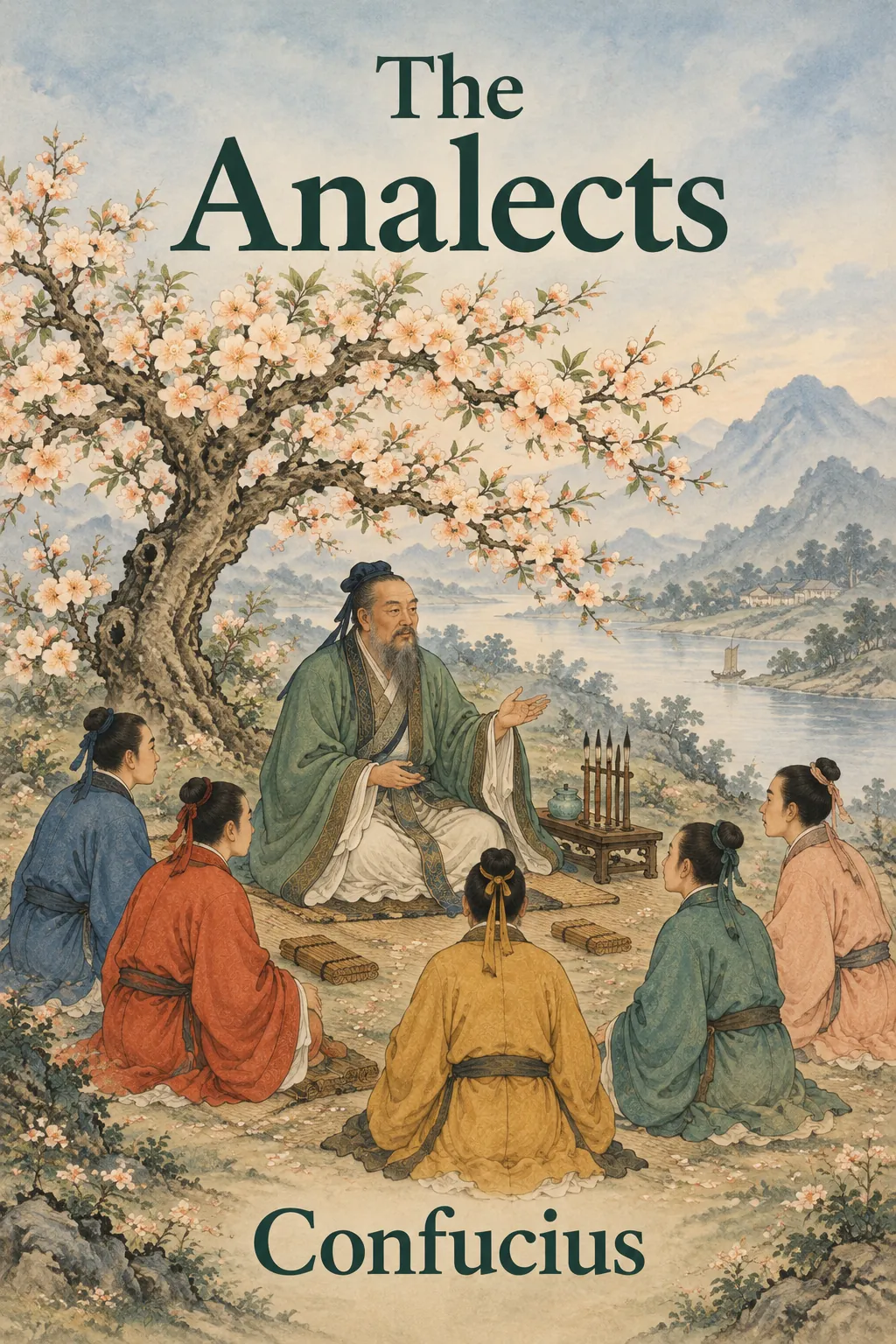
The Analects
by Confucius
The Analects is a collection of sayings and short conversations of Confucius (551–479 BCE) and his students, gathered into 20 short books after his death. It is not a step-by-step system. It is a teacher's voice on how to learn, how to treat parents and friends, how to serve in government, and what makes a person truly good. Its core idea is that character is built by daily practice, and that a leader's example shapes a whole society.
The Big Idea
"The Analects argues that a good society grows from good people: by learning constantly, treating others with care and respect, and practising ritual and duty in daily life, anyone can build real character."
Key Insights
Character grows from daily practice
Confucius cares less about talent than habit. Goodness (ren) in the Analects is not a rare gift but something you approach through steady learning and honest self-checking, one small act at a time. That makes the ideal reachable for ordinary people.
Zengzi asked himself every day whether he had been loyal, trustworthy and had practised what he was taught. Confucius says it took him until seventy to follow his heart without going wrong.
Consideration is the simplest rule
Asked for one word to live by, Confucius chose consideration: do not do to others what you would not want done to yourself. It needs no theory, only imagination about how another person feels. Simple does not mean easy.
Before you laugh at a friend's mistake, picture yourself in their place. That small pause is the Analects' rule in action, and it appears in both Book 12 and Book 15.
Leaders teach by example
Confucius links public life to private character. He says that if a ruler is upright, people follow without orders, and that a leader's virtue is like wind and the people like grass, bending the way it blows.
Asked what a state needs most, he lists food, arms and trust, and says trust is the last to give up. The same logic fits a class, a team or a company: people watch what leaders do more than what they say.
Chapter Breakdown
Chapter-by-chapter summary of the Analects
The Analects has 20 books. Each is named after its opening words, and they are not sorted neatly by theme. Below, each book gets a short summary and a note on why it matters.
Book 1: Learning (Xue er)
The Analects opens by naming its subject: learning. Confucius asks whether it is not a pleasure to study and practise what you learn, and to be glad when a friend arrives from afar. The book then turns to respect for parents, honesty and trustworthiness, and warns that clever talk and a flattering face rarely go with real goodness. Zengzi checks himself every day on three points: loyalty, trustworthiness and practice. Why it matters: the text is framed as a way of life, not an exam subject.
Book 2: Governing (Wei zheng)
Confucius says that a ruler who governs by moral example is like the North Star, which stays put while other stars turn around it. He sketches his own life: set on learning at fifteen, and at seventy able to follow his heart without crossing the line. Here appear the advice to review the old to understand the new, and the warning that study without thought is empty while thought without study is dangerous. Why it matters: personal growth is tied directly to public leadership.
Book 3: Eight Rows of Dancers (Ba yi)
Named for a complaint that a noble family used a ritual privilege reserved for the king, this book is about ritual and music. A student asks what ritual is rooted in, and Confucius answers that sincerity matters more than show: in mourning, grief counts for more than elaborate form. A conversation with Zixia compares ritual to painting. Why it matters: Confucius does not defend empty ceremony; he wants forms that carry real feeling.
Book 4: Living in Goodness (Li ren)
A short book about goodness (ren) in daily life. Confucius says that someone who hears the Way in the morning could die content in the evening. He contrasts the gentleman, who thinks about what is right, with the petty person, who thinks about profit, and advises looking at a worthy person to match them and at an unworthy one to examine yourself. Zengzi explains that Confucius's one thread is loyalty and consideration. Why it matters: goodness becomes practical.
Book 5: Gongye Chang
This is mostly a book of assessments. Confucius judges his students and other people one by one, and each judgement is concrete. Zigong asks what he himself is like and is told he is a precious vessel. Confucius praises a man who loved learning and was not ashamed to ask those below him, and sharply scolds a student who slept through the day. Why it matters: it shows a teacher who judges by conduct, not reputation.
Book 6: Yong Ye
Yan Hui, the favourite student, is praised for living on plain rice in a narrow alley without losing his cheer, and for never repeating a mistake. Confucius says the wise enjoy water and the good enjoy mountains. The book also calls the middle way (zhongyong) a rare virtue, and says that when plainness and polish are balanced, you have a gentleman. Why it matters: contentment and balance, not wealth, mark a person's worth.
Book 7: Passing On (Shu er)
Confucius describes himself as a transmitter, not an inventor, who loves the ancient ways. He is so absorbed in learning that he forgets to eat and does not notice old age arriving. Among any three people walking together, he says, he will find a teacher, and riches gained unjustly are to him like floating clouds. This is the most personal portrait in the text. Why it matters: the great teacher of the tradition presents himself as a lifelong learner.
Book 8: Taibo
The book opens with praise for the ancient prince Taibo, who yielded his throne, then gathers sayings of Zengzi. The scholar must be broad-minded and resolute, he says, because the burden is heavy and the road long. Courtesy without ritual becomes tiring, and bravery without it turns to disorder. On his deathbed Zengzi asks his students to look at his hands and feet, to show he kept his body unharmed. Why it matters: it shows how the disciples carried the teaching on.
Book 9: Zi han
The book begins by saying that Confucius rarely spoke of profit, fate or goodness, and it shows him as modest and open. Standing by a river he remarks that everything flows on like this, day and night. Only in the cold season, he says, do you see that pines and cypresses are the last to lose their leaves, and that an army can lose its commander but an ordinary man cannot be robbed of his will. Why it matters: some of the best-known lines on perseverance come from here.
Book 10: Xiang dang
This is the most unusual book. It reads like a record of Confucius's daily manner: how he spoke at home and at court, what he wore, how he ate, how he bowed. There are few sayings. One short story tells that when his stables burned, he asked whether anyone was hurt and did not ask about the horses. Why it matters: his values appear as habit, with people placed first.
Book 11: Xian jin
Confucius talks about his earlier and later students. The book mourns Yan Hui, whose early death leaves Confucius saying that heaven has destroyed him. Asked by Zilu about serving spirits and about death, he replies that you cannot yet serve people, so how could you serve spirits, and you do not yet understand life, so how could you understand death. He also says that overshooting is as bad as falling short. Why it matters: this is a thinker focused on this world and on balance.
Book 12: Yan Yuan
Asked about goodness by Yan Hui, Confucius answers that it means restraining the self and returning to ritual. To Zhonggong he gives a well-known form of the golden rule: do not do to others what you would not want done to yourself. Asked what a state needs, he lists food, arms and trust, and says that if one must go, trust is the last to give up. Why it matters: ethics and politics meet.
Book 13: Zilu
Zilu asks what a ruler should do first, and Confucius says to correct the names, so that words match reality. Government begins in language. He says that when rulers are upright, people act without orders, and when they are not, orders are ignored. Asked how to treat people in a crowded state, he says first make them prosperous, then teach them. The gentleman seeks harmony without conformity. Why it matters: it is a practical politics built on example and honest speech.
Book 14: Xian wen
Named for a student who asks what shame is, this long book collects judgments on officials, statesmen and the way of the world. Confucius says that in antiquity people studied for themselves, whereas now they study to impress others. Asked whether one should repay injury with kindness, he answers: repay injury with fairness and kindness with kindness. A gatekeeper mocks him as the man who keeps trying though it is hopeless. Why it matters: it shows Confucius dealing with his critics.
Book 15: Duke Ling of Wei (Wei Ling gong)
This book collects short sayings on conduct. Zigong asks for a single word to live by, and Confucius offers consideration: do not do to others what you would not want done to you. Other lines say that someone with no distant worries will have trouble close at hand, that a craftsman who wants to do good work first sharpens his tools, and that the real mistake is to know a fault and not correct it. Why it matters: the Analects' most portable advice is concentrated here.
Book 16: The Ji Family (Ji shi)
Many scholars think this book was added later, because it groups advice in numbered lists. The opening warns that rulers should worry less about poverty than about unequal shares. Then come three kinds of helpful friends (the upright, the trustworthy, the well-informed) and three harmful kinds; three things a gentleman guards against at different stages of life; and three things he holds in awe. Why it matters: the tradition turned lived wisdom into lists that are easy to remember.
Book 17: Yang Huo
The book opens with a powerful official who tries to recruit Confucius. It contains the line that people are close by nature but grow far apart through habit, which shows his faith in education. Visiting a small town where people play music, he jokes that you do not need an ox-cleaver to kill a chicken, then admits he was joking. Clever talk and a smooth face, he repeats, seldom go with goodness. Why it matters: it shows the humorous side of a strict teacher.
Book 18: Weizi
This book looks outward, to people who chose differently. It names worthy men of the late Shang dynasty, then tells of hermits who mock Confucius for wandering from court to court in a broken world. Confucius sighs that one cannot live with birds and beasts, and that if the world were in order, he would not be trying to change it. Why it matters: the Analects lets the opposite view, the withdrawn life, speak, and so shows why he rejects it.
Book 19: Zizhang
This book records disciples rather than Confucius, such as Zixia, Zizhang and Zengzi. Zixia says that goodness lies in learning broadly, holding firm to your purpose, asking earnest questions and thinking about what is near. He also says that someone who notes each day what he lacks and keeps each month what he has learned can be called fond of learning. Zigong defends his late teacher by comparing him to the sun and moon, which no one can harm. Why it matters: teaching carried on after the master's death.
Book 20: Yao Said (Yao yue)
The shortest book closes the text with three fragments: the legendary ruler Yao handing duty to Shun, early kings taking responsibility for their people, and a passage on what a good official values and avoids. The last lines say that without knowing destiny, one cannot be a gentleman; without ritual, one cannot stand; without understanding words, one cannot know people. Why it matters: it ends on self-knowledge, standing in the world and judging others fairly.
Key people and terms
- Confucius (Kong Qiu, 551–479 BCE): a teacher from the state of Lu, in what is now Shandong. He travelled seeking a ruler who would follow his ideas, then taught students. Called Kongzi, Master Kong.
- Yan Hui: the favourite student. He was poor, cheerful and devoted to learning, and his early death caused Confucius deep grief.
- Zilu: a brave, direct student who served in government. Confucius often checks his haste, and trusts him.
- Zigong: a gifted speaker and diplomat. His question about one word to live by drew out the reciprocity teaching.
- Ren (goodness): the central virtue, caring for others shown in conduct. Confucius never defines it once; he answers each student differently.
- Li (ritual): the forms of proper conduct, from ceremony to everyday manners, valued when they carry real respect.
- Junzi (gentleman): the ideal person, defined by character, not birth. The opposite is the petty person.
Applying the Analects and writing about it
The Analects is easiest to write about when you choose one saying and connect it to your own experience, rather than trying to cover all 20 books. Some starting questions:
- How would “do not do to others what you would not want done to yourself” change a recent argument or group project?
- Confucius says overshooting is as bad as falling short. Where does that fit your studying, sport or work?
- He says a gentleman is not upset when others fail to notice him. Is that harder or easier in the age of social media?
- Why has a 2,500-year-old teacher's advice stayed in print?
A clear structure helps: name the saying and its book, explain it in your own words, give an example from your life, and say what you think now. Many lines have more than one reasonable reading, so your own view matters. Keep quotations short and say which book they come from.
Take Action
Practical steps you can implement today:
-
Pick one saying and test it for a week; the Analects is meant to be practised, not just memorised.
-
Before you act toward someone, ask whether you would want it done to you. Use that as a quick check.
-
Treat mistakes as information: admit them early and fix them, because the real error is leaving them uncorrected.
-
Keep learning for its own sake. Review old lessons often and ask people who know more, whatever their rank.
Notable Quotes
"“To learn, and from time to time to practise what you have learned: is that not a pleasure?” (Book 1)"
— Confucius
"“Review the old to understand the new, and you can be a teacher.” (Book 2)"
— Confucius
"“Learning without thought is empty; thought without learning is dangerous.” (Book 2)"
— Confucius
"“Overshooting is as bad as falling short.” (Book 11)"
— Confucius
"“Do not do to others what you would not want done to yourself.” (Book 15)"
— Confucius
Who Should Read This
Students meeting the Analects in a philosophy, history or world-literature course; adults curious about where famous Confucian sayings come from; and anyone who wants practical advice on learning, friendship and leadership. No background is needed, and it suits readers from about age 14 up.
Frequently Asked Questions
Who wrote the Analects?
Not Confucius himself. His students and later followers collected his sayings and conversations after his death, and the text reached roughly its present form by the Han dynasty. That is why books differ in style, and why the later books are often thought to be additions.
Where should a beginner start?
Start with Books 1 and 2, which hold many of the famous lines, then read Books 4 and 12 on goodness. Book 10, a record of Confucius's daily manners, can wait until a second reading.
What does ren mean?
Ren is usually translated as goodness, humaneness or benevolence. It means caring for other people and showing it in conduct. Confucius gives different answers to different students, so the word is better understood through examples than through one definition.
Is the Analects a religious text?
It is mainly read as a book of ethics and practical wisdom, not scripture. Later generations built a tradition called Confucianism on it, and it became state learning in imperial China, but the book itself is a record of a teacher talking with students.
Check Your Understanding
Pick an answer for each question to see if you were right.
-
How many books does the Analects have?
20 — The text is divided into 20 short books, each named after its opening words.
-
Who compiled the Analects?
His students and later followers — Followers gathered his sayings and conversations after his death.
-
Which student is praised for staying cheerful while living in poverty?
Yan Hui — Book 6 praises Yan Hui for his cheer on plain rice in a narrow alley.
-
What single word did Confucius give Zigong to live by?
Consideration — He offered consideration: do not do to others what you would not want done to yourself.
-
Which idea does the saying “overshooting is as bad as falling short” express?
Balance — The line in Book 11 teaches moderation and balance.
About Confucius
Confucius (Kong Qiu, 551–479 BCE) was a teacher and thinker from the state of Lu in China. He looked for a ruler who would put his moral ideas into practice, and in the end he taught students. His followers compiled the Analects, which became a base of education in East Asia for over two thousand years.
Summary Written By

Software Engineer & Writer
Software engineer with a passion for distilling complex ideas into actionable insights. Writes about finance, investment, entrepreneurship, and technology.
View all summaries →Reviews
No reviews yet. Be the first to share your thoughts!
Write a Review
Keep reading
Explore the topic: Personal DevelopmentSummaries

Educated by Tara Westover
Tara Westover
A memoir about a young woman born to survivalists in Idaho who, despite having no formal schooling, teaches herself to…

Atomic Habits: An Easy & Proven Way to Build Good Habits & Break Bad Ones
James Clear
No matter your goals, Atomic Habits offers a proven framework for improving–every day. James Clear, one of the world’s leading…
Think and Grow Rich
Napoleon Hill
What if the secrets to wealth and success weren’t hidden in complex financial strategies, but within the power of your…

Melbourne
Alex Ng
Sophie Cunningham's Melbourne is a deeply personal exploration of Australia's cultural capital, weaving together history, architecture, weather patterns, and personal…
Articles

The Enlightenment Explained: Ideas, Thinkers and Legacy
The Enlightenment was an 18th-century European movement that trusted reason and evidence over tradition and authority. Its thinkers, from Locke…
World History 1700–1918: Revolutions, Industry, Empire and War
Between 1700 and 1918, revolutions, factories, empires and a world war reshaped societies across Europe, the Americas, Asia and Africa.…

Best Stoicism Books for Beginners: Where to Start and Why
Looking for the best stoicism books for beginners? Discover a clear reading route comparing ancient classics like Marcus Aurelius with…