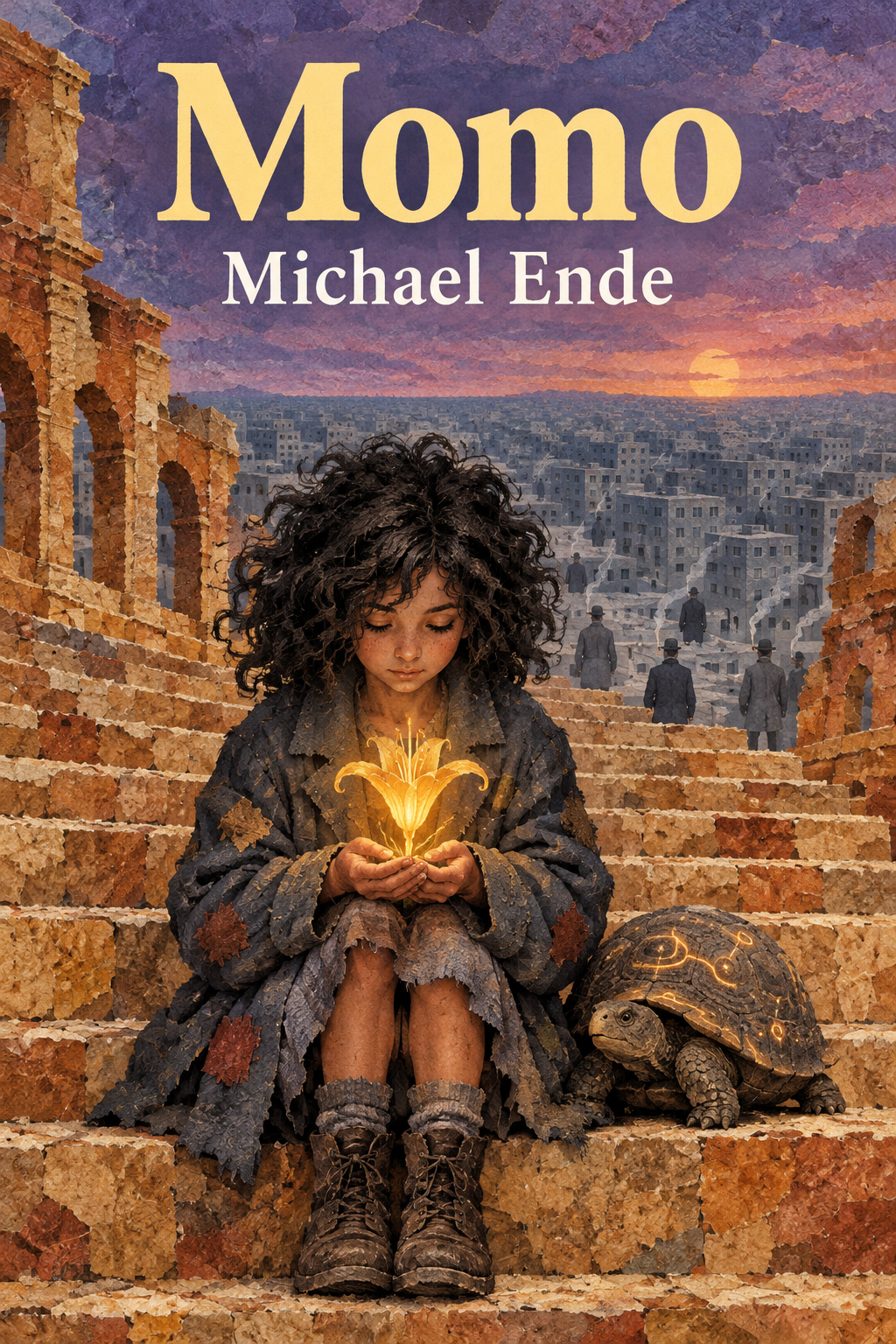
Momo
by Michael Ende
Momo is a German fantasy novel about a girl who fights the men who steal people's time. Momo, a small ragged girl, lives in the ruins of an amphitheatre outside a big unnamed city. Her gift is listening, and people leave her company happier and wiser. Then the grey men of the Timesaving Bank arrive, persuading adults to save time. The more people save, the more rushed and joyless they become. Only Momo sees what is happening, and the grey men decide she is their most dangerous enemy.
The Big Idea
"Time is not money to be saved; it is life itself. Momo shows a city that tries to save every minute and loses the very thing it wanted, and a girl whose gift is simply listening."
Key Insights
Time is life, not money
The book argues that time cannot be banked like money. The grey men promise that saved minutes will pile up with interest, but the minutes simply disappear, and the hours people keep feel empty. Ende turns the everyday phrase “time is money” into a trap: once you measure every moment, you stop living in any of them.
Mr Fusi drops his daily visit to a friend and his slow chats with customers. He saves hours on paper, yet he feels more rushed than ever, and his days start to look the same.
Listening is a gift
Momo has no money, schooling or special skill. What she has is attention. By listening without judging or hurrying, she lets people hear their own thoughts. The book treats this as real power, strong enough that the grey men see a small girl as their most dangerous enemy.
The agent who visits Momo with an expensive doll ends up confessing the grey men's secret, simply because she listens to him so closely that he cannot keep up his act.
Efficiency without joy
As the city speeds up, it also turns grey: new housing blocks that all look alike, jobs done fast and without pride, meals eaten in a hurry. The book argues that a life built only for usefulness loses the things that make it worth living: friendship, care in one's work, and rest.
Nino's friendly little inn becomes a packed fast-food counter. It earns more money, but nobody, not even Nino, has a moment to sit down and talk anymore.
Children's play and imagination
Momo's friends need nothing but an old ruin and a story to have a storm at sea. Later, adults decide play must be useful and put children in supervised “child depots.” Ende suggests that free, pointless-looking play is where imagination grows, and that adults who forget this pass their hurry on to their children.
The talking doll the grey man offers Momo can only repeat a few set phrases. Momo finds she cannot really play with it, while a heap of junk in the ruins once gave the children whole adventures.
Chapter Breakdown
Chapter-by-chapter summary
Spoiler warning: this section covers the whole plot, including the ending.
The book has three parts. Each part is summarised below in two stages.
Part One, Momo and Her Friends (1): The Girl in the Ruins
Nobody knows where Momo comes from. One day this small girl, in a man's jacket too big for her and with a wild mop of black curls, is simply living in the ruins of an ancient amphitheatre outside the city. The neighbours fix up a room for her and take turns bringing food. They soon find out why they need her: Momo listens so well that quarrelling friends make peace, shy people discover their own ideas, and children invent better games when she joins in. She owns almost nothing, but she has plenty of time and gives it away freely. This matters because it sets up Momo's one real power, attention, before anyone tries to take it away.
Part One, Momo and Her Friends (2): Beppo, Gigi and Slow Time
Her closest friends are opposites. Old Beppo Roadsweeper thinks for a long time before he answers, so people take him for slow. Young Gigi Guide talks fast, spins made-up stories for tourists and dreams of fame. Beppo tells Momo how he sweeps a very long street: never by thinking of the whole street, only of the next step, the next breath and the next stroke of the broom, so the work stays calm and even enjoyable. In the evenings the children gather at the amphitheatre and turn a heap of junk into a storm at sea. This part matters because it shows the slow, shared time that the rest of the book puts in danger.
Part Two, The Men in Grey (1): The Timesaving Bank
The grey men arrive: grey suits, grey hats, small grey cigars, and faces nobody can remember. Claiming to work for the Timesaving Bank, they visit people one by one. Agent XYQ/384/b shows Mr Fusi the barber how many seconds he has “wasted” on sleep, his mother, his budgie and a daily visit to a friend. Fusi starts working faster, cuts out his chats with customers and enjoys nothing. The time he saves never comes back to him; his days only feel shorter. The same thing happens all over the city. This matters because it shows how the theft works: people hand over their time willingly.
Part Two, The Men in Grey (2): Momo Learns the Secret
Another agent tries to win Momo over with an expensive talking doll, but her listening makes him blurt out the truth: the grey men live on stolen time. Gigi and the children march to warn the city, but no adult comes to their meeting. That night the agent is tried by his leaders and dissolves into nothing, while Beppo watches and is not believed. Hunted by the grey men, Momo follows a tortoise named Cassiopeia to Nowhere House, home of Master Hora, keeper of everyone's time. This part matters because it reveals who the enemy is and why Momo alone can stand against them.
Part Three, The Hour-Lilies (1): A Year and a Day Later
Hora shows Momo the hour-lilies, flowers that bloom and fade in each person's heart; she must sleep so the experience can take root. She wakes a year and a day later to find everything changed. Gigi is a famous, unhappy storyteller ruled by secretaries. Beppo has agreed to save 100,000 hours for the grey men to get Momo back and sweeps without rest. The children are shut in supervised “child depots.” Alone, Momo is offered her friends back if she leads the grey men to Hora, and she refuses. This matters because her loyalty is tested when she has the most to lose.
Part Three, The Hour-Lilies (2): The Last Flower
Hora stops time and gives Momo a single hour-lily that lasts one hour. With Cassiopeia, she follows the panicking grey men to their underground store of stolen time and shuts its door with the flower. Without new cigars, they vanish one by one. Momo then releases the stolen time, which flies back to its owners like a storm of petals, and the city slows down again. She is reunited with Beppo, Gigi and the children. This part matters because Momo wins with courage and loyalty, not force.
Characters
- Momo: A small girl of unknown age and origin who lives in the amphitheatre ruins. She owns almost nothing, but she has time and gives it away by listening. Her quiet attention helps people think clearly, which is exactly why the grey men fear her.
- Beppo Roadsweeper: An old street sweeper who answers questions only after long thought, so many people think he is slow. His way of sweeping, one breath and one stroke at a time, is the book's clearest picture of how to live in time. Later he works himself ragged to get Momo back.
- Gigi Guide (Guido in some English translations): A young, talkative tour guide who invents stories on the spot and dreams of fame. He gets that fame in Part Three, but the grey men turn him into an empty, overworked storyteller. He shows how success can cost you your own voice.
- Master Secundus Minutius Hora: The ancient, kindly guardian of time, who sends every person their hours from Nowhere House at the end of Never Lane. He can look very old or quite young. He knows all about the grey men, but he needs Momo's courage to stop them.
- Cassiopeia: Hora's tortoise, who “talks” through glowing letters on her shell and can see half an hour into the future. She moves slowly yet always arrives on time, a quiet joke at the expense of the grey men's hurry.
- The grey men: Bald, grey-faced agents of the Timesaving Bank in grey suits, who smoke cigars made from dried hour-lilies of stolen time. They have no lives of their own and exist only as long as they take time from others.
- Mr Fusi (Figaro in one English translation): The barber whose visit from Agent XYQ/384/b opens Part Two. He once chatted with customers, cared for his mother and visited a friend every day. After “saving time” he works faster, grows irritable and enjoys nothing.
- Nino and Liliana: The couple who run a small inn near the amphitheatre and often feed Momo. When she returns, the inn has become a crowded fast-food place where Nino has no time to talk, a small picture of the whole city's change.
- The children (Paolo, Massimo, Franco, Maria and others): They play inventive make-believe games at the amphitheatre and march against the grey men. Later they are placed in supervised “child depots” where every game has to be useful.
Writing about this book
Momo is a popular book report choice because its big question is one every reader can test against their own life: where does my time actually go?
Some angles to try:
- Compare yourself with Mr Fusi. Is there something you cut out to “save time” that you now miss?
- Beppo sweeps one stroke at a time. Choose a task that feels too big and describe what happens if you think only of the next step.
- What do the grey men stand for today? Think about phones, packed timetables or the pressure to be productive, and explain your choice.
- Why does the book make a child the hero, and why is her power listening rather than fighting?
- In the postscript, Ende says the story could be told as if it happened in the past or as if it will happen in the future. What does that suggest about the world he was worried about?
A strong report links one scene from the book to one moment from your own life, then explains what changed in your thinking. Quote a single short line at most and put everything else in your own words.
Take Action
Practical steps you can implement today:
-
When you feel short of time, ask whether you are saving it or just rushing; Mr Fusi's “savings” made his days emptier, not longer.
-
Break a big job into the next small step, as Beppo does with his long street, and keep your breath and pace steady.
-
Listen to someone fully, without planning your reply; Momo shows how much people can work out for themselves when they are truly heard.
-
Protect some time with no purpose at all, for play, talk or daydreaming, because the book argues that this is where life happens.
Notable Quotes
"“You must never think of the whole street at once. Only the next step, the next breath, the next sweep of the broom.” (Part One, Chapter 4, Beppo)"
— Michael Ende
"“Time is life, and life lives in the heart.” (Part Two, Chapter 6)"
— Michael Ende
"“Just as you have eyes to see light and ears to hear sound, you have a heart to perceive time.” (Part Two, Chapter 12, Master Hora)"
— Michael Ende
Who Should Read This
Readers from about age 10 up, including middle and high school students looking for a book report title. Adults who feel constantly busy often get even more out of it than children do. If you liked The Little Prince or The Neverending Story, Momo has the same mix of fairy tale and sharp ideas about everyday life.
Frequently Asked Questions
What is Momo about?
Momo is a 1973 fantasy novel by Michael Ende about a girl who lives in a ruined amphitheatre and has a rare gift for listening. When the grey men of the Timesaving Bank start stealing people's time and the whole city becomes rushed and joyless, Momo turns out to be the one person who can stand up to them.
Who are the grey men in Momo?
They are agents who claim to work for the Timesaving Bank. They talk people into “saving” time, then take that time for themselves, drying the hour-lilies of human time into the cigars they smoke to stay alive. Many readers see them as a picture of the pressure to be busy and efficient at any cost.
What age is Momo for?
It was written for children, and most readers meet it from about age 10. The language is simple and the story is easy to follow, but its ideas about time, work and attention reward older readers too, which is why many adults return to it years later and find a different book.
How does Momo end?
Spoiler: Master Hora stops time and gives Momo a single hour-lily. She follows the grey men to their underground store and shuts its door. Without new cigars, they vanish one by one. Momo then releases the stolen time, it flows back to its owners, and she is reunited with Beppo, Gigi and the children.
Is Momo the same book as The Grey Gentlemen?
Yes. The first English translation, by Frances Lobb, appeared in 1974 as The Grey Gentlemen. Later translations use the title Momo, and some rename characters: Gigi becomes Guido and the barber Fusi becomes Figaro in one version. The story itself is the same.
Check Your Understanding
Pick an answer for each question to see if you were right.
-
Where does Momo live at the start of the book?
In the ruins of an old amphitheatre — Momo makes her home in the ruined amphitheatre outside the city, where the neighbours fix up a room for her.
-
What is Momo's special gift?
Listening — Momo listens so closely that people find their own answers and make peace with each other.
-
What do the grey men smoke to stay alive?
Cigars made from dried hour-lilies — The grey men live on stolen time, which they dry and roll into cigars.
-
Who can see half an hour into the future?
Cassiopeia — Hora's tortoise Cassiopeia sees thirty minutes ahead and shows messages on her shell.
-
How many hours does Beppo agree to save to get Momo back?
100,000 — The grey men tell Beppo he must save 100,000 hours, so he sweeps day and night without rest.
About Michael Ende
Michael Ende (1929–1995) was a German writer, the son of surrealist painter Edgar Ende. He trained as an actor before turning to children's books, starting with Jim Button and Luke the Engine Driver. Momo (1973) won the German Youth Literature Prize in 1974, and The Neverending Story followed in 1979. He lived near Rome for many years, and his books found a huge readership in Japan.
Summary Written By

Software Engineer & Writer
Software engineer with a passion for distilling complex ideas into actionable insights. Writes about finance, investment, entrepreneurship, and technology.
View all summaries →Reviews
No reviews yet. Be the first to share your thoughts!
Write a Review
Keep reading
Explore the topic: FictionSummaries

Out of My Mind
Sharon M. Draper
“Out of My Mind” by Sharon M. Draper is a poignant narrative that explores the life of Melody Brooks, a…

Ender’s Game
Orson Scott Card
“Ender’s Game” by Orson Scott Card is a riveting science fiction novel that transports readers into a future where humanity…

Pachinko
Min Jin Lee
“Pachinko”, a spellbinding multigenerational historical saga by Min Jin Lee, explores the lives of a Korean family trying to make…

The Perks of Being a Wallflower
Stephen Chbosky
The Perks of Being a Wallflower by Stephen Chbosky is a profound coming-of-age novel, told through the intimate letters of…
Articles

The Enlightenment Explained: Ideas, Thinkers and Legacy
The Enlightenment was an 18th-century European movement that trusted reason and evidence over tradition and authority. Its thinkers, from Locke…
World History 1700–1918: Revolutions, Industry, Empire and War
Between 1700 and 1918, revolutions, factories, empires and a world war reshaped societies across Europe, the Americas, Asia and Africa.…

A Christmas Carol themes: generosity, isolation and responsibility
Dickens's novella is usually read as a story about a man who changes his mind. Its themes are sharper than…