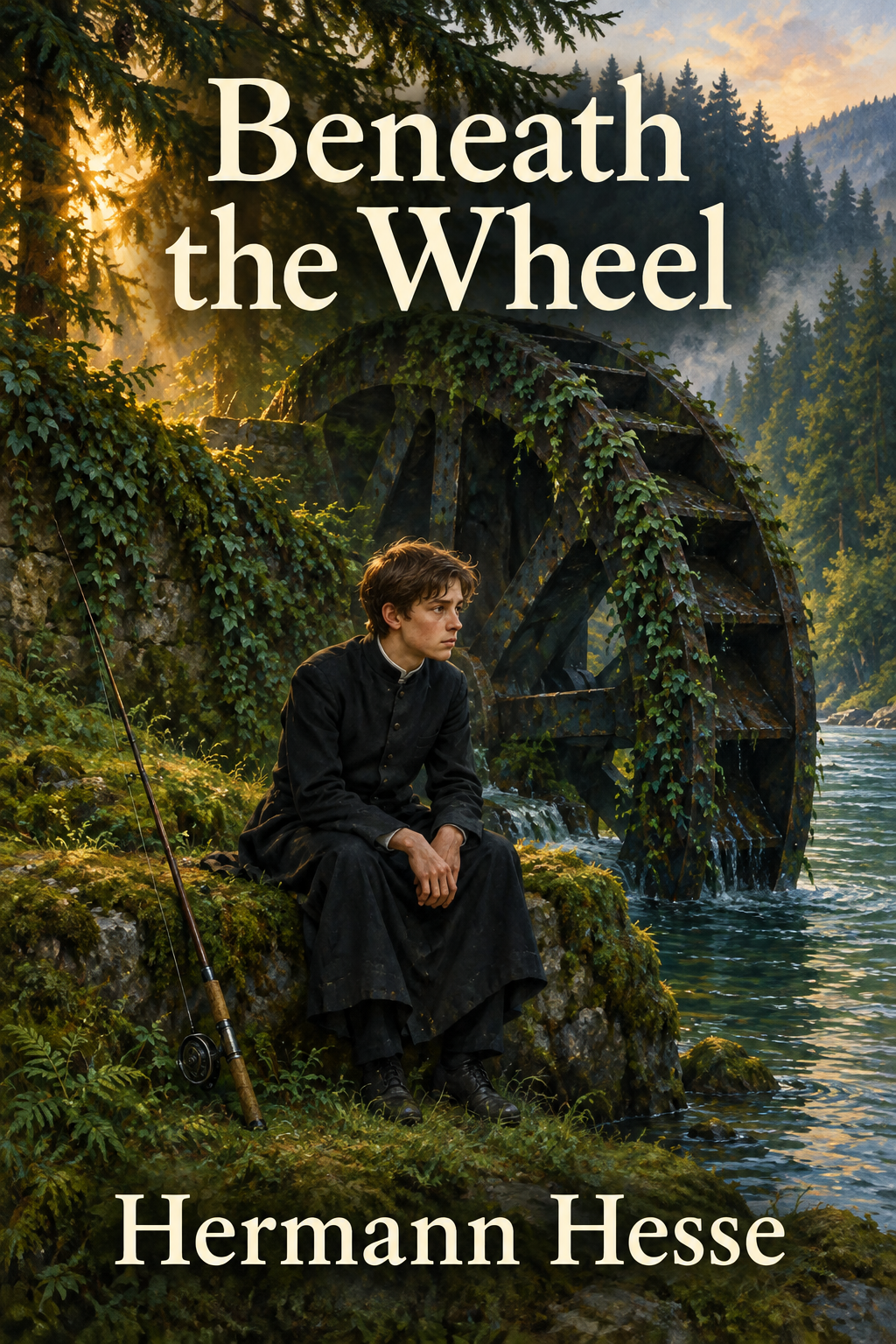
Beneath the Wheel
by Hermann Hesse
Beneath the Wheel is Hermann Hesse's 1906 novel about Hans Giebenrath, a clever boy in a small German town whose teachers, pastor and father see him as the town's great hope. He studies for a famous exam, wins a place at a strict seminary, and gives up his river walks and his own thoughts to keep up. Then a poetic, restless friend arrives, and Hans must choose between duty and himself. It is a short, quiet novel about school pressure.
The Big Idea
"A gifted boy is pushed so hard toward success that he loses his curiosity, his friends and his health. Hesse shows how an education built on pressure can crush the very mind it claims to shape."
Key Insights
Pressure that looks like care
Nearly every adult around Hans says they want what is best for him. Yet each praise and each extra lesson is tied to results, so his worth depends on performance. Hesse shows that harm can come from sincere people who never think of themselves as harmful.
After the exam, the pastor and the rector are delighted, and nobody asks whether Hans wants the seminary.
Learning versus cramming
Hans is curious by nature, but the exam system rewards memory and speed. The more he studies for marks, the less room he has for the fishing, walking and thinking that once made him curious. The novel is a plea to protect the wonder in learning.
At Maulbronn he works harder than ever, and still feels his mind getting duller.
A friend as a mirror
Heilner is not simply a bad influence. He shows Hans a different way to be alive, driven by feeling and art. Hans's trouble is that he has no steady self to hold onto when that new world arrives, so the friendship breaks him as much as it opens him.
Hans neglects his lessons to talk with Heilner, and the staff blame the friend rather than the system.
Who is responsible?
The book refuses an easy answer. Hans's father, teachers, pastor and town all play a part, and so does Hans's own silence. By ending with Flaig's quiet remark, Hesse points toward shared responsibility and asks readers to look at how they treat young people.
At the grave the respectable men feel sorry, but only Flaig suggests they helped cause the loss, and he includes himself.
Chapter Breakdown
Chapter-by-chapter summary
Spoiler warning: this section covers the whole plot, including the ending.
The novel has seven numbered chapters without titles; the short labels below are ours.
Chapter 1: The Boy the Town Is Counting On
Hans Giebenrath is the brightest boy in a small town in the Black Forest region of southern Germany. His father, a merchant, values money and respectability, and the rector, the pastor and the teachers all treat Hans as the town's chance to be proud of itself. Extra Latin, Greek and mathematics fill his days, and fishing, the thing he loves most, is allowed only when his studies are safe. He travels to Stuttgart for the state examination that wins a free place at the Protestant seminaries of Württemberg. He is sure he has failed, yet he finishes second, and the town celebrates as if the victory were its own. Why it matters: Hesse shows the pressure before any crisis, and success only raises the bar, while nobody asks Hans what he wants.
Chapter 2: The Last Free Summer
Hans expects a summer of freedom, but the pastor and the rector soon step in with extra lessons so that he will arrive at the seminary well ahead. He still slips away to the river to fish and wander, and he visits the cobbler Flaig, a devout, plain-speaking neighbour who treats him as a person rather than a trophy. Hans begins to have headaches, which he hides. Why it matters: this is the last stretch of carefree life he gets, and the river feels precious because we sense what is coming.
Chapter 3: The Seminary at Maulbronn
In autumn Hans enters the seminary at Maulbronn, a medieval monastery turned into a boarding school for future pastors. He shares a study room with other boys and works hard at Greek, Hebrew and the rest. There he meets Hermann Heilner, a gifted, moody boy who loves poetry and does not care much for rules. Hans is both drawn to him and unsettled by him. Why it matters: the school is calm and beautiful on the outside, and Heilner is the first person who makes Hans notice what his own life has been missing.
Chapter 4: Friendship and Collapse
The two boys grow close. Heilner talks about art and freedom, and Hans, for the first time, spends hours on feelings instead of homework. His marks fall, and the school's head warns him that the friendship is bad for him. A classmate drowns, which shakes the whole school. Hans begins to faint in class, Heilner clashes with the masters, and finally Heilner runs away. Hans is left alone, judged a failure, and can no longer concentrate. Why it matters: Hesse suggests the school cannot tell the difference between a lazy boy and a sick one.
Chapter 5: Sent Home
Hans's exhaustion deepens into a breakdown, and he is sent home from the seminary. He returns to his town ashamed, as if he had let everyone down. His father is anxious and awkward, and the pastor and teachers who once praised him now keep their distance. He walks by the river, remembers his boyhood, and slowly calms down, though dark thoughts come and go. Why it matters: the people who pushed him offer no help now that he has fallen.
Chapter 6: The Pressing Season and Emma
In autumn the town presses its fruit. Flaig has rented a small press at the lower mill, and Hans helps there. He meets Emma, Flaig's lively niece from Heilbronn, who is staying with the family. She teases him, works beside him and stirs him deeply, but she leaves without saying goodbye, and he is left feeling foolish. Why it matters: this is his one real taste of joy, and it ends in another small hurt.
Chapter 7: The Workshop and the River
With no school and no plan, Hans is sent to work as an apprentice in a mechanic's workshop. He is clumsy among the workmen, but he learns, and he is helped by August, an old schoolmate who is already an apprentice there. On the first Sunday outing, the apprentices drink a lot, and Hans walks home alone at dusk. The next day he is found dead in the river. The book does not say whether he slipped or let go. At the grave, Flaig quietly suggests to Hans's father that the schoolmasters bear some blame, and that the two of them may have neglected the boy as well. Why it matters: Hesse ends by questioning the adults and the system around the boy, not the boy himself.
Characters
Hans Giebenrath
The gifted, sensitive boy at the centre. He loves fishing and quiet walks, but he obeys every adult who pushes him. He is not weak so much as unprepared to say no, and the book follows what happens when nobody teaches him how.
Hermann Heilner
Hans's friend at Maulbronn, a poet who refuses to be shaped by the school. He is moody, charming and stubborn. For Hans he is a window onto another way of living; for the teachers he is a problem to be solved.
Joseph Giebenrath
Hans's father, a local merchant who is proud of his son but understands little about him. He wants Hans to rise in the world and cannot talk about feelings. His kindness is real, and also clumsy.
Flaig
The shoemaker neighbour, a devout man with firm opinions. He is one of the few adults who speaks to Hans as a person. He doubts the school's priorities, and at the end he says so quietly.
The rector, the pastor and the teachers
Together they act as a single force: respectable men who sincerely believe they are helping Hans. They praise him while he wins and pull back when he falters, which shows how conditional their care is.
Emma
Flaig's cheerful niece from Heilbronn, staying with his family for a while. She is playful and not very serious about the meeting, yet she is the one who awakens Hans's first strong feelings. Her sudden departure hurts him deeply.
August
An old schoolmate of Hans who is already a mechanic's apprentice. In the workshop he treats Hans kindly and draws him into ordinary friendship, jokes and Sunday outings. He stands for the plain life Hans might have grown into.
Writing about this book
Beneath the Wheel suits a school report because its central question is easy to state and hard to answer: who is responsible when a young person breaks down? Start with one theme, such as pressure, friendship or freedom, and follow it through three scenes instead of trying to cover everything.
Questions to think about:
- Which adults in the book truly care about Hans, and which care about what he can achieve for them?
- Why does Heilner both help and harm Hans?
- What does the river mean in the first chapters, and how does that meaning change by the last page?
- Is the ending a warning about school, about family, or about the whole society of the time?
Remember that Hesse wrote from his own experience, so you can compare the novel with your own study life. A good report names a specific scene, explains why it stayed with you, and says what you would have done differently as one of the adults.
Take Action
Practical steps you can implement today:
-
Ask a young person what they want, not only how they scored.
-
Protect free time; rest and hobbies are part of learning, not a reward for it.
-
Treat headaches, exhaustion and withdrawal as signals to listen to, not as laziness.
-
Notice whose expectations you are living by, and say no when they are too heavy.
Notable Quotes
"“Failing is simply impossible.” (Chapter 1; our translation from the German original)"
— Hermann Hesse
"“Better to ruin the body ten times over than to harm one's soul.” (Chapter 2; our translation from the German original)"
— Hermann Hesse
"“You and I, perhaps we also neglected many things with the boy, don't you think?” (Chapter 7; our translation from the German original)"
— Hermann Hesse
Who Should Read This
Readers from about 14 and up who want a short, quiet classic about school pressure, growing up and friendship. It suits students writing a book report, teachers and parents, and anyone who has felt crushed by expectations at school or work.
Frequently Asked Questions
What is Beneath the Wheel about?
It follows Hans Giebenrath, a very clever boy in a small German town. His family, teachers and pastor push him to pass a famous exam and enter a strict seminary. The novel shows what that pressure costs him in friendship, health and freedom.
Is Beneath the Wheel based on Hermann Hesse's life?
Partly. Hesse also entered the Maulbronn seminary as a teenager and left it after a short time. He drew on that memory of strict schooling and unhappiness, though Hans and his story are fictional and the ending is not Hesse's own.
What does the title Beneath the Wheel mean?
The wheel stands for the grinding machine of school, exams and social expectations. A boy who gets caught beneath it is crushed slowly. The title was first Unterm Rad in German, and it is also known in English as The Prodigy.
Who are the main characters?
The main characters are Hans Giebenrath, his friend Hermann Heilner, his father Joseph, the shoemaker Flaig, the girl Emma and the apprentice August. The rector, pastor and teachers also matter as a group, because they represent the pressure around Hans.
Is Beneath the Wheel suitable for school reading?
Yes, for older students. The language is plain and the book is short, but it deals with exhaustion, despair and a death at the end. Teachers and parents may want to discuss those themes with younger readers.
Check Your Understanding
Pick an answer for each question to see if you were right.
-
Who is the main character of Beneath the Wheel?
Hans Giebenrath — Hans Giebenrath is the gifted boy whose story the novel follows.
-
Which school does Hans enter after the state exam?
The seminary at Maulbronn — Hans wins a place at the Maulbronn seminary, a school for future pastors.
-
What is Hermann Heilner like?
A poetic, rebellious boy — Heilner is a gifted, moody poet who resists the school's rules.
-
What does Hans do when he is sent home from the seminary?
He becomes a mechanic's apprentice — After his breakdown and a period of drifting, he starts as an apprentice in a mechanic's workshop.
-
What is the main message of the novel?
Pressure without care can crush a young person — Hesse criticises an education that values results over the child.
About Hermann Hesse
Hermann Hesse (1877–1962) was a German-Swiss writer born in Calw, in the Black Forest region. As a teenager he entered the Maulbronn seminary and then left it, an experience that shaped this novel. He went on to write Siddhartha, Steppenwolf and The Glass Bead Game, and won the Nobel Prize in Literature in 1946.
Summary Written By

Software Engineer & Writer
Software engineer with a passion for distilling complex ideas into actionable insights. Writes about finance, investment, entrepreneurship, and technology.
View all summaries →Reviews
No reviews yet. Be the first to share your thoughts!
Write a Review
Keep reading
Explore the topic: FictionSummaries

Out of My Mind
Sharon M. Draper
“Out of My Mind” by Sharon M. Draper is a poignant narrative that explores the life of Melody Brooks, a…

Ender’s Game
Orson Scott Card
“Ender’s Game” by Orson Scott Card is a riveting science fiction novel that transports readers into a future where humanity…

Pachinko
Min Jin Lee
“Pachinko”, a spellbinding multigenerational historical saga by Min Jin Lee, explores the lives of a Korean family trying to make…

The Perks of Being a Wallflower
Stephen Chbosky
The Perks of Being a Wallflower by Stephen Chbosky is a profound coming-of-age novel, told through the intimate letters of…
Articles

The Enlightenment Explained: Ideas, Thinkers and Legacy
The Enlightenment was an 18th-century European movement that trusted reason and evidence over tradition and authority. Its thinkers, from Locke…

World History 1700–1918: Revolutions, Industry, Empire and War
Between 1700 and 1918, revolutions, factories, empires and a world war reshaped societies across Europe, the Americas, Asia and Africa.…

A Christmas Carol themes: generosity, isolation and responsibility
Dickens's novella is usually read as a story about a man who changes his mind. Its themes are sharper than…