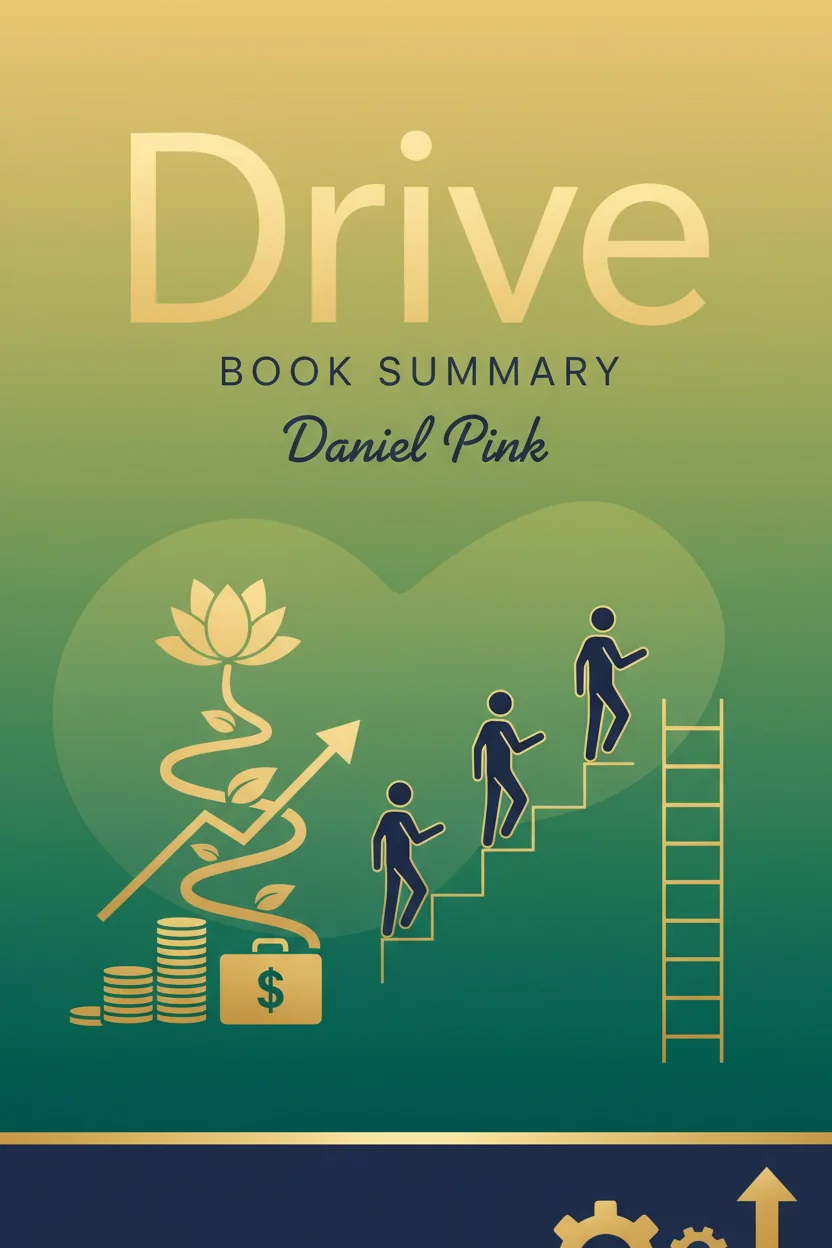
モチベーション3.0(Drive)
Daniel H. Pink 著
ダニエル・ピンクが、モチベーションの科学的根拠を解き明かし、人間のパフォーマンスと満足度を真に向上させる要因を考察した一冊です。
Audibleを試す · Amazonアソシエイトとして、FiveMinReadは適格販売により収入を得ています。 詳細
核心的なアイデア
"真のモチベーションは、金銭などの外的な報酬ではなく、「自律性」「習熟」、そして「目的」という3つの内発的な動機から生まれます。"
重要な洞察
Motivation 3.0
The carrot-and-stick approach (Motivation 2.0) worked for routine tasks but fails for creative, complex work. We need Motivation 3.0 built on intrinsic motivation.
Wikipedia was built by volunteers motivated by purpose, not payment. It outperformed Microsoft's paid Encarta encyclopedia.
Autonomy
People need autonomy over their task (what they do), time (when they do it), team (who they do it with), and technique (how they do it).
Google's famous '20% time' allowed engineers to work on self-directed projects, leading to Gmail and Google News.
Mastery
The desire to get better at something that matters is a powerful motivator. Mastery requires effort, is a mindset (growth over fixed), and is an asymptote (you approach but never fully reach it).
Musicians practice for hours not because they're paid, but because the pursuit of mastery is inherently satisfying.
Purpose
Humans seek purpose—to be part of something larger than themselves. Companies that articulate a transcendent purpose beyond profit attract more motivated people.
TOMS Shoes' 'One for One' model (buy a pair, give a pair) gives employees and customers a sense of purpose beyond commerce.
The Surprising Truth About Rewards
For algorithmic tasks, rewards work. For heuristic (creative) tasks, rewards can actually decrease performance and creativity. 'If-then' rewards narrow focus.
The candle problem: People offered bonuses to solve it faster actually took longer. The reward narrowed their thinking.
章ごとの解説
The Problem with Motivation 2.0
For most of the 20th century, businesses operated on Motivation 2.0: reward good behavior, punish bad behavior. This works for routine, rule-based work.
But in today's creative economy, external rewards can actually decrease performance.
The Seven Deadly Flaws of Extrinsic Rewards
- They can extinguish intrinsic motivation
- They can diminish performance
- They can crush creativity
- They can crowd out good behavior
- They can encourage cheating and shortcuts
- They can become addictive
- They can foster short-term thinking
The Three Elements of Motivation 3.0
Autonomy
People need to direct their own lives. Companies like Netflix and Zappos have discovered that giving employees freedom over how, when, where, and with whom they work leads to better results than micromanagement.
Mastery
People want to get better at things. This requires:
- Mindset: Believing abilities can be developed
- Pain: Mastery demands effort and deliberate practice
- Asymptote: Full mastery is impossible, which makes the pursuit endless and engaging
Purpose
People want to be part of something bigger than themselves. Organizations that frame their mission in terms of purpose—not just profit—attract more motivated workers and customers.
Type I vs Type X Behavior
Type X behavior is fueled by extrinsic desires and concerned less with inherent satisfaction. Type I behavior is fueled by intrinsic desires and concerned more with inherent satisfaction.
Type I almost always outperforms Type X in the long run.
アクション
今日から実践できるステップ:
-
Give yourself and others more autonomy over task, time, team, and technique
-
Set 'mastery goals' in addition to performance goals
-
Create 'Goldilocks tasks'—not too hard, not too easy
-
Ask: Does my work serve a purpose beyond making money?
-
Replace 'if-then' rewards with unexpected 'now that' rewards for creative work
-
Schedule regular 'FedEx Days' for self-directed projects
おすすめの読者
チームの意欲を最大限に引き出したいマネージャー、子供の好奇心を刺激したい親や教育者、仕事への意欲を失っている方、そして効果的な報酬・インセンティブ制度を設計したいビジネスリーダー。
本を全部読みたい方へ
『モチベーション3.0(Drive)』を全文で読む・聴く。
Audibleを試す · Amazonアソシエイトとして、FiveMinReadは適格販売により収入を得ています。 詳細
要約作成者

Software Engineer & Writer
Software engineer with a passion for distilling complex ideas into actionable insights. Writes about finance, investment, entrepreneurship, and technology.
すべての要約を見る →レビュー
レビューはまだありません。最初のレビューを書きましょう!
レビューを書く
続けて読む
このテーマを探る: リーダーシップ要約

サイコロジー・オブ・マネー:要約と5つの考え方
Morgan Housel
『サイコロジー・オブ・マネー』は、経験、運、支出、資産の維持、時間の自由を通して、お金と人の関係を考える本です。ここでは確認できた書籍抜粋…
完訳 7つの習慣(The 7 Habits of Highly Effective People)
Stephen R. Covey
『7つの習慣』は、成功するには見せかけの技術よりも人格を育てることが大切だと説く自己啓発の古典です。コヴィーは、自立のための3つの習慣(主…
ファスト&スロー
Daniel Kahneman
『ファスト&スロー』は、ノーベル経済学賞を受けた心理学者ダニエル・カーネマンが、人の判断と意思決定のしくみを解き明かした一冊です。思考を、…
マインドセット
Carol S. Dweck
能力に対する信念が、いかに学習意欲や達成度に影響を与えるか。キャロル・ドゥエック教授による画期的な研究を解説します。