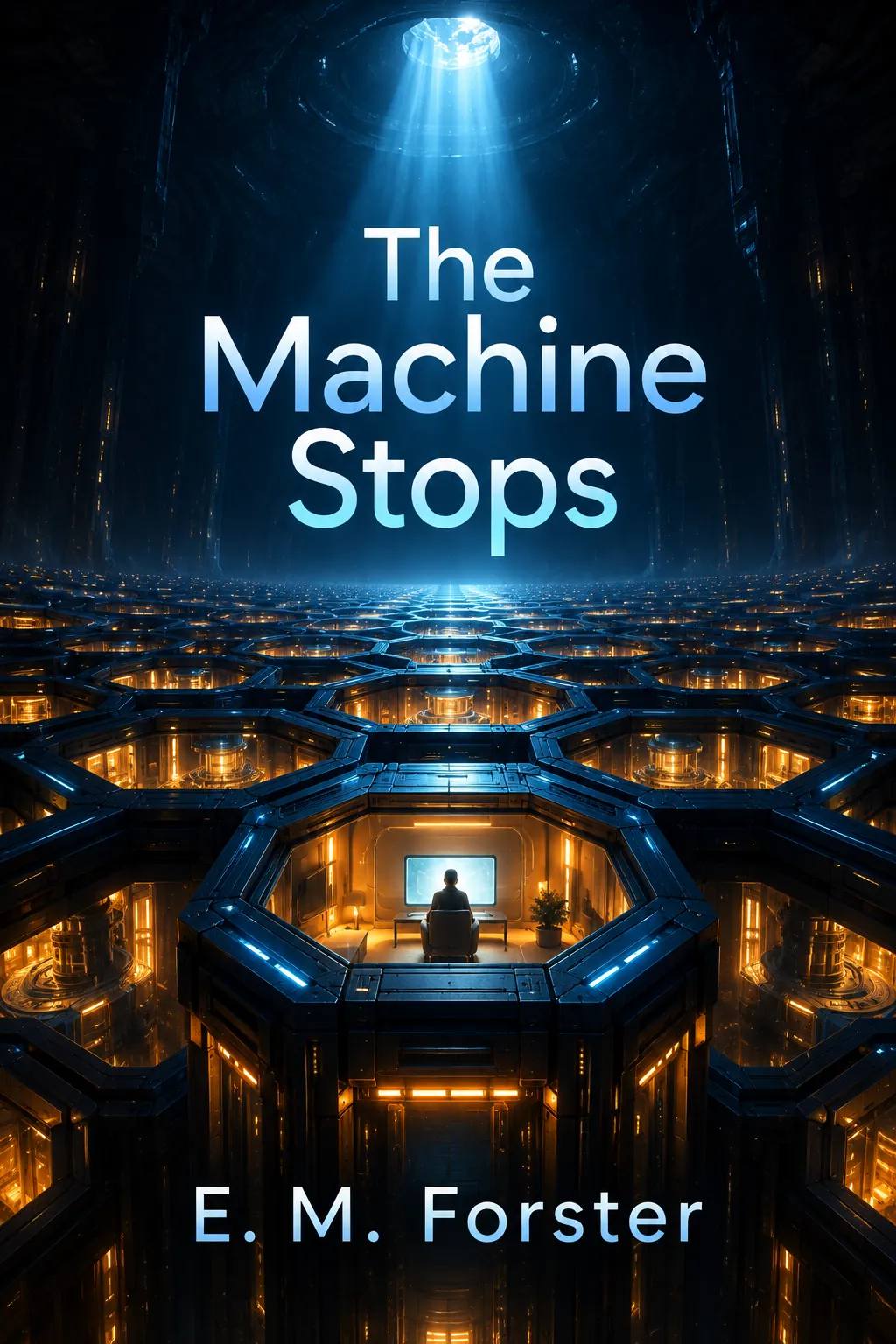
The Machine Stops
oleh E. M. Forster
The Machine Stops is a short story by E. M. Forster, first published in 1909, about a future in which humanity lives in underground cells and relies on one vast Machine for food, light, music and company. Vashti, a contented lecturer, spends her days talking to others through screens. Her son Kuno begs her to visit him in person and tells her what he has seen outside. The story asks what comfort costs.
Coba Audible · Sebagai Amazon Associate, kami mendapat komisi dari pembelian yang memenuhi syarat. Detail
Ide Utama
"In a future where everyone lives alone underground and the Machine supplies everything, E. M. Forster asks what happens when people stop meeting the world directly and start trusting a system they no longer understand."
Wawasan Utama
Convenience can become dependence
The people in the story are not forced underground by a tyrant. They accept the Machine one comfort at a time until they cannot imagine life without it, and nobody remembers how it works. Forster suggests that the real danger of a helpful system is that it makes its users passive.
Vashti can summon food, music and a bath by pressing buttons, yet she is thrown into confusion when the smallest thing stops working. When the faults grow, no one can repair the system because the knowledge has been lost.
Second-hand ideas replace real ones
Vashti lectures on ideas that have passed through many other minds, and her listeners treat that distance as a sign of progress. Forster argues that thinking cut off from sight, touch and experience becomes thin, repetitive and fearful of anything new. In this world a good idea is one that someone else has already summarised.
Vashti shuts the blinds on the mountains because they give her no ideas, while Kuno goes to see the surface for himself. Their quarrel is about a simple question: how does a person really know anything?
The body and the natural world matter
The people of the Machine are physically weak and uncomfortable with touch. Forster treats this as a loss of something essential, not an improvement. The surface, with its real air and sunlight, is called dangerous, yet it is the only place where life continues.
Kuno's wish to see his mother in person and to breathe open air is treated as eccentric, and the Committee punishes it. His escape suggests that human beings need physical presence, not only information.
Knowledge can turn into religion
As time passes, people stop asking how the Machine works and begin to worship it. They read from its Book, treat its buttons with reverence and consider questions improper. Forster shows how a tool can become an object of faith once understanding fades.
Vashti turns to the Book of the Machine when she is frightened and trusts the Mending Apparatus to fix everything. When the Machine fails, her faith has nothing left to stand on.
Rincian Bab
In five minutes
The Machine Stops is a short story by E. M. Forster, published in 1909, set in a future where people live in separate underground rooms and let one huge Machine run their lives.
Nobody in the story is forced into this life, and nearly everybody is content with it.
Forster describes something very like video calls, instant messaging and online lectures, more than a century before they existed.
His real subject is not gadgets but what people lose when they stop meeting the world, and each other, directly.
About the story
Forster first published the story in November 1909 in The Oxford and Cambridge Review, and he reprinted it in his 1928 collection The Eternal Moment and Other Stories.
It is usually described as his only work of science fiction, and he is said to have written it as a reply to the confident technological futures of his day.
The story has three parts: “The Air-Ship”, “The Mending Apparatus” and “The Homeless”.
Because it is short and rich in ideas, it is often discussed in classes on science fiction, technology and society.
Chapter-by-chapter summary
Spoiler warning: this section covers the whole plot, including the ending.
Part 1: The Air-Ship
Vashti lives alone in a small hexagonal room deep underground, as nearly everyone does. Air, light, food, baths and music all arrive at the touch of a button.
Her son Kuno, who lives on the other side of the world, calls and asks to see her “not through the Machine”. Vashti is annoyed and frightened by the idea, and she carries on with her lectures and her routine.
In the end she makes the journey by air-ship, where an attendant's touch shocks her. She closes the blinds on the mountains below, because they offer her no ideas.
This part matters because it shows a world that is comfortable and polite, and cut off from everything physical.
Part 2: The Mending Apparatus (Kuno's escape)
Vashti reaches Kuno's room, which is almost identical to her own, and he tells her that he has been threatened with Homelessness. He explains that he left the city without permission after finding his own way up a ventilation shaft.
On the surface he lay in a grassy hollow in Wessex and breathed real air. At night a white, worm-like machine of the Mending Apparatus dragged him back down.
Part 2: The Mending Apparatus (Kuno's warning)
Kuno says he saw that people still live outside, and he warns that humans made the Machine but can no longer make it do their will. Vashti is horrified, answers coldly and leaves.
This part matters because it shows what lies outside the Machine, and why going there is treated as a crime.
Part 3: The Homeless (the breakdown)
After Kuno's escape the Machine's rulers ban respirators, and people begin to worship the Machine and read its Book like scripture. Kuno warns his mother that the Machine will stop, but she dismisses it as madness.
Soon the music turns harsh, beds fail to appear and the air and light worsen. People simply put up with each fault, and the repair committees pass the problem along.
Part 3: The Homeless (the collapse)
When the whole communication system falls silent, Vashti opens her door on a tunnel full of panicking people. In the dark she finds Kuno, and the two speak and touch directly.
Kuno tells her that people survive on the surface, and then an air-ship crashes into the dying city. Vashti and Kuno die as it collapses.
The ending matters because the Machine never turns evil: it simply fails, and no one left knows how to repair it.
Characters
- Vashti: A lecturer who lives in a hexagonal underground room. She values ideas passed along by others, fears direct contact and trusts the Machine until it fails around her. Her son's request slowly pulls her out of her routine.
- Kuno: Vashti's son, who lives on the other side of the world. He wants to see people and places for himself, escapes to the surface without permission and later warns his mother that the Machine will stop.
- The Machine: The vast system that feeds, houses, entertains and connects humanity. It is not a scheming villain, but something people have gradually come to treat almost as a god, which is why its failure is so shocking.
- The Central Committee: The governing body that sets the Machine's rules, including who may travel to the surface. It threatens Kuno with Homelessness, and it always speaks for the system rather than for the people.
- The Mending Apparatus: The Machine's own repair system. It drags Kuno back underground, and later its committee passes problems along instead of solving them, until the damage is too deep to mend.
- The Homeless: People who live on the surface outside the Machine, or who are sent there as a punishment that city-dwellers assume means death. In the end they are the story's hope.
Writing about this book
A strong essay on this story usually starts from a clear question, such as whether the Machine is the villain or whether the people are.
A good answer is that Forster blames neither the technology nor a tyrant, but the human habit of giving up effort and understanding.
Compare Vashti and Kuno. She values second-hand ideas, while he insists on seeing for himself, and his line that man is the measure makes a short, useful piece of evidence.
Pay attention to the three-part structure too.
Part 1 builds the world, Part 2 shows an alternative, and Part 3 tests the system until it breaks.
For comparison, you could set it beside 1984 or Brave New World, which also imagine controlled societies, though here the control comes from comfort and habit rather than force.
Whatever you argue, use a few brief quotations and explain each one in your own words.
Avoid saying only that technology is bad, because the story is more careful than that.
Why it still feels modern
Readers often point to the glowing plates Vashti uses, which work like video calls, and to lectures that reach thousands of listeners who never meet, as early pictures of online life.
The story also shows people who feel buried in information yet distrust anything the system has not filtered for them.
Forster does not predict a particular device so much as a habit of mind.
The deeper question is how much of daily life we can hand over to systems we do not understand.
Read next
- Dystopia: how stories imagine societies that go wrong, and where this one fits.
- Technological singularity: the idea of technology outrunning human control.
Ambil Tindakan
Langkah praktis yang bisa Anda terapkan hari ini:
-
Ask how the systems you rely on actually work, so that convenience does not quietly replace your own understanding.
-
Meet people and visit places directly now and then, because a screen carries information but not everything a person means.
-
Treat second-hand summaries as a starting point, and test the ideas against your own experience when you can.
-
Keep some skills that do not depend on any single system, so a failure does not leave you helpless.
Kutipan Menarik
"“I want to see you not through the Machine.” (Part 1: The Air-Ship)"
— E. M. Forster
"“Man is the measure.” (Part 2: The Mending Apparatus)"
— E. M. Forster
"“We created the Machine, to do our will, but we cannot make it do our will now.” (Part 2: The Mending Apparatus)"
— E. M. Forster
Siapa yang Harus Membaca Ini
Readers aged about 13 and up, from middle school through university, who want a short, thought-provoking classic of science fiction. It suits students writing about technology and society, fans of dystopian stories such as 1984 or Brave New World, and anyone curious about early predictions of online life. It can be read in one sitting.
Ingin buku lengkapnya?
Baca atau dengarkan The Machine Stops secara lengkap.
Coba Audible · Sebagai Amazon Associate, kami mendapat komisi dari pembelian yang memenuhi syarat. Detail
Tentang E. M. Forster
Edward Morgan Forster (1879–1970) was an English novelist and essayist. He is best known for A Room with a View, Howards End and A Passage to India. The Machine Stops, published in 1909, is usually described as his only science fiction, and it shows his lifelong concern with human connection.
Ringkasan Ditulis Oleh

Software Engineer & Writer
Software engineer with a passion for distilling complex ideas into actionable insights. Writes about finance, investment, entrepreneurship, and technology.
Lihat semua ringkasan →Ulasan
Belum ada ulasan. Jadilah yang pertama berbagi pemikiran Anda!
Tulis Ulasan
Lanjut membaca
Jelajahi topik: Genre dan Gagasan Sci-FiRingkasan

Out of My Mind
Sharon M. Draper
“Out of My Mind” karya Sharon M. Draper adalah kisah menyentuh tentang kehidupan Melody Brooks, seorang gadis muda penderita cerebral…

Ender’s Game
Orson Scott Card
“Ender’s Game” karya Orson Scott Card adalah novel fiksi ilmiah memikat yang membawa pembaca ke masa depan saat umat manusia…

Pachinko
Min Jin Lee
“Pachinko”, sebuah saga sejarah lintas generasi yang memikat karya Min Jin Lee, mengisahkan perjuangan sebuah keluarga Korea dalam mengarungi gejolak…

The Perks of Being a Wallflower
Stephen Chbosky
The Perks of Being a Wallflower karya Stephen Chbosky adalah novel coming-of-age yang mendalam, dikisahkan melalui surat-surat pribadi Charlie, seorang…
Artikel
Distopia: Arti, Ciri-ciri, dan Contoh Terkenal
Distopia adalah masyarakat rekaan yang tampak tertib di permukaan, tetapi menindas kebebasan, kebenaran, atau martabat manusia di baliknya. John Stuart…

Tema A Christmas Carol: kemurahan hati, isolasi dan tanggung jawab
Novela Dickens biasanya dibaca sebagai kisah seorang pria yang mengubah pikirannya. Tema-temanya lebih tajam dari itu: kemurahan hati sebagai praktik,…
Sejarah alternatif
Sejarah alternatif adalah fiksi yang mengubah satu peristiwa nyata, misalnya pertempuran atau pemilu, lalu menelusuri akibatnya sejak titik divergensi itu.…