The Old Man and the Sea by Ernest Hemingway
by Ernest Hemingway
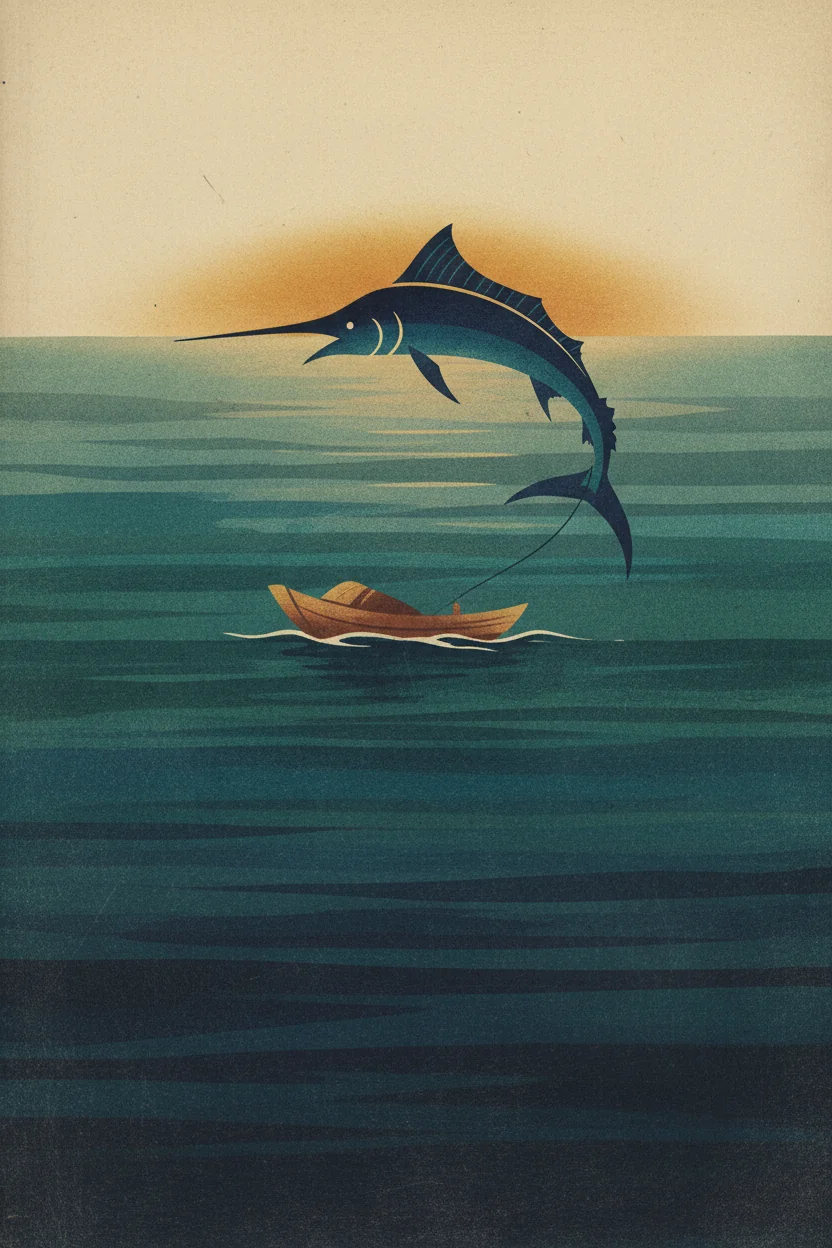
An aging Cuban fisherman, after 84 days of bad luck, hooks a giant marlin and engages in an epic three-day battle of endurance. Though he eventually loses the fish to sharks, his unwavering spirit proves that a man can be destroyed but not defeated.
The Big Idea
"True victory is found not in the achievement of a goal, but in the courage and dignity one maintains while struggling against insurmountable odds."
Key Insights
The Nature of Defeat
Material loss does not equate to spiritual failure.
Santiago loses the marlin's meat to sharks, but he wins the internal battle of willpower and skill.
Brotherhood of Struggle
The hunter and the hunted are linked by a shared destiny and mutual respect.
Santiago calls the marlin his 'brother' and admires its nobility and strength during the fight.
The Power of Ritual
Routine and discipline provide mental stability during crises.
Santiago's meticulous way of setting his lines shows his commitment to his craft despite his age.
Resilience Through Suffering
Pain is a catalyst for discovering one's true limits and strengths.
The physical agony of the line cutting into his back forces Santiago to rely on sheer mental fortitude.
The Cycle of Life
Death and destruction are inevitable parts of a natural order that must be accepted with grace.
The skeletal remains of the fish serve as a testament to the struggle, rather than just a sign of loss.
Chapter Breakdown
Context and Background: The Masterpiece of Simplicity
Published in 1952, The Old Man and the Sea stands as one of Ernest Hemingway's most enduring works and played a pivotal role in him winning the Nobel Prize in Literature in 1954. Written during a period when Hemingway was seeking to prove his literary vitality, the novella is a masterclass in his 'Iceberg Theory'—a style where the surface narrative is sparse, but the underlying emotional and philosophical weight is immense. Set in a small fishing village in Cuba, the story reflects Hemingway's own love for the sea and his obsession with the concepts of endurance, honor, and the inevitable struggle against nature. The simplicity of the prose masks a profound meditation on the human spirit's capacity to endure suffering in the pursuit of greatness.
Plot Overview: The Battle of Wills
The story centers on Santiago, an aging Cuban fisherman who has gone eighty-four days without catching a single fish. He is regarded as salao—the worst form of unlucky—by the other villagers. Despite his failure, he maintains a deep bond with Manolin, a young boy whom Santiago taught to fish. Although Manolin's parents force him to work on a more successful boat, the boy continues to care for the old man, providing him with food and companionship.
Driven by a need to prove his worth and his skill, Santiago sails his skiff far out into the Gulf Stream. On the eighty-fifth day, he hooks a giant marlin. What follows is an epic three-day struggle of endurance. Santiago, alone in his boat, is forced to hold the line with his body, enduring cramps, exhaustion, and loneliness. He develops a deep respect for the marlin, referring to it as his 'brother,' recognizing that they are both bound by the laws of nature and the necessity of struggle. Eventually, Santiago manages to harpoon the fish and lash it to the side of his boat.
However, the victory is short-lived. The blood from the marlin attracts sharks. Santiago fights them off with every tool he has—a harpoon, a knife lashed to an oar, and eventually a club—but the sharks devour the marlin's flesh, leaving only a skeleton. Santiago returns to the harbor exhausted and defeated in a material sense, but spiritually triumphant. He falls into a deep sleep, dreaming of lions on the beaches of Africa, while the village marvels at the size of the skeleton he brought back.
Major Themes: Perseverance and Pride
The central theme of the novella is perseverance in the face of defeat. Santiago's struggle is not merely about catching a fish, but about asserting his existence and dignity. The phrase 'A man can be destroyed but not defeated' encapsulates this ideology. While the sharks destroy the fish (the prize), they do not destroy Santiago's spirit or his courage.
Another critical theme is the interconnectedness of nature. Hemingway portrays the sea not as an enemy, but as a mirror of the human condition. Santiago's relationship with the marlin is one of mutual respect; he kills the fish not out of hate, but because it is the destiny of both the hunter and the hunted. This cycle of life and death is presented as a noble, inevitable process.
Finally, the book explores aging and obsolescence. Santiago's physical decline is constant, yet his mental fortitude remains sharp. He represents the 'undefeated' spirit that refuses to succumb to the limitations of the body, proving that mastery and honor are not tied to youth or material success.
Key Scenes and Symbolic Moments
One of the most poignant scenes is Santiago's internal monologue during the second night of the fight. As he suffers from pain and loneliness, he speaks aloud to himself and to the fish, creating a psychological bond that transcends species. This scene highlights the isolation of the individual and the need for companionship, even if that companion is an adversary.
The climax occurs during the shark attacks. The transition from the triumph of catching the marlin to the desperation of defending it is a brutal reminder of the fragility of success. The image of the skeletal marlin arriving at the shore serves as a powerful symbol: the physical reward is gone, but the legend of the struggle remains. The final image of Santiago dreaming of the lions on the beach of Africa symbolizes his return to a state of innocence and strength, linking his current struggle to the vigor of his youth.
Legacy: Why the Story Endures
The Old Man and the Sea remains a cornerstone of literature because it strips human existence down to its most basic elements: a man, a boat, and the sea. It provides a universal allegory for the human experience—the constant cycle of effort, hope, loss, and resilience. By focusing on a simple fisherman, Hemingway created a story that resonates across cultures and generations, teaching us that the value of a life is measured not by its trophies, but by the courage shown during the fight. It reminds the reader that while failure is inevitable, the act of striving is where true dignity resides.
Take Action
Practical steps you can implement today:
-
Define your success by the effort you exert rather than the outcome you achieve.
-
Cultivate a sense of respect and empathy for your competitors or adversaries.
-
Maintain a disciplined routine to keep your mind sharp during periods of failure.
-
Accept the inevitable losses of life with dignity and without bitterness.
-
Seek mentorship and companionship to sustain your spirit during lonely struggles.
Notable Quotes
"But man is not made for defeat."
— Ernest Hemingway
"A man can be destroyed but not defeated."
— Ernest Hemingway
"Fish, I love you too. I wish I could wish you dead."
— Ernest Hemingway
"Everything old becomes new again. And this old man will show them."
— Ernest Hemingway
Who Should Read This
This book is ideal for anyone feeling overwhelmed by failure or aging, as it provides a profound lesson in resilience. It is also a perfect read for those who appreciate minimalist writing and timeless allegories about the human condition and our relationship with nature.
Summary Written By

Software Engineer & Writer
Software engineer with a passion for distilling complex ideas into actionable insights. Writes about finance, investment, entrepreneurship, and technology.
View all summaries →Reviews
No reviews yet. Be the first to share your thoughts!