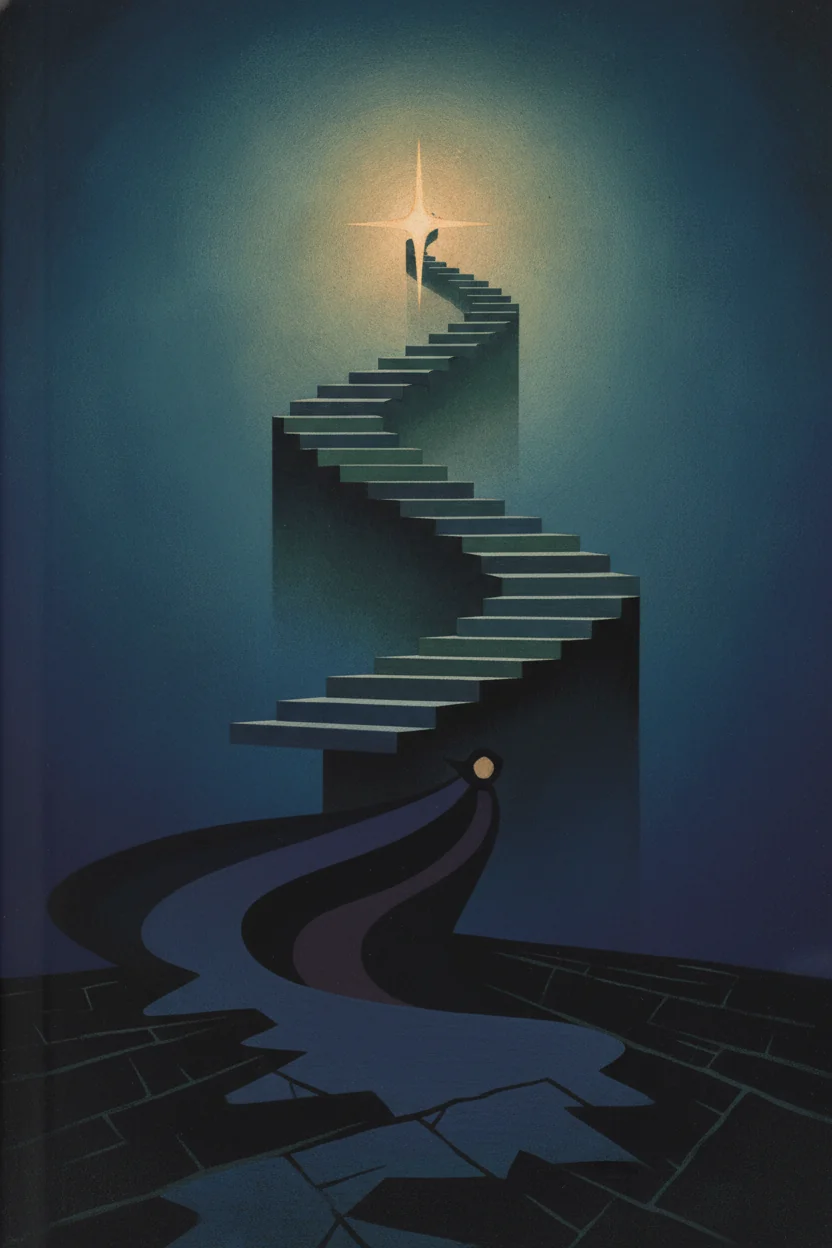
Invisible Man by Ralph Ellison
by Ralph Ellison
An unnamed Black narrator navigates a series of betrayals and ideological traps in mid-century America, eventually retreating into a subterranean hole to contemplate his social invisibility. It is a masterful exploration of race, power, and the search for self.
The Big Idea
"True identity can only be achieved by stripping away the social masks and delusions imposed by a society that refuses to see the individual's humanity."
Key Insights
The Social Mask
People often perceive others based on stereotypes rather than reality, forcing the marginalized to wear masks to survive.
The narrator adapts his behavior to please the college president, suppressing his own ambition to fit the 'humble' mold.
The Illusion of Meritocracy
Education and hard work do not automatically grant equality in a system designed to maintain a racial hierarchy.
Despite his academic success and scholarship, the narrator is still treated as a tool for white amusement during the Battle Royal.
The Trap of Ideology
Political movements can be just as dehumanizing as overt prejudice if they prioritize a collective goal over individual humanity.
The Brotherhood uses the narrator as a mouthpiece for their agenda, ignoring his personal struggles and local realities.
Existential Isolation
Total isolation can paradoxically be the only place where a person can achieve honest self-reflection.
The narrator's decision to live in a basement allows him to synthesize his experiences without external pressure.
The Power of Naming
To be unnamed or misnamed is to be denied a unique identity and reduced to a category.
The narrator remains unnamed throughout the book, emphasizing his status as a representative type rather than a specific person.
Chapter Breakdown
The Context of a Divided America
Published in 1952, Ralph Ellison's Invisible Man is a towering achievement of 20th-century literature that transcends the boundaries of a traditional novel. Written during the early stages of the American Civil Rights Movement, the book serves as a profound psychological study of race, identity, and the systemic erasure of the individual. Unlike many of its contemporaries, the novel does not focus solely on external sociological conflicts but delves deep into the internal struggle of a man trying to define himself in a society that refuses to see him. The 'invisibility' the narrator describes is not physical, but a social invisibility—a blindness caused by the prejudices and preconceived notions of those around him. Ellison uses a sophisticated blend of realism, surrealism, and jazz-like improvisation to illustrate how the Black experience in America is often a performance tailored to meet the expectations of a white audience.
A Journey Through Disillusionment
The plot follows an unnamed narrator from his youth in the South to his adulthood in Harlem, New York. The story begins with the narrator's belief in the 'American Dream' and the promise of meritocracy. After graduating from a prestigious Black college through the guidance of a mysterious benefactor, he is blindsided by a lesson in humility from the college president, who suggests that Black ambition is a dangerous trait. This initial trauma sets a pattern for the rest of the novel. The narrator is repeatedly manipulated by figures who claim to help him—from the wealthy philanthropist who gives him a scholarship to the political agitators of 'The Brotherhood.' Each phase of his life is marked by a different attempt to find a place of belonging, only to realize that he is being used as a tool for someone else's agenda. The climax of his journey occurs in the chaotic streets of Harlem, where a race riot forces him into a subterranean hole, where he lives in isolation, reflecting on the absurdity of his existence.
Major Themes: Identity and Perception
The central theme of the novel is the struggle for individual identity against the crushing weight of social stereotypes. The narrator spends the majority of the book attempting to find a 'true' version of himself, only to discover that he is a mirror reflecting the desires and fears of others. This is closely tied to the theme of social invisibility; the narrator argues that people see only the 'mask' he wears, not the human being beneath. Another critical theme is the danger of ideological blindness. Whether it is the rigid social hierarchy of the South or the pseudo-scientific equality promised by The Brotherhood (a thinly veiled surrogate for the Communist Party), the narrator finds that ideologies often replace one form of blindness with another. He discovers that the 'Brotherhood' is just as interested in using him as a symbol for their political goals as the white Southerners were in using him as a subservient laborer.
Key Scenes and Symbolic Moments
One of the most visceral scenes is the 'Battle Royal,' where the narrator and other Black youths are forced to fight one another for the amusement of white town leaders. This scene serves as a brutal metaphor for the way systemic racism pits marginalized people against each other to maintain a power structure. Another pivotal moment is the narrator's encounter with the briefcase, which contains letters and documents from his past. The briefcase symbolizes the baggage of history and the false promises of education and advancement. The final image of the narrator living in a basement illuminated by 1,369 lightbulbs is perhaps the most potent symbol in the book. The lights represent his desperate attempt to force the world to see him, creating a private sanctuary where he can finally analyze his life without the distorting lens of society's expectations.
Legacy and Lasting Significance
Invisible Man remains essential reading because it captures the timeless tension between the individual and society. It moved the conversation about race from simple political advocacy to a complex exploration of existentialism. By focusing on the psychological toll of invisibility, Ellison provided a vocabulary for discussing systemic erasure that is still relevant in contemporary discussions of identity politics and social justice. The novel's legacy lies in its refusal to provide easy answers; it does not end with a triumphant victory over prejudice, but with a philosophical awakening. It teaches us that the first step toward true liberation is the recognition of one's own invisibility and the courage to define oneself independently of the world's gaze.
Take Action
Practical steps you can implement today:
-
Question the 'masks' you wear in professional or social settings and evaluate if they are erasing your true self.
-
Recognize when a group or ideology asks you to sacrifice your individuality for the sake of a 'greater cause.'
-
Understand that systemic barriers often operate through subtle psychological manipulation rather than just overt laws.
-
Practice active listening to see people for who they are, rather than the stereotypes you may subconsciously project onto them.
-
Dedicate time for solitary reflection to decouple your self-worth from external validation and societal expectations.
Notable Quotes
"I am an invisible man."
— Ralph Ellison
"I was a brindar, a tool, a symbol, a piece of equipment."
— Ralph Ellison
"Perhaps it is a lasting paradox that the more I saw of the world, the less I knew of it."
— Ralph Ellison
"I am invisible until I am seen."
— Ralph Ellison
Who Should Read This
This book is essential for anyone interested in the intersection of psychology, sociology, and literature. It is particularly recommended for readers who enjoy existentialist philosophy, students of American history, and those seeking to understand the deep-seated psychological impacts of systemic racism and social alienation.
About Ralph Ellison
Ralph Ellison (1914–1994) was an American writer who studied music at Tuskegee Institute. His first novel, Invisible Man, was published in 1952.
Summary Written By

Software Engineer & Writer
Software engineer with a passion for distilling complex ideas into actionable insights. Writes about finance, investment, entrepreneurship, and technology.
View all summaries →Reviews
No reviews yet. Be the first to share your thoughts!