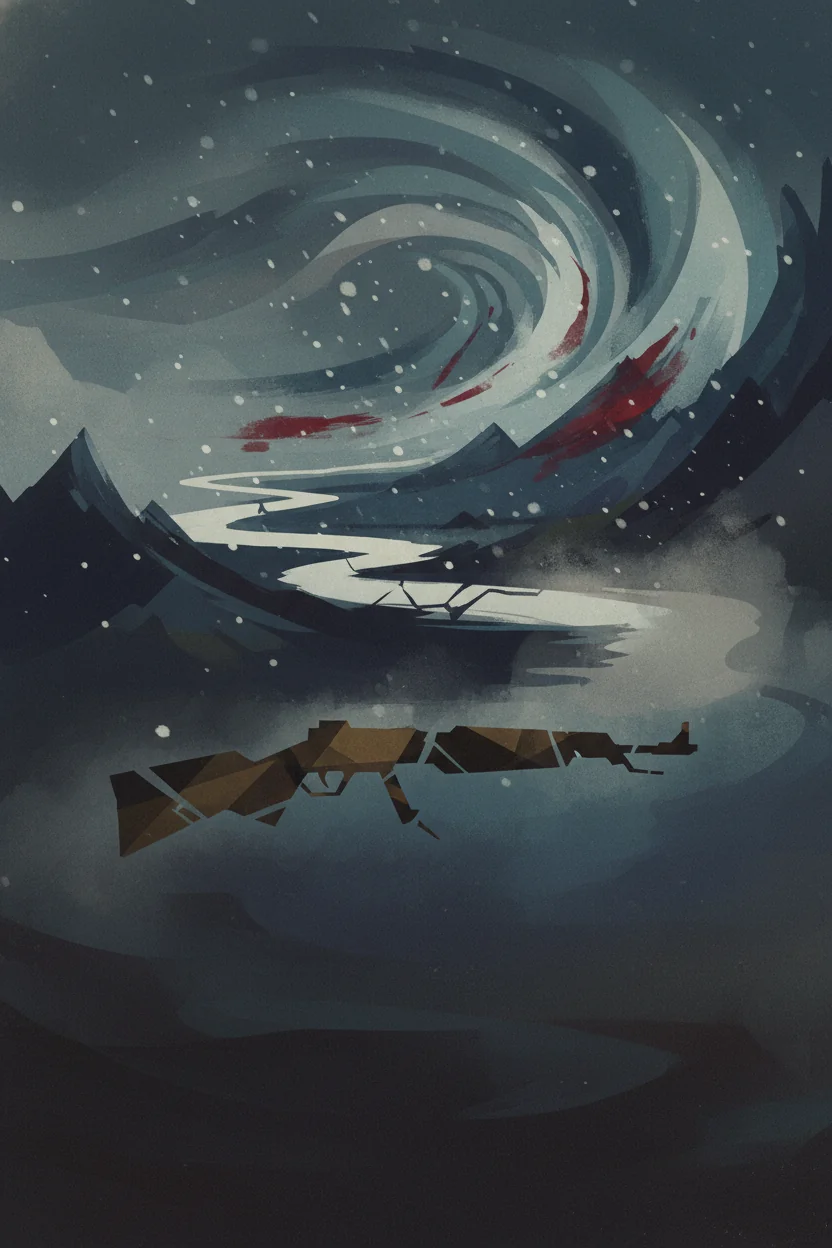
A Farewell to Arms by Ernest Hemingway
by Ernest Hemingway
An American ambulance driver on the Italian front during WWI falls in love with a British nurse. After deserting the army to find peace, their attempt to escape to Switzerland ends in a heartbreaking tragedy during childbirth.
The Big Idea
"The inevitable tragedy of human existence is that love, while providing a temporary sanctuary from a violent and indifferent world, cannot ultimately protect us from loss and death."
Key Insights
The Illusion of Glory
War is stripped of its patriotic veneer and presented as a mechanical process of destruction.
Henry's detachment from the military slogans and his observation of the chaotic retreat from Caporetto.
Love as an Escape
Romantic love functions as a psychological defense mechanism against the horror of war.
Henry and Catherine's intense focus on each other as a way to ignore the surrounding carnage.
The Symbolism of Rain
Nature is not a source of comfort but a reflection of inevitable doom and sorrow.
The rain falling during the final moments of Catherine's life, mirroring her earlier dread.
The Separate Peace
True peace is found not through victory, but through the conscious rejection of societal violence.
Henry's decision to jump into the river and desert his post to be with Catherine.
The Iceberg Theory
Deep emotional trauma is best conveyed through sparse, direct language rather than overt sentimentality.
The blunt, matter-of-fact description of the tragedy at the end of the novel.
Chapter Breakdown
Context and Background: The Lost Generation
Written in 1929, A Farewell to Arms is one of Ernest Hemingway's most enduring works, serving as a semi-autobiographical account of his experiences as an ambulance driver during World War I. The novel is a quintessential piece of 'Lost Generation' literature, capturing the profound disillusionment, psychological trauma, and spiritual void left in the wake of the Great War. Set primarily in Italy, the story reflects the chaos of a conflict where traditional notions of glory and patriotism had been replaced by the grim reality of industrial slaughter. Hemingway utilizes his signature 'Iceberg Theory'—a minimalist prose style where the most intense emotions are felt beneath the surface of simple, direct descriptions—to convey the crushing weight of grief and the fragility of human existence.
Plot Overview: Love Amidst the Ruins
The narrative follows Frederic Henry, an American serving as a lieutenant in the Italian army's ambulance corps. Initially, Henry is detached and cynical, viewing the war as a chore rather than a crusade. His life changes when he meets Catherine Barkley, a British nurse. What begins as a flirtatious distraction soon evolves into a desperate, all-consuming love affair. As the war intensifies, Henry is wounded in the knee by a mortar shell while eating pasta with fellow soldiers, leading to his convalescence in a Milan hospital. It is here that his relationship with Catherine deepens into a committed bond, and she becomes pregnant.
However, the stability of their romance is shattered by the collapse of the Italian army during the retreat from Caporetto. Henry finds himself swept up in a chaotic exodus where officers are executed and soldiers wander aimlessly. Realizing that the war is a senseless machine that consumes everything, Henry makes a conscious decision to desert—his own 'separate peace.' He and Catherine flee to neutral Switzerland, hoping to escape the carnage. Their sanctuary is short-lived; the novel concludes in a devastating tragedy as Catherine dies during childbirth, leaving Henry alone in a silent, indifferent city.
Major Themes: The Futility of War and Love
The central theme of the novel is the inherent futility of existence. Hemingway presents the war not as a battle of ideologies, but as a mindless force of destruction. The word 'glory' is treated with irony; there is no glory in the mud of the trenches or the screams of the wounded. This nihilism extends to the concept of love. While Henry and Catherine find solace in each other, their relationship is framed as an escape from a world that is fundamentally broken. Their love is a 'shelter' from the storm, but the novel argues that no shelter is permanent.
Additionally, the book explores the tension between duty and individual desire. Henry's transition from a soldier to a deserter marks his rejection of institutional loyalty in favor of personal survival and emotional authenticity. The 'arms' in the title carry a double meaning: a farewell to the weapons of war and a heartbreaking farewell to the arms of the woman he loves. This duality underscores the idea that loss is the only inevitable outcome of human attachment.
Key Scenes and Symbols: Rain and Ritual
One of the most potent symbols in the novel is rain. Throughout the story, rain precedes disaster and symbolizes death and misfortune. Catherine’s fear of the rain is a foreshadowing of her own demise, and the final scene takes place under a falling rain, emphasizing the cold, bleakness of the ending. Another pivotal scene is the retreat from Caporetto, where the breakdown of military order serves as a metaphor for the breakdown of civilization itself.
The dialogue between Henry and the priest also highlights the spiritual vacuum of the era. While the priest represents a traditional faith, Henry's skepticism reflects the modern condition. The quote "I am a soldier. I am a soldier and I have a job to do" illustrates Henry's initial attempt to hide behind a professional identity to avoid the emotional toll of the war, a mask that eventually slips as he realizes the absurdity of his position.
Legacy: Why It Still Matters Today
A Farewell to Arms remains a cornerstone of 20th-century literature because it provides an honest, unvarnished look at Post-Traumatic Stress Disorder (PTSD) and the psychological scarring caused by systemic violence. It moved away from the romanticized war stories of the 19th century and introduced a visceral realism that influenced generations of writers. By stripping away the adjectives and focusing on concrete actions, Hemingway captured the essence of grief in a way that feels timeless. The novel serves as a warning that while love can provide a temporary respite from a cruel world, it cannot shield us from the inevitability of loss. It continues to resonate with anyone who has felt alienated from society or struggled to find meaning in the face of overwhelming tragedy.
Take Action
Practical steps you can implement today:
-
Recognize that avoidance of emotional pain often leads to a delayed and more intense psychological crash.
-
Understand the importance of finding a personal 'sanctuary' or support system during times of systemic crisis.
-
Learn to distinguish between institutional duty and personal morality when the two are in conflict.
-
Practice the 'minimalist' approach to communication: focus on concrete facts to convey deeper truths.
-
Accept the impermanence of life to appreciate the value of current connections.
Notable Quotes
"The world breaks every one and afterward many are strong at the broken places."
— Ernest Hemingway
"I was always thinking of her. I was thinking of her and I was thinking of the war."
— Ernest Hemingway
"But we also had the war. The war was always there."
— Ernest Hemingway
"I go home. I walk back to the hotel. It is raining."
— Ernest Hemingway
Who Should Read This
This book is essential for readers interested in classic modernist literature, those studying the psychological effects of war, and anyone who appreciates a poignant, stripped-down narrative about love and loss. It is particularly suited for those who enjoy stories that explore the tension between individual desire and societal expectation.
Summary Written By

Software Engineer & Writer
Software engineer with a passion for distilling complex ideas into actionable insights. Writes about finance, investment, entrepreneurship, and technology.
View all summaries →Reviews
No reviews yet. Be the first to share your thoughts!