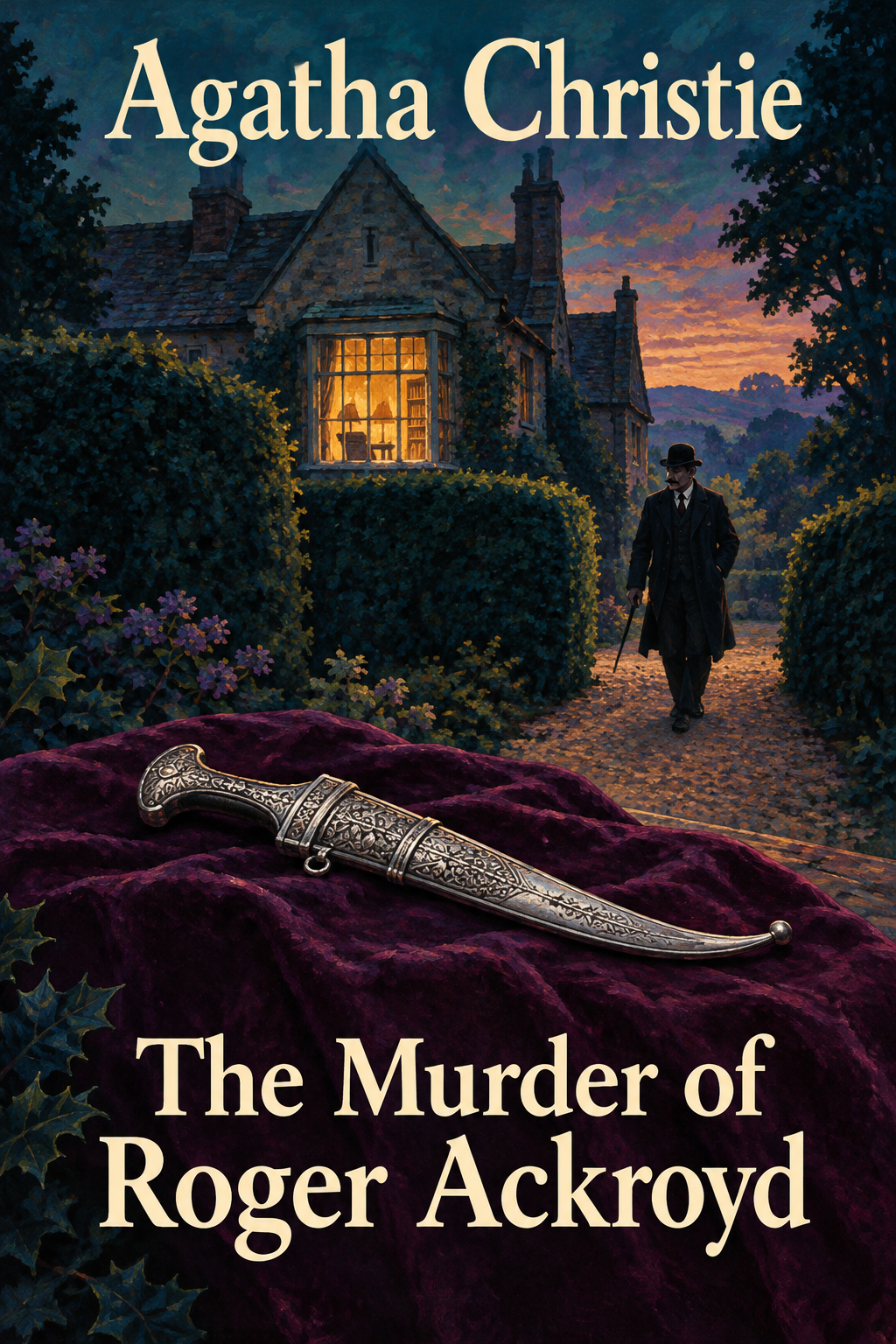
The Murder of Roger Ackroyd
by Agatha Christie
The Murder of Roger Ackroyd is a 1926 Hercule Poirot mystery set in the English village of King's Abbot. A wealthy man, Roger Ackroyd, is found dead in his locked study just after a local widow's suspicious death. Everyone around him has something to hide, from money troubles to a secret marriage. Poirot, who has retired to grow vegetable marrows, is drawn in by the dead man's niece and slowly tests each alibi. It is a puzzle that rewards close attention to every word.
The Big Idea
"In a village where everyone is hiding something, a retired detective must separate lies from silence. Christie's puzzle asks how much we should trust a story simply because it is told so plainly."
Key Insights
Why a calm tone is not proof
Christie builds the book on a simple question: why do we believe a story just because it is told calmly and politely? Sheppard writes in a friendly, orderly voice, and readers relax. The novel shows that tone and truth are different things. A narrator can report accurate events and still decide which ones you see. That idea made the book famous and is still copied in thrillers today. He never lies outright, so the book remains fair play despite its shock.
Reread chapter 1 after finishing. Notice how many sentences are accurate yet incomplete, and how the order of events steers your attention. Try this on any first-person story.
Gossip as a social machine
King's Abbot runs on talk. Caroline Sheppard trades rumours over tea, servants overhear conversations, and neighbours watch each other's visitors. Christie uses this to make a believable community where secrets leak slowly. The same gossip that spreads false ideas also carries the small facts Poirot needs. The book suggests that a village sees a great deal but understands little, because people repeat what they hear and rarely ask what it means. Poirot, an outsider, listens to all of it without believing any of it yet.
Compare what Caroline claims to know with what Poirot actually learns from her. Which details turn out to matter? Keep a note of three examples.
Money, pride and the cost of secrets
Almost every suspect has a private reason to lie, and most of those reasons involve money or reputation. Ralph is in debt, Flora has taken cash, Parker is a listener at doors, and Mrs. Ferrars has paid dearly to keep her past hidden. Christie shows that fear of exposure can push ordinary people into foolish choices. The lesson is not that everyone is guilty, but that hidden shame can make innocent people look guilty. A suspect's silence is not proof of a crime, only of something to protect.
Pick two characters and list what each is protecting. How does Poirot separate a harmless secret from a dangerous one? Use scenes as evidence.
Fair-play clues and slow reasoning
Christie plays a game with the reader. Poirot's clues, such as the moved chair, the phone call and the missing letter, are all mentioned early and in plain sight. The pleasure of the book comes from seeing how ordinary details fit a different pattern. Poirot is patient: he trusts order, method and his “little grey cells” over the dramatic guess. The book rewards readers who slow down and ask what each detail could mean. Even the quiet scenes of tea and dinner carry information, so nothing in the village is only decoration.
On a second read, list every mention of the study chair, the times and the telephone. Which ones look different once you know the truth?
The outsider sees clearly
Poirot arrives as an outsider who has retired and wants only to grow marrows. That distance is his advantage. The villagers think they know each other so well that they stop noticing details, while he notices everything because he knows no one. Christie suggests that familiarity can make people blind, and a fresh viewpoint can reveal what routine hides. The same idea applies in school or at work: a newcomer's questions are often the most useful. His curiosity is polite, but it never stops.
Think of a time a newcomer asked an obvious question that nobody else had asked. What did it reveal?
Chapter Breakdown
Chapter-by-chapter summary
Spoiler warning: this section covers the whole plot, including the ending.
Chapters 1–3: A Death in King's Abbot
Dr. James Sheppard, the village doctor of King's Abbot, is called to the house of Mrs. Ferrars, a rich widow, and finds she has died from an overdose of a sleeping drug. Her husband died a year earlier, and village gossip already whispers that she may have had a hand in it. Roger Ackroyd, the wealthy owner of Fernly Park, had hoped to marry her. Sheppard's sister Caroline collects every rumour, and a mysterious new neighbour is soon revealed to be the retired detective Hercule Poirot, who spends his days growing vegetable marrows. Why it matters: Christie builds a small world in which everyone watches everyone, and the doctor's calm voice sets the tone.
Chapters 4–5: Dinner at Fernly and the Letter
Sheppard dines at Fernly Park with Ackroyd's household: his sister-in-law Mrs. Cecil Ackroyd, his niece Flora, the big-game hunter Major Blunt and his secretary Geoffrey Raymond. Afterwards Ackroyd tells the doctor that Mrs. Ferrars confessed she had poisoned her husband and had been blackmailed ever since. A letter from her arrives, naming the blackmailer, and Ackroyd asks to read it alone. Sheppard leaves before nine, and Ackroyd tells the butler he is not to be disturbed. Why it matters: the reader now knows the motive for murder and the one document that could expose the killer.
Chapters 5–8: Murder and a Missing Letter
Back home, Sheppard takes a phone call saying Ackroyd has been found dead. He hurries to Fernly Park and finds the study door locked. Parker, the butler, says he never made any call, and they force the door. Ackroyd is dead, stabbed with a Tunisian dagger kept in the house, and the blackmailer's letter is gone. His stepson Ralph Paton, who owes money, has vanished from the village, and Inspector Raglan is soon sure he is the killer. Flora, who is engaged to Ralph, refuses to believe it and asks Poirot to take the case. Why it matters: a locked room and a missing suspect push the story into full mystery.
Chapters 9–15: Poirot Questions the House
Poirot begins at the goldfish pond in the garden and collects small clues: footprints on the window sill, a goose quill, and a chair that seems to have been moved. The footprints appear to match Ralph's shoes, which makes the case against him look stronger. Poirot then questions the household in turn, including the parlourmaid Ursula Bourne, the housekeeper Miss Russell, the secretary Raymond and Mrs. Ackroyd, and notices a small gap in each account. He keeps asking one question: why would anyone move a chair? Why it matters: the reader holds the same clues as Poirot, and every suspect's lie starts to look like guilt.
Chapters 16–20: Gossip, Strangers and Confessions
At the Sheppards' house, Caroline hosts a mah-jongg evening full of village talk. Poirot presses Parker, who admits he listened at doors, and traces Charles Kent, a stranger who was in the village that night. Flora confesses she took money from her uncle's room. Miss Russell, the housekeeper, admits that Kent is her son and that she hid the link. Raymond and Major Blunt also explain their movements. Why it matters: each secret looks like guilt at first but turns out to be a smaller private matter, and Poirot clears suspects one by one.
Chapters 21–24: Ursula's Story and Ralph's Story
A newspaper paragraph leads Poirot back to Ursula Bourne. She reveals that she is secretly married to Ralph Paton and met him in the grounds that evening. Poirot then invites everyone to a small gathering at his house and tells them that each of them is hiding something. Ralph finally gives his own account, which shows he did not kill Ackroyd. The scenes are quiet but tense, built almost entirely from conversation. Why it matters: the man everyone distrusts becomes the least likely killer, and the story turns sharply toward a new question.
Chapters 25–27: The Whole Truth
In “The Whole Truth” and “And Nothing but the Truth”, Poirot explains everything. The killer is Dr. Sheppard, the narrator. He was the blackmailer who had been draining Mrs. Ferrars, and he stabbed Ackroyd to silence him and took the letter. A dictaphone made it seem that Ackroyd was alive at half past nine, the chair was put back, and Sheppard arranged the phone call that brought him back to the house as an apparently innocent witness. Poirot offers him a private way out instead of a trial and public shame for his sister. In “Apologia”, Sheppard finishes his account. Why it matters: the narrator was part of the puzzle all along, which changes how the earlier chapters read.
Setting and background
The story takes place in King's Abbot, a fictional English village in the 1920s. Fernly Park is the grand house, and the doctor's surgery, the village inn and the tea tables where gossip spreads are the other main places. Telephones and dictation machines are still new technology, and the social order is strict: landowners, doctors, servants and newcomers know their place. Christie wrote the book in 1926, in the golden age of detective fiction, when readers loved clue-based puzzles. Understanding the setting helps you see why secrets are so valuable and why a single evening can be examined minute by minute.
Characters
- Hercule Poirot: A retired Belgian detective who has moved to King's Abbot to grow vegetable marrows. He prizes order and method, trusts his “little grey cells”, and treats every small inconsistency as a clue. He listens openly but keeps his conclusions to himself until the end.
- Dr. James Sheppard: The village doctor and narrator. He seems calm, kindly and a little modest, and he becomes Poirot's helper during the investigation. Readers see the whole case through his eyes, and his written account is the book itself.
- Roger Ackroyd: The wealthy, strong-willed master of Fernly Park. He hoped to marry Mrs. Ferrars and trusted Dr. Sheppard with her secret. His death starts the investigation, and the letter he receives that evening drives the whole plot.
- Mrs. Ferrars: A rich widow whose death opens the book. She carries a heavy secret from her past and is the subject of village gossip. Her last letter and her confession to Ackroyd set the murder in motion.
- Caroline Sheppard: Dr. Sheppard's sister and the village's best collector of news. She seems nosy, but she watches people closely and sometimes gives Poirot useful hints without realising it. Her chats make King's Abbot feel alive.
- Ralph Paton: Ackroyd's stepson, charming but short of money. He disappears on the night of the murder and becomes the police's prime suspect. He has a private reason for his silence that he is slow to explain.
- Flora Ackroyd: Ackroyd's niece and Ralph's fiancée. She believes in Ralph's innocence and asks Poirot for help. She also hides a secret about money, which makes her look suspicious in her own right.
- Major Hector Blunt: Ackroyd's friend, a quiet big-game hunter who has travelled widely. He rarely shows emotion but is quietly devoted to Flora. His calm manner makes him hard to read, and he answers Poirot's questions in few words.
- Geoffrey Raymond: Ackroyd's capable young secretary. He and Major Blunt heard a voice from the study that evening, so his timing evidence matters a great deal to the puzzle of when Ackroyd died.
- Ursula Bourne: A quiet, dignified parlourmaid at Fernly Park. She works carefully and says little, but she is hiding a major secret linked to Ralph Paton, one that later becomes central to the case.
- Inspector Raglan: The local police inspector, quick, energetic and confident. He soon decides that Ralph is guilty, and his speed contrasts with Poirot's careful questioning. His hurry adds more pressure to the case.
Writing about this book
A good report on this novel does more than retell the plot. Start with a question you can answer with evidence from the book, then choose two or three scenes that support your answer.
- Point of view. How does the first-person voice shape what you notice? Reread chapter 1 and ask what Sheppard tells you and what he leaves unsaid.
- Fair play. Christie plants clues openly. Pick one clue, such as the moved chair or the phone call, and explain how it looks different the second time.
- Secrets in a small community. Nearly every character lies for a private reason. Which lies are harmless, and which cause harm?
- Poirot's method. Compare his patient questioning with Inspector Raglan's quick conclusions. What does the book say about jumping to the obvious suspect?
Tip: keep a list of what each person says and when, then check it against Poirot's final explanation. Use your own words and cite scenes by chapter title. Avoid copying summaries from other sites; your teacher wants your own view.
Take Action
Practical steps you can implement today:
-
Read the first chapter twice: once for the story and once for what is not said. Good mysteries hide clues in plain sight.
-
Separate what a witness saw from what the witness concluded. Facts and opinions often arrive mixed together.
-
Do not assume that the person with the loudest motive is guilty; check the evidence before you accept the easy answer.
-
Be patient with a puzzle. Write down each claim, compare the times, and look for the detail that does not fit.
Notable Quotes
"“Mrs. Ferrars died on the night of the 16th–17th September—a Thursday.” (Chapter 1)"
— Agatha Christie
"“Let us proceed slowly, with due order and method.” (Chapter 20)"
— Agatha Christie
"“I work only with the little grey cells.” (Chapter 23)"
— Agatha Christie
Who Should Read This
Readers aged about 13 and up who enjoy puzzle mysteries, school and college students studying Agatha Christie or the golden age of detective fiction, and anyone who wants a compact, classic whodunit with Hercule Poirot. It works well as a first Poirot novel and suits book clubs that like to argue about clues.
Frequently Asked Questions
Who killed Roger Ackroyd? (spoiler)
Dr. James Sheppard, the narrator, is the killer. Poirot works out that Sheppard had been blackmailing Mrs. Ferrars, killed Ackroyd to silence him and took the letter, and arranged things so suspicion fell on Ralph Paton. Sheppard then wrote the account that makes up the book.
Is The Murder of Roger Ackroyd a good first Hercule Poirot book?
Yes. It stands on its own, because Poirot appears as a retired detective settling into a new village, and you need no earlier knowledge. Many readers start here or with Murder on the Orient Express. Because the book relies on a twist, it is best read before anyone tells you how it ends.
When was it published and where is it set?
The novel was first published in 1926 by Collins in Britain. It is set in the fictional English village of King's Abbot, with the grand house Fernly Park at its centre. The main events happen over a few days in September, soon after Mrs. Ferrars dies.
Why is the book so famous?
It is known for one of the most debated twists in detective fiction. Some readers thought it broke the unwritten rules of the genre, while others praised it as fair play. Christie proved that a trusted narrator could still surprise a careful reader. Its influence is clear in many later mysteries.
Is it difficult to read?
It is a compact novel of 27 short chapters with clear, plain language. Most readers finish it in a few evenings. The vocabulary is simple, and the period details such as telephones, dictation and village society are easy to follow, so it suits older teenagers and adults.
Who is Hercule Poirot?
Hercule Poirot is Agatha Christie's Belgian detective, famous for his waxed moustache, tidy habits and trust in order and method. He first appeared in her first novel, The Mysterious Affair at Styles, and went on to star in dozens of novels and stories. In this book he has retired to a village but cannot resist a puzzle.
Check Your Understanding
Pick an answer for each question to see if you were right.
-
What is Hercule Poirot doing when he first appears in King's Abbot?
Growing vegetable marrows — Poirot has retired and spends his time growing vegetable marrows in his garden.
-
Who asks Poirot to investigate the murder?
Flora Ackroyd — Flora, engaged to Ralph Paton, does not believe he is guilty and asks Poirot for help.
-
What secret did Mrs. Ferrars share with Ackroyd?
She had poisoned her husband and was being blackmailed — Her confession explains both the blackmail and the importance of her last letter.
-
What weapon was used to kill Roger Ackroyd?
A Tunisian dagger — Ackroyd was stabbed with a Tunisian dagger kept in the house.
-
Who is secretly married to Ralph Paton?
Ursula Bourne — Ursula Bourne, the parlourmaid, is Ralph's secret wife.
About Agatha Christie
Agatha Christie (1890–1976) was an English writer of detective fiction and one of the best-selling novelists of all time. She created Hercule Poirot and Miss Marple and wrote dozens of novels, plus the long-running play The Mousetrap. The Murder of Roger Ackroyd, published in 1926, made her name widely known.
Summary Written By

Software Engineer & Writer
Software engineer with a passion for distilling complex ideas into actionable insights. Writes about finance, investment, entrepreneurship, and technology.
View all summaries →Reviews
No reviews yet. Be the first to share your thoughts!
Write a Review
Keep reading
Explore the topic: FictionSummaries

Out of My Mind
Sharon M. Draper
“Out of My Mind” by Sharon M. Draper is a poignant narrative that explores the life of Melody Brooks, a…

Ender’s Game
Orson Scott Card
“Ender’s Game” by Orson Scott Card is a riveting science fiction novel that transports readers into a future where humanity…

Pachinko
Min Jin Lee
“Pachinko”, a spellbinding multigenerational historical saga by Min Jin Lee, explores the lives of a Korean family trying to make…

The Perks of Being a Wallflower
Stephen Chbosky
The Perks of Being a Wallflower by Stephen Chbosky is a profound coming-of-age novel, told through the intimate letters of…
Articles
The Enlightenment Explained: Ideas, Thinkers and Legacy
The Enlightenment was an 18th-century European movement that trusted reason and evidence over tradition and authority. Its thinkers, from Locke…
World History 1700–1918: Revolutions, Industry, Empire and War
Between 1700 and 1918, revolutions, factories, empires and a world war reshaped societies across Europe, the Americas, Asia and Africa.…

A Christmas Carol themes: generosity, isolation and responsibility
Dickens's novella is usually read as a story about a man who changes his mind. Its themes are sharper than…