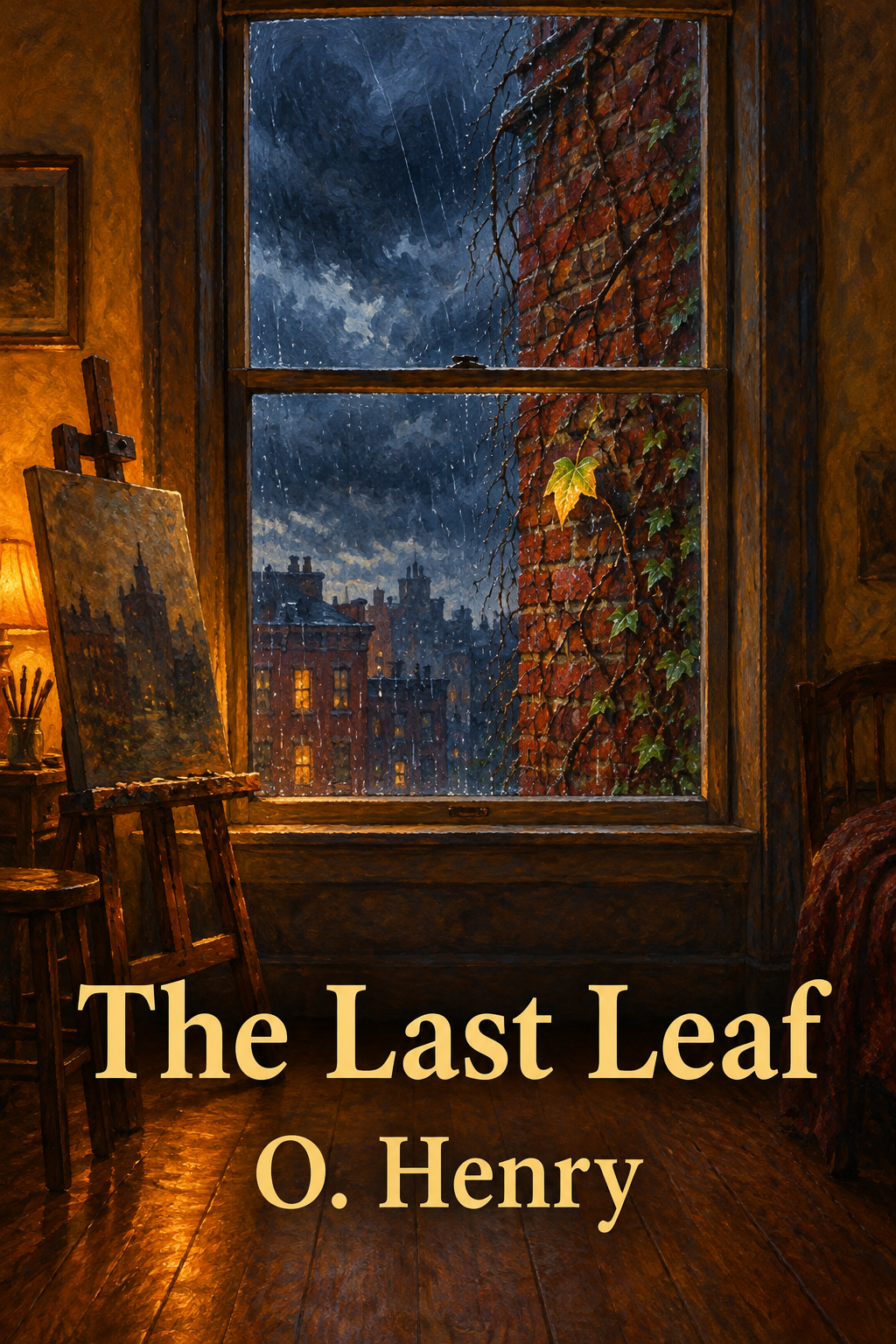
The Last Leaf
by O. Henry
O. Henry's short story is about two young painters in a Greenwich Village studio and a single ivy leaf outside their window. When Johnsy, one of the two, falls ill with pneumonia, she becomes convinced she will die when the last leaf falls. Her friend Sue has to find a way to give her hope, and the story's answer comes from an unexpected place.
The Big Idea
"A sick young painter becomes convinced that her life depends on a single ivy leaf. The story asks how fear and hope shape the will to live, and who might quietly help."
Key Insights
Belief can weigh on the body
The story takes Johnsy's belief seriously, even though the people around her find it foolish. It does not claim that belief cures illness. It shows, rather, how fear and hope shape the will to keep going, and why that will matters so much when a body is weak.
Johnsy counts the leaves each day, and her mood rises and falls with the vine. Her hope and her fear seem to move with every change she sees from the bed.
Help that does not announce itself
The most useful help in the story comes from a place nobody expects. Some people who seem unimportant, or who talk big without results, can still matter a great deal to others. A reader who looks only at surface behaviour may miss what someone is quietly doing.
Behrman's boasting makes him easy to dismiss, and that is part of what gives the ending its force.
What makes a masterpiece
Behrman has talked about a great work for years without making one. The story asks whether a work of art is judged by fame, sales or applause, or by the purpose it serves for someone else.
A piece made for a friend may never be shown in a gallery, yet it can matter more than a famous canvas. Readers can test this idea on their own: which work of art has changed someone's life, and was it famous?
Care in ordinary tasks
Sue's love shows in small, repeated acts: cooking, keeping watch, and talking to the doctor. The story treats this kind of practical care as a real form of friendship, not a minor detail.
Johnsy asks for broth and watches Sue cook, and that simple routine marks a turn toward life. Readers can also think about what everyday help they could offer a friend who has stopped hoping.
Chapter Breakdown
Chapter-by-chapter summary
Spoiler warning: this section covers the whole plot, including the ending.
Part 1: A studio and a window
Sue and Johnsy are two young painters who share a top-floor studio in Greenwich Village, a New York neighbourhood known for its artists. Their window looks out on a plain back yard and the blank side of a brick house about twenty feet away. An old ivy vine climbs part of that wall, and for a while the days are quiet and ordinary. Then the season turns, the leaves begin to fall one at a time, and the vine starts to thin. The room has no other view, so the wall and the vine quietly become the whole outside world for both friends. This part matters because the reader sees the vine first, long before anyone starts to count it.
Part 2: Counting the leaves
Johnsy catches pneumonia and is confined to her bed. At the first visit, the doctor gives Sue an honest but guarded estimate: her chance of recovery is about one in ten, and it depends a great deal on whether she wants to live. From the pillow, Johnsy can still see the ivy, and she begins counting the leaves that remain. Each one that drops feels to her like a countdown. She tells Sue that when the last one falls, she must go too. Sue tries to cheer her up, but Johnsy has settled on her belief and grows weaker. Sue begins to fear that her friend has simply stopped wanting to live. This part matters because it establishes the story's central idea: a belief, not only the illness, is pulling Johnsy down.
Part 3: The old painter downstairs
Downstairs lives Behrman, an old painter who is past sixty and has never found real success. He drinks, earns a little money by posing as a model for younger artists, and has talked for years about a masterpiece he never begins. When Sue tells him about Johnsy's fear, he scoffs at the idea that anyone would die over a falling leaf. After Sue insults him, he grudgingly agrees to pose for her. This part matters because Behrman is introduced as a man whose big words are not matched by any work.
Part 4: The storm
That evening, Behrman poses while Sue and he look out at the ivy in cold rain and snow. Later, a wind and rain storm breaks over the city and batters the window and the old brick wall. Johnsy keeps the same fear in her mind through the long hours. When the storm is over and dawn comes, one leaf is still hanging on the vine. It has not come loose, even after the wind and rain. It looks fragile, yet it holds on. For Johnsy, that single leaf becomes both a hope and a question she cannot yet answer. This part matters because the storm turns the vine into a test, and the reader, like Johnsy, has to wait to see the result.
Part 5: The leaf that stayed
In the morning Johnsy looks toward the window and sees that the last leaf is still there. She calls herself a bad girl for wanting to give up, and she decides that she wants to live. She asks for broth, and she watches Sue cook. An hour later she speaks of one day painting the Bay of Naples. The change is quiet. It comes through a simple request for food and the sight of her friend at work in the kitchen, not through any speech. That afternoon the doctor visits again. In the hall, he tells Sue that Johnsy's chances are now even, and that good nursing will help her win. This part matters because it marks the turning point of Johnsy's story, while the reader still does not know what the night has cost someone else.
Part 6: The doctor's news
In the same hall conversation, the doctor also speaks about the old painter downstairs. Behrman has caught pneumonia too, and the attack is serious. In the doctor's view, there is little hope for him. Johnsy does not hear this yet. The reader, though, is left with a question about what happened to the old painter on the night he posed in the cold rain and snow and the storm broke. This part matters because the mystery of the storm night begins to open at the very moment Johnsy turns toward life.
Part 7: Sue's account
The next day the doctor says Johnsy is out of danger. Then Sue tells her what has happened downstairs. Behrman died in the hospital that day, after being ill for only two days. The building's janitor, Sue explains, had found him on the morning after the storm, helpless in his room, his clothes soaked and icy. Nearby were a lantern that was still burning, a ladder that had been moved, and scattered brushes and a paint palette. This part matters because the old painter's last night reaches the reader through a friend's words rather than through a scene of its own.
Part 8: The masterpiece
Sue's final explanation follows. The leaf on the wall is not real at all. Behrman painted it there on the stormy night, and that is why it never stirred when the wind blew. The old painter who had talked for years about a masterpiece had, without anyone knowing, made one. The story closes on Sue's words about the leaf. This part matters because it changes what the whole story has been about: not only a girl's fear, but a quiet act of generosity.
Characters
- Sue: A young painter who shares the top-floor studio with Johnsy. She keeps the household going, cooks for her friend, and talks with the doctor when Johnsy loses hope. She is practical and steady, and much of the story's warmth comes through her.
- Johnsy (short for Joanna): A young painter who falls ill with pneumonia. She becomes convinced that her life is tied to the last ivy leaf outside her window. Her fear shapes the first half of the story, and her recovery opens the second.
- Behrman: An older painter, past sixty, who has not found success for decades. He drinks, earns money as an artist's model, and talks about a masterpiece he never starts. He is gruff and dismisses Johnsy's fear, but the story shows he has far more to offer than his reputation suggests.
- The doctor: The physician who treats Johnsy. He is never named. He gives Sue a guarded estimate of Johnsy's chances, first about one in ten and later even, and in the afternoon he tells Sue that Behrman has pneumonia too.
- The janitor: The building's caretaker, who is never named and never speaks directly in the story. He appears only in Sue's account, as the person who found Behrman ill and helpless in his room on the morning after the storm, which is how the reader learns what the old painter's night was like.
Writing about this book
A reading response does not need to retell the plot. Choose one moment that stayed with you, then ask why the author placed it where it sits. Some questions to start from are these. What does Johnsy's belief show about how fear works? Why does one leaf, rather than a bigger event, seem to decide everything? How does your view of Behrman change between the first scene and the last? What would the story feel like if it were told only from Johnsy's point of view?
Readers often find it useful to compare the two friends. Sue spends the story in practical action, while Johnsy spends most of it waiting. Ask yourself which of them you would rather be, and why the author may have set them side by side. The ending is also a good place to begin, because the final revelation changes how the earlier scenes read.
Pick one question, support it with two or three details from the text, and write your answer in your own words. Keep quotations short and say which part they come from. A strong response usually makes a clear claim in its first paragraph, gives a few examples in the middle, and closes with a thought that reaches beyond the plot.
Take Action
Practical steps you can implement today:
-
Notice who helps quietly. Look at the people at the edges of a story, not only the central figures.
-
Ask how belief shapes behaviour. Track where Johnsy's fear comes from and how the other characters respond to it.
-
Test the word masterpiece. Decide for yourself whether fame or purpose is what makes a work of art valuable.
-
Notice the small acts of care. Look at how Sue keeps her friend going through ordinary daily tasks.
Notable Quotes
"“When the last one falls I must go, too.” (Part 2)"
— O. Henry
"“Is dere people in de world mit der foolishness to die because leafs dey drop off from a confounded vine?” (Part 3)"
— O. Henry
"“Ah, darling, it's Behrman's masterpiece—he painted it there the night that the last leaf fell.” (Part 8)"
— O. Henry
Who Should Read This
Readers who enjoy short stories with a quiet, surprising ending, and anyone who wants to think about hope, fear and kindness. It suits upper-secondary students and adults, and it is short enough to read in one sitting. It is also a good first step for readers who want to try an English original.
Frequently Asked Questions
Is The Last Leaf a novel?
No. It is a short story by O. Henry, the pen name of William Sydney Porter. It first appeared in the New York World in 1905 and was later collected in The Trimmed Lamp and Other Stories (1907). Because it is short, it can be read in one sitting, and its single room and few characters make it a manageable first English original for many readers.
Where is the story set?
It is set in Greenwich Village, an artists' district in New York. The main room is a top-floor studio, and its window looks out on a brick wall with an old ivy vine. The view from that window is the story's main image, so keep it in mind as you read. The limited view also adds to the sense of enclosure that runs through the story.
Who are the main characters?
Sue and Johnsy are the two young painters at the centre of the story. Behrman is the older painter who lives downstairs, and he plays a larger role in the second half. A doctor and the building's janitor appear in smaller roles, and neither is named in the text.
Why does the ivy leaf matter so much?
For Johnsy, each falling leaf is a sign of how much time she has left. A natural process, leaves falling from a vine, becomes a personal countdown, and that shows how fear can change the way a person reads ordinary things. The one leaf that stays is what finally reverses that reading.
What is the main lesson of the story?
The story is open to interpretation, but it often leads readers to think about how hope and fear affect a person, and how quiet kindness can matter in ways no one sees at the time. You can decide for yourself which idea matters most, and whether the ending changes how you see the characters who came before it.
Check Your Understanding
Pick an answer for each question to see if you were right.
-
Where do Sue and Johnsy live and work?
A top-floor studio in Greenwich Village, New York — They share a top-floor studio in Greenwich Village, an artists' district in New York.
-
What does Johnsy believe will happen when the last ivy leaf falls?
She will die — Johnsy is sure she will die when the last leaf falls, so she watches the vine every day.
-
Which description fits Behrman?
An older painter who has not found success and poses as a model — Behrman is past sixty, has struggled for decades, and earns some money as an artist's model.
-
Who tells Sue that Behrman is ill?
The doctor who treats Johnsy — In the afternoon, the doctor tells Sue that Behrman has pneumonia too.
-
What is the last leaf really?
A painting by Behrman on the brick wall — Behrman painted it on the brick wall on the stormy night, which is why it never moved.
About O. Henry
William Sydney Porter, who wrote as O. Henry, was an American short-story writer born in Greensboro, North Carolina, in 1862. He moved to New York in 1902 and wrote hundreds of stories for magazines and newspapers, many later collected in The Trimmed Lamp and Other Stories (1907). His stories are known for surprise endings and for their warm view of ordinary people in the city.
Summary Written By

Software Engineer & Writer
Software engineer with a passion for distilling complex ideas into actionable insights. Writes about finance, investment, entrepreneurship, and technology.
View all summaries →Reviews
No reviews yet. Be the first to share your thoughts!
Write a Review
Keep reading
Explore the topic: FictionSummaries

Out of My Mind
Sharon M. Draper
“Out of My Mind” by Sharon M. Draper is a poignant narrative that explores the life of Melody Brooks, a…

Ender’s Game
Orson Scott Card
“Ender’s Game” by Orson Scott Card is a riveting science fiction novel that transports readers into a future where humanity…

Pachinko
Min Jin Lee
“Pachinko”, a spellbinding multigenerational historical saga by Min Jin Lee, explores the lives of a Korean family trying to make…

The Perks of Being a Wallflower
Stephen Chbosky
The Perks of Being a Wallflower by Stephen Chbosky is a profound coming-of-age novel, told through the intimate letters of…
Articles

The Enlightenment Explained: Ideas, Thinkers and Legacy
The Enlightenment was an 18th-century European movement that trusted reason and evidence over tradition and authority. Its thinkers, from Locke…
World History 1700–1918: Revolutions, Industry, Empire and War
Between 1700 and 1918, revolutions, factories, empires and a world war reshaped societies across Europe, the Americas, Asia and Africa.…

A Christmas Carol themes: generosity, isolation and responsibility
Dickens's novella is usually read as a story about a man who changes his mind. Its themes are sharper than…