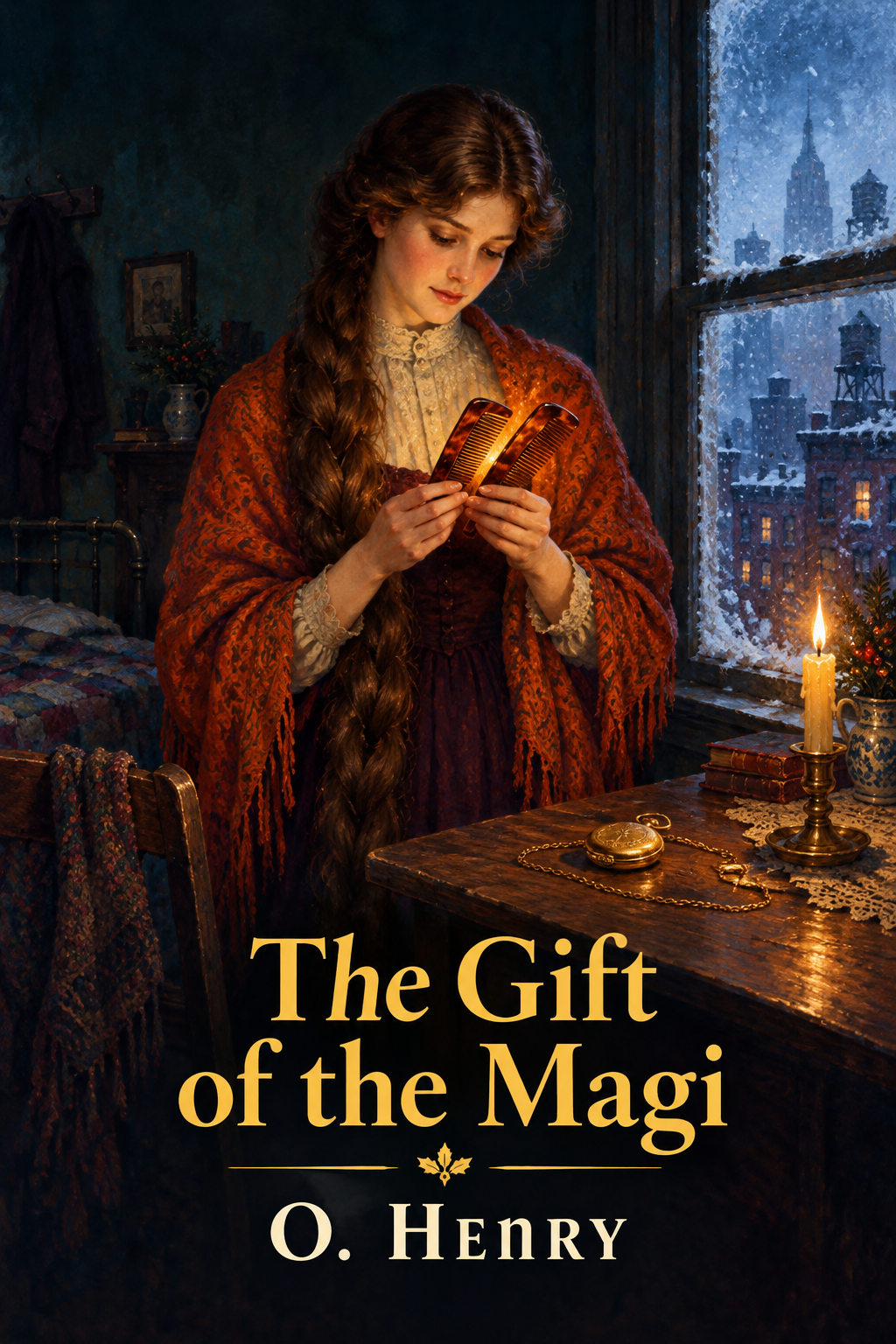
The Gift of the Magi
by O. Henry
The Gift of the Magi is a short Christmas story by O. Henry about Della and Jim, a young married couple in New York with very little money. On the day before Christmas, each of them wants to buy the other a present that shows how much they care. The story is short enough to read in one sitting, and its ending is what makes it memorable.
The Big Idea
"The value of a gift lies in the love behind it rather than its price, and this short story tests that idea on a poor young couple."
Key Insights
Gifts are measured by sacrifice
The story suggests that a gift is worth what it costs the giver, not what it would cost in a shop. Della and Jim both give up something they treasure, so their gifts say far more about their love than any bargain could. That idea is the core of the story.
Della’s hair and Jim’s watch are not luxury goods in the usual sense. Their value lies in memory, family history and what each person was willing to lose. Readers feel that cost even though the amounts of money involved are small.
Irony as the engine of the story
O. Henry builds the story on irony, the gap between what characters expect and what actually happens. The reversal is not there only for surprise; it shows what the couple care about most. Irony works here because the reader is invited to see more than the characters do.
The careful counting of coins in the first scene gives the reader a clear sense of the couple’s limits. When the ending arrives, that early detail makes the outcome feel both surprising and earned. Rereading the opening after finishing the story reveals how deliberate the setup is.
Dignity in everyday things
Watches and hair are ordinary possessions, but in this story they carry family history and personal pride. The story shows that dignity can exist in a poor household even when money cannot make it visible. Small objects become a way of talking about character.
Jim’s watch came from his father and his grandfather, so selling it costs him far more than its cash value. Della gives up hair that the narrator describes as beautiful, which shows how far her love reaches. Both sacrifices are made quietly, with no speeches.
Generosity as careful attention
The closing comparison to the Magi suggests that generosity is a careful act. The giver has to think about the other person’s needs and tastes, not only about what looks impressive. A gift becomes wise when it comes from that kind of attention.
Della chooses a chain to fit Jim’s watch, and Jim chooses combs that Della had admired in a shop window. Each choice comes from thinking about the other person, not about being impressed. That attention is what the narrator praises at the end.
Little room, every detail counts
A short story has little space for explanation, so each object and number has to do work. O. Henry uses a few coins, a chain, a pair of combs and a watch to carry the whole theme. Readers see the method by noticing how these items return in different scenes.
In a one-page story, the watch can appear as a memory, as a sale and as a missing piece of a gift. Tracking these appearances is a good way to write a sharp report on how the story is built.
Chapter Breakdown
Chapter-by-chapter summary
Spoiler warning: this section covers the whole plot, including the ending.
Scene 1: One dollar and eighty-seven cents
The story opens on the day before Christmas in a small furnished flat in New York. Della has counted her savings more than once. She has one dollar and eighty-seven cents, and sixty of those cents are in pennies, saved coin by coin through careful budgeting. Her husband Jim’s pay has dropped from thirty dollars a week to twenty, and the rent is eight dollars a week. Della wants to buy him a proper present, but she has almost nothing to spend. This scene matters because the small sum sets the stakes, so every later sacrifice is measured against real need.
Scene 2: Selling the hair
Della looks at her reflection and sees her long brown hair, which the narrator calls beautiful. She decides to sell it. The buyer is Madame Sofronie, who runs a hair-goods shop. The narrator describes her as large and chilly, and she pays Della twenty dollars. With that money Della buys a platinum fob chain, simple and chaste in design, meant for Jim’s gold watch. This scene matters because Della gives up the hair the story has just described so lovingly, and the reader feels the weight of that choice before Jim appears.
Scene 3: Jim comes home
That evening Jim comes home and looks around the room. He notices that Della’s hair is short, and she tells him that she has cut it off and sold it. Jim has a present for her too, but what he has done is not yet revealed to the reader. Before the gift appears, the narrator pauses with a puzzling remark about the Magi’s gifts and promises to explain it later. This scene matters because a cheerful plan suddenly turns into a moment of real tension, and the reader senses that the couple has kept something from each other.
Scene 4: The exchange
Jim’s present is a set of combs made of pure tortoise shell, with jewelled rims, the kind Della had long admired in a shop window. Jim had sold his gold watch, the one that belonged to his father and his grandfather, to pay for them. Della had sold her hair to buy the chain. Each gift now lacks the thing it was meant to go with: the combs were meant for hair that is gone, and the chain was meant for a watch that is gone. This scene matters because both of them gave up what they treasured, and the meaning of the title comes into focus.
Scene 5: The wise men
In the closing lines, the narrator sets the couple beside the Magi, the wise men who brought gifts to the Babe in the manger. The narrator credits those wise men with inventing the art of giving Christmas presents. The narrator then calls Della and Jim two foolish children who gave up the greatest treasures of their house for each other, yet concludes that of all who give gifts, these two were the wisest. This scene matters because it explains the title and tells the reader how to judge the gifts: by what the givers gave up, not by what the gifts could buy.
Characters
- Della: The young wife at the centre of the story. She counts every coin and is determined to find a Christmas present for Jim, however little money they have. Her choice to sell her hair shows how far she will go for him.
- Jim: Della’s husband. His pay has dropped, but he treasures a gold watch that came down to him from his father and grandfather. He also makes a sacrifice for Della, which the reader learns about only later in the story.
- Madame Sofronie: The proprietor of a hair-goods shop. Madame Sofronie is a large, chilly woman who buys Della’s hair for twenty dollars. She appears in one brief scene, but without this sale Della could not buy the chain, so she drives the plot forward.
- The Magi: The wise men of the Christmas story who brought gifts to the Babe in the manger. They are not people in the plot, but the narrator uses them as a comparison in the closing lines, and the title refers to them.
- The narrator: The voice that tells the story from outside, describing the flat, the coins and the couple’s choices. The narrator sometimes steps in with asides to the reader, and closes by setting Della and Jim beside the Magi. The narrator is a voice rather than a character, but readers should notice it.
Writing about this book
A strong book report on this story does more than retell the plot. Begin with the question the story asks: what makes a gift valuable? Then choose one scene that changed your view, such as the moment Della decides to sell her hair, and explain why it matters to the story. The closing comparison to the Magi is the author’s own frame, so decide for yourself whether you agree with it and say why.
These questions can help you plan the essay:
- Why does the narrator describe the flat, the coins and the rent in such detail before the couple does anything?
- Would you give up something you value for someone you love? What would you choose?
- How does the ending change the way you read the first scene?
- Does the story suggest that poverty limits love, or that it can sharpen it?
Write in your own words and support each point with a detail from the story. Avoid copying summaries or long passages from other sources, because a short personal argument is stronger than a retelling.
Take Action
Practical steps you can implement today:
-
When you choose a gift, think about what it says about the other person, not only about its price.
-
Look for small everyday objects in a story, such as a watch or a comb, because they often carry the theme more clearly than speeches do.
-
After you finish the story, read the first scene again and notice which details now mean something new.
-
In a book report, choose one scene that changed how you felt and explain why, rather than retelling the whole plot.
Notable Quotes
"“One dollar and eighty-seven cents.” (Scene 1)"
— O. Henry
"“Beautiful combs, pure tortoise shell, with jewelled rims.” (Scene 4)"
— O. Henry
"“Of all who give gifts these two were the wisest.” (Scene 5)"
— O. Henry
"“Everywhere they are wisest.” (Scene 5)"
— O. Henry
Who Should Read This
Readers aged twelve and up will find this story easy to follow. It suits middle and high school students reading short fiction in English or literature classes, and anyone who wants a warm Christmas story that can be finished in one sitting.
Frequently Asked Questions
Is The Gift of the Magi a true story?
No. It is a work of fiction by O. Henry, a writer known for stories about ordinary people and clever endings. The story was first published in 1905 and later included in the 1906 collection The Four Million. Readers should treat its events as the author’s invention.
Who are the Magi in the title?
The Magi are the wise men from the east in the Christmas story of the Bible, who visited the infant Jesus with gifts. The Bible does not give their number or their names. O. Henry uses them as a comparison, so the title asks readers to see the couple as wise givers.
What is the main theme?
The main theme is love shown through sacrifice. Both characters give up something they value to buy a present for the other. The narrator suggests that the worth of a gift lies in that cost, which is why the story closes with a comparison to the wise men.
Why do readers still remember it?
Its short length and warm ending make it easy to remember. O. Henry is known for surprise endings that reward a second reading, and this story pairs a Christmas setting with a clear and simple idea about giving.
Where is the story set?
It is set in New York, in a small furnished flat where Della and Jim live. Most of the action happens in and around their home, which makes the couple’s limited means feel close and personal.
What should a reader think about after finishing it?
Think about what you would want to give to someone you love. Putting into words what a gift is meant to say, beyond its price or usefulness, helps the story’s meaning feel close to your own life. Gifts you have given or received can also be good material for a report.
Check Your Understanding
Pick an answer for each question to see if you were right.
-
How much money does Della have at the start of the story?
One dollar and eighty-seven cents — She has saved one dollar and eighty-seven cents, much of it in pennies, through careful budgeting.
-
What does Della sell to buy Jim’s present?
Her long hair — She sells her hair for twenty dollars to Madame Sofronie, who runs a hair-goods shop, and spends the money on a chain for Jim’s watch.
-
What does Jim sell to buy Della’s present?
His gold watch — He sells the gold watch that belonged to his father and grandfather to pay for the combs.
-
What does the narrator suggest about the value of a gift?
Its worth lies in what the giver gave up — The comparison to the Magi shows that the couple’s sacrifice makes their gifts wise, not their price.
-
What kind of writing is The Gift of the Magi?
A short story — It is a single, self-contained story told in a short space, so it is classed as a short story.
About O. Henry
William Sydney Porter, who wrote under the name O. Henry, was an American short story writer born in North Carolina in 1862. He worked in Texas before moving to New York City in 1902, where he wrote many stories known for warm characters and surprise endings. He died in 1910, and this Christmas tale remains one of his best-known works.
Summary Written By

Software Engineer & Writer
Software engineer with a passion for distilling complex ideas into actionable insights. Writes about finance, investment, entrepreneurship, and technology.
View all summaries →Reviews
No reviews yet. Be the first to share your thoughts!
Write a Review
Keep reading
Explore the topic: FictionSummaries

Out of My Mind
Sharon M. Draper
“Out of My Mind” by Sharon M. Draper is a poignant narrative that explores the life of Melody Brooks, a…

Ender’s Game
Orson Scott Card
“Ender’s Game” by Orson Scott Card is a riveting science fiction novel that transports readers into a future where humanity…

Pachinko
Min Jin Lee
“Pachinko”, a spellbinding multigenerational historical saga by Min Jin Lee, explores the lives of a Korean family trying to make…

The Perks of Being a Wallflower
Stephen Chbosky
The Perks of Being a Wallflower by Stephen Chbosky is a profound coming-of-age novel, told through the intimate letters of…
Articles
The Enlightenment Explained: Ideas, Thinkers and Legacy
The Enlightenment was an 18th-century European movement that trusted reason and evidence over tradition and authority. Its thinkers, from Locke…
World History 1700–1918: Revolutions, Industry, Empire and War
Between 1700 and 1918, revolutions, factories, empires and a world war reshaped societies across Europe, the Americas, Asia and Africa.…

A Christmas Carol themes: generosity, isolation and responsibility
Dickens's novella is usually read as a story about a man who changes his mind. Its themes are sharper than…