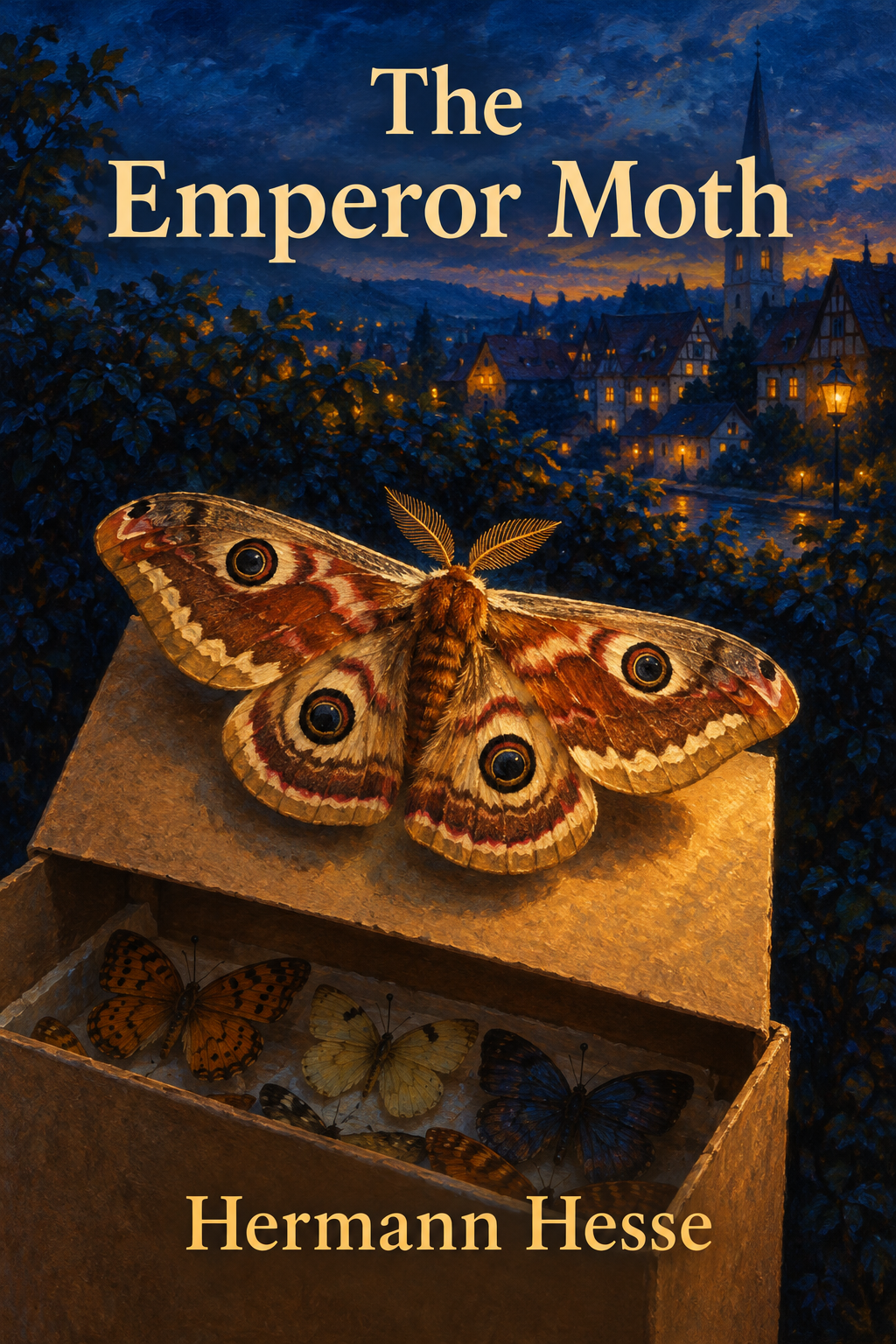
The Emperor Moth
by Hermann Hesse
The Emperor Moth, known in Japan as Shōnen no Hi no Omoide, is a short story by Hermann Hesse. An adult host shows a friend a moth from his new collection, and the friend answers with reserve, so the story turns back to his boyhood. As a poor boy, he kept his butterflies in a cardboard box. The neighbour Emil, a model boy with fine cases, judged his prize harshly. Envy then leads the boy into a rash act he will carry for life.
The Big Idea
"Envy and one rash moment from boyhood can shape how a man remembers himself for the rest of his life."
Key Insights
Envy that hides behind pride
Heinrich's pride in his cardboard box is partly a shield. When Emil dismisses his butterfly, the anger is less about the insect than about feeling small in front of someone he admires. Hesse lets pride and envy appear as one feeling, which is why the boy's reaction looks like defiance and wounded longing at once.
After the criticism he does not argue back. He leaves in anger and decides never to show Emil his work again. Envy often becomes a grudge before it becomes any kind of plan, and the story shows that first stage clearly. Readers can test this against their own experience of wanting what a rival has while pretending not to care.
Accurate criticism cuts deepest
Emil's comments are specific: the mounting is poor and a leg is missing. Emil does not mock; he inspects, and that calm tone is part of what hurts. Specific criticism is hard to answer, because the listener half-suspects it is true, and that makes it harder to forget.
Heinrich has no clever reply, so he carries the sting home with him. Try the test on yourself: a vague insult is easy to shrug off, but a precise correction from someone you respect can shape how you see your own work for years.
A moment that lasts for decades
The act itself takes only moments: a moth lifted from a board, a hurried push into a pocket. Its consequences last a whole life. Heinrich's regret is about what he destroyed, not only what he took, and Hesse makes the gap between those two timescales the core of the story.
The opening scene, in which the friend answers the host's moth with reserve, shows that the memory is still active. The reader senses the cost before the full cause is told, which makes the flashback feel heavy from the start.
Giving up what you loved
After the apology fails to bring anything back, Heinrich stops collecting and crushes his own butterflies by hand. Giving up a passion can be a form of self-punishment, and it can also mark the moment childhood ends.
Read the ending with that gesture in mind: the innocent pleasure of collecting is gone, and what replaces it is an adult's awareness of what was done. Many readers think back to their own childhood hobbies when they reach this point, which is part of why the story lingers.
Chapter Breakdown
Chapter-by-chapter summary
Spoiler warning: this section covers the whole plot, including the ending.
Part 1: A moth from a new collection
The story opens in the present, in the home of a grown man who has taken up collecting again. He shows a visiting friend, Heinrich Mohr, a moth from his new collection. Heinrich reacts with reserve, and the host notices the coolness. That reaction opens the way into the past. The story turns to Heinrich's own boyhood, when he too was passionate about insects. The frame matters because it tells the reader from the start that this is a memory with weight, not a cheerful stroll through childhood.
Part 2: A cardboard box
Heinrich is about ten, and like many boys he hunts butterflies with real passion. His parents are poor. They cannot buy the proper specimen cases that other families can afford, so he keeps his catches in plain cardboard boxes. He is proud of what he has, yet the box also embarrasses him when other boys see it. This detail sets up the story's central imbalance: he has the passion, but not the equipment or the standing that goes with it. His pride is exactly what the next scene will test.
Part 3: Emil's verdict
Next door lives Emil, the son of a teacher and a model of good conduct. Emil keeps an orderly collection and has the skill to mend damaged wings. One day Heinrich catches a rare butterfly and takes it to show him. Emil recognises that the specimen is rare, but he points out flaws in the mounting and a missing leg. Heinrich's delight turns to humiliation and resentment. He leaves angry and never shows Emil his catches again. The criticism stings because it is precise. A vague insult would be far easier to dismiss.
Part 4: The rare emperor moth
Two years later, word goes round that Emil has succeeded with an emperor moth, a rare insect that none of the boys has managed to get. Heinrich knows the moth only from pictures. Old envy and new admiration now pull at him together. What began as a wish to show off has become a hunger to possess what Emil has. Nothing dramatic has happened yet, but the story tightens. The reader senses that Heinrich is about to act on a feeling he has carried since the day of the butterfly.
Part 5: The stairs and the pocket
While Emil is out, Heinrich goes into his room and finds the moth pinned on a spreading board. Overcome by desire, he takes it. Then a maid comes up the stairs, and his conscience wakes. He is suddenly afraid of being caught as a thief. He pushes the moth into his jacket pocket, where it is crushed. He turns back, returns to Emil's room and lays the ruined moth on the table. What distresses him most is the loss of the rare creature, even more than the guilt of the theft itself. The act takes only moments, but its consequences run much longer.
Part 6: The apology
Heinrich confesses to his mother. She says she can forgive him only if he apologises to Emil and offers one of his own butterflies in exchange. He goes. Emil is still trying to repair the moth, without success. Heinrich admits what he did. Emil answers coldly, as if the boy has finally shown what kind of person he is. He refuses the replacement as well. The apology is made, yet it cannot bring the moth back, and the scene makes clear that a gesture cannot settle everything.
Part 7: What cannot be undone
Heinrich understands that what has been spoiled cannot be made good again. He goes home and crushes his butterflies with his fingers until they are dust and scraps. His collecting ends there, and with it goes the innocent pleasure that once belonged to it. The act is both self-punishment and a sign that childhood is over. Hesse leaves the reader with a hard question: how much can one moment decide about the rest of a person's life?
Characters
- Heinrich Mohr: The boy at the centre of the memory, and the grown visitor in the frame. Passionate about insects and poor, proud of his cardboard box and quick to feel humiliated. His envy and one rash moment make him the centre of the story's guilt, and the story stays close to him from start to finish.
- Emil: Heinrich's neighbour, the son of a teacher and a model boy. He keeps an orderly collection in fine cases and has the skill to mend damaged wings. He is precise and correct, and his judgement hurts more than a rough insult would. He is both Heinrich's rival and a mirror of what Heinrich lacks.
- The host: The adult who has taken up collecting again. He shows his new moth to his friend and then recounts the friend's boyhood memory. His part is small, but the frame turns the story into a reflection on the past rather than a simple anecdote.
- Heinrich's mother: She hears her son's confession and insists that he apologise and offer one of his own butterflies in exchange. She wants him to take responsibility for what he did, and her advice is practical, but no apology can undo the damage.
- The maid: A household servant whose footsteps on the stairs startle Heinrich at the crucial moment. She has no further part in the story, yet her small, unplanned presence turns a theft into a disaster.
Writing about this book
If you write a reflection on The Emperor Moth, start with a question rather than a verdict. Who do you sympathise with: Heinrich, with his cardboard box and his hunger for something better, or Emil, whose judgement cuts so deeply? Was Heinrich's guilt in proportion to what he did, or does the story suggest that the feeling outweighed the act? Think about the frame. Why does Hesse place the memory inside a visit from an old friend, rather than telling it straight? Look closely at the moment in Emil's room, where the length of the act and the length of its consequences are far apart. You could write about a time you wanted something that belonged to someone else, or about a judgement you once made about another child and later regretted. Support each point with one concrete scene, and keep your retelling of the plot short. A reader who has the story in front of them needs your reasoning, not a summary.
Take Action
Practical steps you can implement today:
-
Read the opening scene again after finishing, and ask why Hesse starts with a visitor's reserve over a host's moth.
-
Track Heinrich's feelings towards Emil from scene to scene, and mark the point where admiration turns into temptation.
-
Compare the two boys' homes and tools, and ask what each of them stands to lose.
-
Notice that the apology is made but settles nothing, and ask what remains after an apology.
Notable Quotes
"What has been spoiled cannot be made good again, however sorry one feels (Part 7, paraphrased)."
— Hermann Hesse
"The boy suffers more over destroying the rare creature than over the theft itself (Part 5, paraphrased)."
— Hermann Hesse
"Emil refuses the replacement and treats the boy as that kind of person (Part 6, paraphrased)."
— Hermann Hesse
"The boy crushes his own butterflies by hand and gives up collecting (Part 7, paraphrased)."
— Hermann Hesse
Who Should Read This
Readers aged 13 and up, especially students who meet the story in Japanese school classes or in translation. It suits anyone who has been judged by someone they admired, and adults who want a short, sharp look at childhood envy. It is short enough to read in one sitting, so it works well as a first Hesse.
Frequently Asked Questions
Is The Emperor Moth a novel?
No. It is a short story, first published in 1911 under the German title Das Nachtpfauenauge. Because it is short, it can be read in one sitting, which makes it a useful first Hesse for students and for readers who want to test whether his writing suits them.
Why is it known in Japan as Shōnen no Hi no Omoide?
Shōnen no Hi no Omoide is the common Japanese title, so Japanese readers usually know the story under that name. It has appeared in Japanese school reading books for decades, so many readers first meet it in class rather than in English. Search for both titles when you look for study material.
Who is Emil?
Emil is Heinrich's neighbour, the son of a teacher and a model pupil whose butterflies sit in fine cases. He is the boy's rival in collecting and the person whose opinion matters most to him. Hesse presents Emil as precise and correct, and much of the story turns on how that correctness affects Heinrich.
Why does the story start with an adult?
The frame of a visit and a host's moth lets Hesse look back on childhood from the distance of years. Readers learn early that the memory carries weight, so the story reads as a reflection rather than a simple anecdote about a boy and his butterflies. This also explains why the friend's reserve matters so much.
What should I read after this?
If you enjoyed the close look at a young person's inner life, Demian is the next book many readers choose. It follows a young man's inner struggle and shares the same careful attention to conflict within one person. Its tone is more demanding, so reading this short story first helps you get used to Hesse's style.
Check Your Understanding
Pick an answer for each question to see if you were right.
-
Why does the boy keep his insects in a cardboard box?
His family cannot afford a proper specimen case — Money is tight at home, so he cannot buy the kind of case that Emil owns.
-
What does Emil say about the boy's butterfly?
Its mounting is poor and one leg is missing — Emil recognises the rarity, but his criticism of the mounting and the missing leg wounds the boy.
-
Which rare insect does Emil succeed with?
An emperor moth — News of Emil's success stirs the boy's envy again.
-
What startles the boy while he is in Emil's room?
A maid coming up the stairs — Fear of being caught makes him push the moth into his pocket, where it is crushed.
-
What does the boy do after the incident?
He gives up collecting and destroys his own specimens — He realises the damage cannot be undone, and he ends his collecting by crushing what he owns.
About Hermann Hesse
Hermann Hesse (1877–1962) was a German-language writer born in Calw, Germany, who later settled in Switzerland. He received the Nobel Prize in Literature in 1946. His best-known novels include Demian, Siddhartha and Steppenwolf. Hesse often wrote about young people caught between family expectations and their own inner lives, a concern this short story shares.
Summary Written By

Software Engineer & Writer
Software engineer with a passion for distilling complex ideas into actionable insights. Writes about finance, investment, entrepreneurship, and technology.
View all summaries →Reviews
No reviews yet. Be the first to share your thoughts!
Write a Review
Keep reading
Explore the topic: FictionSummaries

Out of My Mind
Sharon M. Draper
“Out of My Mind” by Sharon M. Draper is a poignant narrative that explores the life of Melody Brooks, a…

Ender’s Game
Orson Scott Card
“Ender’s Game” by Orson Scott Card is a riveting science fiction novel that transports readers into a future where humanity…

Pachinko
Min Jin Lee
“Pachinko”, a spellbinding multigenerational historical saga by Min Jin Lee, explores the lives of a Korean family trying to make…

The Perks of Being a Wallflower
Stephen Chbosky
The Perks of Being a Wallflower by Stephen Chbosky is a profound coming-of-age novel, told through the intimate letters of…
Articles

The Enlightenment Explained: Ideas, Thinkers and Legacy
The Enlightenment was an 18th-century European movement that trusted reason and evidence over tradition and authority. Its thinkers, from Locke…

World History 1700–1918: Revolutions, Industry, Empire and War
Between 1700 and 1918, revolutions, factories, empires and a world war reshaped societies across Europe, the Americas, Asia and Africa.…

A Christmas Carol themes: generosity, isolation and responsibility
Dickens's novella is usually read as a story about a man who changes his mind. Its themes are sharper than…