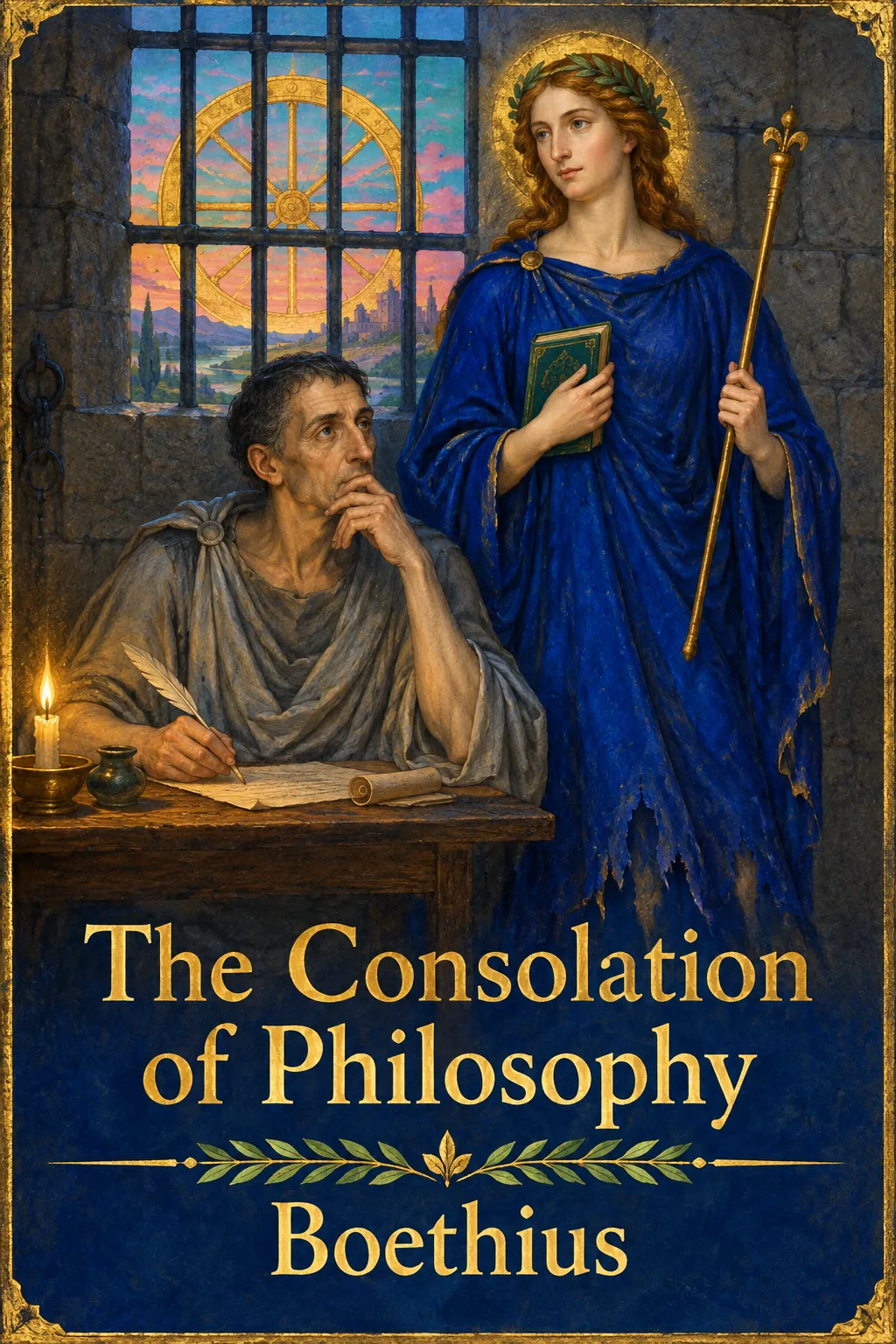
The Consolation of Philosophy
by Boethius
The Consolation of Philosophy is a prison dialogue written around 524 by Boethius, a Roman senator who had lost his office, his property and his freedom. Lady Philosophy visits his cell and talks him out of despair. Across five books she argues that fortune is unreliable, that real happiness cannot depend on it, that the world is ruled by a good providence, and that human freedom survives God's knowledge of the future.
The Big Idea
"Written in prison, the book argues that fortune can take away wealth, rank and comfort but not the true good, which lies in a mind ordered by reason and in a world governed by providence."
Key Insights
Fortune's gifts are only on loan
Wealth, rank and reputation arrive from outside and can leave the same way. Boethius is asked to stop treating them as part of himself. Once he sees them as borrowed, losing them hurts less, and what remains, such as his judgment and his ability to think, comes into view.
Think of a person who loses a job and feels they have lost their identity. Philosophy's advice is to ask which parts of that identity were ever in their own control, and to put their weight on those.
Happiness has to be complete
Money, power, fame and pleasure each give a slice of what people want, never the whole. Real happiness must lack nothing and cannot be taken away, so it cannot sit in any of them. Boethius's answer is that it belongs to the highest good, which he equates with God.
A person who becomes rich and still feels uneasy has already met the first lesson. They got one good thing and found that it did not bring the others with it.
Evil is a lack, not a power
In Book 4 doing wrong is described as falling short of the good, not as having an extra strength. Someone who harms others fails to become what they were made to be, and in that sense is already worse off. Punishment then looks more like treatment than payback.
A cheat who wins a game by deceit holds the prize but cannot honestly enjoy it, and has trained themself in dishonesty. Boethius would call that a loss no scoreboard shows.
Knowing is not forcing
Book 5 argues that God sees all time at once rather than looking ahead from inside it. Seeing an event is not the same as causing it, so divine knowledge need not remove human freedom.
If you watch a friend cross a street, your seeing does not move their feet. Boethius asks us to imagine a viewpoint that sees every day of a life the way you see that single crossing.
Despair is partly forgetting
Philosophy treats Boethius's pain as a lapse of memory rather than an incurable illness. Once he recalls who he is and how the world is ordered, his grief can be held differently. The whole book works as a cure by recollection through conversation.
On a sleepless night, writing down what you value can steady the mind. That small act of remembering is the same first step Philosophy takes in Book 1.
Chapter Breakdown
Chapter-by-chapter summary
Book 1: Grief and a Visitor
Boethius, jailed and awaiting sentence, writes poems of grief. A woman of ageless, towering presence appears at his bedside: Lady Philosophy. She sends away the Muses of poetry, who only feed his sorrow, and asks him to speak plainly. Boethius describes his career, his belief in his own innocence and his anger that a just world allows this. She diagnoses him gently: he has not lost his mind, only his memory. He has forgotten what he is and what governs the world, so he mistakes the loss of fortune's gifts for the loss of everything. Why it matters: the whole book is set up as a cure, and the cure begins with remembering.
Book 2: The Case Against Fortune
Philosophy now speaks as Fortune would, and Fortune's case is simple: everything she gave was on loan. Wealth, office, fame and comfort were never his to keep, and a wheel that lifts a person must also turn them down. Philosophy adds that Boethius still has what matters most: his family, his friends and his own mind. She goes through the usual prizes of life and shows that none can fully satisfy, because each depends on things outside us. The book closes with a hymn to the love that holds the cosmos together. Why it matters: this is the root of the wheel of fortune, an image that shaped medieval art and literature.
Book 3: What Happiness Really Is
Having cleared away false comforts, Philosophy asks what real happiness is. Everyone wants it, she says, but most look in the wrong places: money, power, honour, fame and bodily pleasure. Each gives only a piece of what we want, and none is complete in itself. True happiness must be self-sufficient and lasting, and that can only be the highest good, which she identifies with God. Goodness, unity and happiness turn out to be one thing seen from different sides. Why it matters: this is the philosophical core of the book, where Platonic ideas are joined to a monotheist view of God.
Book 4: Why Do the Wicked Prosper?
Boethius raises the hardest objection: if God is good and rules the world, why do bad people thrive and good people suffer? Philosophy answers in steps. The power to do evil is a weakness, not a strength. The wicked fail to reach what they truly want, so they are worse off even when they look successful, and punishment is closer to medicine than revenge. She then separates providence, God's single plan seen from above, from fate, the same plan unfolding inside time. Why it matters: the book gives a famous early answer to the problem of evil.
Book 5: Foreknowledge and Free Will
The last question is whether anyone can be free if God knows everything that will happen. Philosophy says that knowing is not causing, and that God does not look at time from within it. God lives in an eternal present and holds all of time in one view, the way we can watch someone walking without forcing their steps. Human choices are therefore free and also fully known. The book ends by urging honest living, since every action takes place before a judge who sees all. Why it matters: this definition of eternity was quoted and argued over by Aquinas and many others for centuries.
Key people and terms
Boethius
A Roman statesman and philosopher (about 477–524), consul in 510 and later a senior official at Theodoric's court. In the book he is both author and patient: a grieving prisoner who slowly recovers his ability to reason.
Lady Philosophy
A personified figure who visits the cell. Her robe is torn, as if by people who grabbed pieces of her teaching and ran. She acts as doctor and teacher, gentle at first, then more demanding as Boethius recovers.
Theodoric the Great
King of the Ostrogoths, who ruled Italy from Ravenna. He promoted Boethius, then had him imprisoned on a charge of treason. The book is less about hatred of the king than about how a wronged person can think again.
Lady Fortune
Fortune, personified, speaks through Philosophy in Book 2. Her defence is that what she gave she may take back. Her turning wheel became the book's most remembered image and a staple of medieval art.
The Muses of poetry
At the opening they stand by Boethius and feed his grief with sad verse. Philosophy sends them away, yet the book keeps using poetry, now turned from complaint toward consolation and teaching.
The highest good
A term for what everything seeks. In Book 3 it is identified with true happiness and with God. Partial goods such as money or honour are shadows of it, useful only when they point toward it.
Providence and fate
Terms from Book 4. Providence is God's single plan seen from outside time; fate is the same plan as it unfolds step by step inside time. Seen this way, even a good person's suffering belongs to a larger order.
Eternity
A term from Book 5. Boethius defines eternity as the complete, all-at-once possession of endless life. It is not a very long time but a standpoint from which all of time is seen together.
Writing about this book
Start with a question rather than a plot summary. The book itself opens up several good ones.
- Is Boethius cured by argument, or by being heard? Look at how Book 1 begins before any argument is made.
- Why does Philosophy speak as Fortune in Book 2? What does the change of voice let her say?
- Does the claim in Book 3 that happiness, goodness and God are one thing satisfy you? Where might a reader push back?
- Book 4 says the wicked are unhappy even when they succeed. Test this against a real person or a historical case.
- Does the eternal present in Book 5 solve the free-will problem, or only move it?
Three tips: pick one book and read it closely rather than covering all five; quote briefly and say what you see in the passage; and remember that Boethius wrote as a condemned man, which affects how you read his calm. Avoid calling the work simply Christian or simply pagan. It never mentions Christ, and readers still discuss what that means.
Take Action
Practical steps you can implement today:
-
List what you rely on for your sense of worth, then mark which items could be taken away tomorrow. Spend more effort on the ones that cannot.
-
When something goes badly, ask whether you have lost a thing you borrowed or something that is truly yours. The answer often changes how you respond.
-
Notice which goal you are chasing, such as money, status or praise, and ask whether it could ever be enough by itself.
-
Treat despair as a problem of memory: write down what you know to be true about your values and your situation, then read it back.
Notable Quotes
"“Eternity is the complete and simultaneous possession of endless life.” (Book 5)"
— Boethius
"“Among all the blows of fortune, the unhappiest kind of misfortune is to have once been happy.” (Book 2)"
— Boethius
"“How happy the human race would be if the love that rules the heavens also ruled their hearts.” (Book 2)"
— Boethius
Who Should Read This
Readers of Stoic philosophy, medieval literature or Western intellectual history, and students in upper secondary school or university who meet Boethius in a philosophy, history or literature course. It suits anyone facing a loss and wanting a calm, reasoned way to think about it. The ideas are demanding in Books 3 to 5, but the poems and the dialogue keep the pace readable.
Frequently Asked Questions
Who was Boethius?
Anicius Manlius Severinus Boethius (about 477–524) was a Roman aristocrat and scholar who became consul in 510 and later held a senior post under King Theodoric. He translated and commented on Aristotle's logic for Latin readers, which made him a key link between ancient and medieval thought.
Why was The Consolation of Philosophy written in prison?
Boethius was accused of treason, imprisoned in northern Italy and executed around 524. The book was written during that confinement. It begins with his complaint about his fate and follows his gradual climb out of despair through conversation and reasoning, which is the plot of the book itself.
Is the book Christian or pagan?
Boethius was a Christian and wrote short theological treatises, but this book argues with philosophy alone and never mentions Christ or scripture. That is why readers have called it both a Christian and a Platonic work. Its idea of a good, providential God fits either reading.
What is the wheel of fortune?
It is Fortune's image in Book 2: a wheel that turns constantly, lifting some people and dropping others. Boethius uses it to say that status, wealth and reputation are never secure. The image spread through medieval manuscripts, church decoration and poetry, and survives in everyday phrases.
What language is it in, and how is it built?
It was written in Latin in five books, alternating prose conversation with poems in many metres. It was copied and read across the Middle Ages and translated into vernacular languages, with one version traditionally credited to Alfred the Great and another by Geoffrey Chaucer, called Boece.
Why is it still read today?
It asks how to live when what you rely on can be taken away, and it does so in a short, human dialogue. It also shaped medieval thought, from Dante to Chaucer, and remains a common text in philosophy, history and literature courses.
Check Your Understanding
Pick an answer for each question to see if you were right.
-
Where was Boethius when he wrote the book?
In prison — He wrote while imprisoned and awaiting punishment after being accused of treason.
-
Who visits Boethius in his cell?
Lady Philosophy — Lady Philosophy appears, sends the Muses away and begins to treat his despair.
-
According to Book 2, what are Fortune's gifts like?
Loans that can be taken back — Fortune argues that wealth and rank were only lent, and that her wheel naturally turns.
-
In Book 3, what is the highest good identified with?
God — Philosophy argues that true happiness, goodness and God are one and the same.
-
How does Book 5 reconcile God's foreknowledge with free will?
God sees all time at once in an eternal present — Seeing something is not causing it, and God views all of time together rather than from within it.
About Boethius
Boethius (about 477–524) was a Roman aristocrat, consul in 510 and a senior official under Theodoric, king of the Ostrogoths. He translated and explained works of Aristotle in Latin, shaping medieval education. Charged with treason, he was imprisoned and executed. The Consolation of Philosophy, written in confinement, became one of the most widely read books of the Middle Ages.
Summary Written By

Software Engineer & Writer
Software engineer with a passion for distilling complex ideas into actionable insights. Writes about finance, investment, entrepreneurship, and technology.
View all summaries →Reviews
No reviews yet. Be the first to share your thoughts!
Write a Review
Keep reading
Explore the topic: Personal DevelopmentSummaries

Educated by Tara Westover
Tara Westover
A memoir about a young woman born to survivalists in Idaho who, despite having no formal schooling, teaches herself to…

Atomic Habits: An Easy & Proven Way to Build Good Habits & Break Bad Ones
James Clear
No matter your goals, Atomic Habits offers a proven framework for improving–every day. James Clear, one of the world’s leading…

Think and Grow Rich
Napoleon Hill
What if the secrets to wealth and success weren’t hidden in complex financial strategies, but within the power of your…

Melbourne
Alex Ng
Sophie Cunningham's Melbourne is a deeply personal exploration of Australia's cultural capital, weaving together history, architecture, weather patterns, and personal…
Articles

The Enlightenment Explained: Ideas, Thinkers and Legacy
The Enlightenment was an 18th-century European movement that trusted reason and evidence over tradition and authority. Its thinkers, from Locke…
World History 1700–1918: Revolutions, Industry, Empire and War
Between 1700 and 1918, revolutions, factories, empires and a world war reshaped societies across Europe, the Americas, Asia and Africa.…

Best Stoicism Books for Beginners: Where to Start and Why
Looking for the best stoicism books for beginners? Discover a clear reading route comparing ancient classics like Marcus Aurelius with…