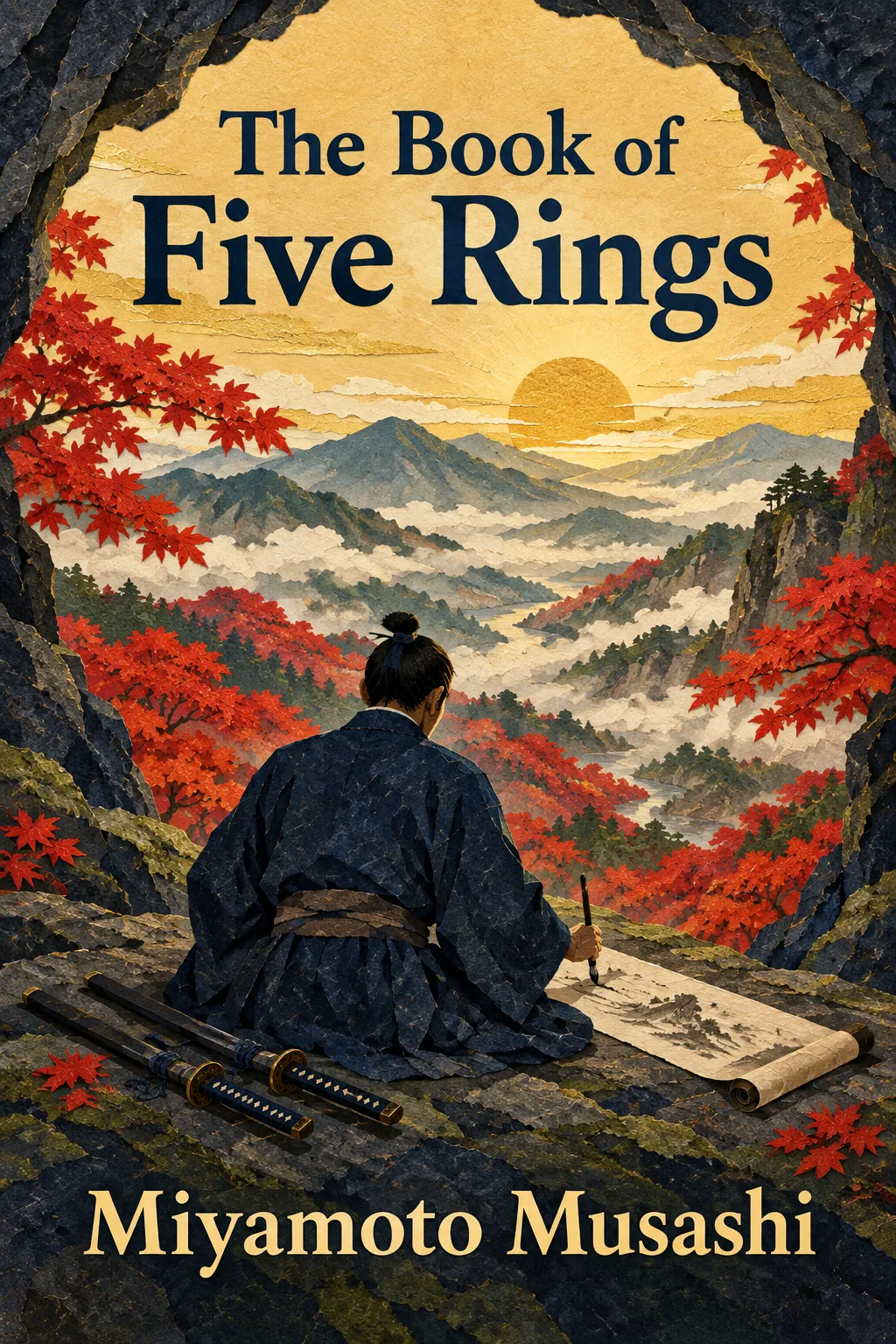
The Book of Five Rings
by Miyamoto Musashi
The Book of Five Rings is a short manual on strategy written by the swordsman Miyamoto Musashi near the end of his life, around 1643 to 1645. It is divided into five scrolls named Ground, Water, Fire, Wind and Void. Musashi starts with his own two-sword school, moves through posture, timing and fighting, compares other schools, and ends with a state of mind free of fixed habits. Although it describes duels, it reads as a guide to training, judgement and keeping a steady mind under pressure.
The Big Idea
"Miyamoto Musashi's Book of Five Rings argues that winning comes from steady practice, clear seeing and a calm, flexible mind, not from a single secret technique or a favourite weapon."
Key Insights
Practice beats secrets
Musashi repeatedly criticises schools that sell secret techniques and flashy tricks. In his view, strength comes from daily repetition that builds the body and the judgement, not from one hidden move. He sums this up with the idea that a thousand days of practice forge a skill and ten thousand days refine it. The point is not that talent is unimportant, but that nothing replaces time spent on the basics, done with care and attention. A learner who respects the basics becomes steady and hard to surprise.
A violinist who spends ten minutes on scales every day will usually outgrow one who only practises showpieces.
Two ways of seeing
Musashi divides sight into two. The perceiving eye (kan) takes in the whole scene, including the opponent's intention and the flow of the situation. The looking eye (ken) follows one visible point. He wants the first to be strong and the second weak. If you stare at the sword tip, you miss the feet, the space around you and the opponent's mood. Looking widely and calmly lets you notice small changes early, and it keeps panic from narrowing your attention.
A football player who watches teammates and defenders, not only the ball, can move a step earlier.
No favourite tool
Musashi dislikes any attachment to one weapon, one stance or one style. He presents five stances, then says that the real stance is to have none, so that you can answer what the moment requires. Fighting with two swords expresses the same thought: do not lock yourself into a single method. A method works when it suits the situation and becomes a handicap when it does not. What matters most is the judgement that chooses it.
A student who changes study methods by subject and by season often improves faster than one who repeats the same habit.
Read the rhythm
Musashi says that everything has its own timing. In a fight, you win the initiative by reading the opponent's rhythm, keeping your own and, when needed, breaking theirs. Acting too early or too late both fail. The idea reaches beyond combat to conversation, sport and work: a well-timed move needs less force than a rushed one. Taking one breath to see the flow before acting often saves time in the end.
In a meeting, waiting for the moment when the discussion turns can make your point land more easily.
The Void: freedom after training
In the last scroll Musashi calls a mind without confusion or attachment the Void. It is where training is meant to end: once the forms are learned, you are no longer trapped by them. Forms are needed to learn, but clinging to them narrows your movement. With a thorough grounding you can move freely and meet each situation as it is. This is the finished shape of improvement in the book: rules absorbed so deeply that they no longer feel like rules.
A musician who knows the score by heart can change the expression naturally to fit the room.
Chapter Breakdown
The Book of Five Rings in five minutes
The Book of Five Rings is a strategy manual by the swordsman Miyamoto Musashi, written near the end of his life in Kumamoto. Musashi says he fought more than sixty matches from his youth and never lost. Looking back after the age of thirty, he wondered whether he had won because he had mastered strategy, or because of natural talent or the weakness of his opponents. He kept training, and by about fifty he felt he had reached the Way naturally. The book records what he learned. Its title refers to five elements, Ground, Water, Fire, Wind and Void, and the text is divided into five scrolls to match.
Chapter-by-chapter summary
Scroll 1: The Ground Book
The Ground Book is the introduction. Musashi explains why he calls his subject the way of strategy, or heihō, and says that it is a path for warriors in general, not only for swordsmen. He compares a commander to a master carpenter, who must know materials, plans and the abilities of the workers. He then introduces his two-sword school, explains why he divided the book into five scrolls, and finishes with a short list of habits for the student, such as learning many arts, noticing small things and doing nothing useless. It matters because it frames everything that follows: strategy is a whole way of living and working, not a bag of sword tricks.
Scroll 2: The Water Book
The Water Book is the practical core on technique and mind. Water takes the shape of its container, and Musashi wants a fighter's spirit to be just as adaptable: calm, neither tense nor careless, and the same in battle as in daily life. He teaches posture, a broad way of looking in which the perceiving eye (kan) is strong and the looking eye (ken) is weak, a relaxed grip, and footwork that is the same walking and fighting. He lays out five stances and five basic forms, and stresses that every move aims at cutting the opponent. He closes with the idea that a thousand days of practice forge a skill and ten thousand days polish it. It matters because it shows that his method rests on repetition and relaxed attention.
Scroll 3: The Fire Book
The Fire Book deals with real fights, from one person against one to armies against armies. Fire grows and shrinks quickly, so this scroll is about timing, place and seizing the initiative. Musashi describes using light and terrain to your advantage, three kinds of initiative (attacking first, waiting, or moving at the same moment as the opponent), and many ways to break an opponent's rhythm: pressing down a move just before it begins, putting yourself in the enemy's position, and shaking the enemy's calm. He insists that the same principles apply to a single duel and to ten thousand soldiers. It matters because it turns the philosophy of the first two scrolls into judgement under pressure.
Scroll 4: The Wind Book
The Wind Book uses an old sense of the word for wind, meaning style or manner, to examine other schools. Musashi goes through the habits of rival schools: those that prize very long swords, those that rely on strong blows, those that love elaborate stances, those that fuss over footwork or speed, and those that hide simple lessons behind talk of secret and inner teachings. His complaint is that each fixes on one trick and mistakes it for the whole Way. It matters because describing what he rejects makes clear what he values: a method that is flexible, practical and honest about what works.
Scroll 5: The Void Book
The Void Book is the shortest. Musashi says the void is where nothing exists that can be pointed to, and where nothing is yet known. For him it is a mind without confusion, fixed attachment or clouds of doubt. A person who trains on the Way, he says, comes to a state where no single technique holds him, and he acts freely; from there he sees the Way as void and the void as the Way. It matters because it names the goal of the whole book: not mastery of rules but the ability to act without being trapped by them.
Key people and terms
Miyamoto Musashi
Early Edo-period swordsman, born around 1584, who says he fought more than sixty duels without a defeat. He founded the two-sword school Niten Ichi-ryū, moved to Kumamoto in his last years, and finished this book shortly before dying in 1645. He was also a skilled ink painter.
Terao Magonojō
A student of Musashi who received the finished book, according to tradition, shortly before the swordsman's death. Musashi's own manuscript is not known to survive, so modern editions depend on early hand copies of the text.
The Hosokawa family
Lords of Kumamoto domain in Higo province, who welcomed Musashi as an honoured guest from about 1640. He began writing the book in a cave called Reigandō on Mount Iwato near Kumamoto.
Sasaki Kojirō
A swordsman remembered as Musashi's most famous opponent, said to have been beaten in 1612 on the island of Ganryūjima. The Book of Five Rings does not discuss the duel, but the story shapes Musashi's popular image.
Niten Ichi-ryū
Musashi's school, whose students learn to fight with a long and a short sword together. His reasoning is practical: warriors already carry both swords, so they should be able to use both freely.
Heihō (strategy)
The old word for the art of fighting and command. Musashi stretches it beyond swordsmanship to cover how a commander leads, how a craftsman works and how a person trains the mind.
Hyōshi (timing and rhythm)
The beat of any action. Musashi says every art and trade has its own rhythm, and that victory in a fight comes from reading the opponent's rhythm, keeping your own and breaking theirs.
Sen (initiative)
The power to set the pace. Musashi describes three kinds: attacking first, waiting for the opponent to move, and striking at the same moment as the opponent, and he teaches when to use each.
Kū (the Void)
Literally emptiness. In the final scroll it means a clear mind with no confusion, attachment or fixed habit, which Musashi presents as the goal of all the earlier training and the ground for free action.
The Book of Five Rings key ideas in quotes
Several lines from the book are often quoted. “A thousand days of practice to forge the skill, ten thousand days to polish it” is the best known, and it sums up Musashi's trust in patient repetition. “Let the perceiving eye be strong and the looking eye weak” tells you to watch the whole scene rather than one point. “Take the void as the Way, and see the Way as void” closes the book. Read alone they sound like slogans; in context they are conclusions from a lifetime of training.
Writing about this book
If you are writing an essay or report on The Book of Five Rings, avoid simply retelling the duels. Choose one idea and test it against your own experience. Good themes are practice and patience, seeing the whole situation, flexibility, and the freedom that comes after learning the basics. Questions to think about:
- Why does Musashi warn against loving one weapon, one stance or one trick? Have you ever relied too much on a single method?
- How could the “perceiving eye” help in a match, an exam or a difficult conversation?
- Musashi says to keep your mind the same in battle as in daily life. Is that realistic, and what would it take?
- Why might a manual on fighting from the 1640s still be read in business, sport and design?
Remember that Musashi wrote for warriors in a military society, then compare that with how modern readers use the book. Quote briefly, name the scroll, and explain each line in your own words.
Take Action
Practical steps you can implement today:
-
Plan to practise for thousands of days, not a few; steady repetition of the basics beats any secret shortcut.
-
Look at the whole situation, not only the one point in front of you, so small changes reach you early.
-
Avoid depending on a single tool or method; choose what suits the moment, and train the judgement that chooses.
-
Aim for the same calm mind in high-pressure moments as in daily life, and prepare it in advance.
-
Notice the rhythm of people and situations, and choose the right moment to act instead of rushing in.
Notable Quotes
"“A thousand days of practice to forge the skill, ten thousand days to polish it.” (Water Book)"
— Miyamoto Musashi
"“Let the perceiving eye be strong and the looking eye weak.” (Water Book)"
— Miyamoto Musashi
"“Keep your state of mind no different from your everyday mind.” (Water Book)"
— Miyamoto Musashi
"“Take the void as the Way, and see the Way as void.” (Void Book)"
— Miyamoto Musashi
Who Should Read This
Readers from about age 14 up, including high-school and college students, who are curious about samurai history, Japanese culture or strategy. It also suits athletes, managers and creatives who want a compact, practical view of training, timing and judgement. The text is old, so a version with notes helps.
Frequently Asked Questions
What is The Book of Five Rings about?
It is a strategy manual written by the swordsman Miyamoto Musashi near the end of his life. Across five scrolls, Ground, Water, Fire, Wind and Void, it covers his school, posture and technique, fighting and timing, the faults of other schools, and a mind free of fixed attachments. Many readers use it as a guide to training and judgement.
When and where was The Book of Five Rings written?
Musashi settled in Kumamoto around 1640 and, according to tradition, began writing in late 1643 at Reigandō, a cave on Mount Iwato. He finished it shortly before he died in 1645 and gave it to his student Terao Magonojō.
What are the five rings?
They are Ground, Water, Fire, Wind and Void, named after five elements familiar from Buddhist thought. Ground sets out the basics, Water covers technique and mind, Fire deals with real combat and timing, Wind compares other schools, and Void describes a mind free of attachment.
What are the key ideas of The Book of Five Rings?
The main ideas are steady practice over secret tricks, seeing the whole situation, using the right tool for the moment, reading timing and rhythm, and keeping a calm mind that is not trapped by habits. Musashi treats these as one way of living, not only as fighting skills.
Is The Book of Five Rings hard to read?
The original is in early Edo-period Japanese, so many readers choose a modern translation with notes. Because the book is short and practical, most people can read a good edition in a few hours. This summary gives you a map, and then you can read each scroll slowly.
Check Your Understanding
Pick an answer for each question to see if you were right.
-
Which scroll of The Book of Five Rings comes last?
Void — The Void Book is the shortest and closes the work.
-
What does the idea of a thousand days to forge and ten thousand days to polish stress?
Patient, repeated practice — It says that skill comes from long, steady repetition.
-
Which scroll compares Musashi's views with other schools?
Wind — The Wind Book examines the habits of rival schools.
-
What is Niten Ichi-ryū known for?
Using a long and a short sword together — It is Musashi's school of using two swords.
-
What is the “perceiving eye” (kan)?
An eye that takes in the whole scene — Musashi wants this broad way of seeing to be strong.
About Miyamoto Musashi
Miyamoto Musashi (about 1584–1645) was a Japanese swordsman of the early Edo period, famous for his many duels and his two-sword style. He was also an ink painter and calligrapher. He wrote The Book of Five Rings in his last years in Kumamoto, and it is now the best-known Japanese book on strategy.
Summary Written By

Software Engineer & Writer
Software engineer with a passion for distilling complex ideas into actionable insights. Writes about finance, investment, entrepreneurship, and technology.
View all summaries →Reviews
No reviews yet. Be the first to share your thoughts!
Write a Review
Keep reading
Explore the topic: Business StrategySummaries

The Psychology of Money
Morgan Housel
Morgan Housel’s insightful exploration of how psychology affects our financial decisions and wealth-building journey.
Thinking Fast and Slow
Daniel Kahneman
“Thinking, Fast and Slow” by Daniel Kahneman is a groundbreaking exploration of human psychology. It delves into how our two…

Mindset
Carol S. Dweck
Carol Dweck’s groundbreaking research on how beliefs about ability shape motivation, learning, and achievement.
Strategy: A History
Lawrence Freedman
“Strategy: A History” by Lawrence Freedman is a comprehensive exploration of the evolution of strategy in various realms, from military…
Articles

Let Them Theory vs task separation: where responsibility starts
Let Them Theory and task separation both ask you to stop managing other people’s choices, but they start from different…

Scout Mindset vs Growth Mindset: Beliefs and Abilities
Scout mindset checks beliefs against evidence; growth mindset concerns developing abilities. A fictional presentation example shows how to use both…

Spaced repetition vs rereading: how to review a book
Compare the timing of spaced review with the task of recalling or rereading. Work through a fictional example, check mistakes,…