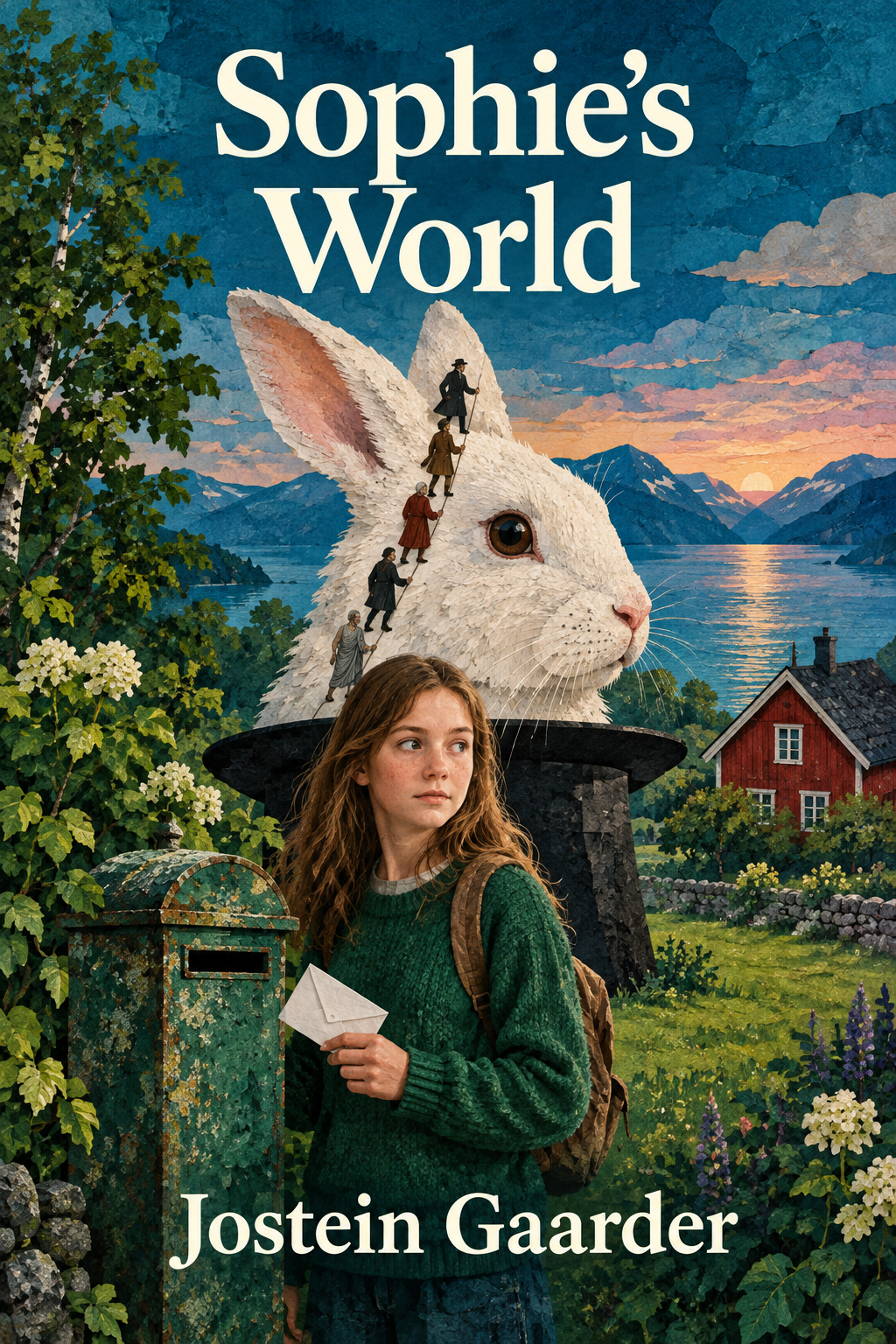
Sophie's World
by Jostein Gaarder
Sophie's World is a novel that teaches the history of Western philosophy through a story. Fourteen-year-old Sophie Amundsen finds an unsigned note in her mailbox asking, “Who are you?” Soon a mysterious teacher, Alberto Knox, sends her lessons on thinkers from the ancient Greeks to modern times. While she studies, odd clues appear: postcards addressed to a girl named Hilde, whom Sophie has never met. The more Sophie learns, the more she suspects that her own world hides a bigger puzzle.
The Big Idea
"Philosophy begins with wonder. A teenager's mysterious correspondence course becomes a tour of Western thought, from the ancient Greeks to today, built around two questions: who are we, and where does the world come from?"
Key Insights
Philosophy starts with wonder
Alberto's first lesson says that to be a philosopher, you only need to stay amazed that the world exists. Children do this naturally, and adults often lose the habit. The book treats curiosity as a skill that can be practised, not just a mood.
The rabbit-and-top-hat image shows two kinds of people: those who sit comfortably in the fur and those who climb up to look at the magician.
Good questions matter more than quick answers
The book opens with “Who are you?” and “Where does the world come from?” without answering either. Every thinker Sophie meets offers a reply, and each reply raises a new problem. Readers learn that a question can be worth keeping open.
Sophie is not told what to believe about Plato or Descartes. She must decide for herself, and the lessons keep reminding her to think.
Ideas answer one another
Gaarder presents philosophy as a long conversation. Plato reacts to Socrates, Aristotle reacts to Plato, and Kant tries to settle the argument between those who trust reason and those who trust experience. Seeing the links makes the history easier to remember.
Locke says the mind is a blank slate, Hume doubts what experience can prove, and Kant replies that the mind also shapes experience.
How much of reality is our own view?
Berkeley, Kant and the Romantics all ask how much of the world is built by the mind. The novel turns this into a plot, as Sophie begins to wonder whether her world is something somebody else imagines. It gives a puzzle that stays with the reader after the book ends.
The clue of Hilde's postcards, and then the Berkeley chapter's discovery that Sophie and Alberto are characters in a book, make Sophie's own life a test of Berkeley's idea.
Chapter Breakdown
Chapter-by-chapter summary
Spoiler warning: this section covers the whole plot, including the ending. The book has 35 short chapters, so they are grouped here into ten parts, mostly by the thinkers each part covers.
Part 1: Questions in the mailbox
Sophie Amundsen finds two unsigned notes: “Who are you?” and “Where does the world come from?” A thick envelope follows with a first lesson. It says a philosopher is someone who never gets used to the world, and it compares the universe to a rabbit pulled out of a top hat. Most people live deep in the rabbit's fur, while philosophers climb the hairs to look at the magician. Before long, postcards for a girl called Hilde begin to turn up as well. Why it matters: the book teaches how to ask questions before answers, and it plants its central mystery.
Part 2: Myths and the first natural philosophers
Alberto Knox, Sophie's unseen teacher, explains how myths about gods gave way to the first attempts to explain nature by reason. Thales, Anaximenes and Empedocles each guess what the world is made of. Parmenides and Heraclitus argue over whether anything truly changes. Democritus proposes tiny, indivisible atoms, and Alberto compares them to Lego bricks. Why it matters: Sophie sees that philosophy started as a way of looking for natural causes, and that each answer was a reply to the one before.
Part 3: Socrates, Plato and Aristotle
Socrates questions the people of Athens in the marketplace and is sentenced to death for it. Plato answers with a world of ideas: the things we see are imperfect copies of perfect forms, and the cave story shows how people mistake shadows for reality. Aristotle replies that forms live inside things themselves and invents the study of logic. Meanwhile Sophie follows Alberto's dog, Hermes, to the Major's cabin by a lake and finds objects that link the place to Hilde. Why it matters: these three thinkers set the questions the rest of the book keeps revisiting.
Part 4: Hellenism and the Middle Ages
The lessons move through the Cynics, Stoics and Epicureans, then Plotinus, early Christianity, Augustine and Thomas Aquinas. Sophie finally meets Alberto face to face. More postcards for Hilde arrive, and Sophie's mother grows worried about her daughter's odd mail and new friend. Why it matters: Sophie learns that ideas travel through history, and that faith and reason were often entangled.
Part 5: Renaissance, Baroque, Descartes and Spinoza
Alberto describes the Renaissance's new confidence in humans and science, then the Baroque's sense that life is a stage or a dream. Descartes decides to doubt everything and arrives at “I think, therefore I am.” Spinoza argues that God and nature are one. Why it matters: doubt becomes a method, and the question “how can I be sure I am awake?” starts to feel uncomfortably close to Sophie's own life.
Part 6: Locke, Hume and Berkeley
Locke says the mind starts as a blank slate filled by experience. Hume goes further and doubts that we can prove cause and effect. Berkeley claims that only minds and ideas exist. In the Berkeley chapter (chapter 23), Sophie and Alberto work out that they are characters in a book that Albert Knag, Hilde's father, wrote for Hilde's fifteenth birthday. The postcards had already hinted that he is a UN soldier far away, and Hilde's home is called Bjerkely, a name close to Berkeley's. Why it matters: the idea that the world might exist only in a mind turns from theory into the book's hidden structure.
Part 7: Enlightenment, Kant and Romanticism
The French Enlightenment trusts reason and fights superstition. Kant says the mind itself shapes what we experience, through space, time and cause. The Romantics reply by praising feeling, nature and imagination. Having learned what they are, Sophie starts to suspect that the author controls her letters, her cat and even her thoughts. Why it matters: Kant gives the book its best tool for talking about how much of our world comes from us.
Part 8: Hegel, Kierkegaard and Marx
Hegel sees history as a conversation of ideas that keeps correcting itself. Kierkegaard turns toward the single person and the leap of faith. Marx looks at how work and money shape society. Sophie plans a philosophical garden party for her fifteenth birthday, while Alberto privately tells her they must find a way out of the story they are in. Why it matters: the lessons now cover whole societies as well as individual minds, and they are given while the two plan their escape.
Part 9: Darwin, Freud and our own age
Darwin's theory of evolution shows life as a long chain of change. Freud describes the unconscious mind. The last lessons cover existentialism, with Sartre arguing that people must create meaning for themselves. All the while Alberto and Sophie keep planning how to slip out of the author's control. Why it matters: the philosophy lessons are delivered under pressure and double as preparation, because Sophie must decide how to act, which is the question existentialism puts at the centre.
Part 10: The garden party and the escape
At Sophie's garden party, the guests behave more and more strangely. Alberto and Sophie slip away from the author's control and escape the pages. Hilde reads these events in her own world, and her father is left unable to command what he made up. Sophie and Alberto continue to exist, unseen by ordinary people but able to walk through the world, free to keep asking questions. Why it matters: the ending turns the book's central idea into action: asking questions is what makes you free.
Characters
Sophie Amundsen
A curious fourteen-year-old who lives on the edge of a Norwegian town. She starts out as a student of philosophy and becomes the book's most determined questioner.
Alberto Knox
Sophie's mysterious teacher. He sends lessons by letter and later in person, and tries to keep his student one step ahead of the author.
Hilde Møller Knag
A girl who turns fifteen in the same period as Sophie. Her father writes the book that Sophie lives in, and Hilde reads it as a birthday gift.
Major Albert Knag
Hilde's father, a UN officer posted abroad. He creates Sophie and Alberto to teach his daughter philosophy from a distance.
Sophie's mother
A caring parent who worries about her daughter's mysterious letters and friends. Her ordinary life gives a contrast to the philosophy lessons.
Hermes
Alberto's dog. He delivers material to Sophie and leads her to the cabin by the lake.
Sherekan
Sophie's cat. He gives her a small, familiar companion while she thinks about big questions.
Jorunn
Sophie's school friend. Her normal teenage world shows how unusual Sophie's weeks of study have become.
Writing about this book
Sophie's World is a good choice for a book report because it combines a story with real ideas. A strong report picks one question and follows it. For example: why does Gaarder tell the history of philosophy as a mystery instead of a textbook? How do the lessons and the plot about Hilde reflect each other? You could trace one idea, such as Plato's world of forms or Berkeley's idealism, and show how it changes the way Sophie sees her life.
Questions to think about: what do you wonder about that others take for granted? Which philosopher's answer feels closest to your own experience, and which do you doubt? What does the ending suggest about freedom? Choose two or three scenes, explain what happens in your own words, and say what you believe, not what the book wants you to believe. Teachers usually prefer a clear personal view over a long list of facts.
Take Action
Practical steps you can implement today:
-
Write down one question about the world that you usually take for granted, and spend ten minutes on it.
-
When you read about an idea, ask which earlier idea it is replying to.
-
Test a belief by asking how you would know it is true, as Descartes and Hume did.
-
Keep a short notebook of questions you cannot yet answer, and return to it every few months.
Notable Quotes
"“Who are you?” (The Garden of Eden)"
— Jostein Gaarder
"“Where does the world come from?” (The Garden of Eden)"
— Jostein Gaarder
"“The only thing we require to be good philosophers is the faculty of wonder.” (The Top Hat)"
— Jostein Gaarder
Who Should Read This
Readers aged about 13 and up who want a friendly first step into philosophy, plus students preparing for school philosophy or ethics classes. It suits readers who enjoy puzzles and mysteries, and it works well as a reading-group or school book.
Frequently Asked Questions
What is Sophie's World about?
Sophie's World is a novel about a fourteen-year-old Norwegian girl who receives letters from a philosopher named Alberto Knox. His lessons cover Western philosophy from the ancient Greeks to modern times. At the same time, Sophie begins to find clues that her own world is not what it seems.
Is Sophie's World a real book about philosophy or just a story?
It is both. The philosophy lessons are accurate introductions to real thinkers such as Socrates, Plato, Descartes and Kant, while the plot around Sophie and Hilde is invented. Many readers use it as a first overview before reading primary sources.
Who are the main characters in Sophie's World?
The main characters are Sophie Amundsen, her teacher Alberto Knox, and a girl named Hilde Møller Knag. Hilde's father, a UN officer, plays a key role. Sophie's mother, Alberto's dog Hermes and Sophie's cat Sherekan also appear often.
Which philosophers does the book cover?
It follows the history of Western thought in order, from the natural philosophers, Socrates, Plato and Aristotle, through the Middle Ages, Descartes, Spinoza, Locke, Hume, Berkeley and Kant. It then moves on to Hegel, Kierkegaard, Marx, Darwin, Freud and existentialism.
What age is Sophie's World suitable for?
It was written for readers in their early teens, but adults read it too. Younger readers may find the long lessons challenging, so it helps to read the story in short sections and to talk about the ideas with a friend or teacher.
Check Your Understanding
Pick an answer for each question to see if you were right.
-
What does the first note in Sophie's mailbox ask?
Who are you? — The first note simply asks “Who are you?”, which sets up the book's central question.
-
Who is Sophie's mysterious philosophy teacher?
Alberto Knox — Alberto Knox sends Sophie lessons and later meets her in person.
-
To whom are the strange postcards addressed?
Hilde Møller Knag — The postcards are for Hilde, but they arrive at Sophie's house.
-
What image does Alberto use to describe the universe in his first lesson?
A rabbit pulled from a top hat — Alberto compares the universe to a rabbit pulled out of a magician's top hat.
-
Which Greek thinker is linked to the world of ideas?
Plato — Plato argued that the things we see are imperfect copies of perfect forms.
About Jostein Gaarder
Jostein Gaarder (born 1952) is a Norwegian writer and former philosophy teacher. Sophie's World, first published in Norwegian in 1991 as Sofies verden, made him internationally famous. It has been translated into dozens of languages and is widely used as a first introduction to philosophy.
Summary Written By

Software Engineer & Writer
Software engineer with a passion for distilling complex ideas into actionable insights. Writes about finance, investment, entrepreneurship, and technology.
View all summaries →Reviews
No reviews yet. Be the first to share your thoughts!
Write a Review
Keep reading
Explore the topic: FictionSummaries

Out of My Mind
Sharon M. Draper
“Out of My Mind” by Sharon M. Draper is a poignant narrative that explores the life of Melody Brooks, a…

Ender’s Game
Orson Scott Card
“Ender’s Game” by Orson Scott Card is a riveting science fiction novel that transports readers into a future where humanity…

Pachinko
Min Jin Lee
“Pachinko”, a spellbinding multigenerational historical saga by Min Jin Lee, explores the lives of a Korean family trying to make…

The Perks of Being a Wallflower
Stephen Chbosky
The Perks of Being a Wallflower by Stephen Chbosky is a profound coming-of-age novel, told through the intimate letters of…
Articles

The Enlightenment Explained: Ideas, Thinkers and Legacy
The Enlightenment was an 18th-century European movement that trusted reason and evidence over tradition and authority. Its thinkers, from Locke…

World History 1700–1918: Revolutions, Industry, Empire and War
Between 1700 and 1918, revolutions, factories, empires and a world war reshaped societies across Europe, the Americas, Asia and Africa.…

A Christmas Carol themes: generosity, isolation and responsibility
Dickens's novella is usually read as a story about a man who changes his mind. Its themes are sharper than…