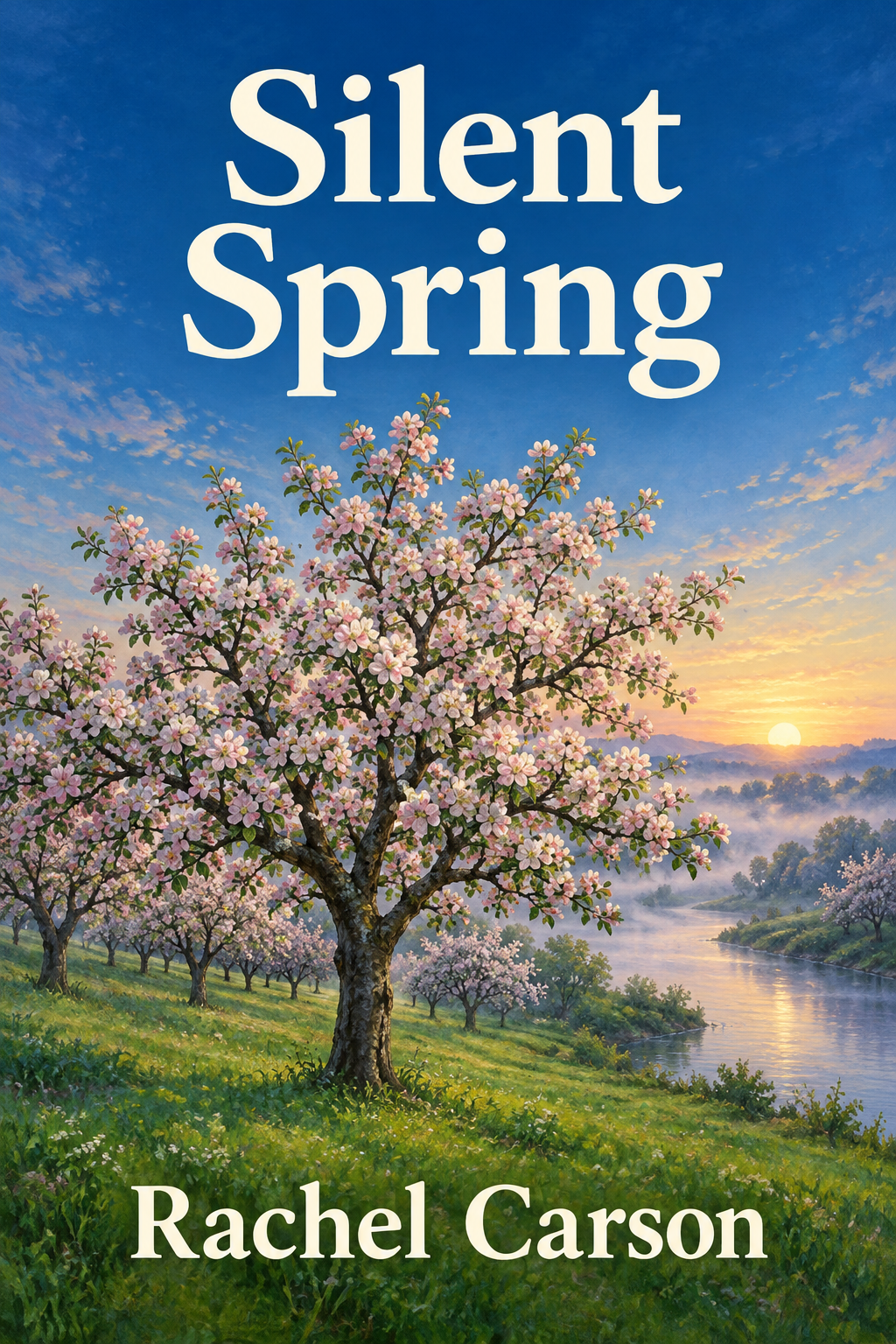
Silent Spring
by Rachel Carson
This Silent Spring summary covers Rachel Carson's 1962 warning about chemical pesticides. Carson shows how sprays such as DDT move through water, soil and food chains, killing birds, fish and other wildlife, and how they can harm people too. She argues that people have a right to be secure from lethal poisons and to know the facts, and she ends by urging less toxic ways to control pests.
The Big Idea
"Rachel Carson argues that chemical pesticides, sprayed without enough care, poison wildlife, water and people, and that humans should look for less toxic ways to control pests."
Key Insights
Poisons travel far from the spray
A chemical that goes on one field does not stay there. Rain washes it into streams, it seeps into soil and groundwater, and it moves up the food chain as small animals eat contaminated plants and insects and larger animals eat them. Carson's central point is that pesticide use should be judged by where the chemicals end up, not only by where they were aimed.
Her chapter on surface waters follows residues from rain and runoff into rivers and underground supplies, showing why one spray can harm wildlife far away.
Blanket spraying harms the wrong creatures too
Sprays chosen to kill one pest also kill beneficial insects, birds, fish and other animals that were never the target. Carson argues that these losses were often not studied well enough, so the true price of a spray program stays hidden from the people who approve it. A tool that cannot tell friend from foe is a blunt instrument, and she treats it that way.
Her chapter on birds describes robins and other songbirds found dead after spraying against elm disease, showing how a single program can remove a whole group of animals from a neighborhood.
The right to know and the right to be safe
Carson's main ethical claim is that people have two rights: to be secure from lethal poisons, and to know the facts about what is being used around them. The second right supports the first, because residents and workers who do not know what they are exposed to cannot protect themselves or ask for better methods.
Her chapter on the human price describes farm workers, spray crews and families near sprayed fields who were poisoned, which shows that these rights concern real people as well as wildlife.
Nature pushes back, and the costs add up
Pests can develop resistance to a chemical, and killing their natural enemies can let their numbers rebound. Each spray can therefore create the need for another, stronger one. Carson treats this as a cycle that gathers force over time, and she argues that a method that cannot stop the cycle is not a lasting answer.
Her chapters on resistance and on the avalanche-like growth of pest problems show how a control that works in one season can leave a bigger problem in later seasons.
Chapter Breakdown
Chapter-by-chapter summary
The book has 17 chapters. Each summary below covers what Carson argues and why it matters.
Chapter 1: A Fable for Tomorrow
Carson opens with an imagined American town where life seemed to live in harmony with its surroundings. Then spring arrives without the usual birdsong. Livestock sicken, fish die and people fall ill, and no one can say at first what has caused it. The story is written as a fable, but Carson presents it as a warning built from real events, and it previews the evidence she gathers in later chapters. The chapter sets the emotional tone for the whole book and gives the title its image of a silent spring.
Chapter 2: The Obligation to Endure
Carson starts from the idea that all living things depend on one another and on the soil, water and air around them. She argues that the habit of trying to control nature with chemicals is a dangerous mistake, and she sets the chemical threat beside other dangers that people have created. The chapter names two rights: the right to be secure from lethal poisons and the right to know the facts about what is being used. Its central move is to turn the book from a list of harms into a question of responsibility. Without that frame, the chapters that follow would read as a catalog of accidents rather than an argument about how people should act.
Chapter 3: Elixirs of Death
This chapter is a survey of the chemicals themselves. Carson describes the main families of insecticides, including chlorinated hydrocarbons such as DDT and the organophosphates, and she explains how these substances act on the nervous systems of insects, birds and people. She also covers arsenic compounds, herbicides and systemic insecticides, which are taken up into a plant's own tissues. Throughout, she reports cases of animals and people who died after exposure. The chapter gives readers the basic vocabulary they need, and it shows why even a small exposure can be dangerous.
Chapter 4: Surface Waters and Underground Seas
Carson follows pesticides after they leave the sprayer. Rain carries them off fields and forests into streams, rivers and lakes, and some seep down into the groundwater that feeds wells and reservoirs. Fish and other aquatic creatures take the chemicals into their bodies, and birds that feed on fish can be affected too. Carson describes how the water cycle spreads poisons far beyond the place where they were used. The chapter's central point is simple: a spray applied in one field can end up in water that people and wildlife depend on many miles away.
Chapter 5: Realms of the Soil
Carson describes soil as a living community rather than inert dirt. Earthworms, insects, fungi and microscopic organisms break down dead plants and animals and return nutrients to the plants that grow above them. Carson explains that many insecticides and herbicides applied to the ground reach these organisms and can persist there for a long time. The chapter argues that the health of the soil is the foundation for everything that grows on it. It is a quiet chapter about damage that is easy to overlook, and it shows how weakening the base of the food web affects every level above it.
Chapter 6: Earth's Green Mantle
This chapter turns to plants, the green cover that shields soil from wind and rain and gives food and shelter to insects, birds and mammals. Carson describes how herbicides and broad sprays can strip away this cover. Bare ground can then wash away, and the plants that once fed other species disappear. The damage to plant life moves upward through the food chain, because most food webs begin with plants. The chapter shows that a harm that looks small at ground level can ripple outward to almost every animal that depends on the land.
Chapter 7: Needless Havoc
Carson looks at spraying programs that treated large areas against a single pest, often without a clear need for such wide coverage. Sprays aimed at insects in gardens, fields and woodlands also killed beneficial insects, birds, fish and other wildlife that were never the target. She argues that many of these campaigns went ahead with too little study of their effects. The chapter asks whether the harm was worth the result, and it points out that the costs of blanket spraying fall on creatures that had nothing to do with the problem. It is the book's sharpest case against careless use.
Chapter 8: And No Birds Sing
This is the chapter that gives the book its title. Carson describes birds that died after exposure to insecticides, including robins and other songbirds found dead after spraying against elm disease. She paints a picture of gardens and woods where birdsong had once been ordinary and was now missing. Birds matter here because they are easy to notice and eat insects, so their absence is an early and visible sign that something has gone wrong. The chapter gives the reader a concrete, emotional image of what the chemicals are doing to ordinary life.
Chapter 9: Rivers of Death
Carson turns to fish kills in rivers, streams and ponds that followed pesticide runoff or direct spraying. She describes how chemicals can kill fish outright and how they can also remove the small insects and other creatures that fish depend on for food. The chapter shows that life in water can be wiped out quickly, sometimes after a single application. Rivers and lakes are shared resources, so a poison that kills their fish affects anglers and fishing communities, the wildlife that depends on the water and everyone who lives downstream.
Chapter 10: Indiscriminately from the Skies
Carson examines aerial spraying, in which planes cover large areas with insecticides. Her main case is the 1957 campaign against the imported fire ant in the American South, which sprayed huge areas and killed wildlife far beyond the target. She argues that spraying from the air cannot be aimed precisely enough to spare other living things. The wider the spray area, the more non-target life is harmed, and once the chemical is in the environment it stays there. The chapter asks readers to weigh the reach of the technology against the responsibility that comes with it.
Chapter 11: Beyond the Dreams of the Borgias
Carson compares modern synthetic chemicals with the poisons of legend, including those associated with the Borgia family of Renaissance Italy. Her point is that the new chemicals are made in vast quantities and reach people through food, water and air. Ordinary people are exposed to them without knowing and without choosing it. The chapter suggests that the danger is not only deliberate poisoning but everyday, unseen contact with chemicals. That shift from the dramatic to the ordinary is the key idea of the chapter.
Chapter 12: The Human Price
This chapter turns from wildlife to people. Carson describes cases of pesticide poisoning among farm workers, spray crews and families who lived near sprayed fields. She notes how hard these poisonings are to recognize, because the symptoms can look like other illnesses and are not always recorded. Her argument is that the human cost of these chemicals has been easy to miss. The chapter shows that pesticide harm is not only an environmental concern but also a question of public health that affects specific people.
Chapter 13: Through a Narrow Window
Carson examines the effects of small, repeated doses. Some of these chemicals are stored in body fat and build up over time, so exposure that seems harmless once can add up across months and years. She argues that many safety tests look at a single dose or a short period and therefore miss these longer-term effects. The chapter questions whether the usual tests show the full picture. Its title suggests how narrow the view is, and its central warning is that a risk can be real even when it is too small to see on a short test.
Chapter 14: One in Every Four
Carson links cancer to chemical exposure. She points to older cases, including the cancers seen in chimney sweeps exposed to soot, to show that certain substances are known to cause cancer. She argues that because carcinogens are present in everyday life, reducing exposure is a more realistic form of protection than waiting for a cure. The chapter adds a serious human health concern to the book's warnings about wildlife and water. It asks readers to treat prevention as the first line of defense.
Chapter 15: Nature Fights Back
Carson shows how pests respond to chemicals. Insects develop resistance, so stronger or more frequent sprays become necessary, while the natural predators that once kept pests in check are killed off. Nature tries to restore balance, but the recovery can be slow and uneven. Carson describes a cycle in which each new chemical provokes a new kind of resistance. The chapter argues that chemical control can fail on its own terms, which weakens the case for relying on it as the main answer to pests.
Chapter 16: The Rumblings of an Avalanche
This chapter describes how a spraying cycle can create new pest problems. When chemicals wipe out the natural enemies of an insect, that insect can multiply, and more spraying follows. Carson compares this process to an avalanche that starts small and gathers force. The chapter shows how a spray meant to solve one problem can deepen it, and how the costs of chemical control build up over time until they exceed the damage of the original pest. A reader who finishes this chapter can see why a single season's results can mislead.
Chapter 17: The Other Road
In the last chapter Carson argues that people do not have to rely on poisons alone. She describes alternatives, including biological control that uses the natural predators and parasites of a pest, and methods such as sterilizing insects so that they produce no offspring. She calls for careful study of how each local ecosystem works, so that methods fit the place where they are used. The book ends with a choice about direction rather than only a warning. That is why the final chapter matters: it turns the argument into a practical path.
Key people and terms
- Rachel Carson: The author, a marine biologist and writer who turned careful science into plain language for general readers. Her argument draws on reports of wildlife deaths, medical cases and scientific studies, and she writes with a sense of responsibility rather than alarm for its own sake.
- DDT: The best-known chlorinated insecticide of the period, widely used against insects in farming, forestry and public spraying. Carson uses it as the central example of a chemical that lasts in the environment and builds up in living things.
- Chlorinated hydrocarbons: A family of persistent insecticides that includes DDT. They can remain in soil, water and body fat for long periods, which is why Carson treats their durability as a main concern.
- Organophosphates: A group of insecticides that act on the nervous system. Many are acutely poisonous to people and animals, but they tend to break down faster in the environment than the chlorinated type.
- Systemic insecticides: Chemicals taken up into a plant's sap and tissues, so the poison can reach parts of the plant the spray never touched. Carson raises this as a reason the harm can be hard to contain.
- Biological control: Using a pest's natural enemies, such as predators and parasites, to keep its numbers down. Carson presents it in the final chapter as the main alternative to relying on poisons alone.
Applying the book in real life
These questions can guide a class discussion or a personal reflection. They give you ways to think, not ready-made answers.
Start by tracing the path of a chemical. Carson does not stop at saying that pesticides are harmful. She shows the route from sprayer to soil, water, animals and people. Ask which steps of that route are visible where you live, such as local pest control or farm practice, and who keeps records of what is applied.
Then ask who decides and who pays. A spray program can benefit one group while its costs fall on wildlife, farm workers and families downstream. Did the people who bear those costs have a say in the decision?
Finally, compare the book with today. Carson wrote in 1962, and pesticide rules and research have changed a great deal since then. A strong reflection separates what she got right from what has changed and what remains debated.
Take Action
Practical steps you can implement today:
-
Ask what is sprayed near where you live, why it is used, and whether residents can see the official records.
-
When a pest appears, look first at its food, shelter and natural enemies before reaching for a poison.
-
Treat early warnings, such as vanishing birds or dying fish, as signs of harm to the whole system.
-
When a chemical is called safe, ask what was tested, at what dose and for how long.
Notable Quotes
"“The ‘control of nature’ is a phrase conceived in arrogance, born of the Neanderthal age of biology and philosophy.” (Chapter 17: The Other Road)"
— Rachel Carson
"“We stand now where two roads diverge.” (Chapter 17: The Other Road)"
— Rachel Carson
"“There was once a town in the heart of America where all life seemed to live in harmony with its surroundings.” (Chapter 1: A Fable for Tomorrow)"
— Rachel Carson
Who Should Read This
Students of biology, environmental science and history, and general readers who want to understand where modern environmental concern began. The book suits high school students and older readers. Some chapters describe animal deaths and poisoning in plain and sometimes vivid detail, so younger readers may want an adult to read alongside them.
Frequently Asked Questions
When was Silent Spring published?
Silent Spring was first published in 1962 by Houghton Mifflin in the United States. It drew wide public attention to how chemical pesticides affect wildlife and people, and it is often credited with helping to start the modern environmental movement.
What is the main argument of Silent Spring?
Carson argues that widely sprayed chemical pesticides harm wildlife, water, soil and people, and that the damage is often ignored or poorly studied. She also argues that people have a right to be safe from lethal poisons and to know what is being used, and she calls for less toxic ways to control pests.
Is Silent Spring only about DDT?
No. DDT is the best-known example, but Carson also covers other chlorinated hydrocarbons, organophosphates, arsenic compounds and herbicides. Readers who know only DDT will find that the book covers a much wider range of chemicals and their effects.
Why is the book called Silent Spring?
The title comes from the opening fable, where spring arrives without birdsong, and from the chapter titled And No Birds Sing. The silent landscape stands for the loss of wildlife that Carson links to chemical spraying, which makes the title an image as well as a warning.
What does Carson propose instead of relying on chemicals alone?
In the final chapter she describes biological control, which uses a pest's natural enemies, and methods such as sterilizing insects. She calls for careful study of each local ecosystem so that control methods fit the place where they are used.
Check Your Understanding
Pick an answer for each question to see if you were right.
-
In which year was Silent Spring first published?
1962 — The book first appeared in 1962, published by Houghton Mifflin.
-
Which chapter opens the book with an imagined town?
A Fable for Tomorrow — The opening chapter, A Fable for Tomorrow, describes a town where spring arrives without birdsong.
-
Which group of insecticides does DDT belong to?
Chlorinated hydrocarbons — DDT is a chlorinated hydrocarbon, a persistent insecticide that builds up in the environment.
-
Which of these is one of the two rights Carson says people should have?
The right to be secure from lethal poisons — Carson names the right to be secure from lethal poisons and the right to know the facts.
-
What is the main alternative Carson describes in the final chapter?
Biological control using natural enemies — The final chapter, The Other Road, describes biological control and other methods that rely on ecology rather than poison alone.
About Rachel Carson
Rachel Carson (1907–1964) was an American marine biologist and nature writer. She first became known for her books about the sea, and Silent Spring, published in 1962, is widely credited with helping to start the modern environmental movement.
Summary Written By

Software Engineer & Writer
Software engineer with a passion for distilling complex ideas into actionable insights. Writes about finance, investment, entrepreneurship, and technology.
View all summaries →Reviews
No reviews yet. Be the first to share your thoughts!
Write a Review
Keep reading
Explore the topic: Personal DevelopmentSummaries

Educated by Tara Westover
Tara Westover
A memoir about a young woman born to survivalists in Idaho who, despite having no formal schooling, teaches herself to…

Atomic Habits: An Easy & Proven Way to Build Good Habits & Break Bad Ones
James Clear
No matter your goals, Atomic Habits offers a proven framework for improving–every day. James Clear, one of the world’s leading…
Think and Grow Rich
Napoleon Hill
What if the secrets to wealth and success weren’t hidden in complex financial strategies, but within the power of your…
Melbourne
Alex Ng
Sophie Cunningham's Melbourne is a deeply personal exploration of Australia's cultural capital, weaving together history, architecture, weather patterns, and personal…
Articles

The Enlightenment Explained: Ideas, Thinkers and Legacy
The Enlightenment was an 18th-century European movement that trusted reason and evidence over tradition and authority. Its thinkers, from Locke…
World History 1700–1918: Revolutions, Industry, Empire and War
Between 1700 and 1918, revolutions, factories, empires and a world war reshaped societies across Europe, the Americas, Asia and Africa.…

Best Stoicism Books for Beginners: Where to Start and Why
Looking for the best stoicism books for beginners? Discover a clear reading route comparing ancient classics like Marcus Aurelius with…