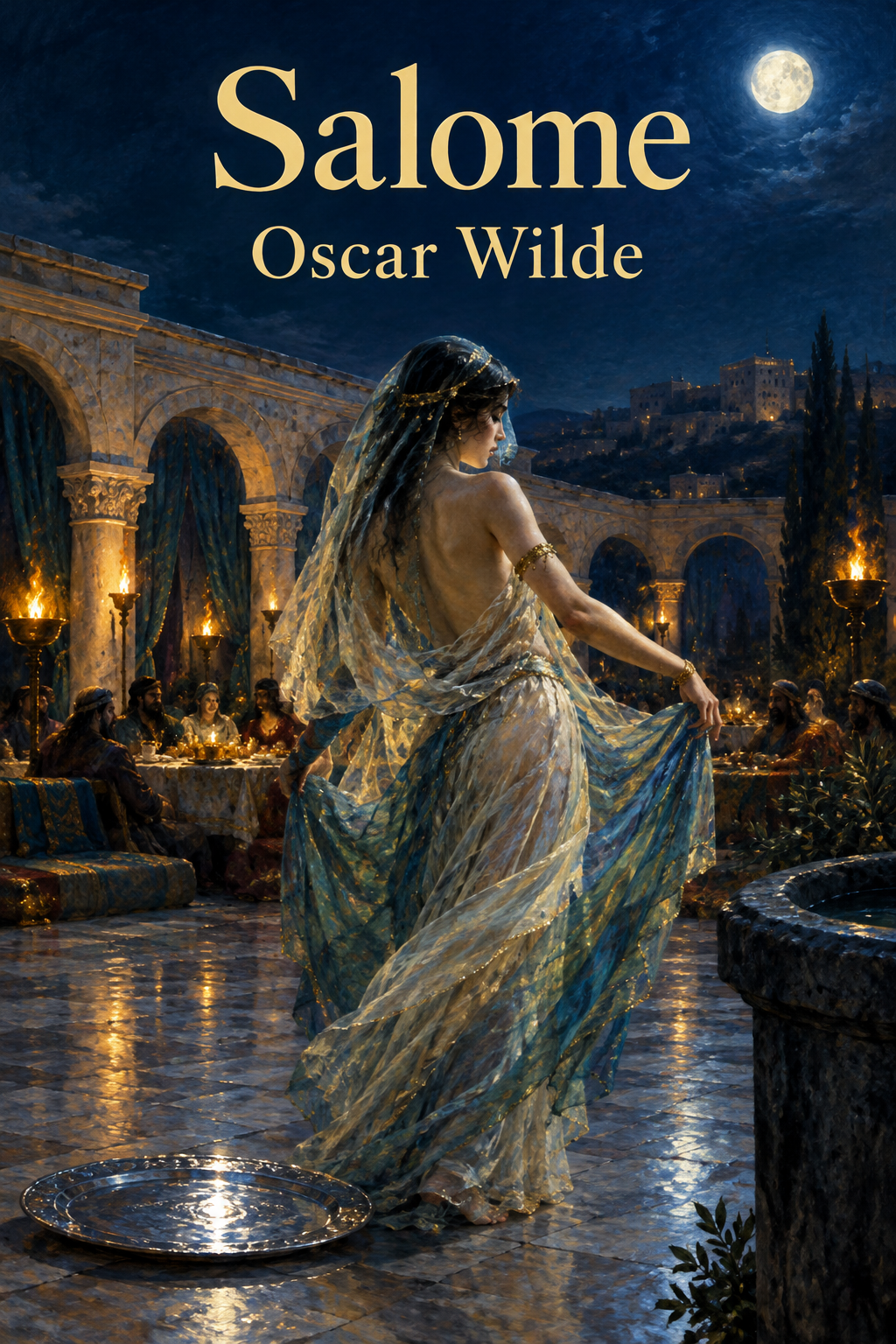
Salome
by Oscar Wilde
Salome summary in brief: Salome is a one-act play by Oscar Wilde, first written in French in 1891. Set on a moonlit terrace in the palace of Herod, the tetrarch of Judaea, it follows Herodias's young daughter Salome as she becomes fixated on Jokanaan, a prophet held in a cistern. Her desire pushes the court into a dangerous bargain, and every character is pulled into a struggle over looking, power and faith.
The Big Idea
"Oscar Wilde's one-act play shows how one spoken wish, made before a powerful ruler, can trap an entire court in its own fear and desire."
Key Insights
Desire turns into a demand
Salome’s wish begins as a private fixation on one man. It becomes a public demand once Herod swears his oath in front of the court, because he cannot refuse without losing face. The play shows how a promise made to impress others can trap the person who made it.
Herod’s offer of jewels, peacocks and half his kingdom sounds generous, yet each gift looks like an attempt to buy his way out of the bind. Salome sees the oath for what it is and names the single price she wants.
Looking is a form of power
The play keeps returning to who looks at whom. The young captain watches Salome, the page warns him not to, Herod’s eyes follow her, and Salome looks only at the prophet. Looking is tied to desire and control, and whoever is looked at can lose the upper hand.
The page’s repeated warnings show that everyone at court understands the danger. Looking is not an innocent act here; it is the first step towards disaster.
A frightened ruler
Herod reacts to omens: the moon, the blood he has slipped in, the beating of wings. His fear shows that power in the palace rests on nerves rather than command. His offers look like bargaining to escape a dread he cannot name.
As the omens pile up, he keeps reaching for new gifts while his nerves fray. The offers sound less like generosity than like a man trying to buy calm.
Loud faith, quiet truth
Religious groups argue at length about prophets, miracles and the Messiah, yet their debate changes nothing in the palace. The one speaker who sounds sure of himself is the prophet, and the court keeps him in a cistern.
Setting the noise of the debate against a single voice lets readers ask whether argument leads to understanding, or simply fills the room while the powerful make their choices.
Chapter Breakdown
Chapter-by-chapter summary
Spoiler warning: this section covers the whole plot, including the ending.
Part 1: The moonlit terrace
The play opens on a terrace above a feast in Herod’s palace, under a pale and strange moon. A young Syrian, captain of the guard, cannot stop looking at Princess Salome, and a page who serves Herodias keeps warning him not to. The page senses that something bad is coming. Nearby, soldiers talk about a prophet named Jokanaan, whom Herod has locked in a cistern, and about the religious quarrels that trouble the court. Herod has forbidden anyone to bring the prophet out. The guards are uneasy, and the scene sets up a palace where even looking at the wrong person feels dangerous.
Part 2: Salome comes out
Salome slips away from the banquet and steps out onto the terrace. She is drawn by a voice rising from the cistern, the voice of the prophet, and she orders that he be brought out so that she can see him. The young captain, already infatuated with her, obeys even though Herod has forbidden it. The prophet is raised from his cistern. The scene shows how one request from a princess can override a ruler’s command, and how easily a guard puts a woman’s wish above his duty. From here on, Salome’s fascination with the prophet drives the play.
Part 3: The prophet and the princess
Jokanaan first denounces Herodias and the marriage that binds her to Herod. He then speaks of a coming figure whom he calls the Son of Man, and he tells Salome to seek that figure by the Sea of Galilee. Salome is not moved by his message. Instead she praises his body, his hair and his mouth, and begs to kiss him. He refuses every time and curses her. This is the play’s most intense exchange: the more he refuses, the more fixed her desire becomes, until the refusal itself seems to demand an answer.
Part 4: The captain’s despair
Overwhelmed by his hopeless love for Salome, who now looks only at the prophet, the young Syrian takes his own life and falls between Salome and the prophet. The prophet is returned to his cistern. The page mourns his friend and recalls the perfume and silver earrings he once gave the captain. He also admits that he had seen this misfortune coming. The death marks a turning point: the court’s desire has now cost a life, yet the palace carries on with its noise.
Part 5: The feast resumes
Herod, Herodias and the court return to the terrace, and the mood is edgy. Herod is restless. He keeps looking at the moon, says he slipped in blood, and hears sounds that may be wings beating above him. When the soldiers report the captain’s death, Salome refuses food and wine. Meanwhile religious groups argue over prophets, miracles and whether the Messiah has come, and Herod and Herodias quarrel about their marriage. The scene shows a ruler who cannot silence the noise around him, and whose fear grows with every omen.
Part 6: The dance of the seven veils
Herod asks Salome to dance for him. She performs the dance of the seven veils, and he is delighted. He swears to give her whatever she asks, even up to half his kingdom, and offers jewels, a rare emerald, fifty peacocks and the high priest’s mantle. Salome turns all of it down and names one thing: the head of Jokanaan on a silver platter. Herod is horrified and begs her to choose something else, but Herodias backs her daughter. Herod’s public oath now binds him, and the play moves steadily towards its final demand.
Part 7: The silver shield and the final order
The executioner, Naaman, goes down to the cistern and returns with the prophet’s head on a silver shield. Salome takes it, speaks to the dead prophet and kisses his mouth. Herod, appalled, turns on her and orders the soldiers to kill her. They obey and crush her beneath their shields. Wilde closes every exit: Herod’s oath, Herodias’s grudge and the court’s silence leave no way out for anyone, and the play ends on a dance that has become a death sentence.
Salome characters
- Salome: Herodias’s daughter and a young princess at Herod’s court. Her wish to kiss the prophet and, later, her demand for his head drive the plot. Wilde treats her less as a child than as a person who discovers that a single spoken request can command a ruler.
- Herod Antipas: The tetrarch of Judaea, powerful but unsteady. He is haunted by omens and by his own guilt, and he is reluctant to harm the prophet. Yet the public promise he makes to his guests binds him, and he cannot withdraw from it.
- Herodias: Herod’s wife and Salome’s mother. Jokanaan has publicly denounced their marriage, so she has reason to resent him. She backs her daughter’s request for the prophet’s head and presses Herod to keep his word.
- Jokanaan: A prophet held in a cistern, whose voice reaches the terrace before he does. He denounces Herodias and the marriage, speaks of the Son of Man, and refuses every attempt by Salome to draw close. His few words carry the play’s most steady moral voice.
- The Young Syrian: The captain of Herod’s guard. He is infatuated with Salome and disobeys Herod’s order by bringing the prophet out of the cistern. His hopeless love leads to his death during the play.
- The Page of Herodias: A young attendant who keeps warning the captain not to look at Salome. He sees the trouble coming, and after the captain’s death he mourns him as a friend.
- Naaman: The executioner. He goes down to the cistern and brings the prophet’s head to the terrace, where Salome receives it.
Writing about this book
Salome is short enough to read in one sitting, so you can afford to reread the scenes that puzzle you. Three questions make good starting points. First, how does Wilde use the moon, the cistern and the blood to show Herod’s fear? Second, who holds the power in each scene, and how does it change hands? Third, does Salome act freely, or is she pushed by her mother and by Herod’s promise? You do not need one right answer. Support your view with a specific line or stage moment, and explain why it changes what you think about the play.
The play also sets religious argument against a single voice. Ask whether the noisy debates in the court make the prophet’s message stronger or weaker, and whether Wilde is commenting on a court that talks more than it listens.
Take Action
Practical steps you can implement today:
-
Track who is looking at whom in each scene, and ask who holds the upper hand at each moment.
-
Follow how Herod’s public oath narrows his choices once he has made it, even as he tries to change course.
-
Notice the moon, the cistern and the blood as signs of what each character fears.
-
Compare the prophet’s few words with the long religious debates, and ask which carries more weight.
Notable Quotes
"“I will kiss thy mouth, Jokanaan.” (Part 3)"
— Oscar Wilde
"“Something terrible may happen.” (Part 1)"
— Oscar Wilde
"“Kill that woman!” (Part 7)"
— Oscar Wilde
Who Should Read This
Readers aged 15 and up who study drama, English literature or the stories behind the Bible will get the most from this short play. Because it runs as one act, it works well as a single-sitting read. Its themes of desire and violence suit mature readers, so teachers may want to guide younger students through the ending.
Frequently Asked Questions
Is Salome based on the Bible?
Partly. It draws on the Gospels of Matthew and Mark, which describe a banquet where a dancing girl asks for John the Baptist’s head. Those Gospel accounts never name her. Wilde takes that bare outline and builds a court, a prophet and a dance around it, adding a great deal of tension and dialogue.
What is the dance of the seven veils?
It is the dance Salome performs for Herod, in which she removes veils one by one. Herod is so pleased with the performance that he swears to give her anything she asks. The dance is the hinge of the plot: it turns a girl’s request into a royal promise that others must honour.
Did Wilde write Salome in English?
No. He wrote it in French in 1891, and the French text was published in Paris in 1893. The English edition appeared in 1894, translated by Lord Alfred Douglas and illustrated by Aubrey Beardsley. Wilde is said to have reworked Douglas’s draft extensively, so the English text reflects his editing as well as Douglas’s translation.
Why was it not staged in Britain for so long?
In 1892 rehearsals were under way for a London production, but the Lord Chamberlain, who licensed plays, refused permission because the play puts biblical characters on stage. The first public performance in England did not take place until 1931.
Is Richard Strauss’s opera the same story?
The 1905 opera Salome by Richard Strauss is based on Wilde’s play, but it is a separate work. Its music, staging and emphasis change how the story feels. This page covers the play only.
Check Your Understanding
Pick an answer for each question to see if you were right.
-
Where does the play take place?
A moonlit terrace in Herod’s palace — The action unfolds on a terrace above the feast in Herod’s palace.
-
Where is Jokanaan being kept when the play opens?
In a cistern — He is held in a cistern, and the captain has to bring him out for Salome.
-
What does Salome ask for after the dance?
The head of Jokanaan on a silver platter — Herod offers gifts first, but Salome insists on the prophet’s head.
-
Which groups argue about prophets, miracles and the Messiah?
Jews, Nazarenes, Pharisees and Sadducees — Several religious groups debate these questions at the court without settling them.
-
Who first wrote the play, and in which language?
Oscar Wilde, in French — Wilde wrote it in French in 1891, and Douglas later made the English translation.
About Oscar Wilde
Oscar Wilde (1854–1900) was an Irish writer and playwright, known for the novel The Picture of Dorian Gray and his witty society comedies. He wrote Salome in French in 1891, and it appeared in Paris in 1893. The first English edition, translated by Lord Alfred Douglas, came out in 1894 with illustrations by Aubrey Beardsley.
Summary Written By

Software Engineer & Writer
Software engineer with a passion for distilling complex ideas into actionable insights. Writes about finance, investment, entrepreneurship, and technology.
View all summaries →Reviews
No reviews yet. Be the first to share your thoughts!
Write a Review
Keep reading
Explore the topic: FictionSummaries

Out of My Mind
Sharon M. Draper
“Out of My Mind” by Sharon M. Draper is a poignant narrative that explores the life of Melody Brooks, a…

Ender’s Game
Orson Scott Card
“Ender’s Game” by Orson Scott Card is a riveting science fiction novel that transports readers into a future where humanity…

Pachinko
Min Jin Lee
“Pachinko”, a spellbinding multigenerational historical saga by Min Jin Lee, explores the lives of a Korean family trying to make…

The Perks of Being a Wallflower
Stephen Chbosky
The Perks of Being a Wallflower by Stephen Chbosky is a profound coming-of-age novel, told through the intimate letters of…
Articles

The Enlightenment Explained: Ideas, Thinkers and Legacy
The Enlightenment was an 18th-century European movement that trusted reason and evidence over tradition and authority. Its thinkers, from Locke…
World History 1700–1918: Revolutions, Industry, Empire and War
Between 1700 and 1918, revolutions, factories, empires and a world war reshaped societies across Europe, the Americas, Asia and Africa.…

A Christmas Carol themes: generosity, isolation and responsibility
Dickens's novella is usually read as a story about a man who changes his mind. Its themes are sharper than…